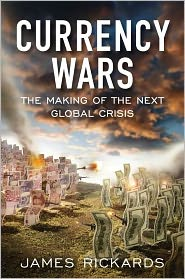
Currency Wars: The Making of the Next Global Crisis
When President Richard Nixon closed the gold window to foreign central banks in 1971, he ended the Bretton Woods monetary system created after WWII. President Nixon effectively substituted the dollar for gold and in so doing, created an unprecedented era of economic prosperity – and a vehicle for endlessly expanding public debt in the U.S.
In his timely new book, Currency Wars: The Making of the Next Global Crisis, my friend and colleague James Rickards tells the story of currency wars going back more than a century. Rickards lays the ground work for the next phase of global beggar-thy-neighbor in this timely volume, which comes to market as the illusory stability of the post WWII era gives way to a more dynamic and volatile future in the international economy.
How many of us recall that, in addition to ending the convertibility of the dollar into gold, in 1971 President Nixon also imposed wage and price controls and tariffs on foreign goods? Unfamiliar pressures regarding growth and employment forced Nixon, who was at least nominally a conservative Republican, to embrace state intervention in the economy. But similar pressures had already forced Nixon’s predecessors to take like actions during WWI, the Great Depression and WWII, including FDR’s dreadful dollar devaluation in 1932-1933, actions which made the Depression longer and deeper.
Today similar pressures regarding employment and growth confront leaders in the US and other industrial nations. As the age of the dollar as the main global currency seems to be ending, the neoliberal orthodoxy of free trade and global markets is also receding. Thus Rickards begins his book with a bold prediction:
“Today we are engaged in a new currency war, and another crisis of confidence in the dollar is on its way… The new crisis will likely begin in the currency markets and spread quickly to stocks, bonds and commodities. When the dollar collapses, the dollar-denominated markets will collapse too. Panic will quickly spread throughout the world.”
While I agree with Jim that the post-WWII currency framework is collapsing, I do not agree with his assessment that the dollar system will necessarily implode into a crisis. A far more likely scenario, I believe, is that the willingness of investors in other nations to hold dollars is going to decline slowly, but not much because of the dearth of alternatives. Even modest change will force austerity and fiscal constraints on a US population unused to such limitations and also force change on other nations. But speaking as a conservative and unabashed nationalist, I welcome such an evolution. We will emerge from the adjustment the strongest, most competitive nation on earth.
“While the outcome of the current currency war is not yet certain,” Rickards writes, “some version of the worst-case scenario is almost inevitable.” Perhaps.
One of the strengths of this book is that Rickards takes the reader through the history of currency and trade wars over the past century and more, but it also suffers from our collective proximity to the last century of Pax Americana. Can any of us yet write about currency wars with a vision and perspective free of the distortions of the American military victory in WWII and the Cold War?
Whether you look at the US relationship with China, an area Rickards knows and treats intimately, or the present economic turmoil in the European Union, the fact is that all of our problems stem from a US-centric design for global monetary and trade flows. In this regard, the author quotes Hu Jintao, General Secretary of the Chinese Communist Party: “The current international currency system is the product of the past.”
All currency systems are, of course, a function of a bygone era and particularly of the dominant economic power at that time. Prior to the rise of the US as an economic power during WWI, for centuries before the British empire was the dominant political economy in the world. Before WWI, the City of London was the banker to the world. The pound sterling was convertible into gold and acted as a discipline on UK fiscal behavior. By the start of WWI, however, the UK was broke and no longer able to support its currency, thus the newly created Federal Reserve Bank of New York under Governor Benjamin Strong came to the rescue.
Rickards states very plainly that he expects to see nations start to explicitly back their currencies with gold and even other hard commodities, and migrate away from exclusive use of the dollar as a means of exchange and as a reserve currency for global central banks.
“What is the tipping point for dollar dominance,” Rickards asks? “Is it 49 percent of total reserves, or is it when the dollar is equivalent to the next largest currency, probably the euro?” Recent events suggest, however, that the euro is unlikely to become the replacement for the dollar as the dominant global reserve currency, though mostly for political rather than economic reasons.
The author ends his book with a conclusion that is often heard from economists, namely that “the path of the dollar is unsustainable and therefore the dollar will not be sustained.” While such predictions may be welcome grist for the hard money, gold-loving audience which follows the author and is already propelling this book to the top of the league tables, I must disagree.
Rickards posits a return to a gold-backed dollar, the financial collapse of the industrialized world and the reappearance of regional trade blocks as just some of the possible outcomes for the US currency. Such scenarios are red meat for the proponents of gold and metal-backed currencies.
But another possibility is that the U.S. will continue doing what it has done through most of its history and especially since the introduction of the fiat paper dollar during the Civil War, namely use inflation and debt to meet the current need for a means of exchange for the domestic and global economy, even if it means embracing a level of inflation that gradually impoverishes its people. The 99% of Americans who are the focus of the Occupy Wall Street protest are less victims of the rich than of the steady inflation caused by dissolute fiscal policies in Washington and accommodation of growing public debt by the Fed.
But even with the chaotic fiscal policies of America’s democracy, people around the world continue to hold dollars. Why? Rickards does not fully address or answer this key question, again perhaps reflecting the dollar-centric view that is the legacy of WWII and the cold war. But for those of us who have worked in the developing world and seen hyperinflation and political corruption up close, the answer is self-evident.
Rickards rightly notes that the Chinese, Russians and even the EU have the capacity to back their currencies with gold. But so what? The key reason that individuals in the US and around the world use dollars as a means of exchange, even if less and less a store of value, is that America is one of the few nations on earth that still believes that people should be free – to live, work and accumulate wealth. Indeed, the size of the inflating dollar enables this global embrace.
The political restrictions placed on individual freedom in the fascist, authoritarian societies of Europe and Asia makes their currencies unattractive, gold backed or not. Whether you speak to people in Berlin, Moscow or Beijing, the answer to the question – Where would you most like to live? – is almost always the US. All we need to do in the US is start to make gradual, steady changes in our fiscal behavior and we can quickly restore the attractiveness of the dollar as the preferred global reserve currency.
Americans may be crazy and ill-disciplined in matters of money, but we still allow enough personal freedom to our people that there is a chance to achieve life, liberty and the pursuit of happiness – something most of the people of the world will never see save in their dreams. As a young Chinese student named Ping related to Fox Buterfield at the end of his 1982 book, China: Alive in the Bitter Sea: “If China ever opened its doors, everybody would go. To the United States.”
Buy Currency Wars if you want to learn the history and language of the global currency markets and the political economy which they support. But don’t necessarily take as gospel the bearish tone of Rickard’s pronouncements as necessarily being the most likely outcome of this great game.
Source:
Currency Wars: The Making of the Next Global Crisis by James Rickards


Tweet
Facebook
Reddit
Digg this!


November 18th, 2011 at 9:25 am
Jim is totally off the mark, there is nothing that could possibly end the dominance of the dollar in world trade, simply because there is nowhere else substantial demand for imports as in the U.S. Look at the Chinese, Japanese economies, most of them are geared towards producing for the U.S. market and their final product do not really sell even half the volume in the twice as populous Eurozone. Do you think there will be ever strong demand for $100 Mattel toys within China? Or that they will ever need cars without having their export oriented jobs?
It is simple as that: if the Asians want to work, they have to accept the USD and all other foreign currency for the matter and this has nothing to do with sustainability of current policies or past interests(we can regard UST holdings as something to be written of). If they do not want to work, well we can wish them happy rioting and occupying of Mao square.
November 18th, 2011 at 9:41 am
[...] [...]
November 18th, 2011 at 10:31 am
“President Nixon effectively substituted the dollar for gold and in so doing, created an unprecedented era of economic prosperity”
WTF? That’s not how I remember the 70s.
November 18th, 2011 at 10:41 am
“[The USA] will emerge from the adjustment the strongest, most competitive nation on earth.”
It’s statements like this that made me laugh all the way through your review. Unfortunately, Rickards will be saying “I told you so,” when all is said and done. I think if you don’t see the reality of what he’s saying, your ideas on investment and markets must be about 50 years in the past. All this patriotic ballyhoo about how free America is and that is the reason we’ll finally succeed, well… that is just magical thinking. First of all, I don’t know what I have to do to show you we’re not free. It should be painfully obvious the United States is under a tyranny and the well-being of its citizens is the last thing on the government’s mind. The USA is part of the globalist web and all economic issues must be appraised from a 100% global perspective. Sometimes, the USA is going to do what’s best for Europe or China, not what’s best for the United States. The United States government is not in charge anymore. The people in charge are an international tribunal of unelected officials (UN, EU, IMF, etc.). The betrayal laid on us by our politicians and bankers knows no limits. I believe it will only get worse. They will say it’s for the greater good, but it’s for their own good, as powerful globalist individuals. In their minds, they are indeed “greater” than us.
The other commenter has some kind of imaginary China in his mind, where there is no one else on the planet who can afford the toys produced in sweatshop factories, except exuberant, healthy little white kids in the American suburbs. Maybe the toys won’t cost $100 over there, but they cost about $0.03 to make, so there is some wiggle room on the retail price. The truth of the matter is this: As the middle class melts away in America, the middle class rises in China. So who will be buying all the toys and all the other crap the Americans can’t afford? It will be the Chinese. Why? Because, when all is said and done, the Communists understand Capitalism better than the Capitalists do. The American elite are too used to legalized theft & the game being obscenely tilted in their favor. They forgot how an economic system is actually supposed to work. They couldn’t last one day in an un-manipulated market. When they’re no longer receiving handouts from their cronies and when their crimes and fraud begin to be punished by jail or death, they will realize that “market making” is not quite as easy as they thought. The Chinese cronies shall rise and the Western cronies shall fade. America is just a flash in the historical pan, whereas China has ruled before.
November 18th, 2011 at 11:32 am
I find myself in rare disagreement with Whalen (a brilliant guy):
“The political restrictions placed on individual freedom in the fascist, authoritarian societies of Europe and Asia makes their currencies unattractive, gold backed or not. ”
Really? A reintroduction of the D-mark would be infinitely more attractive than the dollar. This is not an impossible scenario the way I see it.
“Whether you speak to people in Berlin, Moscow or Beijing, the answer to the question – Where would you most like to live?”is almost always the US. ”
This statement betrays an incredibly america-centric bias from Whalen. Sounds like it’s been a while since you’ve been in Berlin, dude. It is a very cool, vibrant place to live. I can also assure you most Germans do NOT want to move to the US, and that Americans in general are very well liked(deservedly so, IMO) , they are also often ridiculed behind their backs for their arrogance toward Europe and Europeans in general.
I am not German, but I have lived all over Europe as well as spent several years in the US. Personally, I prefer New York to Berlin, Rome or Athens, and I think the US is the greatest place on earth, but this is not the consensus opinion over here. This ain’t the fifties, buddy. And comparing Berlin to Moscow or Beijing is just plain ludicrous.
November 18th, 2011 at 1:32 pm
[...] Read James Rickards’ Currency Wars: The Making of the Next Global Crisis as a history of the currency markets. (Big Picture) [...]
November 18th, 2011 at 3:51 pm
Chris Whalen is Dead Wrong on American freedoms…the United States is turning into a Police State..and the Dollar is not going to last because the Federal Reserve with Ben Bernanke running it, is a sure thing to fail!
November 18th, 2011 at 6:15 pm
Boy we got some crabby foolks on this thread. I stick to my rosy scenario none-the-less. Free and crazy is better than the alternatives
Chris
November 18th, 2011 at 10:29 pm
This is a completely false statement by Whalen:
“President Nixon effectively substituted the dollar for gold and in so doing, created an unprecedented era of economic prosperity.”
On what statistical basis can one draw such a conclusion?
A second statement that I find highly questionable:
“A far more likely scenario, I believe, is that the willingness of investors in other nations to hold dollars is going to decline slowly, but not much because of the dearth of alternatives.”
So with US government debt currently at 100% of GDP (and total credit market debt near a historically unprecedented 350% of GDP), federal deficits consistently running near 10% of GDP, and the printing press repeatedly being used to accommodate all this, we are to believe that going forward, the willingness of foreign investors to hold dollars will simply “decline slowly”. That with the present trajectory of economic policy, there wouldn’t eventually be a far more rapid freefall in the demand for dollars. Those kind of things just happen to foreign countries (like Greece), but since the US is so amazing compared to the rest of the world, this simply won’t happen. In other words: THIS TIME IT IS DIFFERENT.
Whalen goes on to state the US can manage to print its way out of the problem and come out stronger than ever:
“But another possibility is that the U.S. will continue doing what it has done through most of its history and especially since the introduction of the fiat paper dollar during the Civil War, namely use inflation and debt to meet the current need for a means of exchange for the domestic and global economy, even if it means embracing a level of inflation that gradually impoverishes its people.”
Given the historically unprecedented amount of debt carried in the US, it is highly questionable that the debt can be devalued by stealth in a straight line linear fashion (through inflation) by increasing the quantity of money over a long period of time. The persistent devaluation of the currency could very well lead to an non-linear drop in demand for US currency (both foreign AND domestic). You cannot be assured that the velocity of money won’t eventually explode exponentially — causing hyperinflation. But I forgot, according to Whalen, hyperinflation is a “developing world” phenomenon. And “political corruption” as well (as if the US political parties aren’t already rotten to the core).
You’ve already gotten a taste from what we’ve observed with QE2. How about QE3? How’s that going to work out? And QE4, QE5, etc? That is what Whalen is effectively proposing, right? What will the social conditions be in the US as we proceed further down this path?
Last quote:
“All we need to do in the US is start to make gradual, steady changes in our fiscal behavior and we can quickly restore the attractiveness of the dollar as the preferred global reserve currency.”
The whole point of the government debt binge by the US political elite is to maintain the Ponzi scheme of total credit market debt at its historically unprecedented level (and perpetuate the phony appearance of economic stability to the public). They DON’T WANT the US economy to delever. It’s too painful. We are living under the “no pain at all costs” regime of economic management. That has been their modus operandi since the Lehman collapse. You must have read what Larry Summers said recently. I think it’s more than clear. All political pretensions to the contrary are nothing but a charade to “maintain confidence” for another year (like most US political “reforms” nowadays).
December 7th, 2011 at 9:32 am
The problem currently with the Euro is that its a single currency backed system very similar to the Gold Standard. This is the reason Europe is a mess. Its not the deficits per say that are causing higher bond yields and austarity but the fatal flaw in the Euro which makes balancing trade figures/deficits impossible. Why is it impossible? The Euro is a gold standard idea. Of course it makes people spend what they have, but as we all know the real world doesn’t work this way.
Debter nations have to issue debt to make up the difference in their trade policies. This is why China continues to buy our treasuries and support out dollar funding market. Its not because they love treasuries. This is why any movement away from USD Denom Assets is murderous to not just Americans but the whole planet.
You can’t fight 21st century economic problems with 19th and 20th century ideas.
December 7th, 2011 at 9:35 am
Previous to my point. I understand that China is a surplus country not a deficit one. My point is China can talk all they want. Its all talk. They buy Treasuries because they themselves peg their funny money to the USD. If they ever floated – it would plummet against the USD. If they don’t support our Treasury market- they would have to plow it back into their funny money currency. Which option do you think is better in the eyes of China?