10 Tuesday PM Reads

Email this post Print this post
By Barry Ritholtz - November 29th, 2011, 4:30PM

Afternoon train reading:

• Are You A Born Investor? (Psy-Fi Tech)
• The Man Who Busted the ‘Banksters’ (Smithsonian Mag)
Marshall Auerback: Interview (Resource Clips)
• Counting the Underwater Homeowners (Economix)
• In the Name of Corporate Profitability, 1781 and Today (The Reformed Broker) see also Are Corporate Balance Sheets Really the Strongest in History? (Hussman Funds)
• Echoes of history: The German fear of inflation rears its ugly head again (Periscope Post)
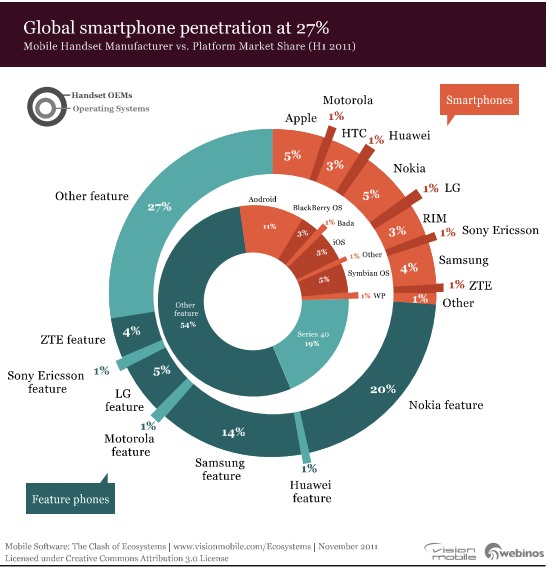
• Network Effects: How Google & Apple Dominate Mobile (Read Write Web)
• How Brooklyn Got Its Groove Back (City Journal)
Bartlett: Gingrich and the Destruction of Congressional Expertise (Economix)
• No art? No social change. No innovation economy. (Metropolitan Group)

What are you reading?
>

Source: Read Write Web

Fact or Fiction: Is the Consumer Back?

Email this post Print this post
By Barry Ritholtz - November 29th, 2011, 3:30PM

~~~

Source:
Fact or Fiction: Is the Consumer Back?
Stacy Curtin
Daily Ticker

Flow Chart For The EFSF

Email this post Print this post
By Guest Author - November 29th, 2011, 2:30PM

Peter Tchir started TF Market Advisors in 2011 as a platform to trade marketable securities as well as provide expert market information. He is a regular guest on Bloomberg TV and radio, and is often quoted in the Wall Street Journal, the Associated Press, and Fox Business News. Peters clients include top hedge funds, money managers, and asset allocators.

Pete Tchir tries to explain the EFSF.

~~~

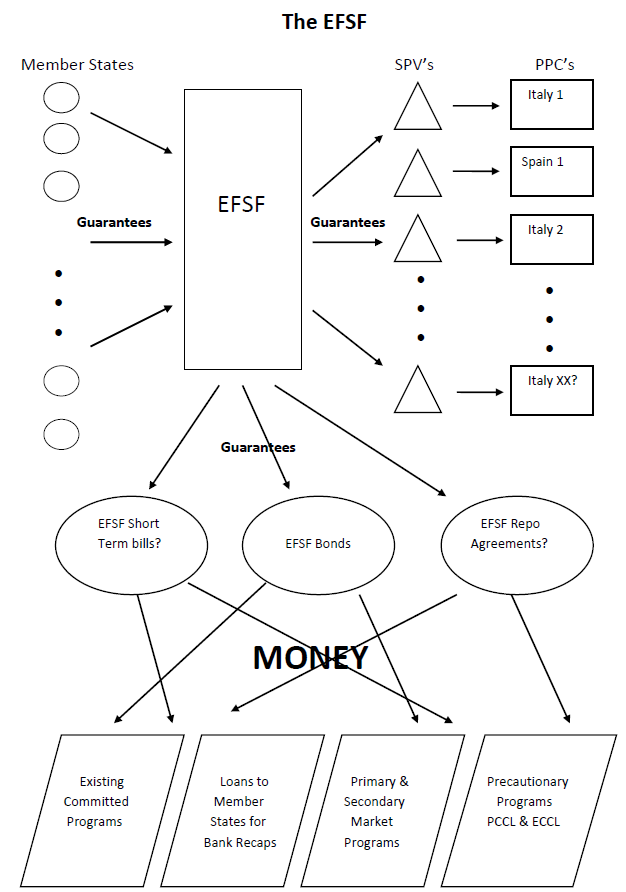
Here is our best attempt at a flow chart for the EFSF that tries to capture everything it does. If it looks complicated, that is because it is complicated.

>

>

Member States

There are 17 Member States who provide Guarantees to the EFSF.  Ireland, Portugal, and Greece have “stepped out” and are actually not providing guarantees.  Italy and Spain are likely to use funds so it is unclear if they will remain Member States providing Guarantees.  There are 6 AAA Member States, their guarantees are just over €440 billion.  Their guarantees limit the maximum amount of guarantees that the EFSF can issue and still achieve a AAA rating.

EFSF Fund Raising

The EFSF has been issuing notes or bonds that rely on guarantees from the EFSF (and its Member States) to raise money.  This program would continue.  The EFSF has contemplated issuing short dated bills and possibly utilizing repo agreements.  All of these money raising efforts will count against the maximum of €440 billion AAA guarantees at its disposal.

EFSF SPV’s and PPC’s

The EFSF is planning on creating a unique SPV for each bond that it provides a PPC for.  So each Italian bond that is issued under the PPC program would have a unique SPV and tradable PPC.  The list of possible PPC’s reminds me a little bit of a bobsled race at the Olympics.  In the current draft, the EFSF hopes to use guarantees rather than cash to provide “credit support” to the SPV’s that then issue the PPC’s.  Those guarantees would also count against the €440 billion capacity of AAA guarantees.  I think this structure has several problems, but we will look at the PPC’s more closely later today in a separate article.

EFSF Use of Proceeds

Assuming the EFSF gets away with its plans to only use guarantees for the PPC’s, then the proceeds from their fund raising has four outlets.  They have to fund existing commitments made to Greece, Ireland, and Portugal.  It appears that the EFSF will not recapitalize banks directly, but will instead make loans to countries so they can recapitalize their own banks.  In any case, this will use up cash raised from either bond sales or bill sales (this cannot use the repo market).  The EFSF would also launch the Primary Market Purchase program (PMP) and would be able to intervene in the secondary markets.  Both of these programs would rely on advice from the ECB, particularly for the secondary market activity.  The proceeds for this could come from bond sales, but may also be able to use the repo market (details and how that impacts the EFSF’s ratings need to be determined).  The EFSF also plans to launch some Precautionary Programs.  These programs would provide relatively short term funding, with rollover provisions, and would be based on similar IMF facilities.  It is contemplated that the IMF would be involved in management of these programs.

CIF’s

I did not show the co-investment approach since it is too vague to even guess how the flows would look, but can be clearly added later.

Stretching the guarantees

The EFSF has many mandates and lots of potential demands for money in serving those goals.  Only the PPC shows an obvious attempt to get some leverage from the proceeds.  With the markets remaining weak for German and French paper, and existing EFSF paper, it is unclear how much money can be raised, or how much they can leverage their AAA guarantees.  The AAA would track any changes to any of the 5 largest AAA guarantors.

Source: TF Market Advisors
By Pete Tchir

Merkel to neuter the German Constitutional Court?

Email this post Print this post
By Barry Ritholtz - November 29th, 2011, 2:28PM

It looks as if Mrs Merkel is trying to neuter the German Constitutional court on matters relating to the euro zone financial issues – possibly without a referendum, report German newspapers. All part of the Machiavellian plan, I set out the other day. The Constitutional Court is to opine on a number of issues in coming day.

This manoeuvre, if true – likely – makes me more and more certain that a grand plan is being hatched, quite possibly along the lines I suggested over the weekend. Should be bullish, boys and girls;

The FT reports that European banks have raised just under 2/3rds of their required debt financing requirements of US650bn for the current year – the ECB will have to cough up the rest – some balance sheet the ECB is building. The ECB will, we know from the wink, wink, nod, nod comments, provide at least 2 year (quite likely even 3 year) financing for European banks.
In addition, expect interest rate cuts – below the previous 1.0% floor effectively established by that clown Trichet. A reduction in interest rates in December is very likely;

The EFSF is indeed a “dead duck” – it is unlikely to be leveraged more than 2 1/2 times, if that. The plan, based on yet more hint, hint stuff, seems to be to involve the IMF, and 3rd parties (through the IMF)’ together with the EU – does that mean the ECB lending to the IMF, who ten on lends to the relevant Euro Zone countries. If the ECB is involved in this way, it will be most convoluted scheme I’ve seen for some time but hey, I think we’ll take anything, given the diet of complete rubbish we have had to date from the Euro Zone/EU/ECB;

Even more intriguing – Draghi is being summoned to the Ecofin meeting and news reports suggest he will also attend the EU heads of State meeting on the 9 th December. A deal where Germany forces through fiscal measures, followed by the “independent” ECB buying bonds/ embarking on QE, looks like the deal that is being attempted/ organised. Great note by Credit Suisse – Mr Wilmot setting out the scenario. I totally agree with his assessment;

UK Chancellor downgraded the countries GDP forecasts to 0.7% next year (0.9% this year), though warned of a possible – unfortunately likely – 2012 recession. Borrowing would be higher than initially expected and overall debt to GDP higher. However, the international community still believes in the UK – sterling rose, even against the US dollar;

Basically, signs are that Germany has finally got it and is coming up with a plan. Bitter experience has taught me to be uber cautious, but surely this time………The fact that Germany has recognised that even it may well be in the sights of those nasty Anglo Saxon’s well, it may be playing a part. Germany’s banks are also an issue, together with the realisation that it’s allies are getting worried.

Either way, let’s hope for some sensible resolution – I would really like to move on to something else. Indeed, there are huge issues around.

Taibbi: Judge Rakoff’s Rejection of SEC/Citigroup Settlement

Email this post Print this post
By Barry Ritholtz - November 29th, 2011, 2:00PM

Keith and “Countdown” contributor Matt Taibbi of Rolling Stone discuss the remarkable decision by U.S. District Judge Jed Rakoff to reject a $285 million settlement between Citigroup and the Securities and Exchange Commission for misleading investors. Taibbi points out that banks take punitive settlements in stride, saying, “They recognize that every now and then they’re going to get dragged into court, they’re going to have to give a little bit of money to somebody, and then they get to walk away and keep doing it.”

Matt Taibbi on Judge Rakoff’s decision to reject the SEC’s latest settlement with Citigroup

QE3 all but guaranteed

Email this post Print this post
By Peter Boockvar - November 29th, 2011, 1:30PM

Likely confirming QE3 on Dec 13th when the FOMC next meets, Fed Gov Yellen, part of the Bernanke, Dudley trio said while the “Fed continues to provide highly accommodative monetary conditions to foster a stronger economic recovery in a context of price stability,” she said “the scope remains to provide additional accommodation through enhanced guidance on the path of the federal funds rate or through additional purchases of longer term financial assets.” Fed members pick their words very carefully and she wouldn’t be saying this unless they were prepared to act. Other voting members saying the same recently have been Dudley, Evans and Tarullo and Bernanke’s beliefs are along the same lines. Thus, those that want even more Fed action already have 5 of the 11 voting members. This meeting will come days after the EU fiscal union will be enhanced at the Dec 9th EU summit with hopes of some that the ECB will follow with something more. Trading this market has never been more difficult but notwithstanding all the worrisome European headlines, if there is one thing markets like, it’s central bank juice.

We Expect The Stock Market To Bottom This Week & Then Rally For A Combination Of Technical And Fundamental Reasons

Email this post Print this post
By Bob Bronson - November 29th, 2011, 1:00PM

November 27, 2011:

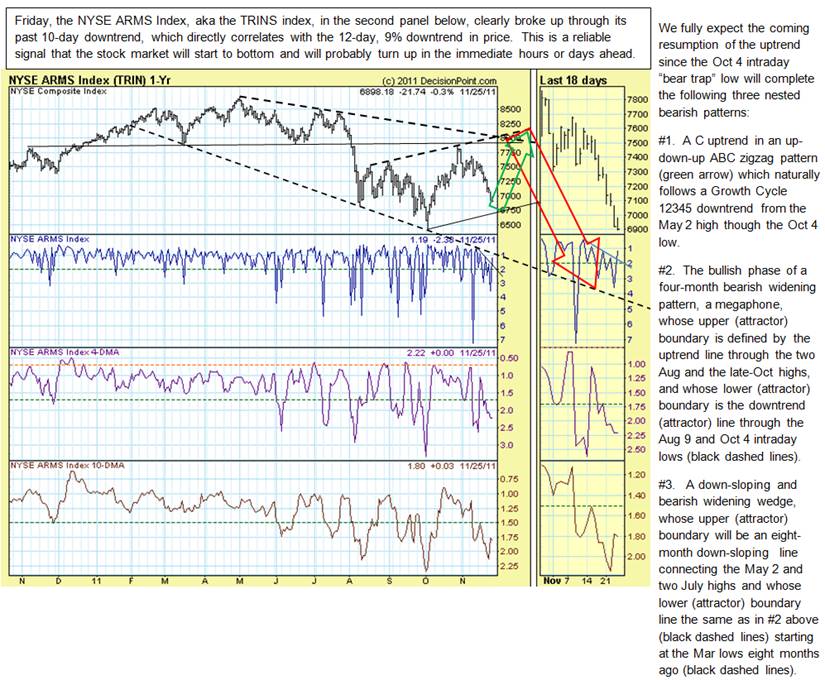
The short term (weeks) bullish setup of several technical patterns, which are annotated in the first chart below is consistent with:

(a) the labor market leading the reacceleration in the U.S. economic recovery (see the charts and table of unemployment claims further below) as measured by the U.S. core business cycle, using quarterly GDP data, and by the monthly business cycle coincident indicator data from the Conference Board (CB), both adjusted for population growth, as demonstrated in charts further below; and

(b) the ongoing Strong Season of the annual stock market cycle from its bear-trap Oct 4 low, including the upcoming bullish yearend holiday season with its Christmas, Santa Claus, and the combination of month-end, quarter-end and yearend rallies, summarized in the schematic even further below.

Combined, we fully expect these chart patterns, fundamentals and seasonal conditions to lead to a significant short term stock market bounce, completely reversing its current oversold condition just as the Q4 pre-earnings reporting season gets underway in January.

Even more important to this occurring will be negatively correlated moves from both the bond market, which started topping out Friday, and the U.S. dollar doing the same this coming week, in spite of the constant barrage of (supposedly) negative news on the Eurozone debt crisis.

As a result of over-touted Economic Cycle Research Institute (ECRI) and many others being too early in their U.S. recession calls over several months, we expect that by yearend, all-important permabull institutional investors will join in a herding consensus that the U.S. economy is both decoupling from Europe, which is back into recession again, this time driven by austerity fiscal policies, and from the incipient slowdown in the investment-bubble driven Chinese economy.

All of this will support the NDX long position in our double-profit potential, countertrend hedge recommendation, which has virtually eliminated all portfolio volatility for the past almost four months.  Profits were taken months ago in our long-standing long positions in gold and bonds and short positions in the U.S. dollar.   Of course, we expect to re-establish these positions in our recommended model portfolio later next year.

We believe the coming popular assessment of a decoupled, reaccelerating U.S. economic recovery will then have been only correct on an intermediate term (months) basis, since longer term we still expect an after-shock, double-double dip global recession, following the financial crisis and Great Recession in the U.S.

We still fully expect the global economy will later enter into a vicious cycle, or downward spiral, with negative feedback loops, as the major international trading blocs have rolling recessions that will progressively interlock.  This will result in our long-standing call for a China/commodity bust and a follow-on major currency crisis continuing the forex de facto devaluation of the U.S. dollar since 1985 as the trading blocs clash trying to solve their sovereign deficit/growth problems in a major win-lose foreign trade battle that will last for several years.  The U.S. will likely ultimately win with a formal devaluation of the dollar.

If you are a Wall Street Journal subscriber, here’s a dozen-years late realization of the investor mass mood that we expect will become widely prevalent at the end of the equity Supercycle Bear Market late next year and persist for several years thereafter: Very slow growth 2012 then long bear to 2020

But please don’t confuse this with thinking we are perpetual doom and gloomers.  We fully expect all of this, as we forecasted more than a dozen years ago with our SMECT model A Forecasting Model That Integrates
Multiple Business and Stock-Market Cycles
to end the still-ongoing, ultimately debt and asset deflationary U.S. Supercycle Cycle Winter (see our summary quant table at the bottom here), and that it will be naturally followed by a reflationary economic Supercycle Spring, which will probably bring the Dow 30 ultimately to between 50,000 and 100,000 by 2030.

More specifically, our long-standing working model is that we expect the U.S. stock market will probably triple every eight years, if not double every five years, during the next equity Supercycle Bull Market.  And following the incipient equity Supercycle Bear that started 6.7-months ago on May 2, that Supercycle Bull Market will naturally follow a very volatile technical basing period during the two years between the coming Presidential election and the following midterm Congressional election in 2014.

Note in the first two charts below that initial unemployment claims, one of ten components of the CB’s (LEI), have declined to their lows seven months ago  (especially on a four-week smoothed basis), which is bullish for the U.S. stock market.  The stock market is another one of the LEI components, so the two time series are coincident to each other with a high inverse correlation, especially over several months.  And continuing claims, in the third chart, have even broken to new lows, which is equivalent to new highs in the stock market.

Read the rest of this entry »

Home Prices Weaken in Q3 of 2011

Email this post Print this post
By Barry Ritholtz - November 29th, 2011, 12:00PM

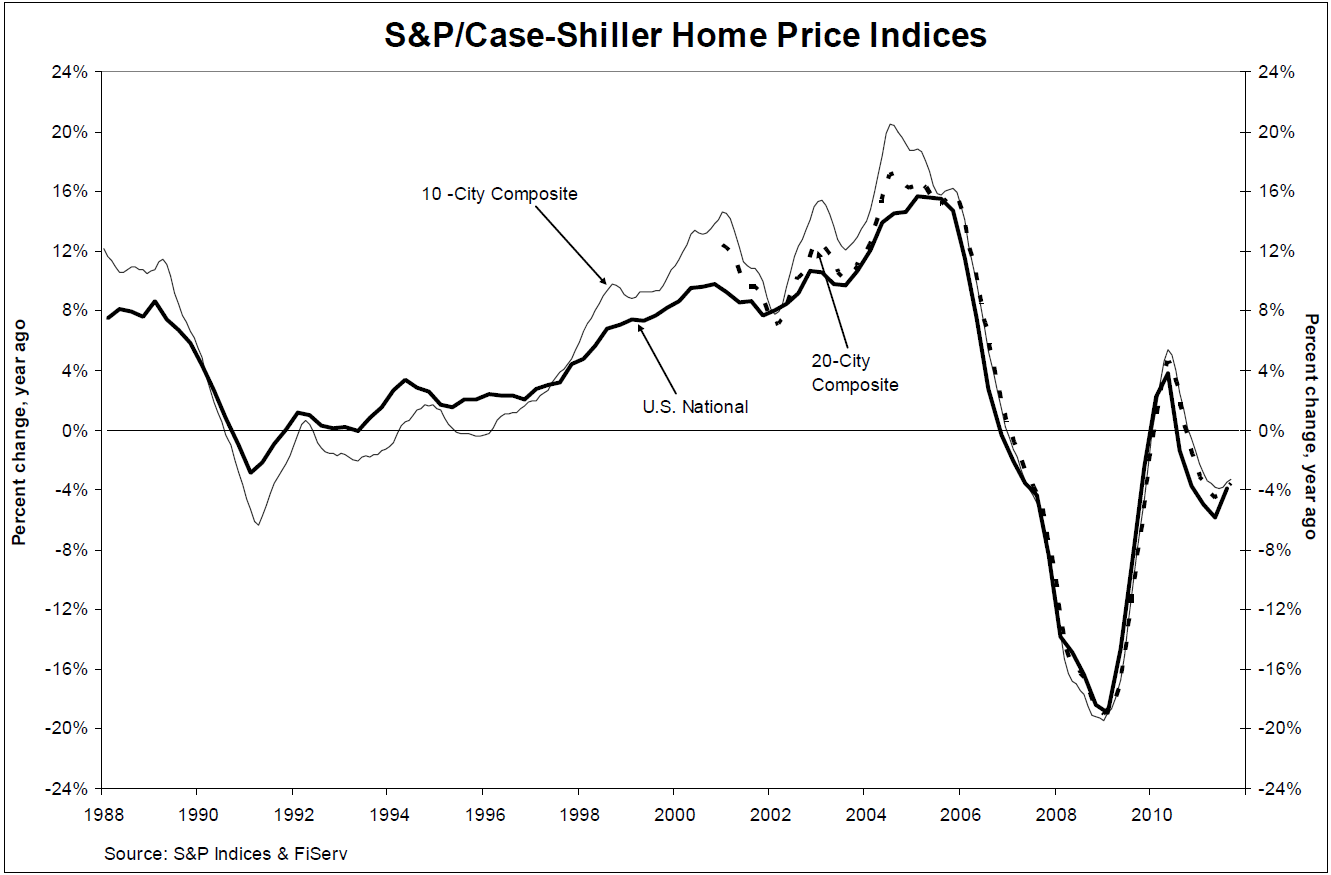
The data point of note is that “the national index posted an annual decline of 3.9%, an improvement over the 5.8% decline posted in the second quarter. Nationally, home prices are back to their first quarter of 2003 levels.”

This should not be astonishing to anyone who has been paying attention.

>

click for larger charts

>

>
Source:
S&P Indices, Press Release
Home Prices Weaken as the Third Quarter of 2011 Ends
According to the S&P/Case-Shiller Home Price Indices
November 29, 2011

Euro in `Death Struggle,’ FX’s John Taylor Says

Email this post Print this post
By Barry Ritholtz - November 29th, 2011, 11:59AM

John Taylor, founder, chairman and chief executive officer of FX Concepts LLC, talks about the outlook for the euro and the European sovereign debt crisis. Taylor, speaking with Betty Liu and Dominic Chu on Bloomberg Television’s “In the Loop,” also discusses the Japanese yen.


Source: Bloomberg, Nov. 29

Confidence surprises to upside but…

Email this post Print this post
By Barry Ritholtz - November 29th, 2011, 11:45AM

Consumer Confidence in Nov at 56 as measured by the Conference Board was well above expectations of 44 and up from 40.9 in Oct. It’s the best since July and is almost back to the 11 month avg ytd of 57.6. The Present Situation rose 11.2 pts to the best since May and Expectations rose by 17.8 pts to the most since July. The answers to the labor market questions were most encouraging as those that said jobs were Plentiful rose to 5.8 from 3.6, the best since May ’09 and those that said jobs were Hard To Get fell 4.8 pts to the lowest since Jan ’09. Those that said Business Conditions were Good rose and those that said they were Bad fell and the same responses were given for the next 6 months out. Those that plan to buy a home within 6 mo’s rose slightly but those that plan to buy an automobile fell a touch. One year inflation expectations fell to 5.5% from 5.8%, the lowest since Jan. Bottom line, as seen in the recent readings of initial jobless claims below 400k, the labor market continues to stabilize and that is a key factor in the improvement in this confidence figure BUT the caveat is the survey period ended Nov 15th, right before the markets headed south in response to more European stress.

45 queries. 1.076 seconds.