Chase to Hedge Funds: Drop Dead

Email this post Print this post
By Barry Ritholtz - November 29th, 2011, 10:30AM

We don’t fancy your kind around these parts. Sheriff, why don’t you show the man to his horse, . . . its best if you were to just mosey along, move out of town.

>

Fascinating note from Chase to a Hedge Fund client of ours: “JPMorgan Chase will no longer provide financial services to Hedge Funds or Private Equity customers.”

Before you assume its Dodd-Frank regs, the services in question are 1) Checking account; and b. Savings account.

Astonishing . . .

>

chase2hedgefunds dropdead

Europe again…

Email this post Print this post
By Peter Boockvar - November 29th, 2011, 9:31AM

European Finance Ministers will hopefully agree and provide details today on the suped up EFSF with 20-30% insurance coverage on new bond issuance with a leveraging of 3-4 times. Imperative in this new entity in actually functioning as hoped will be France hanging on to its AAA credit rating which of course is very tenuous. They will also discuss national (as opposed to central euro zone) guarantees of bank debt issuance, similar to what was in place in 2008 there and in the US, to ease funding concerns. The ECB failed to fully sterilize the 203.5b euros of bond purchases they’ve conducted to date, taking in deposits of 194.2b euros. This is not the first time they’ve failed so we can’t read too much into this just yet. Some believe that 300b euros is the limit on what they will eventually be able to fully sterilize. The euro basis swap is rising to a new high but as we get to yr end, banks are doing all they can to delever and strengthen their balance sheets so tightness in interbank lending markets are a combination of general stress amongst banks but also exaggerated by yr end activity. Italy sold debt at 3 differing maturities at yields all above 7%. While the 7% threshold put Greece, Ireland and Portugal in the hands of the EU/IMF, Italy’s primary surplus can keep them away for a period of time. Belgium sold short term bills at more than double the rates of just 3 weeks ago. Nov euro zone economic confidence fell to the lowest since Nov ’09 and was a touch below estimates. I look forward to the time when my morning comments are not predominantly on Europe but who knows when that will be.

10 Tuesday AM Reads

Email this post Print this post
By Barry Ritholtz - November 29th, 2011, 9:30AM

Here are today’s astonishing reads:

• WTF?!? How Paulson Gave Hedge Funds Advance Word (Bloomberg)
Not so fast with that SEC Settlement with Citi:
…..-SEC versus Citigroup, Judge Rakoff Decision (Federal Court SDNY)
…..-Judge Blocks Citigroup Settlement With S.E.C. (NYT)
…..-Did Citi Get a Sweet Deal? (Pro Publica)
…..-Judge Jed Rakoff courageously rejects SEC-Citigroup settlement (Wash Post)
• Great White North Becomes a Refuge in Global Investing Storm (WSJ)
• Fee Drought Triggers ‘Bloodletting’ for Stock Traders (Bloomberg)
• A Minsky moment in the eurozone? (FT Alphaville)
• Hedge Fund 13F Positions For 3Q11 (Street of Walls)
• The eurozone really has only days to avoid collapse (FT.com) see also Europe’s shrinking money supply flashes slump warning (Telegraph)
Unprofitable since Kitty Hawk: American Airlines Parent AMR Files for Bankruptcy (Bloomberg)
• Facebook Targets Huge IPO (WSJ) see also Google+ Was Never a Facebook Competitor (Read Write Web)
• Apple’s iPad-Crazed Toddlers to Spur Holiday Sales Rush: Tech (Businessweek)
• Contempt Of Court Order Sought Against Overstock CEO Patrick Byrne (Seeking Alpha) Byrne experienced the largest drop in approval ratings among employees this year(Internet Retailer)

What are you reading?

>

by RJ Matson

Are Earnings Cyclical?

Email this post Print this post
By James Bianco - November 29th, 2011, 8:30AM

Bloomberg.com – Grantham Calls Margins ‘Freakishly High’ That Doll Says Are Here to Stay

U.S. companies are the most profitable in more than 40 years, and some of the best-known stock pickers are divided over how long that will last. Bob Doll, chief equity strategist at BlackRock Inc. (BLK), said low labor costs and cost-saving technology will allow companies to keep up their profitability. Jeremy Grantham, chief investment strategist of Boston-based Grantham, Mayo, Van Otterloo & Co., said margins will send stock markets tumbling when they eventually revert to their mean. “The implication for the stock market is ugly, because it means earnings are unsustainably high,” Grantham’s colleague Ben Inker, GMO’s director of asset allocation, said in a telephone interview. GMO, an investment manager that oversees $93 billion, puts the fair value of the Standard & Poor’s 500 Index at between 950 and 1,000, compared with the 1,158.67 level at which it closed last week. U.S. companies’ ability to squeeze more profit from each dollar of sales is pushing earnings higher, even as the economy has grown at a below-average clip since the recession ended in June 2009. Grantham, who called corporate profits “freakishly high” in an August commentary, sees wide margins as an aberration. Some of his competitors say changes in the economy and the way firms operate could keep them near peak levels for another year or two.

Comment

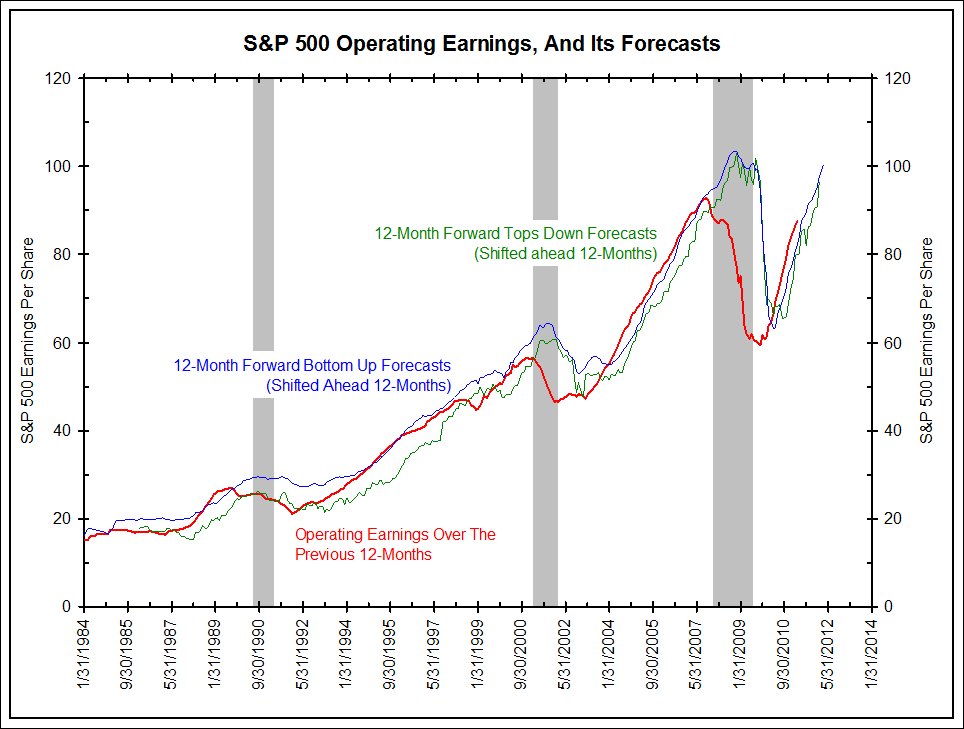
Everyone agrees that earnings are cyclical except when they are at a high.  So are earnings at a peak?

The first chart below shows S&P operating earnings (red line) and 12-month forward forecasts  shifted ahead 12 months.  The second chart shows the difference between the forecasts and actual releases.  The shaded areas highlight official recessions.

Wall Street is one of the few places where practice does not make perfect. Notice that every subsequent recession sees larger earnings error rates than the previous recession.

During the 1990/1991 recession, top-down forecasters (strategists) were too optimistic by 10%.  Bottom-up forecasters (adding up the 500 company forecasts) were too optimistic by 25%.

During the 2000/2001 recession, top-down forecasters were too optimistic by 25%.  Bottom-up forecasters were too optimistic by 23%.
During the 2007/2009 “Great Recession”, top-down forecasters were too optimistic by 39.6%.  Bottom-up forecasters were too optimistic by 40%.

Also notice the difference between the top-down and bottom-up forecasts.  Strategists are getting significantly worse at predicting earnings than their 1980s and 1990s counterparts.

What Does This Mean?

If the economy goes into recession, earnings forecasts are not 10% to 12% too high.  Instead they might be 20% to 40% too high.  In other words, if the economy goes into recession, the earnings forecasts are horribly wrong.   They might be so wrong that one can make the case that the market might be overvalued. We believe this is part of what is bothering the markets, the epiphany that the economy is much weaker than expected and a recession will blow a hole in earnings forecasts to the point that the market might not be cheap anymore.

Source: Arbor Research

Multiverse of Exploration & the Future of Science 2021

Email this post Print this post
By Barry Ritholtz - November 29th, 2011, 8:00AM

Click for ginormous graphic:
http://newsletters.clearsignals.org/zoom_it/IFTF_SR-1454A_FutureofScience_Map_lg.jpg

>

Source:
A Multiverse of Exploration: The Future of Science 2021
CNN, November 2011

The Con Man’s Lament: Equity vs Commodity Firms

Email this post Print this post
By Barry Ritholtz - November 29th, 2011, 7:25AM

There may be no honor among thieves, but there has always been some small measure of dignity — even respectability — amongst the con men of the equity markets.

Apparently, there is no such corresponding code of honor amongst commodity trading firms.

I refer of course to the debacle that is MF Global. How on earth could $633 million in customer accounts simply disappear?

As it turns out, quite legally.

The regulations governing these customer accounts are 25 plus years old, according to a few insiders I spoke with. They gave the firms an ability to hypothecate (lend) client money, so long as it was only used to legally purchase investment grade sovereign debt.

So that was what MF Global did.

As originally conceived, client monies were only supposed to purchase US Treasuries. However, so as to not offend trading partners (and other reasons), the regs were written so as to include any “investment grade sovereign” in the rules. Hence, AA rated European sovereign debt, despite the obvious fact that in 2011 they are obviously not the equivalent of US Treasuries, technically qualify. Whether this violates the obvious spirit and intent of the law will be for a judge to decide.

Of course, this raises another question: If the corrupt and compromised rating agencies had actually done their jobs — downgrade European junk to what it really was — would MF Global been able to empty client accounts? I suspect not.

Regardless, consider the Con Man’s Lament: The past half century of boiler rooms, accounting scandals, pump & dumps, backdated options, corrupted analysts, IPO spinning, derivative debacles, etc., have all come about for this simple reason: Brokerage firms cannot simply reach into client accounts and take the money for firm use.

This wasn’t a face-in-hand moment — Hey, why didn’t we think of that? — amongst equity criminals. Rather, it was a well understood rule that was enforced without question. “Borrow” money from a client account without their knowledge, go to jail for grand theft.

Consider:

• If the weasels at Stratton Oakmont or any other ’90s boiler room thought they could merely empty client accounts, they would have. Instead, they had to concoct enormous Pump & Dump schemes to dupe willing rubes out of the money.

• If Merrill Lynch could have merely grabbed billions from Orange County, rather than create an elaborate derivatives scheme that ultimately bankrupted the county, don’t you think they would have done that?

• Instead of the IPO spinning to capture assets and revenues that most of the major bulge bracket firms did int he boom times of the late 90s, wouldn’t it have been easier to merely leverage up client accounts?  Heads we win, tails you lose?

• Would any of the major accounting firms had to do such absurd audits of firms like WorldCom or Tyco? They worked hand in hand with Wall Street to help capture money. (But steal? Never!)

• Consider the side pockets developed by Enron with the help of McKinsey & Co. If there was a way to simply take client money, why would anyone bother going through all that trouble?

• Even the convoluted Lehman’s Repo 105 was a way to hide $50 billion per quarter from investigators and regulators. Had they been able to tap client monies, who knows how their saga might have ended.

Now, that may not sound like much, but it is worth considering. Neccessity being the mother of invention forced the very worst enterprises on the equity side to engage in all manner of deception and duplicity by morally compromised, ethically challenged bad actors. They had to do this, because they could not merely grab monies from client accounts.

It was a point of pride amongst equity con men that they did not merely steal. They cajoled, wheedled, scammed, and cheated, but they never stole.

Hey, what kind of people do you think we are?

Moody’s threatens ALL Euro Zone countries with downgrades

Email this post Print this post
By Kiron Sarkar - November 29th, 2011, 6:44AM

Kiron Sarkar is an investor and advisor in London. Formerly in the M&A dept of N M Rothschild in London, he was head of M&A of Rothschild (Hong Kong) and worked on their international privatisation team. He worked as privatisation adviser to the UK Governments Know How Fund. Most recently, he was European Head of Media, Tech and Telecoms at CIBC World markets. Kiron has acted as a lead adviser in respect of over US$150bn of deals and has worked globally in both developed and emerging markets.

~~~

Moody’s threatens to downgrade ALL Euro zone countries – hey, that includes Germany does it not. Off course it does. I really wonder what officials in the German Finance Ministry think of that – a bit of a shock – well, possibly stronger emotions than that, I suspect. However, why the surprise – in my view Moody’s is just reflecting the reality of the situation.

French newspaper reports (La Tribune) suggest that S&P may downgrade the country’s outlook to negative in the next few weeks – personally, I do not believe that France will be able to maintain it’s AAA rating, so no surprise. French unemployment rose to the highest since December 2009. Looks increasingly as if Sarkozy is “French toast” in next years Presidential elections – no great loss, but the likely winner (a socialist) – who knows what he will be up to. Basically, more
uncertainty – just hope (likely) that the euro zone issues will be sorted out before that – making it more difficult for the potential Socialist candidate to complicate the process.

The far more important point is that Germany is finally recognising that it is not financially immune. The other big issue is whether Germany comes up with a credible solution re the Euro Zone and, by default (maybe not the right word to use, given the current situation) for themselves.

Read the rest of this entry »

MBS Litigation Update: Why BofA Will Lose the Loss Causation Argument and Wish It Had Settled with MBIA

Email this post Print this post
By Barry Ritholtz - November 29th, 2011, 6:30AM

Isaac Gradman is one of the nation’s leading experts on mortgage backed securities litigation. He is the author The Subprime Shakeout mortgage litigation blog, and the editor of the newly released book, “Way Too Big to Fail: How Government and Private Industry Can Build a Fail-Safe Mortgage System,” by Bill Frey. Follow him on Twitter @isaacgradman

With all eyes in the mortgage litigation world glued to the pending decision on Partial Summary Judgment in MBIA v. Countrywide, et al., commentators are beginning to speculate that a settlement may be in the offing between the two MBS heavyweights.  However, as we get closer to a decision on MBIA’s fully briefed motion with each passing day, and as BofA continues to suffer heavy casualties with each stroke of Judge Eileen Bransten’s pen, the nation’s largest bank by total deposits is running out of time to avoid another potentially disastrous result.

Indeed, rumors were already swirling as early as this past July that BofA had settled this lawsuit, sending the bond insurer’s stock soaring, but all gains were quickly erased as the market recognized the news as exactly that – just a rumor.  Then, last month, another rumor emerged that again reported that a settlement was in the works, and this time the rumor revealed a purported price tag for this settlement – $5 billion.

Of course, every rumor contains a kernel of truth, and this one made sense – given the devastating precedent this lawsuit could set for BofA, it must be carefully considering, and is likely in the process of discussing, a settlement with MBIA.  This past week, in fact, BofA reportedly settled a class action suit regarding Merrill Lynch securities to the tune of $315 million (interestingly, this settlement was first reported by Alison Frankel, who has also been suggesting that an MBIA settlement may be forthcoming).  If this report is true, could a settlement with one of the most dogged and successful plaintiffs in the slew of MBS suits against BofA be far off?

Having already suffered tough-to-swallow losses on the issues of statistical sampling, scope of discovery, fraud claims and successor-in-interest liability, BofA is now facing an even more significant loss.  At risk if BofA does not settle quickly is an adverse decision on the causation standard to be applied to putback claims – one of the key defenses cited by the bank (and by Bank of New York in justifying its settlement number on behalf of BofA) in maintaining that its obligations to repurchase defective subprime and Alt-A mortgages will be contained.

Aside from BofA’s string of losses before Judge Bransten, all signs from a legal perspective point to MBIA winning its Motion for Partial Summary Judgment on the issue of whether it can exclude BofA’s post-closing defenses (i.e., that the housing downturn, not Countrywide’s poor underwriting, caused MBIA’s losses) and focus on whether reps and warranties were breached at the time of the MBS Trusts’ closing.  But with this motion having been fully briefed for over a month, it seems that if BofA was going to head off this loss with a settlement, it would have done so by now.  So, assuming that this case does not settle in the next few weeks, I’m going to tell you why the next decision in this case – in one of the earliest-filed pieces of mortgage crisis-related litigation – will produce more bad news for the beleaguered Big Four Bank.

Loss Causation Background

For readers unfamiliar with the issues at stake, we’ll start with a little background.  Countrywide, in conjunction with dozens of other subprime and Alt-A originators, sold trillions of dollars worth of loans to Wall Street during the 2000s and provided the purchasers with certain guarantees – known as reps and warranties – regarding the quality of the loan underwriting they would employ and the loan guidelines they would follow.  The purchase and sale contracts for these loans specified that if any of these reps and warranties were breached with respect to a particular loan, and the breach materially and adversely impacted the value of the loan or the interest in the loan of the investor or bond insurer, the originating bank would have to buy back the loan at par (the original face value).

Though this description of banks’ so-called putback liability is noncontroversial, a major dispute has emerged over what is meant by “material and adverse impact.”  Countrywide/BofA, along with many other banks with legacy loan origination liability, has argued since these MBS lawsuits were first initiated that the “material and adverse” language created essentially a loss causation standard.  That is, plaintiffs were required to prove that each breach of reps and warranties identified actually caused the loan to go into default.

Plaintiffs like MBIA, on the other hand, have argued that the standard means what it says – that the breach has to simply impact the value of the loan by making it riskier and more likely to default.  They point to several provisions of standard Pooling and Servicing Agreements (the contracts governing the creation of MBS) that provide specifically for situations in which performing loans are required to be bought back.

You would think that the presence of provisions allowing for the repurchase of current loans would end this discussion – but BofA and other banks with repurchase liability have continued to argue this point.  I will run through each of these arguments in turn – as detailed in Countrywide’s Opposition to MBIA’s Motion for Partial Summary Judgment – and explain why none of them hold water.

Countrywide’s Loss Causation Arguments

Countrywide spends the first three-plus pages of the loss causation section of its memorandum making the unremarkable point that a breach of rep and warranty must have a material and adverse impact – that a breach alone is not enough.  This amounts to the quintessential straw man argument: Countrywide sets up a flimsy characterization of MBIA’s argument only to batter it into the ground.

It accomplishes this by seizing on one admittedly imprecise line in MBIA’s Motion, that “MBIA may invoke the repurchase provisions upon showing that the characteristics of a loan was [sic] not as represented by Countrywide” (Motion at 22), to suggest that MBIA is denying the existence of a materiality requirement.  Yet Countrywide ignores that in the very next sentence of its brief, MBIA states that Countrywide’s repurchase obligation is triggered “if MBIA’s interest in the loans is ‘materially and adversely’ affected by Countrywide’s breach…[meaning there is a] material increase in the risk profile.” Id. I doubt that Judge Bransten will have much patience for the creation of a dispute where none exists.

Read the rest of this entry »

Why a Stimulating Job Can Improve Your IQ

Email this post Print this post
By Barry Ritholtz - November 28th, 2011, 10:38PM

Many people think of IQ as a genetic trait like eye color, something you’re born with and stuck with for life. But as Sue Shellenbarger explains on Lunch Break, evidence is mounting that IQ can change over an individual’s lifetime.

11/28/2011 2:26:03 PM

Open Thread: S&P500 = 1250 < Dec 31 ?

Email this post Print this post
By Barry Ritholtz - November 28th, 2011, 8:30PM

My head trader needs to be placed under some form of sedation.

Every 3% move in the markets — and admittedly, there have been lots of them – causes him to bounce off of the walls like volatility powers his personal DJAI1 (a personal Bloomberg terminal accessory that is only available on trading desks).

Last week, he was expecting Armageddon; this week, he thinks we melt up into year end. He is Mr. Coincidental Sentiment, and I have long since learned to contextualize his madness.

He offered me $100 bet that the SPX would hit 1250 before December 31 2011.

Would you take the bet?

>

_________________________

1 Dow Jones Anal Intruder

45 queries. 1.040 seconds.