
Debt Doesn’t Matter ?

Email this post Print this post
By Barry Ritholtz - January 23rd, 2012, 11:30AM

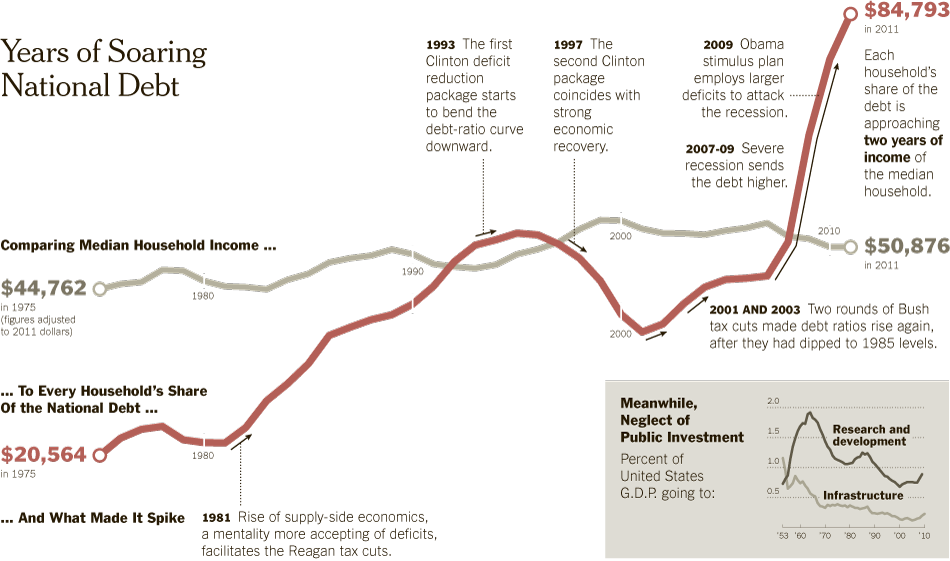
Huge chart from Steven Rattner’s Sunday NYT Week in Review Op Ed:
>

click for ginormous graphic:
>

Source:
The Dangerous Notion That Debt Doesn’t Matter
STEVEN RATTNER
NYC, January 20, 2012
http://www.nytimes.com/2012/01/22/opinion/sunday/the-dangerous-notion-that-debt-doesnt-matter.html

Comments

Please use the comments to demonstrate your own ignorance, unfamiliarity with empirical data, ability to repeat discredited memes, and lack of respect for scientific knowledge. Also, be sure to create straw men and argue against things I have neither said nor even implied. Any irrelevancies you can mention will also be appreciated. Lastly, kindly forgo all civility in your discourse . . . you are, after all, anonymous.

67 Responses to “Debt Doesn’t Matter ?”

  1. Hantra Says:

    REALLY!? When was this article written? 1988? I mean. . . when was the last time you heard Republicans say that “debt doesn’t matter”? Not any time in the past three years, that’s for sure.

    Awkward timing on this one.

  2. cognos Says:

    Uh, was this written by a 5th grader?

    We don’t owe debt in “2011 dollars”… it makes no sense to adjust the income. No sense.

  3. AtlasRocked Says:

    National debt – whether by overspending or undertaxing, have never repaid back the debt created. Note this chart doesn’t include SS and Medicare, proclaimed as “mandatory” and “contracts with the people” but they aren’t on the national debt total. Estimates of these obligations run far higher, $75-100 trillion. Apply 5X multiplier to the debts in the chart to get the real amounts of debts we’re creating.

    What does it say about an organization when they won’t adhere to standard accounting practices, when they hide “mandatory” debt from their debt total? Are they friendly, caring entities, or deceptive, nefarious organizations hiding a debacle ?

    I liked your article a few weeks ago Barry about the president not really affecting the economy, it is largely true, IMHO. Reagan and Bush had tax cut policies that APPEARED to create growth, but like Greenspan’s low interest rates, the total effect was the worst possible solution: They appeared to do good, but in the long term allowed policy makers to never address real policy solutions. Who knows what can cure the economy now, the effect of debt – maybe good during Reagan and Bush’s tenure – now appears to be scaring people during Obama’s term. It’s like heroin – it masks pain and allows the country to avoid trying and evaluating real cures. We must balance our budget if for no other reason than to allow us to discriminate good policy from bad. But we have a political party here that keeps voting overwhelmingly to not force the gov’t to balance it’s budget.

    Let’s not forget 5 economic trends that appeared in the early 90s, which IMHO opinion really boosted the economy, none had anything to do with Clinton’s ideas:

    1. Oracle – Allowed full enterprise management. Huge productivity tool.
    2. Cheap PCs – my engineering office went from 1 PC per cubicle to 2 per engineer.
    3. Cheap MS office apps – we used Excel all the time, super powerful tool.
    4. Lot of cheap engineers from the Defense layoffs of the Bush I era. I recall a million engineers were laid after Desert Storm I. I was in the industry, my factory went from 12k employees to 5k in a few years.
    5. The spread of the internet for communication and automation.

  4. Disinfectant Says:

    Rattner wrote: “Government borrowing is still debt that must eventually be paid off, just as we were taught in introductory economics.”

    THIS IS NOT TRUE! To wipe out all U.S. Government debt would require wiping out all U.S. private savings. If you want a fantastic global depression, go ahead and try to pay down all of that debt.

    It is absolutely stunning that high-ranking officials and advisors in charge of running our monetary policies have no idea how the monetary system actually works. Not just in the U.S., but seemingly everywhere this is a problem (see http://www.france24.com/en/20111216-british-economy-very-worrying-says-french-minister-francois-baroin for a boneheaded French Finance Minister who doesn’t understand the difference between countries that can and cannot print their own currencies). This does not speak well of the future.

  5. Frilton Miedman Says:

    It’s all symptomatic of diaparity.

    As wages fall flat, government spending increases to offset drops in consumption.

    As a small business owner I see both ends.

    Cuts to social spending result in a drop in revenues for my business, contrarily, corporations who’ve already maxed their market share are constantly attempting to expand into my local territory using their advertising, name recognition and buying power to crush me.

    Ultimately, it all boils down to the assumption that f corporate executives are making big paychecks – we all are….it will tickle down.(see above charts to reference how well that’s worked)

    All supply-side economics does not an economy make, there’s more than just one ingredient to this recipe and wealthy campaign contributors won’t like the other ingredients.

  6. DeDude Says:

    I think this is sort of a rant against a misunderstanding of what Krugman wrote a few weeks back.

    http://www.nytimes.com/2012/01/02/opinion/krugman-nobody-understands-debt.html?ref=paulkrugman

    The issue was never whether debt matters; but whether it matters more than a stalled economy and high unemployment.

    I think that it is refreshing to look at debt as a failure to tax. The spending is done. The result of failing to tax as much as you spend is that a liability (debt) and a corresponding assets (treasuries) are created. Since the debt is almost all held by US citizens, both the assets and the liabilities are held by the same county. What gets passed on to future generations is not just the debt but also the assets, so in reality we have simply chickened out (or F’ed up) and passed the responsibility of collecting the taxes for previous spending, to the next generation. But since the assets were also passed on there is no reason that it should be that hard to do. Instead of taxing the rich bastard in the past 30 years the way we should have done, we will have to tax those rich bastards heirs of all that ill gotten gains from their parents bribing congress into giving them irresponsible tax-cuts.

  7. West Says:

    Alternate, somewhat over-simplified narrative explaining post-Clinton debt:

    1. 9/11 Caused a desire to stimulate
    2. This caused lower interest rates…
    3. And a disinterest in regulating anything that would slow lending
    4. This led to a bubble in real estate pricing
    5. Which banks lent against
    6. And investment banks wrote derivatives against
    7. When asset prices fell, these banks became insolvent
    8. Our government bailed them out at taxpayer expense
    9. All of which caused the economy to slow.

    I think it unfair to lay this at the feet of either the Republicans or Democrats. Of course infrastructure spending as a percentage of expenditures will drop when expenditures explode.

    While the chart may be accurate, the narrative positions the NY Times as a political voice rather than an objective commentator.

  8. RW Says:

    Ratner’s article is logically incoherent and primarily composed of misapplied economic principles and straw man arguments: rebuttals of points that no one, including proponents of deficit spending during a liquidity trap, has ever made; e.g., http://tinyurl.com/6oekqag

    $1 Million Dollar Prize! Can You Find Someone Who Holds the View That Steve Rattner Rants Against In the NYT?

  9. DeDude Says:

    The right wing is trying to convince people that the national debt, which resulted from completely inappropriate tax-cuts for the rich, should be “fixed” by cutting the poor and the middle class. The social security and Medicare benefits that regular people paid for through adequate taxing all their life, must be cut and raided to cover a debt that was created by irresponsible and unpaid tax-cuts handed out to the rich. I think it is a lot more just to just confiscate the ill-gotten gains from the rich, by increasing their taxes.

    DON’T CONFISCATE MY SOCIAL SECURITY CHECH – TAX THE RICH

  10. West Says:

    To clarify, all of our elected representatives that supported these actions are responsible for the mess. However, ultimate responsibility lies with the Bush Administration since they were elected to lead the country. There were massive failures of judgement and leadership.

    Many of the people responsible for the bad decisions got rich while the average taxpayer shoulders the burden of their mistakes. Government complicity redistributed the losses.

  11. Petey Wheatstraw Says:

    West:

    I agree with your timeline, except for the reason you give for the beginning of the cascade. This, IMO, is more accurate

    1. 9/11 Created an excuse and an opportunity to loot the National Treasury and affect the largest redistribution of wealth and debt in the history of the world.

  12. AtlasRocked Says:

    Dedude – you’re money is gone. Clinton borrowed heavily from the fund. You’re party has voted to NOT balance the budget multiple times, in 1996 when the Clinton-Gingrich era neared a balance point, and now this year. They voted OVERWHELMINGLY to not fund your favorite programs. Here are the numbers for you:

    995_BBA________FOR_____AGAINST
    REPUBLICAN______228_______2
    DEMOCRATIC_______70_____128

    Senate, WHERE IT FAILED, all Dem’s but 1 against it:
    REPUBLICAN_______51______12
    DEMOCRAT_________1_______34

    All but 25 Dems voted against the BBA in 2011.

    2011_BBA________FOR___AGAINST
    REPUBLICAN______235_______4
    DEMOCRATIC_______25_____161

    You can see the Republicans are voting to mandate your favorite programs get fully funded with taxes.

    If you want your benefits, which you and your allies all showed up at the polls to vote for, you have to convince those same 51% to show up to vote for taxes.

    Can you post any pictures of the political protests after Obama, Pelosi and Reid’s House and Senate re-passed the Bush tax rates they decried as awful when Bush was in office?

    What cities were they rallying in? How many people?

  13. TR Says:

    There must be a reason this economy was allowed to run out of control and over the edge. I still think there is enough ‘taxing power’ to right this ship. I just can’t square why it hasn’t been done. Anybody got any ideas?

  14. Frilton Miedman Says:

    DeDude Says:
    January 23rd, 2012 at 12:39 pm
    ” The right wing is trying to convince people that the national debt, which resulted from completely inappropriate tax-cuts for the rich, should be “fixed” by cutting the poor and the middle class. ”

    ~~~

    Exactly, families living on less than $30K don’t make big campaign contributions, Dave Koch does.

    Last I checked, the “Powers of Congress” section of the Constitution doesn’t assign Congress to the duty of king-making, however, it does specify to tax and regulate commerce for the benefit of the whole.

    Rattners chart clearly distinguishes the fact that 30 years of promoted “trickle down” has blatantly failed in that promised benefit.

    The fact that the Citigroup Plutonomy conference convened to openly discuss the successful elimination of Democracy in the U.S. should be a red flag.

    The wealthiest individuals in the world openly boast that America is no longer a Democracy….yet some here insist on the notion that to tax or regulate corporations or the wealthy is “socialism”.

  15. DeDude Says:

    @West;

    I would say that the need to stimulate was a natural consequence of redistributing income and wealth from the consumer class to the investor class. However, the imbalance between consumption vs investment money not only slowed the economy, but also created a huge excess of investment money, that created bubbles. The bubble in housing had the side effect of allowing the consumer class access to money, via home-equity loans. That prevented the economy from experiencing the slow deterioration it should have suffered due to the lack of income gain in the consumer class.

  16. Invictus Says:

    “WITH little fanfare, a dangerous notion has taken hold in progressive policy circles: that the amount of money borrowed by the federal government from Americans to finance its mammoth deficits doesn’t matter.”

    I have not seen anybody making that argument. Nobody. So it would be helpful if Mr. Rattner could get a bit granular on whom, exactly, is.

  17. Mike in Nola Says:

    The posts about 9/11 leave out the point that a big contribution to national debt over the past decade has resulted from the invasion of Iraq for which 9/11 was used as an excuse. While it didn’t come down the way they planned it, it was done partially for the benefit of big oil. Also, the trillion or so spent on the war did not go for the benefit of Iraqis or even particularly for the benefitour servicemen and women; it went largely to defense contractors.

  18. cognos Says:

    Oh… its all a little bit true.

    The amount of US debt does not matter that much. Interest service is fairly deminimus.

    Overall… we might expect the US national debt to remain between 50-100% of GDP (as it has for 100 years?!).

    And it 100 year… it will be over $100T. Which isn’t really a big deal… just the same % of GDP its always been.

    But yeah, people and pundits will prob also continue to go ‘nuts!” over it… just like they did in the 80s.

  19. TR Says:

    :) Frilton, You are probably correct. Congressional behavior does us in, upsets balance. I so love Kevin Phillips reads.

  20. DeDude Says:

    By the way the use of average (debt per household) and median (income per household) in the same graph is misleading. Either the guy don’t understand numbers or he is deliberately trying to blow up differences. If you want to create understanding (rather than feed a narrative) the issue is gross domestic income (GDI) vs. debt. And you have to show both collective (national) and personal debt to get a real feel for the size of the problem. If people have a lot less personal debt then they are better equipped to pay down collective debt. Finally as others have mentioned the real issue is not the absolute size of the debt but the cost of servicing the debt. But I guess his narrative would not have been supported by showing the facts and clearly presenting the problems – so straw men and misleading graphics had to be it.

  21. wally Says:

    One man’s debt is another man’s wealth.
    When you write about decreasing debt, you need to think it through – where will the wealth go?

  22. West Says:

    The CBO estimates the cost of the wars through 2017 to be about 2.4 trillion dollars. This is approximately $7,773 per US citizen.

  23. 4whatitsworth Says:

    Hmm.. I doubt that the debt can go to infinity without it mattering so at some point it clearly will matter. Yes, the investment in public infrastructure has been badly neglected and yes the safety net in the United States is suspect.

    Now what is the problem and what do we do about it.

    #1 Have all government employees move the real equity of their pensions to a standard 401 K or allow the general public access to the government retirement program.

    #2 Have government workers use the same insurance as everyone else no special programs

    #3 Make interest payments on debt have an impact on government workers salaries

    #4 Have the government be accountable for investment spending the right roads, bridges and core infrastructure matter and the long term economic benefit would off set the debt.

    I know this will never happen so for now we need to starve the bastards no higher taxes!

  24. DeDude Says:

    @ wally;

    A good point. Those who want to decrease the national debt should be asked: “who’s wealth will you use to decrease the debt?” My understanding is that the current tea-partying house GOP’ers want to take my social security trust fund wealth away to reduce the national debt.

  25. Frilton Miedman Says:

    West, the chart above displays debt per “household”, at approximately 115 million H-holds in the U.S., that comes to $23,400+ per household using the CBO figure.

    Where per capita household debt has increased roughly $50K each, that means 50% of the increase in debt since 2000, from the end of Clinton’s administration, is attributed to war spending alone.

    The Bush tax cuts account for about $300 billion per year, that account for $26,000 per household.

    There’s the $50K per household increase in two easily outlined policies.

    Meanwhile, defense contractors, TBTF banks, multinational corporations and nukmerous other politically influential entities got filthy rich off deregulation, lower tares and foreign trade while removing wealth from the he rest of us.

    This is what Dylan Ratigan refers to as “extractionism”.

    Frankly, I’m amazed we’re not in worse shape.

  26. Frilton Miedman Says:

    ‘scuse the typo’s…BR really needs an edit feature for those of us with all thumbs.

  27. rd Says:

    It doesn’t matter until it does. See Japan and Greece as examples of how long it can last and then what happens when it matters.

    It is amusing to see the Republicans currently whacking Mitt Romney for executing their tax policies as they intended. Based on the rhetoric over the past week, one would think that Clinton era tax rates should be back in place to prevent people like Mitt from making all of that money while having low tax rates. BTW, that would probably balance the budget too which seems to be another key talking point these days.

  28. MayorQuimby Says:

    What Cognos and others refuse to comprehend is that it isn’t the dollar itself that is weaker, it is that there are so many more of them. If capital formation abates, prices collapse and those obligations become ENORMOUS and we default instantly. Which is why this is are REALLY dangerous…perpetual growth and inflation is REQUIRED with perpetual deficit spending hence 0% fed funds and QE 3 TALK, inflation targeting etc.

    YOUR purchasing power is not a concern. And so you all vote for your own impoverishment. It is both amazing and sad to witness.

  29. MayorQuimby Says:

    DeDude said:

    “Those who want to decrease the national debt should be asked: “who’s wealth will you use to decrease the debt?” My understanding is that the current tea-partying house GOP’ers want to take my social security trust fund wealth away to reduce the national debt.”

    Absolutely. Count me as one of them.

    1. Social Security is not “wealth”. To characterize defined benefits (the burden of which falls upon the current working class proletariat) as wealth ie a foregone conclusions and a MUST is absurd. They exist so long as they are supportable and when the Fed is MONETIZING DEBT and PRINTING by making whole 20 cent bonds to the tune of hundreds of billions or even tens of billions – I’d say – we are at that point RIGHT NOW.

    2. Prices will fall with budget cuts btw so to some extent (not all but some), these losses incurred by retirees will be mitigated by lower prices for food, gas etc.

    Wally said:

    “One man’s debt is another man’s wealth.
    When you write about decreasing debt, you need to think it through – where will the wealth go?”

    The flipside of debt is wealth but only so long as they monthly checks are going out/coming in. Once that stops, that “asset” can bankrupt the banker in a flash.

  30. Frwip Says:

    Yo, Rattner ! Ya got yer sorry arse handed over to yah…

    Duly and properly shredded and discombobulated by the Krugman, here:

    http://krugman.blogs.nytimes.com/2012/01/21/the-least-refuse-of-a-squirrel/

    Rattner may be an ok financier and turn-around artisan but when it comes to macro-economics, he is, alas, a bumbling moron who cannot understand the difference between a classic interest-rate driven recession and a post-credit-bubble recession. The typical example of Keynes’ practical men.

  31. MidlifeNocrisis Says:

    What Disinfectant said.

    Very sad that some people do not understand our monetary system. How on earth are we going to get folks to understand that the US Government is the sole source provider of non-convertible fiat dollars and that the only way you have a dollar bill in your pocket is that the Government, at some point in time, had to deficit spend that dollar into existence.

    ……. has to be paid back……… geeezzzze, give me a break.

  32. Frilton Miedman Says:

    Dedude, in two words – tax policy….you won’t win a debate with a brainwashed neo-con, I seriously think Fox uses subliminal programming – or something, there’s no getting through.

    There’s no Acknowledgement of the obvious data, just the idea that your head is bleeding because you haven’t been banging it against the wall enough…you just need to bang it harder, more frequently.

    Do something about the Bush losses of $300 billion per year or the annual loss of $1 trillion in revenues that Alan Simpson, Dave Stockman and other Reagan era conservatives continually talk about, the bulk of those “job creating” tax loopholes have failed in their promoted intent.

    Any tax cuts, breaks or loopholes should be in direct reciprocation for ACTUAL “jobs created” and small business growth.

    It’s an oxymoron when GE pays ZERO tax for laying off Americans and hiring in China…why are we giving them “job creating” tax breaks while at the same time discussing cuts to those who lost out to begin with?…The cookie cutter response to this is usually “you don’t understand capital markets”, with no acknowledgement for the empirical, the obvious end result of diminished middle class with exploding disparity

    I don’t buy the lie that we’re not able to find enough revenue’s to avoid depraved cuts to Social Security, food programs and medicare when the wealthiest in America have experience a 280% increase in wealth since 1980 at the same time the rest of us have lost ground.

  33. MayorQuimby Says:

    Krugman, as usual, spins things to fit his point du jour:

    “What I was actually saying, of course, is that debt is a liability that we pass to the next generation — but it’s also an asset that we pass to the next generation. It can cause problems, but it doesn’t impoverish the country the way an excessively large mortgage impoverishes a family.”

    Which is a nice glossing over of the reality that money is formed on the back of collateral not by Bernanke. When the FOMC is the creator of money, we essentially live in an entirely different monetary system.

    Regardless – the point is ***EXCESSIVE DEBT*** not “debt” in an abstract sense.

    Debt can be a powerful motivator and propel growth. It can also bankrupt entire continents quickly.

    The extent to which it is one and not the other is entirely dependent upon how debt is handled and Krugman NEVER goes there…he never mentions any possibility of debt being excessive or even catastrophic.

    And yet any 2 hour trip to your public library will yield the truth.

    Krugman is best ignored most of the time. Rattner is not what I would call enlightened either.

  34. MayorQuimby Says:

    “I don’t buy the lie that we’re not able to find enough revenue’s to avoid depraved cuts to Social Security, food programs and medicare when the wealthiest in America have experience a 280% increase in wealth since 1980 at the same time the rest of us have lost ground.”

    Frilton-

    Do the math. Look at the CBO figures and trajectories. Cuts are coming as are tax increases for the wealthy and eventually all of us. That’s where the math takes us. It is almost a moot point and simply a matter of time.

    The sad part of this is the fact that ALL gvmt spending creates jobs – Social and Medicaid (healthcare, medical), Defense (weapons sales, deals which bring cheap oil etc.). All 50 states have defense contractor jobs. Cut ANYTHING and you will see massive job losses.

    Which is what happens when you go broke!

  35. wally Says:

    Quimby,
    Krugman’s point is valid, and is the same thing I’m asking above. All of what we now is call government debt is counted on somebody’s ledger somewhere (and mostly in the US) as their bonds or other obligations… their wealth. When you extinguish government wealth you either default or pay off… which means all the persons who own those bonds now have their wealth in another form – say, cash (which is still a government obligation, isn’t it?). What to do with it then? I think a very high proportion of those persons would probably be inclined to turn right around and buy government bonds with the cash. Which defeats the purpose.
    The bigger problem, to me, is that the high level of government debt has increased the concentration of wealth. Ownership of government obligations is not widespread; this contributes to the ongoing choking-down of the middle class and therefore, of the US economy.

  36. Frilton Miedman Says:

    Mayor, no debate that cuts equate to job loss, nor that a continuance of grwoth via government employment isn’t sustainable.

    We’re entirely ignoring the why of it, why is government hiring…why is the private sector falling short?

    Hint – foreign trade, an educated Chinese worker can live off less than 10% an American counterpart’s salary, while the American’s salary incorporates the cost of the most expensive healthcare in the world, who in turn, owns our government via lobby bucks….this problem isn’t just healthcare either.

    No debate on the productivity in terms of growth….we cannot be a society of nurses/doctors paid via Medicare, any more than we can be a society of CEO’s paid via tax breaks.

    My debate revolves around the raw stupidity of continuance of distorted Reaganomics/the Bush tax cuts when the data is so overwhelmingly obvious that the tax incentives are failing.

    It’s time to get money out of government & policy making, invoke common sense and use practical logic by giving “job creating” tax incentives in DIRECT exchange for jobs created.

    If GE hires 10,000 Americans, we should give them “X” percentage off their taxes.

    If GE fires 10,000 Americans while opening a plant in China or India…why are we cutting medicare or Social Security to offset those “job creating” tax breaks?

  37. AtlasRocked Says:

    @Frilton: “Cuts to social spending result in a drop in revenues for my business, contrarily, corporations who’ve already maxed their market share are constantly attempting to expand into my local territory using their advertising, name recognition and buying power to crush me.”

    So you have a vested interest in expanding gov’t spending. Now I see why you’re such an advocate.

    I make some money of defense spending – but I still advocate we cut it by 3-5%.

    You need to put a disclaimer in your posts – you are advocating for gov’t spending that fills your own pockets, you are a tainted advocate for community good.

    Dedude and Wheat, what about you? Are you getting money from government social spending programs too?

  38. Joe Friday Says:

    AtlasRocked,

    National debt

    I believe you mean federal debt. “National debt” is completely different metric.

    Clinton borrowed heavily from the fund.

    I’m afraid not.

    The monies in the trust fund are all still exactly where they should be.

    You’re party has voted to NOT balance the budget multiple times, in 1996 when the Clinton-Gingrich era neared a balance point, and now this year.

    Once again, the ‘balanced budget amendment’ is a SCAM to lock in the massive tax cuts for the Rich & Corporate, and only gullible people fall for it.

  39. West Says:

    Frilton, are you sure that you want the government incentivize anything with tax breaks? Profits are all the incentive that is needed for business to hire.

    The government should be there to:

    - Insure fair competition
    - Free from manipulation by anyone; including the government
    - Free from unnecessary complication
    - Without abusing the environment or workforce

    CRITICAL: The more manipulated the economy is, the harder it will be to manage. The consequence of manipulation causes complexity that becomes a burden instead of a benefit. There is the law of unintended consequences to consider.

    Make exceptions for industries that need to be supported due to national interest.

  40. Joe Friday Says:

    BTW, a major problem with Rattner’s chart is that he utilizes “Median Household Income”, which as I have illustrated previously is not a measurement of anything. Don’t take my word on it, David S. Johnson, who is the chief of the Housing and Household Economic Statistics Division at the Census Bureau’, has addressed the reason why “Household Income” was rising while real wages and salaries were actually declining:

    The difference between rising household income and falling wages and salaries may be traced to two factors. Household income can include other sources of income, such as from stock dividends. And some households may have added low-income workers – they would raise the income of the household, but at the same time bring down the median wage.

    “Median Household Income” is not a valid metric. The real wages of the vast overwhelming majority of Americans DECLINED during the period of that chart. Technically, they fell during the 12 years of Reagan/Poppy Bush, rose during Clinton’s two terms, and then dove again during the two terms of Chimpy Bush.

  41. DeDude Says:

    @ Mayor;

    “he never mentions any possibility of debt being excessive or even catastrophic”

    So how do you define “excessive debt”? or “catastrophic debt”? So far Japan has done fine even with debt in excess of 200% GDP

    You have predicted the imminent arrival of Armageddon for a very long time. I still have not seen any convincing evidence that it is about to arrive. The brain dead continuation of upwards sloping curves into the sky is not convincing to anybody who ever saw Bushes argument for why we had to cut taxes in 2001 (and hand back the exploding surplus to taxpayers before we drowned in it).

  42. West Says:

    With regard to the decline of middle class, it was inevitable that the industrialized world, destroyed in WWII would rebuild itself. Many countries emerged with a population that is hungrier than ours, unburdened by debt and not encumbered by regulation.

    As a result they became more competitive and we lost many jobs. We can argue about the Reagan era, taxes, etc. Even if other policies were in place, the world was bound to become more competitive. We were bound to loose jobs.

    The rich got richer because their paychecks were not constrained by their ability to drive to work. Their money could go to work anywhere in the world. Also, the Federal Reserve has a policy of inflation. The rich buy or build assets that go up in value when inflation.

    In one regard, established business have benefited by an increase in regulation. When regulation grows, new companies have difficult time becoming established. That is why so much growth has occurred in parts of our economy that are not encumbered by regulation, i.e. the internet. That is why (in part) so many small internet startups have been able to thrive.

    Do you think that a new Boeing could start-up and grow in the United States today? I’d rather start an internet company. I don’t’ have to deal with the EPA, building department, FAA, FDA, etc.

    Our focus should be about what makes the USA a better place to do business, and about depriving foreign countries intending harm from access to our capital. This means a man-on-the-moon style overhaul of our energy, medical, tax and labor laws.

  43. Frilton Miedman Says:

    AtlasRocked Says:
    January 23rd, 2012 at 3:50 pm
    @Frilton:……
    ” So you have a vested interest in expanding gov’t spending. Now I see why you’re such an advocate.

    I make some money of defense spending – but I still advocate we cut it by 3-5%.”

    You need to put a disclaimer in your posts – you are advocating for gov’t spending that fills your own pockets, you are a tainted advocate for community good. ”

    ~~~~

    It looks like you slept through Economics, it’s ok, we’ll start with the basics-

    If Social Security, medicare or food programs are cut, a percentage of the population’s disposable income is also cut, the local food market is hurt, the plumber, the landlord, the car dealership, the clothes store….this list is endless but easily figured out by factoring the size of cuts.

    Everyone in America is affected, me, you, everyone..ESPECIALLY small businesses not engaged on foreign trade (me)….as Mayor Quimby correctly points out.

    I deviate from Quimby, that taxes should only be raised on the beneficiaries of failed policies of the last decade, the rest of America (99% of us) should be given the opportunity to catch up, small businesses need those “trickle down” growth inducing breaks, not multinationals hiring in China.

    What your missing, as usual, is the REASON for the increased consumer and government debt in conjunction with diminished middle class net worth….”trickle down” is an almost complete failure, the wrong entities are getting the wrong breaks, the growth over the last 3 decades has been primarily consumer credit driven, not by real wage growth, the last decade has absolutely crushed tax revenues, even Greenspan is pleading for tax increase.

    Greenspan, the Ayn Rand prototype, wants taxes increased, imagine that.

    Hedge fund managers, banking executives, some making $1 billion in a year paying 11% effective rates for “job creation” while manipulating the real estate market and scamming the public with “triple A” CDO’s….job creation?…really?…”trickle down”…really?

    We then find ourselves scraping the losses from Social spending, which in turn hurts us at the worst time in a recessed economy….all because banks, corporations and the wealthy can buy elections, they own us all right up to the Supreme Court.

    I’m a Libertarian, I refuse to believe that so many fellow Libertarians are this stupid to buy the idea that bribery is good for Democracy…even during the advent of the Tea Party I saw past the influence Rupert Murdoch and Dave Koch linking their own tax cuts and deregulation to “personal liberty”…stating w need to get “big government” out of the way of protecting it’s people from plutocracy..

    Let’s get real, time to stop watching Fox network, you’re better off gleaning financial news from the WWE or National Inquirer.

  44. AtlasRocked Says:

    @Joe – Post the paragraph in the BBA Bills that I put there that show a cut in spending. These were wide open bills, no constraints on increased taxes or reduced spending. Notice I left out the 2011 Senate vote because that bill did constrain spending relative to the GDP. I don’t like it, but that wasn’t a Democrat vote against balancing the budget, that was spending cut vote.

    Why don’t you post where the bills say tax cuts occur? In both cases, taxes were below spending at the time, they would have locked in a tax increase and spending cut to the place the voters agreed to. Neither party would be able to play deficit games after these passed.

    You’re a documented liar Joe. It’s unbelievable what you’ll say and document. Your reputation means nothing to you at all.

    I openly discredit Republican tax cut policy here for both Reagan and Bush. You document a lie about the Balanced Budget Amendment being tax cuts!!! Incredible.

    You exemplify what the Democrat party is all about. You flee from voters having to only vote for benefits that are paid for taxes, it is your worst nightmare, the Democrat’s worst nightmare.

    You are an individual and party hack that openly has voted to pass on massive debts for our kids. I’m saving your posts to show to the kids when they awaken to the nightmare you’ve created for them.

  45. MayorQuimby Says:

    Dude-

    Re: Japan. And Greece went under with far less than that. I do not know the exact point at which the market walks away but it will if pushed too far.

    Which is why Krugman’s suggestion that you *always* spend *whatever* it takes to spur growth and THEN worry about the ramifications is utter nonsense! As if the world were so simple! Print whatever money is needed and live for a million zillion years!

    Clearly, there are limits. Going broke is a REAL possibility for the USA and one which you and others should take QUITE seriously for the “austerity” you all detest (meaning you spend what you earned and that’s it – how tragic@!) will be forced upon us all.

    As for Bush – he is and was a douche. But he didn’t do anything Bush Sr. or Clinton or Reagan or Obama hasn’t done.

    Once again – THIS is the only chart that matters aside form our debt:

    http://www.acting-man.com/blog/media/2011/02/Total-Credit-Market-debt-vs.GDP_.png

    Until you understand that pushing up on that top line is not possible unless the bottom line follows…it will not *click* for you. Money is tied to real economic output and those two lines must come close to converging SOMEHOW.

  46. JimRino Says:

    Dick Cheney said Debt doesn’t Matter, or Deficits don’t Matter.
    Dick was wrong about a lot of things.

    But, this chart should go back to 1921, so that we can see what happened in 1929.

  47. Joe Friday Says:

    West,

    The whole “regulations are strangling business development” meme was recently debunked. The major problem experienced by American businesses is simply lack of demand.

  48. Frilton Miedman Says:

    Mayor Quimby, consumer debt, as indicated on that chart, is substantially more dire than government debt….both are symptomatic of failed “trickle down”….the timing of the paabolic rte of increse in 1980 says it all.

    What’s most Interesting about it,

    1) America is the wealthiest country in the world.

    2) Someone is proposing that America can “go broke” under current fiscal trajectory.

    This comes to mind-

    “The Congress shall have Power To lay and collect Taxes, Duties, Imposts and Excises, to pay the Debts and provide for the common Defence and general Welfare of the United States; ……”

    and this -

    “To regulate Commerce with foreign Nations, and among the several States, and with the Indian Tribes;”

    According to Fox Networks interpretation of what’s Constitutional, the founding fathers were “socialists”.

    We’re the wealthiest country in the world, but we’re going broke, interesting indeed.

    If America “goes broke”, it would certainly seem a matter of “common defense and general welfare” of the United states, enough so as to utilize the “powers of Congress” at least to some degree in order to avert such a massive threat to the United States.

    Unless some wing-nut wants to propose that the “personal liberty” of corporations and the wealthy takes priority over the “common defense and general welfare of the United States”….is this what the architects of the Constitution had in mind?…that he United States should go as far as to sacrifice itself to preserve the “personal liberty” of corporations?

  49. West Says:

    Joe Friday,

    Regulation would make it nearly impossible for Boeing to build an assembly facility like the one they have in Everett Washington; one of the largest buildings in the world. Recently, regulation just stopped the Keystone pipeline. It’s kept oil companies from drilling off of our coast, which caused more money to go overseas. On and on.

    It’s just not credible to say that over-regulation does not have a negative effect on our economy.

  50. Frilton Miedman Says:

    West, babies & bathwater for deregulation, everything isn’t black or white.

    The pipeline, in terms of jobs created, is a sham.

    Estimates range from 2500 to 6000 temporary jobs will be created.

    The left has a valid concern on the environmental impact for the fact that the processing of shale oil emits 3X the CO of standard drilling, that’s enormous.

    I’ll skip he global warming debate, whether or not it’s man made is insubstantial in the face of the possibility that it is man made…far too much risk for lack of compelling evidence to disprove it’s man made and most of the contrary evidence is produced by impartial sources funded by big oil.

    On the other hand, I find little reason for the global science community to want to undermine the economy, they have nothing to gain in lying, as some corporate sponsored entities claim.

    In terms of the ROI for job creation vs savings from cutting costs in energy, we’re better off expanding the grid to facilitate solar, wind, nat gas, nuclear and alternatives to reduce our demand for oil.

    It’s inevitable that we have to do it, nows as good a time as ever…we certainly need the jobs, not just 5,000 temporary jobs either.

  51. Freddy Hutter - TrendLines Research Says:

    The path of structural deficits and their effect on the national debt is easily trackable via the GAO. I’ve charted the journey to 2040 and it’s not a pretty picture. USA’s sovereign debt is poised to be downgraded to “B” in 2022: http://trendlines.ca/free/economics/DebtWallUSA/DebtWallUSA.htm

  52. rspeck65 Says:

    I love this topic, but I’m not finding much use in the way Rattner has politicized the issue in this editorial. Granted, macro economic policy is drawn from the power of political movement, but there’s too much of blame and anger in this piece to take it too seriously. His main conclusion is reasonable; that long term benefit should be the objective of spending. What’s really troubling is how rarely either side of the political spectrum follow’s through on their respective rhetoric. Did GW Bush really create smaller government during this eight years or balloon our debt? Has Obama really fulfilled goals of improved education spending and upgraded infrastructure?

    I recently did a piece on underground markets: http://bit.ly/woBBET

    Roughly 20% of all spending in the US occurs off-the-books on illicit as well as legal goods. How much could we impact our deficits with proper monitoring and taxation of these markets?
    Regardless of which end you sit on the political spectrum, the issue is real. Our spending is not reasonable and the problems we face now and with future generations cannot be dismissed. Debt matters. I’ve sat on the boards of companies and other organizations and you cannot govern without a concern for debt and striking a proper balance. While I worked for GE in the late 80′s, Jack Welch set the leverage ratio to 8:1. This was effective for managing one of the worlds largest corporations and maintaining low borrowing costs with its AAA rating. It’s okay to borrow, but the question is what is the cost versus the benefits of the investment.

    Ironically, Europes debt crisis really requires a solution that dramatically cuts austerity programs and gets spending in line with reality, but they can’t seem to get that done. We are in for a similar debate over this next decade as we cannot fullfill those obligations, no matter how hard we squeeze those eyes closed.

  53. AtlasRocked Says:

    I was sold on Bush’s and Reagan’s tax cuts too – they really did result in high GDP growth afterwards, higher than Obama overspending has created – but none of them created pay-back revenue.

    The math shows why: Say the Gov borrows $100M for a tax cut or a keynesian push. if the marginal tax rate is 15% of GDP, it takes 1/0.15, or $666B in GDP growth just to pay back $100B in tax revenue, and only 10% that is now spent on debt payment!!! So we need 10x **more** growth to balance it! It would take a $6.66 trillion growth spurt just to pay back $100M in deficit spending!

    Deficit spending is a complete lie about paying back debts. It is an end game.

  54. AtlasRocked Says:

    I was sold on Bush’s and Reagan’s tax cuts too – they really did result in high GDP growth afterwards, higher than Obama overspending has created – but none of them created pay-back revenue.

    The math shows why: Say the Gov borrows $100M for a tax cut or a keynesian push. if the marginal tax rate is 15% of GDP, it takes 1/0.15, or $666M in GDP growth just to pay back $100B in tax revenue, and only 10% that is now spent on debt payment!!! So we need 10x **more** growth to balance it! It would take a $6.66 Billion growth spurt just to pay back $100M in deficit spending!

  55. AtlasRocked Says:

    i mangled that math, sorry…. if a $100B is borrowed….it takes $6.666 trillion in growth to pay back the loaners.

  56. 873450 Says:

    TR Says:

    “There must be a reason this economy was allowed to run out of control and over the edge.”
    Deficits and Debt did not matter when Reagan and Bush #2 occupied the White House.

    “I still think there is enough ‘taxing power’ to right this ship. I just can’t square why it hasn’t been done.”
    Grover Norquist

    “Anybody got any ideas?”
    Let voters scrutinize Romney’s and Gingrich’s tax returns dating back 10-12 years. Upon learning and understanding what they did to earn money, who paid it to them, where they park it and how they spend it, the electorate should know what to do.

  57. Frilton Miedman Says:

    AtlasRocked Says:
    January 23rd, 2012 at 8:01 pm
    ” I was sold on Bush’s and Reagan’s tax cuts too – they really did result in high GDP growth afterwards, higher than Obama overspending has created – but none of them created pay-back revenue. ”

    ~~~~

    I know there’s a lot to read here, but you missed the part where during the periods of Reagan & Bush reign consumer & government debt soared in unison with GDP while median wages fell and the top 1% rose. (see chart at the top)

    The entire premise of this topic is just that, growth based on debt isn’t sustainable….and no, Obama isn’t responsible for trends going back 30 years, I’m sick of hearing it.

    The break in that pattern of debt was during Clinton’s office, the deficit receded at the same time he increased taxes at the top, which completely dispels the myth that taxing the wealthy automatically equates to economic decline.

    On Obama’s “immense” spending, of $1.4 trillion in stimulus 40% was in tax cuts, we have had positive job growth almost every month since, we’re almost at his projected 8% unemployment rate….and he repeatedly stated at the start of his office this was going to be a long hard fight.

    The estimated results of that stimulus is that it salvaged/created 3 million jobs.

    Again, to remind, Greenspan now states he never intended for Bush to keep those tax rates permanent, they were only supposed to be in place until we erased Clinton’s surplus.

  58. MayorQuimby Says:

    Frilton- That was total credit not consumer credit.

    It shows the degree to which excess credit and therefore asset pricing is in play and is unsupportable by current economic activity. It also shows the degree to which the banking system is insolvent if a ‘shock’ were to occur. Finally, it shows that everything is 40 – 60% too expensive but that to allow that correction (which is necessary and ultimately inevitable) would mean massive unemployment beyond what we saw in the 1930′s.

    It shows that we are in a dire situation and ONCE AGAIN, those at the top won’t see it coming.

    But it IS coming.

  59. kaleberg Says:

    Debt only matters when a Democrat is in the White House. It never seems to matter if there’s a Republican. Debt is strictly a partisan issue, probably because Republicans figure it helps them get elected. If Republicans were serious about the deficit, they’d be screaming for a tax increase on the 1%. Clinton showed that even a modest increase in the higher brackets can balance the budget, and tax increases at the high end stimulate the economy, probably because the billionaires have to work harder to stay in place rather than just raking it in as dead weight.

    Republicans like to borrow and spend, but this just gets us big, short lived booms with nothing to show for them. Reagan could only prop up the Soviet Union for so long. Communism was a failure, and only the American build up could keep the old regime on life support. Bush gave us a war in Iraq and a war in Afghanistan that were fought with remarkable military inefficiency and a great deal of corruption. Meanwhile, we’re living on the fat piled up by Democrats since the New Deal.

  60. AtlasRocked Says:

    Here’s how bad it is: We’d have to DOUBLE the GDP today, and hold that for 10 years, in order to pay off the debt created by Obama. Same for Bush. That is, to pay off $4 trillion of debt created, we’d have to add $16 trillion to the economy and keep that in place for 10 years to pay off the deficit created.

    Here’s the math:
    $16 trillion * 10 years is $160 trillion. Say we raised taxes to 25% of the GDP (~10% higher than now), that would yield $40 trillion of tax revenue. Now skim 10% of that tax revenue to go to deficit payments: that’s 4 trillion dollars of debt payment.

    When Joe-Wheat-deDude-Krugman says the debt doesn’t matter, they are saying they don’t care at all about paying back the borrowing. There is no way we can double our economy any time soon. There is no way we can double the economy and hold it there for 10 years in the near term. They are saying they want to create a completely unpayable debt and they don’t care what the side effects are. Sustaining their ideology is more important than the math or paying back the people we borrow from.

    That’s one definition of fraud: taking out a loan you have no intention of paying back. JoeWheatDudeKrugman are advocating the US government become a massive fraud perpetrator, and they will proclaim fraud, in this case, is legal, because it is doing good.

    And we haven’t even touched the unfunded liabilities of SS and medicare here. They are also for perpetrating that fraud on our lenders: Keeping mandatory debts off of our debt total. They’ll call them mandatory out one side of their mouth, then argue to keep these debts off the books with the other side of their lips.

  61. MayorQuimby Says:

    Kale- Clinton accomplished nothing but more levering up and bubble blowing. The idea that he was a fiscally prudent president is a myth and is unsupported by facts:

    http://www.acting-man.com/blog/media/2011/02/Total-Credit-Market-debt-vs.GDP_.png

    http://www.craigsteiner.us/articles/16

  62. Frilton Miedman Says:

    MayorQuimby Says:
    January 23rd, 2012 at 9:36 pm
    ” Frilton- That was total credit not consumer credit. ”

    I know, I guess I should have been more clear, my point is that consumer credit to wages (net worth) is in far worse shape the government debt to GDP.

    This “should” provoke at least two questions -

    1) Which is more immediately detrimental to growth?

    2) What can be done to reverse it?

    I also agree on this –

    “It shows that we are in a dire situation and ONCE AGAIN, those at the top won’t see it coming.”

    I’m hearing Reagan era conservatives like Dave Stockman, Paul Criag Roberts (considered the founder of Reaganomics), Bruce Bartlett, and as I stated above, even Greenspan, cite problems with current tax rates as unsustainable.

    Paul Craig Roberts has gone as far as to speculate we may have to go through a literal revolt by the people in order to separate our political system from special interest bribe money. His blog at Infowars reads like a radical 60′s lefty hippie, it’s crazy to read the founder of Reaganomics talk so negatively of Neocon politicians, whom in turn constantly refer to themselves as Reaganites
    His blog- (http://www.infowars.com/labor-day-should-be-renamed-corporation-day-or-war-day/)

    The Paul Ryan plan was the height of depraved stupidity, overdoing it on going even further down the path that got us here to begin with.

    The ring leader for the logic behind all this, the Heritage Foundation, predicted Bush’s tax cuts would generate 6 million new jobs by 2011 back ten years ago,….they were off by about 40 million, give or take and yet they’re still the predominent think-tank driving conservative policy.

    Despite this outright failure in projection, they now want to promote the idea that because those who fall within the lowest income groups own TV’s, microwaves or refrigerators it means they aren’t really that bad off….so we should make cuts in any programs targeted to them and continue ridiculously low rates at the top.

    As Atlas points out, though I don’t receive direct benefits from this spending, we ALL benefit from it economically, if we cut 5% in social spending, it’s a guarantee that 5% comes out of consumption which then hits domestic small business the hardest.

    If we increase taxes on the wealthy by 5%, it has almost no effect on consumption or domestic hiring.

    NO business makes hiring decisions based on tax rates, it’s all made based on demand and the need to expand.

  63. DeDude Says:

    @Mayor;

    The difference between Greece going under with 200%GDP of national debt is that Japan print its own currency. So who is the most relevant comparison to US? Going broke is never a REAL possibility for a country that print its own currency. Not that getting out of debt by printing is a desired outcome, but it is the way you go if you cannot get the population to accept taxing sufficiently to cover what it demands that government spend. The chart you are linking to is a dishonest scare tactic chart. You need a logarithmic scale and you should simply present debt as a % of GDP. Krugman has argued very convincingly why you should remove financial debt from the total http://krugman.blogs.nytimes.com/2012/01/22/notes-on-deleveraging/ and then the picture admittedly shows a problem, but not nearly the kind of “sky-is-falling” narrative that you are trying to sell.

  64. Joe Friday Says:

    AtlasRocked,

    Post the paragraph in the BBA Bills that I put there that show a cut in spending.

    What the hell are you going on about ?

    The “BBA” is a SCAM to lock in the massive tax cuts for the Rich & Corporate.

    How did you get so gullible ?

    You’re a documented liar Joe. It’s unbelievable what you’ll say and document. Your reputation means nothing to you at all.

    You’re projecting.

    I was sold on Bush’s and Reagan’s tax cuts too – they really did result in high GDP growth afterwards

    False.

    They both resulted in negative GDP.

  65. Joe Friday Says:

    West,

    I wasn’t giving you my opinion. It’s been documented that federal regulation is NOT the problem with our national economy. If anything, it’s under-regulation.

  66. Frilton Miedman Says:

    Right Joe, Gramm-Leach-Bliley, the removal of Glass-Steagall, a wonderful piece of deregulation that gave us a near repeat of the Great Depression.

  67. AtlasRocked Says:

    Joe, I found the gub’mint saying what I’ve been telling you, so you can believe it now:

    http://www.bea.gov/newsreleases/national/gdp/gdpnewsrelease.htm

    ” The acceleration in real GDP in the fourth quarter primarily reflected an upturn in private
    inventory investment and accelerations in PCE and in residential fixed investment that

    WERE PARTLY OFFSET BY …. a downturn in federal government spending,
    …. and a larger decrease in state and local government spending.

    Lower gub’mint spending lowered the GDP. It’s not a conservative deception, bro.

    It’s baked into the GDP equation.

93 queries. 0.516 seconds.