Did Google Kill The Longtail ?

Email this post Print this post
By Barry Ritholtz - January 25th, 2012, 2:30PM

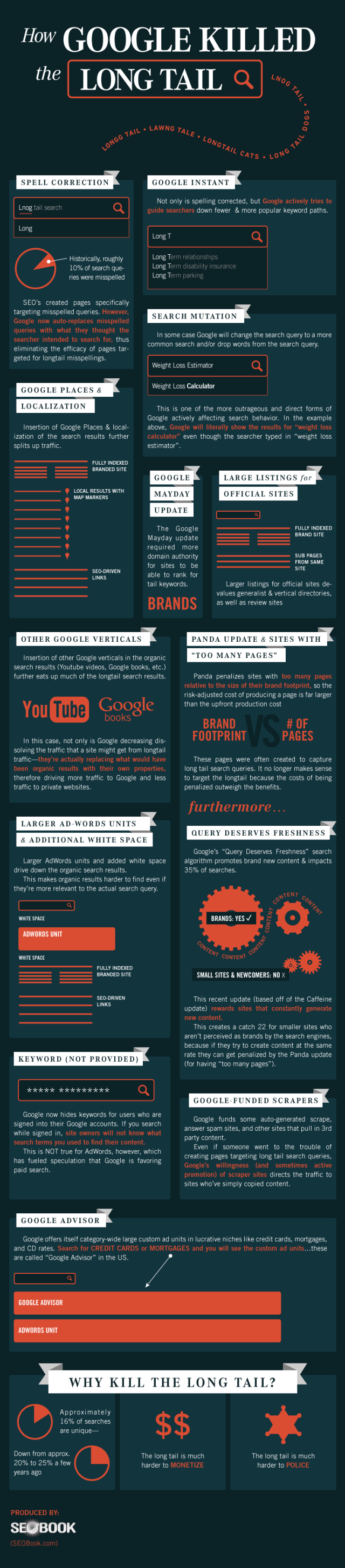
Via SEO Book, comes this interesting look at how Google is impacting search results:

>

click for full graphic
How Google Killed the Longtail Infographic.

Infographic by SEO Book

Comments

Please use the comments to demonstrate your own ignorance, unfamiliarity with empirical data, ability to repeat discredited memes, and lack of respect for scientific knowledge. Also, be sure to create straw men and argue against things I have neither said nor even implied. Any irrelevancies you can mention will also be appreciated. Lastly, kindly forgo all civility in your discourse . . . you are, after all, anonymous.

8 Responses to “Did Google Kill The Longtail ?”

  1. Robert M Says:

    Reading to much Roubini. What do you mean by longtail?

  2. Frilton Miedman Says:

    Might be a good idea to ‘splain longtail at the start of the article, once I did a web search, got the definition, I realized this is an excellent piece. (I opened the article thinking it was related to “fat tail” and Google had affected the stock market)

    On the article,
    It would seem that “TBTF” isn’t just a banking problem, we now face a potential likelihood of allowing Google to define the way we search and influence the type of information we can obtain. (thinking how Fox’s 60% viewer market share influenced the 2010 midterms by scaring the crap out of viewers with “socialism”, “death panels” and “government takeovers”)

    As it now stands, Google PPC is the lifeblood for countless small businesses, having gradually pushed other SE’s like Yhoo, MSN or AOL into obscurity while prices for PPC have skyrocketed over the last five years.

  3. dsimmons Says:

    The “long tail” of the internet was popularized here. ( http://www.wired.com/wired/archive/12.10/tail.html ). From a SEO perspective, I can see how they think that the long tail gets killed by Google steering people to more popular sites. Actually, the long tail is a consumer based phenomenon not a search engine driven one. Additionally, the stakeholders in buying and selling stuffed woodpeckers are not going to be driven away by Google autocomplete. This infographic cuts to the concern of the SEO community and does it well, but not the long tail community and definitely not its supposed death.

  4. leeward Says:

    If you go to this link and see the graphic that explains the long tail.

    http://longtail.typepad.com/the_long_tail/about.html

    There is a good explanation with it too.

  5. A7L-B Says:

    So, back to Dogpile? Or some elsewhere?

  6. Did Google Kill The Longtail ? « that dismal science Says:

    [...] Did Google Kill The Longtail ? Like this:LikeBe the first to like this post. [...]

  7. seobook Says:

    Spot on Frilton Miedman…the risk is the ability to arbitrarily redefine culture & frequently dial into the lowest common denominator & to frequently use size as a proxy for quality.

    The economics of featured content online are often quite awful…

    - a lot of longtail search traffic was ate up by low quality regurgitation on content farms
    - if you put it behind a paywall then companies like Google pay folks to wrap it in AdSense & make it publicly accessible (so then you need to spend more resources fighting that off)
    - even if you spend the extra capital to build a brand much of that brand equity gets arbitraged by the search results (until Google got in trouble for selling scam drug ads they had 50000 advertisers peddling counterfeit products on AdWords & a BIG PART of why Google’s CPC rates were unexpectedly low in Q4 was because a lot of brands were buying their own brand keyword using extended Google ads with sitelinks…those brands bidding on their own brand keywords get a high CTR but a lower CPC…there is only so much Google can charge a brand for its existing brand equity while still gaining buy in / before they get push back)
    - Google’s panda update smoked a lot of the crappier sites, but due to Youtube promotion, Google Books promotion, top down vertical ads (in areas like mortgage & credit cards) the traffic is still getting chopped up…but it goes from Google to Google. Demand Media’s eHow was the defining site for the content farm category & their CEO recently mentioned that Google is still pre-paying them to create more video “content” to post to YouTube
    - Google+ is perhaps Google’s most egregious move in extending the above trend…they claimed thin content deserved to get torched, and then they outrank publishers with the Google hosted/scraped version that someone you know posted.

    I would have explained the longtail more in the infographic, but the primary audience we aimed it at was marketers who were well aware of the terminology…then the infographic just kept spreading to other broader circles online…it did far better than anticipated in terms of reach.

    —-

    In terms of this quote:

    “Actually, the long tail is a consumer based phenomenon not a search engine driven one.”

    Type a few letters into a Google search page and see how they try to complete the search query.

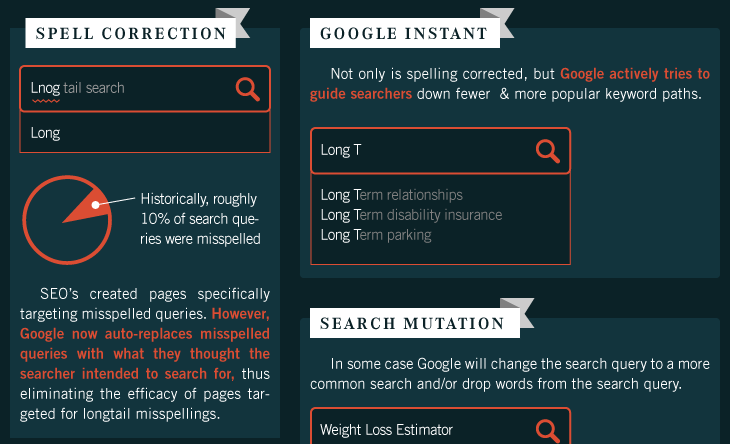
    When the search engine *actively guides* the user’s search toward a smaller grouping of keywords (via forced search suggest that is turned on by default) they are lowering the diversity of keywords that people search for. For a long time Google suggested that up to a quarter of the queries people search for were unique. More recently they put that number at 16% … so even as the number of searchers has grown & the frequency of search has grown, they still consolidated that demand against a smaller basket of keywords. … And further beyond that, as Google hosts more information & directs more traffic to its own fraternal websites that further guts the tail of traffic.

    When I first got started in search (2003) I made thousands of Dollars from a website simply because I was a bad speller & was only 1 of 2 websites that mispelled a certain keyword in a certain way. :D

    Since then Google (and other search engines) have got much better at spell correction. They also are more aggressive at using synonyms (like big vs large) so even if a big brand site doesn’t have the word “big” in the content of a page they may still rank for related searches because a page has the word “large” on it.

    —-

    “So, back to Dogpile? Or some elsewhere?”

    The meta search engines (like Dogpile) have historically been pretty darn rough in terms of mixing ads into the editorial results, but there are some start ups (like Blekko & DuckDuckGo) that are trying to push a pure/clean search interface that lacks many of the conflicts associated with Google trying to promote their own related sits. So far though they sort of lack the budget to buy awareness & marketshare…Google just paid Mozilla close to a billion Dollars for an exclusive 3 year deal to be the default search provider in the US & many EU countries.

  8. seobook Says:

    “the stakeholders in buying and selling stuffed woodpeckers are not going to be driven away by Google autocomplete”

    ah, but *which* stakeholder? some animals are more equal than others!

    1.) in the US, Amazon.com is growing at about double the rate of ecommerce.
    2.) a lot of niche ecommerce sites were smoked by Google’s Panda update (NPR even highlighted examples of it).
    3.) Google sells CPA-based (rather than CPC-based) ads to big box brand stores. Smaller advertisers have to absorb the conversion risk to buy those ads, bidding on a CPC basis.
    4.) the Vince & Panda algorithm updates both put more emphasis on branding.
    5.) as if all the above wasn’t bad enough, in 2012 Google wants to create a service to compete against Amazon’s Prime…and that service will likely be built off of working with a few number of big box stores (since it is easier for Google to manage a more limited number of partnerships with businesses)

    Sure there will always be someone there to sell you a general purpose widget, but the diversity of businesses able to sell it to you is what is in question. Small businesses are getting repeatedly crushed because it is expedient toward furthering the business goals of ad networks that call themselves search engines. ;)

    Of course if Google pushes too far in that direction they end up consolidating the markets too much & have a harder time inserting themselves as a layer (not only are they going to try to compete against Amazon Prime, but now that Amazon has so much traffic they put a lot of ads on the Amazon.com webiste & use user purchase history to help with ad targeting to start building out a more distributed ad network).

    Some of the smaller businesses have took to working on platform-based sites like Etsy & KickStarter….which are sorta artistic focused eBay-like platforms, but as search engines keep inserting themselves they gut a lot of business models…which forces a lot of people who built small businesses on a transactional model to build a more service oriented business structure.

Leave a Reply

You must be logged in to post a comment.

59 queries. 0.280 seconds.