How Often Does the Film Industry Cry Wolf Over Piracy?
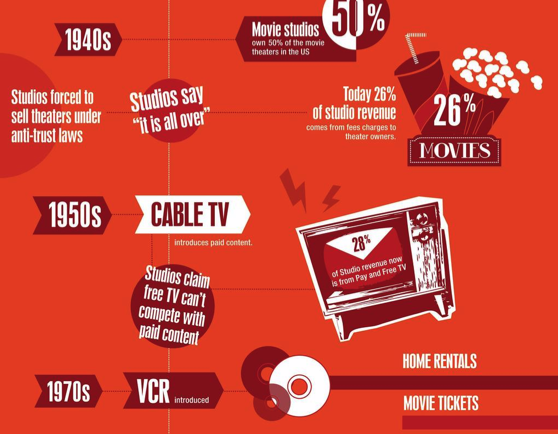
Via TechDirt, we learn the frequency with which Hollywood insists every new technology will destroy the movie business:
giant infographic after the jump

Via TechDirt, we learn the frequency with which Hollywood insists every new technology will destroy the movie business:
giant infographic after the jump

Please use the comments to demonstrate your own ignorance, unfamiliarity with empirical data, ability to repeat discredited memes, and lack of respect for scientific knowledge. Also, be sure to create straw men and argue against things I have neither said nor even implied. Any irrelevancies you can mention will also be appreciated. Lastly, kindly forgo all civility in your discourse . . . you are, after all, anonymous.
You must be logged in to post a comment.
January 27th, 2012 at 6:50 pm
Interesting to see Rupert Murdoch call out Google for stealing and thievery, while Sky grabs and broadcasts users’ YouTube videos without license or proper credit.
http://shkspr.mobi/blog/index.php/2012/01/sky-news-infringed-my-copyright/
January 27th, 2012 at 7:43 pm
Go look at the copyright notices on wax cylinders and early records: http://news.slashdot.org/story/07/06/18/1557222/even-century-old-records-had-restrictive-licensing
The more things change, the more they stay the same.
January 27th, 2012 at 8:31 pm
I agree with those that claim this is really about the film industry attempting to hang on to their 20th Century business model. Sure there’s a bunch of piracy going down, but I have serious doubts that if piracy could be magically eliminated at the wave of a hand, that the bulk of those people would then turn around and make their purchases at full retail, so how much of these imaginary losses are they actually experiencing ?
January 28th, 2012 at 6:45 am
I recently read from my Time-Life book series on: Hypocrites of History – Volume I, that…
In the very early 1900′s (pre-1915) …independent movie studios relocated to southern California, not only for the bright sunny climate, but to intentionally evade patent claims by Thomas Edison’s N.J. based Motion Picture Patents Company …since Californian patent law enforcement was pretty lax at the time.
…and it’s just ’bout a hundred years since it was ruled that Edison’s Trust (MPPC) went “far beyond what was necessary to protect the use of patents or the monopoly which went with them”
History is Awesome!
January 28th, 2012 at 8:49 am
Reporting from Thailand. No copyright laws here. Refreshing actually. Seeing the opposite end of the spectrum here shows me that perhaps ours may be unreasonable?
January 28th, 2012 at 10:48 am
lot of loud-mouthed whiners in the biz.
January 28th, 2012 at 11:02 am
Someday, they may be right. However, as long as there is seemingly endless demand for low quality content, they will be ok.
January 28th, 2012 at 12:03 pm
Here’s a TEDTalk providing a bit of a backgrounder, plus possible implications, from earlier this month:
http://www.ted.com/talks/lang/en/defend_our_freedom_to_share_or_why_sopa_is_a_bad_idea.html
One question that may be worthy of asking–”How effective would the enactment of SOPA/PIPA be at suppressing production of pirated media content in China?”
And on the topic of low quality content (Who’d want to protect most of the crap that heavily populates cable programming these days? A-a-a-h, bring back the good ol’ days when A&E was actually Arts & Entertainment.)–I imagine there is not much incentive to invest in a quality production (you know, a presentation which actually involves writers, actors, set design, character development, etc.), when it may be tough to be found among the 200+ channels most people can peruse, and the competition can make just as much money from advertising with their ‘send a cameraman and sound man out into the field to capture the bemusing antics of yokels’ production style, which rakes in the dough with it’s low production cost, high profit margin approach.
Perhaps that is why the possibility of offering ‘a la carte’ channel selection to cable subscribers may never happen. People just might select channels which offer higher quality programming, and media companies would have to actually invest in something which requires more than a two man field team and time on a video editing suite.