The Future Of The Euro

Email this post Print this post
By Barry Ritholtz - January 15th, 2012, 3:30PM

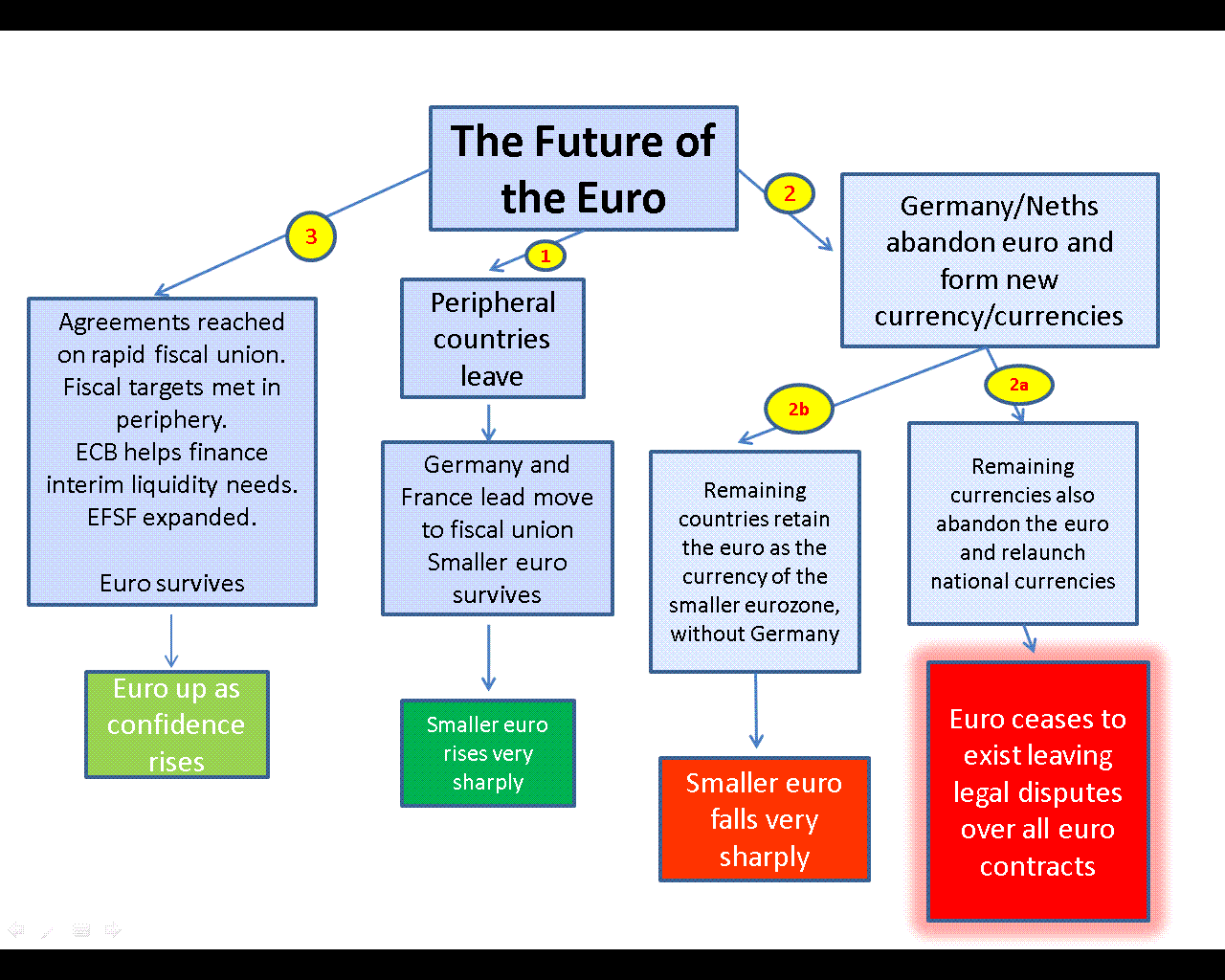
Click to enlarge:

Source: FT.com

Comments

Please use the comments to demonstrate your own ignorance, unfamiliarity with empirical data, ability to repeat discredited memes, and lack of respect for scientific knowledge. Also, be sure to create straw men and argue against things I have neither said nor even implied. Any irrelevancies you can mention will also be appreciated. Lastly, kindly forgo all civility in your discourse . . . you are, after all, anonymous.

24 Responses to “The Future Of The Euro”

  1. sabre_jenn Says:

    Scenario #3 is hopelessly unrealistic, but seems to be the preferred choice for the political class (bankers, politicians, and other lying cheating types).

    Fiscal union on paper is nice, but won’t matter unless the new rules get enforced. Enforcement will require popular support (which the EU does not have) or it requires armed troops (which the EU does not have).

    Greeks have rioted over the spending cuts that Brussels has demanded. Germans don’t want to pay for all of Europe’s cushy retirement systems as Brussels wants. Whichever country you agree with — the point is that no one supports Brussels

    The Euro was always an empty promise. Member countries “supported” the EU and its rules when the EU was handing out benefits, but no one agreed to pay any of the costs.

    That is what fiscal union means — member countries would have to *SHARE* the costs. Zero support for this. Every country wants “the other guy” to pay

  2. Transor Z Says:

    €8 trillion Eurozone GDP reduces by 50% (so-called “peripheral” countries accounting for ~€4 trillion GDP) and basically becomes the Franc-Mark, as a fundamental underpinning of the EU concept (unitary currency) suffers a mortal blow.

    Projected likely result: Euro rises very sharply.

    Oh, okay.

  3. howardoark Says:

    They left out, “Massive oil strike in Aegean Sea” as one of the prerequisites for No. 3.

  4. Iamthe50percent Says:

    I must be hopelessly naive. I don’t understand why Greece defaulting on its debts harms any country except Greece. They renege, no one lends them money again. They drop the Euro so that they can create fiat money and then they can’t buy from Germany any more because Germans don’t want worthless Drachmas. Greece solves her own problems by spending less, or collecting taxes because no one will lend them money. If I default on my mortgage it’s my credit rating that goes in the toilet, not the Dollar.
    Why do they need a common fiscal policy? It might be nice and it probably means a Federated Europe a la the USA. It might mean civil war in Europe like it did in the USA also. But my neighbor down the street doesn’t have to go in hock if I default and neither do Germany or France.

    I didn’t understand why the TBTF banks melting down meant the fiscal SYSTEM had to melt down, either. Unless the doomsayers were talking about the banks going away and just disappearing like in the 19th century. Why couldn’t they have gone bankrupt, been taken over by the FDIC and reopen on Monday like any other bank? Except that a lot of rich people would have lost a lot of money, of course. But why should it have affected my $5K checking account if Citibank had declared bankruptcy? It mattered to Vikram Pandit a great deal, but what did it matter to me, Mr. Small Ordinary Depositor?

  5. NoKidding Says:

    How about:
    4) A series of last-minute ineffective temporary resolutions drags the Euro out for years, as each the member nations follow a subset of rules they agree with and ignore the rules they disagree with. Nations like Greece, that seemingly can’t possibly live up to agreements made by their political class, fumble forward with the status quo because none of its peer states has the balls to hold them to their word. THe value of the currency, with its perpetually uncertain future, tracks the other major currencies, because nobody’s individual bet is big enough to move the market. Large interest rate spreads continue. Needs to be reevaluated in five years.

  6. CitizenWhy Says:

    Oh really, the smaller Euro rises. Why?

    The abandoned nations print enough of their new currencies, and value it very high, to pay off their debts to Germany-France-Netherlands. After all, the Germany-France group abandoned the Euro, broke the contract, can’t expect good faith payment as usual.

    As a result German-French banks collapse or taxes shoot up in Germany-France so their insolvent banks can be permanently subsidized. Meanwhile the abandoned baddies in the periphery start banks de novo, unencumbered. The ECB alsio collapses. Their “reserves” in toxic assets go unsold or at a 75-90% discount from face value. And the “baddies” shrewdly forbid capital inflows from Germany-France. or other nations with predatory banks. No more foolish lending/borrowing. Each country has its own currency, which works only in its own country, but that allows for wages and services and lending without accumulated debt. See Iceland.

    Will LaGarde at the IMF walk away from giving huge sums of money, at high interest rates, to the “bad” governments so they can ship most of that money to German-French banks. One BIG fraud. If so, the game really is up. She is far more important than Sarkozy at this point.

  7. smctel Says:

    Ridiculous that 3 is all OK. That is what got us in this trouble in the first place. Kick the can down the road. Punish the hard working responsible people and reward the lazy irresponsible people. This article is terrible and must have been written by a 10 year old that has no responsibilities.

    Money just falls out of the sky. So what would people learn from this, it is OK to spend and borrow as much as you want. If you cannot pay the adults will come in and bail you out.

  8. craig.r.jackson Says:

    None of the scenarios is satisfactory to Germany because in no outcome can it have an artificially low currency that props its exports. The euro has allowed Germany to be the second largest exporter in the world with one of the highest labor costs. Within Europe, the euro, along with cut throat financing, has allowed it to export goods to the PIIGS that they could never afford to buy. The euro gives Germany cover. Allows it take the high ground. Germany with a strong currency is toast. Maybe the US should make a currency alliance with Mexico, then loan Mexico a lot of money it cannot repay. See! There are many ways to subsidize exports that don’t defy WTO. How clever of the Germans to figure it out. So what is Germany’s incentive? They’re best case scenario is to dangle the PIIGS over a slow fire listening to them squeal the euro down. That is exactly what they are doing.

  9. MayorQuimby Says:

    Fiscal union is more possible than people might think.

    Do not underestimate the power of the *dark side* hahahahaha.

    Seriously – they will at least try to make it happen.

  10. philipat Says:

    There are only tow ways out of the mess. First, the ECB prints like the Fed in a massive QE. Second, the North directly transfers wealth to the South, either through a fiscal union or directly. The problem with both of these is that the German people, who would have to underwrite this, don’t agree and will not allow it to happen. They see the South as lazy and fiscally irresponsible and don’t want to pay for Greek train drivers to retire at 50 on a pension of EUR 150K.

    The political classes of Europe started this as a POLITICAL construct not as a viable sustainable economic model. Now the political classes are isolated from their own people. In just about every European country, if the people were asked directly “Do you want to remain in the Euro?” the answer would be NO. So the political classes got the Eurozone into this mess and now need to get it out. That is the message the ECB is sending to Brussels so count out Option 1 (Above). Option 2 remains politically impossible because of domestic elections.

    Scenarios 1 and 2b are the only possible outcomes.

    That is, I believe, known as “Check mate”. Or perhaps Czech mate?

  11. Futuredome Says:

    Greeks retirement age isn’t 50, but 55. Even in Germany, you can retire before 65. Germany wanted this model to export deflation to the Greeks and Spaniards. Nothing more or less. The French are just as guilty.

    It is like a gold standard for Greece.

  12. Petey Wheatstraw Says:

    If the Euro fails, all hell will break loose.

    In the case of widespread litigation (2a), I’m sure the lawyers will want to be paid in dollars.

    Fools.

    In the case of a complete Euro failure, they might want payment gold.

    A complete Euro failure might also be a good time for QEIII and a massive flood of dollars to keep up with demand (y’know — for the bankers).

  13. Captain Ned Says:

    C’mon, we all know that the only BP-approved way to fix this is to find a US investment bank executive to prosecute and jail. After all, jailing I-bank execs seems to be the default solution here for everything.

  14. EdDunkle Says:

    How about Europe steps back in time a couple of centuries and settles things the old fashioned way: with a war.

  15. sabre_jenn Says:

    This blog (link below) goes through all the scenarios one by one — and refutes the notion that the Euro’s collapse would be a big issue… they have been there before

    http://macrorants.wordpress.com/2012/01/15/fact-and-fantasy-on-the-euro/

  16. Simon Says:

    @ iamthe50percent If you want to be the 10percent or even the 1percent or better yet the .1percent you need to understand this stuff.

    Its actually very simple.

    If you make bread and your neighbor makes flour and you always pay your neighbor less for his flour than he pays you for your bread (maybe because you have an automatic bread maker and it takes you no time or effort at all to make your bread) and as a result your neighbor eventually starts to starve to death because he can not afford to buy your bread any more than where will you get your flour from? In this case Greece makes the flour and Germany makes the bread.

    What Germany and France do not seem to fully comprehend is that if they don’t let Greece of the hook for some of its loans from them (they lend money to them so that they could buy German bread) then there will no longer be a market for all that good German bread they are so good at making. Think cars and trucks etc rather than bread.

    Letting Greece off the hook is another way of saying fiscal union.

  17. Simon Says:

    The flour bread analogy is not so great as it implies an industrial vs commodity country relationship which is not the point. The point is when it come to trade unless both side benefit equally there is no point and the relationship is unsustainable. There! International trade is just like a marriage.

  18. Simon Says:

    The point is when it come to trade unless both side benefit equally there is no point and the relationship is unsustainable. There! International trade is just like a marriage.

  19. sjm Says:

    I have to say that scenario 3 seems hopelessly naive. Greece has repeately defaulted on it’s debts over the years. The simple fact is that Greeks don’t pay back their debts like Germans. The idea that they can “share” monetary and fiscal policy is laughable. I might add that we have a similar situation here; Californians don’t seem nearly as responsible with debt as do Texans; but at least here we have a federal government with the power (and perhaps the will) to force Texans to make good on California’s debts. In Europe, where everything important requires a unanomus decision by all member states, it really is hopeless.

    About the only thing they are likely to agree on is that there won’t be any lawsuits. Who are you going to sue; the Greek pensioners? The government doesn’t have any money! And where would you sue the Greek government when they decide to pay you in Drachmas instead of Euros? You won’t get anywhere in a Greek court and if you really wanted to kill all trade in Europe for generations just allow German holders of Greek debt start suing the Greek government in German courts and siezing Greek assets in Germany. I suspect enough people will see the futility of lawsuits to prevent them from happening.

    Nope, I just see everyone eventually exiting and printing their own money. Weak nations will devalue thier curriencies, investors will take their lumps, the naysayers will be proven right after all and people will conclude that extending credit at German interest rates levels to Greeks, just because they are denomonated in the same currency, was, in retrospect, kinda stupid.

  20. Finance Addict Says:

    Very interesting. Also in light of the fact that the really bad news out of Europe was *not* the S&P downgrade, but rather the signs that the ECB is getting very, very angry with what’s going down.

    http://financeaddict.com/2012/01/the-ecb-is-very-p-o-d/

  21. jnutley Says:

    sjm said:

    “Californians don’t seem nearly as responsible with debt as do Texans”

    Bullshit! When the oil patch is having a dry year the Texans are at least as irresponsible as anyone else. Drive down the price of oil and show me how fiscally responsible Texas is. Also, have those monetarily virtuous Texans made good on all the money defrauded from pension funds all across the U.S. by Enron? You’re posting Red State propaganda.

  22. ilsm Says:

    EdDunkle,

    If the Croats kept up all that East German mechanized equipment the Germans sent down to put off the Serb…………..

    And the Serb will help.

    The Kosovars may even get in on the fun.

    US supplies could be had at Camp Bonnsteil.

    The EU could be occupy Athens by 1 July. A lot slow than in 1941.

  23. Petey Wheatstraw Says:

    sabre_jenn:

    Lots of counter-party risks in the global economy. Not so sure we’ve ever witnessed the likes of what will happen when the cascade of defaults get rolling.

  24. howardoark Says:

    I Am the 50%

    Petey Wheatstraw answered your question – Greece defaulting is the snowball that gets the avalanche started. Spain and Portugal would see their interest rates rise precipitously which would then kill Italy, destroying the northern European banks (and probably the US and English ones too). Economic activity grinds to a halt in Europe, not doing anything for US exporters who last time I looked were the source of our recovery.

    At least that’s the theory the world’s finance ministers are working on.

Leave a Reply

You must be logged in to post a comment.

85 queries. 0.366 seconds.