
10 Thursday PM Reads
My afternoon train reading
• How Companies Learn Your Secrets (NYT Magazine)
• MBIA tells judge of newly uncovered Countrywide fraud database (Reuters)
• When Models Trump Common Sense (Tim Iacono)
• Citigroup Whistle-Blower Says Bank’s ‘Brute Force’ Hid Bad Loans From U.S. (Bloomberg)
• 5 Lessons From the Rise of the BRICs (The Atlantic)
• Is Any CEO Worth $189,000 Per Hour? (Businessweek) see also The Top 1% Must Stop Insisting They’re Not Rich Right This Instant (Gawker)
• Forget Buffett — it’s time for the Dimon Rule (Washington Post)
• The Japanese liquidity trap, revisited (Alphaville)
• Venture Capital: The new money men (Crains New York)
• The Delivery Guy Who Saw Jeremy Lin Coming (WSJ) see also Basketball-Crazy China Ponders Meaning of Jeremy Lin’s Race (Bloomberg)
What are you reading?
>
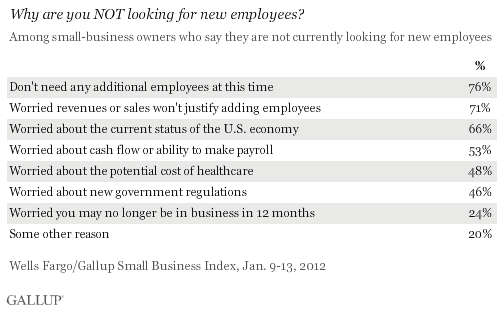
Why Aren’t Small Business Hiring ?
Source: Gallup


Tweet
Facebook
Reddit
Digg this!


February 16th, 2012 at 4:30 pm
Dodd-Frank’s Potential Effects on Credit Rating Industry
http://libertystreeteconomics.newyorkfed.org/2012/02/the-dodd-frank-acts-potential-effects-on-the-credit-rating-industry.html
ABC Does Unpaid(?) Commercial Announcement for Republicans
http://www.cepr.net/index.php/blogs/beat-the-press/abc-does-unpaid-commerical-announcement-for-the-republicans-on-the-evening-news
February 16th, 2012 at 4:38 pm
Why Facebook Is Never Safe
http://newmatilda.com/2012/01/23/why-facebook-never-safe
February 16th, 2012 at 4:46 pm
Awesome, audit announces 84% fraud rate days after a sweetheart deal between the govs and the fraudsters, America been berry berry good to it’s biggest crooks
http://www.newser.com/story/139824/sf-audit-finds-massive-flaws-in-foreclosures.html
February 16th, 2012 at 4:48 pm
More about HFT
Nanosecond Trading Could Make Markets Go Haywire
By Brandon Keim
On wired.com
http://www.wired.com/wiredscience/2012/02/high-speed-trading/
The analysis involved five years of stock market trading data gathered between 2006 and 2011 and sorted in fine-grained, millisecond-by-millisecond detail. Below the 950-millisecond level, where computerized trading occurs so quickly that human traders can’t even react, no fewer than 18,520 crashes and spikes occurred. The study’s authors call those events “financial black swans,” though they’re so common that the black swan label probably doesn’t fit anymore.
February 16th, 2012 at 4:52 pm
BR – I am reading The Quants by Scott Patterson. Have you read it? Do you haev an opinion on it? Thanks.
~~~
BR: Loved it!
Here’s my conversation with Patterson in 2 parts:
http://www.ritholtz.com/blog/2010/12/tbp-interview-scott-patterson-the-quants/
http://www.ritholtz.com/blog/2010/12/part-ii-scott-patterson-quants/
February 16th, 2012 at 5:03 pm
Re BRICs: http://www.bloomberg.com/news/2012-02-15/billionaire-batista-in-talks-with-sovereign-funds-to-sell-gold-unit-stake.html
Curious: “Batista’s joint venture with Foxconn Technology Group, a maker of metal casings for Apple Inc., will invest $2.5 billion in a plant to make electronic screens in the South American country, he also said today. The billionaire is expanding into new segments after becoming Brazil’s richest person by selling shares in commodities and logistic startups including OGX Petroleo e Gas Participacoes SA (OGXP3), the country’s second-biggest oil company by market value, and MMX Mineracao & Metalicos SA, an iron-ore producer.”
And for the peanut gallery GAFISA! maybe it’s gonna really go again. Then again what do I know? (as the only person here to have mentioned Ventana Gold when it was trading at ~5.30 -long before it got taken out by lil ole Eike at 14+).
February 16th, 2012 at 5:11 pm
I remember when Lula da Silva was the next Joe Stalin, the freakin Cuco! ‘We’re doomed if that pinko takes over!’ Well, funny how things work out…he retired and nary a kulak was killed. Plenty of indios and environmental activists though- still wasn’t enough to get off of Bill O’Reilly’s pinhead list…
From Atlantic:
“A strong civil society can come from a number of things: labor unions, public interest groups, political parties, and most importantly the right to elect and unelect leaders. Civil society is very weak in China and Russia, it is large but struggling in India, and it is relatively successful in Brazil. This may help explain why, of the four BRICs, Brazil seems to enjoy the greatest stability. Compared to China’s looming threats from inflation or a transition trap, Russia’s demographic crisis, and India’s rampant corruption, Brazil is downright boring. Its economy is lightly but competently managed, the hyperinflation crisis of the 1980s is behind it, and both the state and market seem to work in some kind of benign concert. The country has the greatest political rights and civil liberties of the four BRICs, according to the latest rankings from Freedom House, and its civil society actively participate in politics (unlike in India, where citizens vote but often have few other outlets, such as unions, for participation). It’s not a cure-all to solve the problems of a developing economy, but a strong and free civil society seems like a good way to at least deter them from getting too bad.”
February 16th, 2012 at 5:27 pm
The Future Tense “Stock Market Sentiment – We Can Only Go Higher” (not really)
http://www.ftense.com/2012/02/stock-market-sentiment-we-can-only-go.html
Sentiment is at an extreme that has only been reached twice in the past 5-years, once when the Dow hit its high in late 2007 and the other in 2010 at the end of QE2. Both times the markets were drunk on euphoria and both times the markets soon turned downward.
February 16th, 2012 at 5:39 pm
Economic Policy Institute
Misguided CPU Act would cut tech workers’ wages
By Ross Eisenbrey | February 16, 2012
Corporate lobbyists have begun an intense campaign on Capitol Hill to cut the earnings of workers who use computers for a living. Sadly, a couple of Democrats who ought to know better have joined this campaign, which is focused on making sure computer systems analysts, computer programmers, software engineers, and other “techies” don’t qualify for overtime pay. Democratic Senators Kay Hagan of North Carolina and Michael Bennet of Colorado have, along with four Republican co-sponsors, introduced the cleverly named CPU (Computer Professionals Update) Act. It is premised on the notion that labor law governing the pay of IT professionals hasn’t kept pace with the changing economy. While labor law regarding IT pay should be updated, it should be updated in a way that increases workers’ pay, instead of cutting it, as would the CPU Act.
…
http://www.epi.org/publication/misguided-cpu-act-cut-tech-workers-wages/
February 16th, 2012 at 6:11 pm
I incorporated this year in Illinois with a total of three new employees. We broke away from the old employer. Unemployment insurance was 0.55% but because we are new it is now 4.3%. no big deal but it is another 20,000 on my comp when i have never laid anyone off in any 20 years. Lucky me it stays this way for 3 full years. I understand i should get the lowest rate but if you want new business to hire do you need to charge me the highest?
February 16th, 2012 at 6:12 pm
That was “Shouldn’t Get the lowest rate”
February 16th, 2012 at 6:32 pm
http://jessescrossroadscafe.blogspot.com/2012/02/ritholz-has-main-theme-right-but-gets.html
February 16th, 2012 at 6:52 pm
AMERICANS NOT FALLING FOR THE CALLS FOR ‘SHARED SACRIFICE’
In a National Journal poll, Americans overwhelmingly do not agree with the RightWing’s contention that ‘entitlement’ or ‘safety-net’ programs are driving our federal deficits & debt. About 70% hold the view that our federal deficits & debt are as a result of the undertaxation of the wealthy and excessive defense spending:
“the survey found Americans unconvinced that safety-net programs represent a major source of the deficit problem. When asked to identify the biggest reason the federal government faces large deficits for the coming years, just 3 percent of those surveyed said it was because of ‘too much government spending on programs for the elderly’; only 14 percent said the principal reason was ‘too much government spending on programs for poor people’. Those explanations were dwarfed by the 24 percent who attributed the deficits primarily to excessive defense spending, and the 46 percent plurality who said their principal cause was that ‘wealthy Americans don’t pay enough in taxes’.”
NATIONAL JOURNAL
February 16th, 2012 at 7:08 pm
More protection of the large/monopoly by our clueless, self-serving friends in congress.
“The House bill would also restrict the FCC from reserving any of what it acquires in the auctions as unlicensed spectrum, which isn’t allocated to specific companies. Entrepreneurs freely working with unlicensed spectrum created all sorts of wireless applications, like garage-door openers, baby monitors, cordless phones and Wi-Fi.”
http://www.sfgate.com/cgi-bin/article.cgi?f=/c/a/2012/02/08/BUJ31N47QI.DTL
February 16th, 2012 at 7:12 pm
Oddly enough I’m reading Tim Duy’s original point-by-point rebuttal to Bullard that the Tim Iacono article, “When Models Trump Common Sense,” inexplicably did not link to:
It’s Worse Than You Think by Tim Duy
The Duy article that Iacono does link to is mixed in with the rest of the links but is actually the follow-up to Bullard’s partial retraction (via Economist’s View) in response to Duy’s original rebuttal: James Bullard Responds to Tim Duy.
Again With Potential Output by Tim Duy
These three posts and Bullard’s original speech comprise the main conversation, all the rest is pretty much color or side-commentary; quite useful, particularly if some of the economic geek-speak is hard to track, but not essential to the argument.
The Iacono article itself is simply a screed and can safely be skipped. It makes the right point but in the wrong arena since Bullard not only lacks a model he lacks adequate evidence and “common sense” must therefore dictate the exact opposite of Iacono’s putative point: An absence of both mechanism and a dearth of supporting data suggest Bullard is quite possibly wrong and would certainly be wrong to make Fed policy affecting an entire nation on the basis of his argument.
NB: For those who really want to understand what the Fed is up to, Tim Duy is essential reading.
February 16th, 2012 at 8:16 pm
Taxpayers screwed again as settlement gives banks credit for subsidized HAMP mortgage mods
http://www.ft.com/cms/s/0/8220e886-58b2-11e1-9f28-00144feabdc0.html
A Facebook valuation … central tendency around $70b … doesn’t include a Zuck haircut
http://aswathdamodaran.blogspot.com/2012/02/ipo-of-decade-my-valuation-of-facebook.html
Krugman Playboy Interview… and you thought they were irrelevant
http://www.playboy.com/magazine/playboy-interview-paul-krugman
The ultimate Steve Jobs video collection
http://chill.com/scott/collection/the-ultimate-steve-jobs-collection
Taiwan surgeon drops LASIK over long-term side effects
http://www.chinapost.com.tw/taiwan/national/national-news/2012/02/15/331686/Surgery-pioneer.htm
February 17th, 2012 at 3:24 am
Pick a path solution to the Greek Crisis
http://crookedtimber.org/2012/02/16/so-what-would-your-plan-for-greece-be/
February 17th, 2012 at 7:55 am
CITI screws the gov with bad mortgages…I don’t know if this even rates as news anymore in an industry where fraud (at least large scale fraud) is the norm.
http://www.propublica.org/article/how-citibank-dumped-lousy-mortgages-on-the-government