
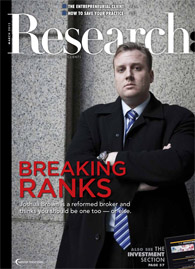
Joshua Brown is one angry former broker

Email this post Print this post
By Barry Ritholtz - February 24th, 2012, 12:56PM

Awesome cover story in the March 2012 Research Magazine on my colleague Josh Brown:

“Joshua Brown is one angry former broker. The 35-year-old financial advisor, whose Reformed Broker blog has brought him wide acclaim in recent years, has just written a book meant to uncover the perfidy of Wall Street. Backstage Wall Street is part plea, part mea culpa, part screed. Brown unmasks the financial industry for all to see, revealing the less-than-honest sales tactics of boiler-room brokers and dressing down investment banks for running away with fees and riches while Mom and Pop retail investors are left holding the bag.

Brown makes some startling claims: wirehouse brokerage firms will be gone in 10 years, as will the “suitability” standard governing broker-dealers. Mutual funds? They’ll be gone too, replaced by their fast-rising cousins, ETFs. Brown takes his readers on the bumpy ride of Wall Street, from 2000 (when he started), through the credit crisis of 2007-2008, to the present day, when you can find him as a reinvented registered investment advisor, happily banking management fees instead of commissions.”

I already read his book (Backstage Wall Street: An Insider’s Guide to Knowing Who to Trust, Who to Run From, and How to Maximize Your Investments), its a Molotov cocktail thrown at the brokerage industry.

>
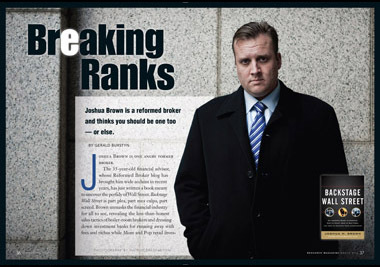
>

Source:
Breaking Ranks
Gerald Burstyn
RESEARCH MAGAZINE, February 24, 2012
http://www.advisorone.com/2012/02/24/breaking-ranks

Comments

Please use the comments to demonstrate your own ignorance, unfamiliarity with empirical data, ability to repeat discredited memes, and lack of respect for scientific knowledge. Also, be sure to create straw men and argue against things I have neither said nor even implied. Any irrelevancies you can mention will also be appreciated. Lastly, kindly forgo all civility in your discourse . . . you are, after all, anonymous.

23 Responses to “Joshua Brown is one angry former broker”

  1. The Window Washer Says:

    Kudos to Josh, well deserved success.

  2. Concerned Neighbour Says:

    I haven’t read the book, but the more people exposing the cesspool that is much of Wall Street the better. I commend him for his courage. I do the same for BR, who has always struck me as an honest and trustworthy individual. In other words, what a Wall Street career guy should be.

  3. Mark E Hoffer Says:

    well, at least, someone will understand Why? Charlie Merrill should be Hung, in Effigy..

    http://www.time.com/time/magazine/article/0,9171,989774,00.html

    those ‘Roads’ (“Bringing Wall St. to Main St.) need to torn up–as assuredly as the ‘Interurban’, of yore, were..

    http://search.yippy.com/search?query=GM+destroyed+the+Interurban&tb=sitesearch-all&v%3Aproject=clusty
    http://www.thefreedictionary.com/assuredly

    though, you know, DTJB, ETF, or no, the S&P 500-ization, of the ‘Economy’, will continue unabated until the ‘Index’-Yardstick is snapped (use discontinued)..

  4. SOP Says:

    It is always interesting to hear what “will be gone in 10 years”…

    Thank you Mr. Brown. I hope your book, and janet tavakolis’ new book, can capture the short attention-span of at least a few people.

    When was the last time Warren or Charlie warned us about “Weapons of Financial Mass Destruction” ???

  5. flocktard Says:

    Just to comment here on “suitability” versus “fiduciary” and “fee based” versus “commission.”

    On the first issue: there is a tale told – in Judaism, this is known as a “midrash”- about a famous sage called Rabbi Hillel. A Roman soldier once taunted the old man and commanded him: “Teach me your Torah standing on one leg.” Hillel obliged: “That which is hateful to you, do not do to your fellow man. The rest is commentary. Go and learn.”

    If you put your clients interest’s first, you solve your “suitability” issue and fulfill your “fiduciary” mandate. The only difference is semantics. Protect your customer. Do the right thing. Even when they can’t see it. The rest is commentary.

    Secondly, I have found that while some believe fee based advisory is a better deal for the client, this is not neccessarily the case. As sure as commissions can incentivize activity, fee basing can incentivize sloth. There are thousands of so-called “wealth managers” who sit on their ass raking in fees while assets languish for years, without the slightest bit of attention. I’ve seen it myself. These people are a disgrace to the profession. They gather assets for the purpose of NOT having to “manage” them.

    I do agree that the wirehouse is going the way of the dodo. Which is why so many brokers are fleeing to the independent model, where no anxious sales manager is squeezing the life out of your book to make him look good and hit targets.

  6. morganbroker Says:

    I am a major wirehouse broker. I have working now for 4 years. I have ~$50 million under management – mostly gathered from cold calling. I bring in about ~$10 million a year in new assets. I do financial plans for everyone of my clients. I have ~65% of my book as advisory (wrapped.) The other bit is in fixed income – mainly individual bonds that I buy and hold. I am in the top 5% of the firms advisors with the same level of experience as me. I do not use the firms “cookie cutter” tactical asset allocations, but depend on them more as a rough guideline.

    I do not feel any pressure from my firm to push any product or platform. In fact, when I started we were urged, not pushed, but urged to set up fee based practice.

    There are “brokers” in my office that do commision business, but they are of a different generation. Mostly old guys who have problems adapting to a changing world. They are literaly a dying breed.

    I have taken accounts from independant RIAs that pull the same shienanagens that “reformed broker” rails against. Cookie cutter asset allocations, with a 1.5% fee and some crappy mutual funds layered in. As a matter of fact I just took a $3million relationship from an independant that was doing just that. The ACATS will clear Monday.

    You can find plenty of crappy advise in either channel – independant or wirehouse. Just laying it all at the wirehouse’s feet is not fair. In my opinion it is more of a cultural problem with older brokers that will correct itself naturally over the long run.

  7. Long Time Asset Manager Says:

    morganbroker:

    You started in 2007 — do you mean to say you were raising significant assets during the recession, then in 2008 during crash, then during the widely hated rally of 09 10 ?

    I don’t mean to call you a liar, but what you say sounds rather incredulous.

  8. Barry Ritholtz Says:

    incredulous or incredible?

  9. louis Says:

    Did you guy’s hire a photographer to follow you around?

    GQ called they want their money out.

  10. Mark E Hoffer Says:

    incredulous or incredible?

    “incredible”

    but, it makes him “incredulous”

    http://www.thefreedictionary.com/

    for the, Low, net Financial Cost, ’tis ‘a Bargain’..~

  11. GuinnessFan Says:

    Josh, I see this available for pre-order at Amazon, but with no Kinndle offering :( . Geez, first time I’ve used a whatever face.

    Aren’t your experiences just the modern day version of “Where are the Customers Yachts”.

  12. morganbroker Says:

    Yes, I did raise assets during that whole time period. I must admit that I did inherit around $5mill from brokers leaving the business in 08-09 but the of it I raised myself. The market growth from 09 until now hasn’t hurt either.

    I am at a wirehouse because of branding. I find it easier to get in front of people because of the name behind me. Will I ever go independent? I’ll run the numbers when I am done with my marketing/growth phase.

    You can believe me or not. I really don’t care.

    All I was trying to get across was that you can still run a successful clean practice at a wirehouse. I have never been pressured by my manager or any one to push a product or squeeze more revenue out of my clients. Maybe I am an exception but I doubt it. I have been asked to speak and have been held out as an example to “rookie” advisors just starting out. If my major wirehouse employer wanted to promote churn and burn they wouldn’t be holding me as an example to new advisors. My average my ROA is 0.9%.

    Have I seen churn and burn brokers at my firm or other major wirehouses? Yes! But I have also seen them on the independent RIA side as well.

    Two weeks ago I came across an independent RIA buying and selling high yield debt to a women in her 60s! It was all the money she had and he decided it would be a good idea to buy and sell BB debt and below for her.

    These accounts are the easiest to get!

    I’m sure all of us here have seen things that would make the consumer hair stand on end. But it is prevalent in both wirehouses and independent RIAs.

    Those bad advisors are eventually going to die out due to natural selection. A clean advisor is going to pull the curtain back and show them the truth of what is going on in their account. Eventually the old school churn and burn broker, no matter what platform they are on, will be a thing of the past.

  13. call me ahab Says:

    good post,

    dude looks older than 35- maybe getting jaded at an early age puts a few years on a man

  14. call me ahab Says:

    from the article:

    The reality is that [fund managers] mean-revert. Even a manager who outperforms for three years straight will probably under-perform long enough so that in the end it nets out just to be the same. So essentially mutual funds have found themselves to be the high-cost provider . . .[for example] if somebody just buys the semiconductor index as an ETF, it’s very, very unlikely that the acting manager at Putnam is going to be able to beat that index over long stretches of time.

    the dude’s right- if he works for you, wise choice

  15. bill750 Says:

    I’ve been a major wirehouse financial advisor since 1972. I’ve only been with two firms during this entire time – 25 years at my current firm. While brokers have not always been subject to the fiduciary standard, I’ve always run my business by the simple rule that if it’s not in the clients’ best interest, don’t do it – whatever “it” is. For the last 25 years, I’ve been running a discretionary fee-based business and have retained clients far longer than average for one simple reason (besides the fact that I’m very good at what I do) – I have no reason other than the clients’ best interest to execute trades in my client accounts. What all that means is that I have operated under the fiduciary standard for many years. It appears that the new rules will have even commission-based brokers operate under this standard. In my business, everything is done on an agency basis – as a matter of fact, I couldn’t execute a principal trade in these accounts if I wanted to (which I don’t). I manage a substantial amount of money and have a pretty decent track record, which is why I don’t need to prospect for business – my clients are so loyal that they refer people to me all the time. Believe me, I know there are a lot of scumbags in my business, unfortunately. Yet there are many financial advisors like me who really are concerned about their clients and do everything we can to make sure their interests are properly served.

    I take accounts away from brokers that abuse the trust of their clients all the time. I see examples where a client who never sells anything and only buys a few shares of stock or reinvests proceeds from called or matured bonds is being charged a “wrap” fee. I still have a number of clients who prefer to do business the old way, because I’ve told them that since there’s very little trading of securities in their accounts that they are far better off paying a commission every now and then. I manage my discretionary accounts fairly actively, and practice the type of risk management that clients would never do on their own, because they fall in love with the stocks they own – just like so many separate account managers do. There are absolutely no transaction fees or hidden fees like the transaction costs paid by a mutual fund and not reported as part of their expense ratio. I believe my clients are getting a fair go for the fees they pay me. They must believe it also or they would have pulled their accounts years ago or refused to refer people to me. Since most of my book is discretionary and buys and sells are handled as blocks, every client, from smallest to largest, gets equal treatment – exactly the same price at exactly the same time.

    I only take new clients who appreciate my approach to the business and are willing to pay for my services. There are plenty of people who want to work with an advisor they respect and trust. If they would rather deal with some anonymous clerk on an 800 number who is barely capable of executing unsolicited trades, then I have no interest in pursuing a relationship with them. I know everyone who visits this site is a very sophisticated investor who doesn’t need any guidance or help because they can do it all by themselves (I’m kidding). But there are millions of people who can’t or won’t do it themselves because they don’t know how or simply would rather be doing something else. People will spend months researching a trip to Italy, but they will buy a stock online after getting a tip from a friend (or a cab driver or shoeshine guy) and lose thousands of dollars in the process. If someone really knows more than I do (or at least thinks they do), and there are plenty of people in that category, then they don’t need me, and I don’t want them as clients.

  16. brokrbob1 Says:

    Business models don’t cheat people. People cheat people.

  17. Lyle Says:

    Agreed that there are honest brokers who care about their customers, but how to find them? Unfortunately both good and bad enter the business every day. It is sort of like used car dealers there are indeed some that are honest, but again how do you tell? (Perhaps live in a small town where word of mouth works). The current crop of bad advisors will leave the business to be replaced by a new crop, just like the mortgage loan officers described in A Colossal Failure of Common Sense, them move from business to business as the opportunities present themselves. Of course if one watches American Greed on CNBC the number of successful Ponzi schemes is huge as well. Perhaps Ronald Regan’s slogan with respect to the Soviet Union applies trust but verify.

  18. end game Says:

    I’m a private wealth advisor, a euphemism for stockbroker to the very rich. I manage $400 million and I’ve been in the business for 25 years. In 1987 my major wirehouse firm pushed a unit investment trust with a 1 year term that invested in 30 stocks and charged a 3% commission … which they then rolled into another 1 year, 3% trust. I knew not to touch that Just last month, the very senior and successful advisors in my office piled into a fixed income closed end fund at the IPO with a 3% sales charge. I knew to avoid that as well. I thought everyone knew not to buy a closed end fund at the initial offering price. Throughout my career, I never felt pressure to do anything I didn’t think was right for my clients. The problem has always been 1. a lack of advisors without the academic training to know what to do, the investment equivalent of creationists who either don’t or refuse to understand evolution; 2. product development people focused on sales rather than vehicles that can perform; and 3. a lack of character among too many in the industry, putting their own paychecks ahead of client accounts. The result is tens of thousands of products, a consumer that is absolutely bewildered and who therefore needs “advice”, professional advisors who are only slightly less bewildered than the clients they serve, and zero transparency into the fees and performance of the brokers. Look at the Barron’s Top 1000 … do they show average investment performance performance for any of them? The primary criterion is assets under management, and nearly all of them are nominated by their firms. Guess which advisors make their firms happiest? Those who charge the highest fees. I know many of the Barron’s list personally… and for the most part their net of fee performance is nothing to write home about. “morganbroker” charges 90 basis points, not counting all the management fees and expense ratios of the managers and funds he places clients in. That is slightly higher than the average of 83 basis points for the industry, which is ludicrously inflated for the advice that is offered up. I charge 40 basis points. Yet the vast majority of brokers fail to do simple, basic blocking and tackling: 1. core/satellite equities; 2. fundamental, not cap-weighted indexing; 3. using a 365-day, tax loss harvesting index manager to minimize clients’ tax bills; 4. reducing the “house” markup of 1 point on a risk-free Treasury bond or TIP down to a half or a quarter

  19. end game Says:

    I’m a private wealth advisor, a euphemism for stockbroker to the very rich. I manage $400 million and I’ve been in the business for 25 years. In 1987 my major wirehouse firm pushed a unit investment trust with a 1 year term that invested in 30 stocks and charged a 3% commission … which they then rolled into another 1 year, 3% trust. I knew not to touch that Just last month, the very senior and successful advisors in my office piled into a fixed income closed end fund at the IPO with a 3% sales charge. I knew to avoid that as well. I thought everyone knew not to buy a closed end fund at the initial offering price. Throughout my career, I never felt pressure to do anything I didn’t think was right for my clients. The problem has always been 1. a lack of advisors without the academic training to know what to do, the investment equivalent of creationists who either don’t or refuse to understand evolution; 2. product development people focused on sales rather than vehicles that can perform; and 3. a lack of character among too many in the industry, putting their own paychecks ahead of client accounts. The result is tens of thousands of products, a consumer that is absolutely bewildered and who therefore needs “advice”, professional advisors who are only slightly less bewildered than the clients they serve, and zero transparency into the fees and performance of the brokers. Look at the Barron’s Top 1000 … do they show average investment performance performance for any of them? The primary criterion is assets under management, and nearly all of them are nominated by their firms. Guess which advisors make their firms happiest? Those who charge the highest fees. I know many of the Barron’s list personally… and for the most part their net of fee performance is nothing to write home about. “morganbroker” charges 90 basis points, not counting all the management fees and expense ratios of the managers and funds he places clients in. That is slightly higher than the average of 83 basis points for the industry, which is ludicrously inflated for the advice that is offered up. I charge 40 basis points. Yet the vast majority of brokers fail to do simple, basic blocking and tackling: 1. core/satellite equities; 2. fundamental, not cap-weighted indexing; 3. using a 365-day, tax loss harvesting index manager to minimize clients’ tax bills; 4. reducing the “house” markup of 1 point on a risk-free Treasury bond or TIP down to a half or a quarter

  20. Sechel Says:

    Brokerages incentivize their sales force to sell what makes them the most money. If that’s not a conflict I don’t know what is. Case in point many of the big banks create obscure structured notes to sell to their clients in place of cd’s or medium term notes offered by corporations. The investors are told of a higher yield but rarely understand the true credit profile as well as all the features that affect return. Most of these products would never be offered to an institutional account because they investments designed not to perform well. Seems like only yesterday we heard about retail clients being used as a dumping ground for auction rate munis.

    Also people aren’t speaking up enough about the high fees associated with managed accounts.

  21. Francois Says:

    “Business models don’t cheat people. People cheat people.”

    Business models can incentivize people to cheat people. See mortgage securitization as a glaring example. It’s all explained in crystal clear non-euphemism language in this must-listen-to interview with a real professional at detecting and prosecuting financial frauds:

    http://harryshearer.com/news/le_show/player/?id=816&start=00:21

  22. end game Says:

    bill750, you make some good points, you’re obviously experienced, and I believe you are sincere. But why go only halfway in your client service? Why manage the assets yourself when you could hire some of the very finest equity managers in the world? One very good study by Arnott showed that 93% of large cap managers underperformed the S&P 500 over a 10-year period, after taxes were taken into consideration. Are you really one of the top 7%? If not, why not use index funds along with your active style? And you can improve significantly on the S&P 500 by using fundamental indexing. The core/satellite construct is standard in the institutional world. Why just give clients “a fair go” when you could instead deliver institutional-quality portfolio construction and fees? I’ve been monitoring broker hires on Fundfire for the past 12 months and rarely have i seen brokers charge less than 60 basis points. Do you? And isn’t it best for clients to own a global bond and stock portfolio? That’s what the capital asset pricing model suggests is the minimum-risk portfolio for investors of average risk tolerance… but you didn’t mention it. And against what benchmark do you measure your performance? Do you use a global securities market index? I doubt it, because the largest warehouses don’t offer such an index for client reviews, even though it’s the only relevant one and is needed desperately. I know; I’ve researched this for years. Don’t fool yourself that just because clients stay put it’s because they think they are getting a good deal. Most stay because they have absolutely no idea how they are really performing, net of all fess and taxes.

  23. JasRas Says:

    There is no doubt that damage has been caused by ALL in the industry. Brokerages, discount brokerages, RIA’s, ETF’s all have their dark side.

    If there was an argument for brokerages going extinct, it’s because most are woefully behind on technology, investment options for clients, and client communication options.

    That said, using an advisor at a brokerage is akin to swimming in the ocean at the marked off, designated swimming area with a lifeguard. Despite the image Joshua portrays of brokerage vs. RIA, there are far fewer absolute devastation stories in the brokerage realm because you have all sorts of oversight and recourse.

    Look at the latest examples of devastation in the RIA world over the last 4 years: Sandford (billions??) Madoff(hundreds of billions???), Shrenker….

    If the RIA area want to truly put the death spike in brokerages, they need to grow up as a group and cull their heard, regulate more vigilantly, and be able to demonstrate that via active PR campaigns. Until then, every time I hear an ad on Bloomberg radio for the Jewish Communal Fund, I will remember why they need to advertise and raise funds: Bernie Madoff…

    Lastly, there is a lot of blame game going on, yet no one turns inwards and looks at themselves. I know, psychology tells me that’s the last place we’ll place blame… yet a co-worker was relaying to me why she migrated over to the full brokerage side as a support staff person. At a large discount brokerage firm she worked at one of their regional sights for “Gold” clients at the margin desk. Seems that most of her day was spent making margin calls on people. When she saw a pattern of people that had found a weakness in the firms computer system that allowed them to game the system and get much more margin than allowed by current rules, she ran it up the management chain. To which, they said they were aware of the problem, thanks…and did nothing. Heaven forbid it mess up their volume flows… So two groups were culpable: the discount brokerage turning a blind eye on a known problem, and the clients who willfully took advantage of the system. Her last day was after making a call on an account with a house call larger than the value of the account. The owner had funded the account with 2 helocs on his house that he bought with no money down. (fyi, most heloc docs prohibit depositing into investment accounts) His wife didn’t know any of this, and he had more than wiped them out… That was her last call of the day…

    These stories don’t happen at major wirehouses because they end up making the client whole in arbitration, because lawyers argue “know your client” and win. Lawyers can make the same argument with RIA’s, but in the end there is no deep pockets to protect the client. So it’s a hollow victory at best.

    RIA has a long way to go in my opinion. There are a lot of great RIA’s, but there are still a lot of great advisors. The most important thing is to do your homework and treat it with the gravity the issue deserves.

77 queries. 0.392 seconds.