
More reads for your weekend:
• Jubak: 5 rules to survive a market crisis (MSN Money)
• How to Beat Government Bonds—Using Social Security (WSJ)
• FiveBooks: Michael Lind on American Economic History (The Browser)
• How Much Is a Good Central Banker Worth? (The Atlantic)
• For LinkedIn Founder Reid Hoffman, Relationships Rule the World (Wired)
• George Soros and the Bundesbank’s Patriotic Putsch (Telegraph)
• Karma Crash (NY Mag)
• The Top Five Special Interest Groups Lobbying To Keep Marijuana Illegal (Republic Report)
• 11 Early Scathing Reviews of Works Now Considered Masterpieces (mental floss)
• Tracking Creation in Glen Rose: In the beginning, God created dinosaurs and humans, and they walked together in Texas (Texas Observer)
What are you reading?
>
Time to Cut Back on Apple?
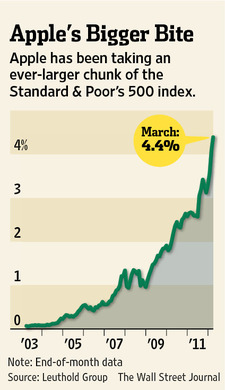
Source: WSJ

Category: Financial Press
Please use the comments to demonstrate your own ignorance, unfamiliarity with empirical data and lack of respect for scientific knowledge. Be sure to create straw men and argue against things I have neither said nor implied. If you could repeat previously discredited memes or steer the conversation into irrelevant, off topic discussions, it would be appreciated. Lastly, kindly forgo all civility in your discourse . . . you are, after all, anonymous.


http://www.nytimes.com/2012/04/22/business/at-wal-mart-in-mexico-a-bribe-inquiry-silenced.html?_r=1&hp
Vast Mexico Bribery Case Hushed Up By Wal-Mart After Top Level Struggle.
Really today’s must-read. Looks like it will be example # 12,132 that it isn’t the crime it is the cover up that will get you. Innocent until proven guilty of course but this 7600 word piece is pretty thorough. Wal-Mart’s press release sort of confirms things to. Corruption isn’t just limited to the banks!
this is disturbing:
(via Farmaggedon, at Of Goats and Men)
http://www.youtube.com/watch?v=IH_my56FkuQ&feature=player_embedded#!
‘Consider an unmarried man in average health, age 62—the youngest age for starting retirement benefits. His payoff for waiting until age 67 to collect is the equivalent of buying a long-term bond that pays 3.2% a year. For a woman, all else held equal, it’s a 4% yearly return, according to Mr. Shoven and his research partner, Sita Slavov at Occidental College.’ — WSJ
Wow, 3.2%, how impressive! This article makes the same blinders-on assumption that Social Security itself makes: namely, that Treasury bonds constitute your ENTIRE investment universe.
Nobody is the real world is that stupid. Every pension fund in the country (including those for government employees) has an equity allocation, and often some alternative investments as well. Any diversified portfolio should be able to beat a 3.2% return, as a TBP post from yesterday demonstrated.
An even more insidious assumption is that Congress won’t change the rules. When this gang of chiselers and check-kiters get themselves into a fresh jam, does anyone seriously think they won’t hike taxes on SocSec payments, cut benefits, or both?
When it comes to depending on a politicized Ponzi scheme, your best move is always to TAKE THE MONEY AND RUN, regardless of the juicy theoretical IRR from depending on the kindness of crooked strangers.
Besides, are you actually gonna take financial advice from a frayed-collar journo named “Jack Ho”? Bwa ha ha ha …
BR reads the WSJ so we don’t need to waste our time.
NPV of waiting on your SS is likely less than taking it soonest, waiting says you are betting you will live 10 years past the point that you don’t remember what money is for.
SS’ “problem” is the excess receipts were spent on blowing things up and warfare welfare, nothing that will produce things to pay out in the future.
The penalty for 7% returns is the money stays in the SSTF when you pass on.
Francine Mckenna on auditor rotation and mortgage foreclosure review
http://retheauditors.com/2012/04/13/im-in-congress-foreclosure-review-work-cited-by-congressman/
ilsm says:
“waiting says you are betting you will live 10 years past the point that you don’t remember what money is for”
Woke up by the dogs EARLY this morning, thanks for the good laugh (and I totally agree)…
I have not seen an FDIC Bank Failure chart from the Chart Store here in some time. Is there any chance you can get one for your loyal appreciative readers?
I have contributed a hefty six figures into the SS fund through running a private business but will never see a dime of benefit due to a Reagan era law that was crafted to prohibit some classes of government employees from double dipping. My retired educator defined benefit pension is bullseyed.
Fairness, anyone?
[...] Ritholtz, Michael Lind has a fascinating article on American economic history that makes some sense out of [...]
ssc: if you lived out in the sticks like me, that’s as regular an occurance as being awakened at all hours by them due to deer parading through the back yard in groups of 10 or more, a groundhog trying to get to the garden or just chasing away evil spirits (i now routinely get up about
5 a.m.) . Happy for you!
Conscience…: i misread the first few words of your statement as a comment about someone with a medical injury to be dealt with possibly by Tommy Johns surgery.
Here’s one for all you wine lovers out there (i make my own each year):
http://news.yahoo.com/marijuana-infused-wine-high-080000147.html
[...] via The Big Picture [...]
[...] via The Big Picture [...]
Why the municipal problem may be bigger than we think: http://www.syracuse.com/news/index.ssf/2012/04/post_584.html
NYS has about as close to a fully funded pension plan as you can find in the pulic sector. The cities are being forced to continue to make large payments today to cover their workers. It is causing severe pain to their budgets, BUT it should reduce the long–term pain because that part of their long-term liability should be fairly well funded in the future. It also means that they are more careful about hiring workers today. Unfortunately, NYS pisses away far too much money at the state level and also makes too many unfunded complex, unreasonable demands on the municipalities and counties so that is hurting the local finances.
If you live in a state that has done a very poor job of funding public pensions, watch out. These problems will be coming to you in spades in the future.
I suspect that reduced state and local spending will be a major drag on the economy over the next decade as well as the impact of delayed infratructure improvements. It would not surprise me if it drops GDP by 1%-2% a year from what is attainable.
Why is almost everyone ignoring the Oracle/Google trial? It is obvious that Google, as it is want to do in it’s lack of respect for others intellectual property, did some wholesale copying of Java in creating Android, not even bothering to remove some of the comments saying that the code belonged to Sun. (Sun was later bought by Oracle, which is why Oracle is suing.)
Google then started giving away Android and this lack of cost largely contributed to the fact that Android has far surpassed Apple in market share worldwide. This is important stuff that no one is reporting. It’s as if MSFT and Apple were in a lawsuit where one had caught the other stealing code wholesale and has the potential to change the landscape in mobile phones and tablets.
Many of these manufacturers selling Android devices already pay MSFT royalties for various other patents. If they also have to pay Oracle in a very low margin market, that could be a killer; it might be more economical to abandon Android for something like Windows phone or Samsung’s proprietary phone OS. This could be esp. relevant with the upcoming release of Windows 8 which is going to work on phones and tablets and on which MSFT will probably be only too happy to cut deals in order to assure it’s success and cut into Android’s market share.
There is lots of meat in the Oracle accusations. One of the biggest smoking guns is where one of the chief Android developers said in an email that all the alternatives to using Java code really “sucked” and that they needed to get a license for Java. Not often you find that kind of admission in writing. Now he claims he didn’t really mean what he said, what he said is what he said.
Here’s what looks like a reasonable summary of what has transpired so far:
http://www.theregister.co.uk/2012/04/20/oracle_google_java_lawsuit_summary/
Questions for Tad Patzek, Peak Oil Expert and UT Petroleum Engineering Prof
TO: Do your views get you in trouble with your colleagues in the petroleum department?
TP: Where it really gets me into trouble is where people are absolutely naïve, do not understand notions of energy and power, do not know how you produce energy and power, and have absolutely unrealistic expectations and are absolutely narcissistic at the same time…
… technology—the word that is most beloved by Americans—brings us new solutions and in fact I do work with the biggest, most technologically-driven industry on this planet, which is the oil and gas industry, and I am at the forefront of that technology.
So I have to laugh sometimes at the blind faith of other people in technology, because I do it every day and I know that it can be very useful but it’s not a miracle…
——–
TO: You paint such a hopeless and pessimistic picture…
TP: No, I don’t. No, I don’t.
I’m just trying to be realistic, you see, the thing again – since we have a very loose relationship to the truth and reality, we are unwilling to face reality, instead we are telling lies to one another, right?
We call it optimistic and positive attitude, when somebody’s trying to tell you the truth you call them pessimistic and a dark picture.
Well how about something else: we live within our means, we spend what we have and then if we have an excess of it we devote it to something else. Now how is that for a novel way of living?
TO: Any final thoughts?
TP: We need to start having an adult, honest, public discourse of the sort that I have not seen in our country for the last 20 years. The time is coming when we have realized our ventures into real estate and into financial engineering have led us to a disaster and that is because we have based our hope on something that is imaginary …
… I don’t think we can actually count on government doing too many things, it’s too besieged by everybody these days.
In the end it’s up to us – each individual to ask ourselves what can I do myself without the government programs, without massive resources and subsidies, so that I use less energy and live a better life. And what’s wrong with that?
http://www.texasobserver.org/forrestforthetrees/questions-for-tad-patzek
On 11 scathing reviews:
Change is always an assault on the status quo. The status quo is where the money and the reputations are, so anything new and different will always face rejection by a fair percentage of the population, including the experts. The numerous rejections that monstrous bestsellers and great books have received from the first few publishers are proof. Also, the numerous #1 musical hits of yesteryear that nobody can even recognize today is further proof of how fickle and short-lived the status quo can be.
Pentagon smear campaign ??
http://blog.sfgate.com/griffith/
Both Bush II and Obama entered their presidency with a recession left over from the previous administration. Clearly the one Obama was handed was a lot worse by any measure than the one Bush II got from Clinton. Yet when it comes to loss of jobs after 3 years, Bush II was worse than Obama, and a lot worse when you just look at private sector jobs (because Bush II was helped by an expanding government sector whereas Obama has been hurt by a decrease in the government size). I guess the increase in government deficit spending did a lot more for jobs than taxcuts for them there “job creating” 1%-ers.
http://krugman.blogs.nytimes.com/2012/04/22/the-drywall-chronicles/
DeDude,
“Both Bush II and Obama entered their presidency with a recession left over from the previous administration.”
Merely a well-repeated RightWing myth.
* There was NO “recession” during the entirety of Clinton’s two terms.
* The first Chimpy Bush “recession” (according to the NBER, which is the official private-sector arbiter of when the national economy enters a recession), started well into March of 2001.
FROM Jack Hough: “How to Beat Government Bonds-Using Social Security (WSJ)”
“Life expectancies have soared since the 1960s”
Ah, NO.
Why is this so difficult for so many to grasp ?
* The increases in overall life expectancy are almost entirely due to decreases in infant mortality. People who live to retirement age only live on average about two years longer than they did 75 years ago. Men live about one year longer, women about three years longer.
* And, the fact that retirees tend to live SLIGHTLY longer today than they did 75 years ago is MUCH more true of richer beneficiaries than poorer beneficiaries, so not exactly indicative of the society as a whole.
the weekly rail numbers
http://www.aar.org/AAR/NewsAndEvents/Freight-Rail-Traffic/2012/04/~/media/aar/weekly_traffic_reports/2012/2012-04-19-railtraffic.ashx
ilsm,
“SS’ ‘problem’ is the excess receipts were spent on blowing things up and warfare welfare”
No.
By federal statute, Social Security monies can ONLY be spent on Social Security benefits.
Apple featured on the front page of today’s (Sunday) Mercury News.
“Tech giant is Silicon Valley’s new powerhouse, passing Hewlett-Packard and reaching an unprecedented level of dominance.”
http://www.mercurynews.com/
The kind of thing that shows up closer to the end of a cycle, yes?
My reads:
Land of Promise: An Economic History of the United States, Michael Lind — aligns with your WaPost column today. To me, your and Lind’s analyses suggest the question is: How do we rebuild effective national economic institutional arrangments so that the remarkable entrepreneurial energy of the young indeed are able to achieve its potential and accrue to the nation’s benefit?
Best regards,
AR
Joe;
I think that it is fair to say that Bush II cannot be held responsible for a recession that started in March 2001 – just like I would not try to hold Obama responsible for job losses that occurred in the first half year of his presidency (before his policies could be implemented).
What Bush II can be blamed for was that he did not institute good policies that quickly would have returned the country to the Clinton era’s economic growth and budget surpluses. He inherited a mild (normal and sound) recession and turned it into a disaster of unfunded tax cuts for the rich.
DeDude,
“I think that it is fair to say that Bush II cannot be held responsible for a recession that started in March 2001″
Why the hell not ?
I already addressed this about six months ago to you and others:
http://www.ritholtz.com/blog/2011/10/understanding-federal-debt-presidential-budgets-fiscal-year-edition/
“just like I would not try to hold Obama responsible for job losses that occurred in the first half year of his presidency”
Why would you ? The national economy entered recession in December of 2007, and was obviously slowing for a time well prior to that. Obama wasn’t even inaugurated until January of 2009.
“[Bush II] He inherited a mild (normal and sound) recession…”
Nope.
That’s like the kid who murdered his parents asking the judge for mercy because he’s an orphan. Chimpy Bush CAUSED, not inherited the recession.