Click to enlarged graphic:
Source: I.Imgur.com
Category: Data Analysis, Food and Drink
Please use the comments to demonstrate your own ignorance, unfamiliarity with empirical data and lack of respect for scientific knowledge. Be sure to create straw men and argue against things I have neither said nor implied. If you could repeat previously discredited memes or steer the conversation into irrelevant, off topic discussions, it would be appreciated. Lastly, kindly forgo all civility in your discourse . . . you are, after all, anonymous.


Yes indeed, “What fools these mortals be.”
Brain-washed lemmings to the capitalist profit-driven sea.
It’s all about shelf space.
at least there are 10. seems better than the political illusion of choice
Most of these product types are better than they were ten years ago (even if a half gallon of Dreyers is now only 1.5 quarts).
e.g. Liquid laundry detergent leaks less, cleans better, and cleans more clothes with less goo.
A person could do a lot worse than buy these companies as a portfolio at the exclusion of all else. At least they make products, not electromagnetic waves du jour. These companies will still be a force when Facebook and some of the other “fads” are a dim memory.
I am wearing today a short sleeve Ralph Lauren polo shirt I bought in 2003 – its probably been worn and washed 200 times. Its still uniformly blue, though not as dark blue as it once was. The illusion of choice illustrated above is a result of companies optimizing on process and conquering competition as a result.
I don’t see the need for 500 local soda pop microbrews, though there are plenty of those marginal garage operations.
Soda, snackfood, toilet paper, these are things that can easily be made “good enough” by large faceless low-margin corporations that pump quarterly dividends out to the grandkids of old rich guys.
Excellent graphic, but bad title, IMO. What’s the illusion? (And please don’t whip out a Moody Blues lyric here! :) )
There are hundreds of options to choose from on that list. I guess if you buy stuff based on a preference for certain corporate ethics or policies, then yes, your options are more limited. But even then, ten different corporations seems to me like a pretty good number of options.
And these are just the majors listed here. There are plenty of store brand, local or web based mom and pop type options for most of this stuff.
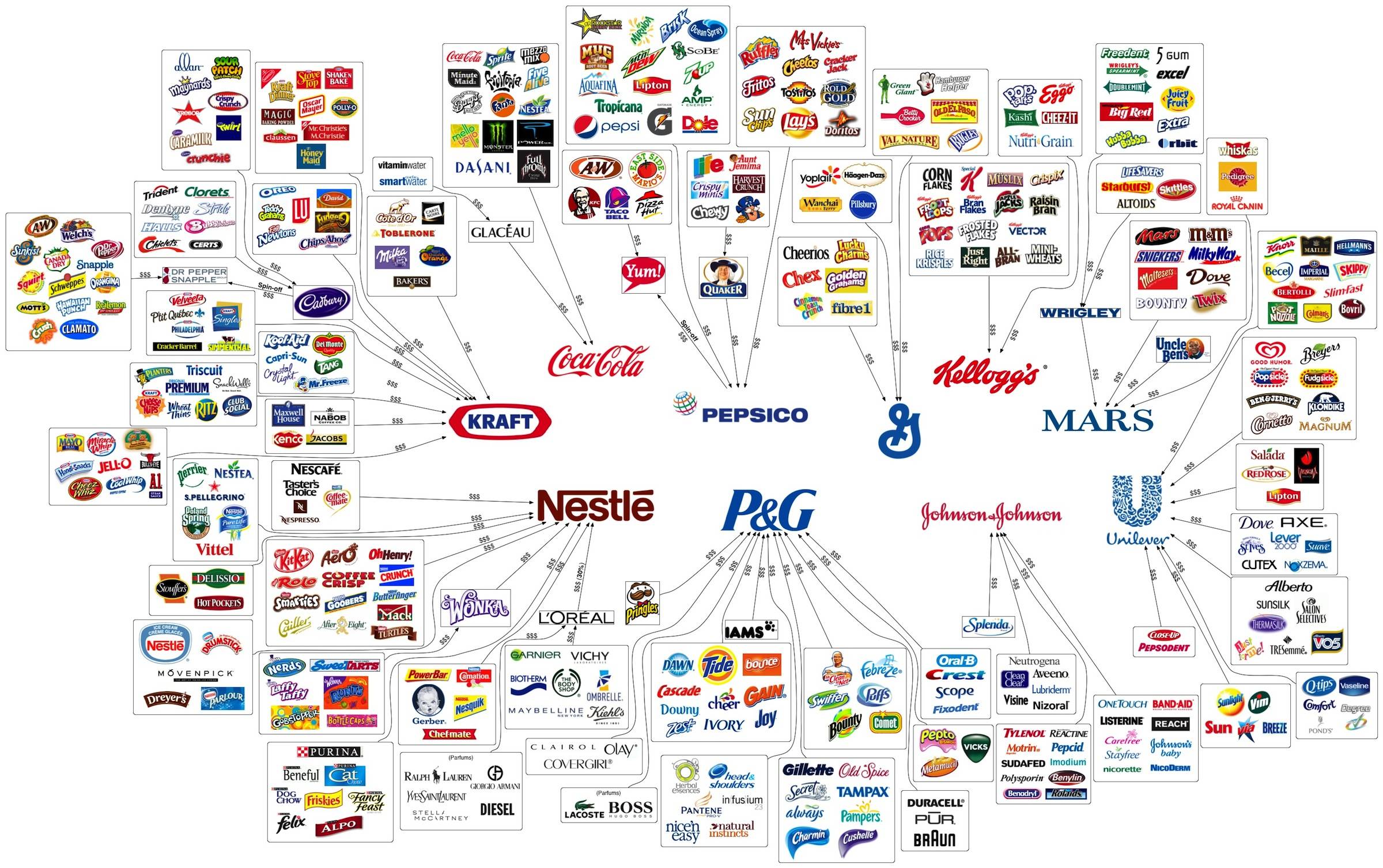
How do Coca Cola and Nestle both own Nestea?
And all full of more sugar and/or chemicals than you could possibly need. ;^) I’ll keep shopping at my local health foods stores, thanks anyway.
Morticia is right: ” It’s all about shelf space. ” and they are the gatekeepers owning most all the food drink and bath supplies.
So do they own the stores , farms etc in a way unbeknownst to us?
Maybe they do
Eerily redolent of the consolidation of the banking industry after 1994…..
Anybody notice a theme here:
Consolidation of wealth (1%)
Consolidation of media
Consolidation of Food Co.s
If you want to really learn about the “illusion of choice”, listen to this great podcast:
http://www.partiallyexaminedlife.com/
And in particular: Spinzoa!
That´s probably more choice than many other countries in the world, an certainly more choice than what humanity has had in the previous 2000 years.
Throughthelookingglass: “So do they own the stores , farms etc in a way unbeknownst to us? ”
Not directly. But you could make a similar chart for supermarkets showing the various names owned by Supervalu, Kroger’s, Safeway, etc. Then the big food processing companies: ConAgra, Dean, Cargill, Tyson, Smithfield, etc. A lot of farmers basically work for the packers on a contract basis, like sharecroppers. So, basically, a large part of what shows up on most supermarket shelves is put there by giant conglomerates.
Personally, a lot of my food comes from a local CSA.
Interesting how a title can influence a discussion. We were looking at the exact same graphic at work some time ago, and talking about consumer brands as an investment.
I think this graphic is more like a Rorschach test. If you think that consolidation of industry in the hands of a few mega companies is detrimental to the consumer or the economy in general, you’ll chuckle ruefully and shake your fist.
If you are ok with the consolidation of industry in the hands of a couple in the hands of a few mega companies, you’ll nod and note that there are hundreds of choices and the products are better than in previous years, as NoKidding has above.
I would suggest the only problem I see here is that for a consumer who wants to vote against consolidation of industry by voting with their dollars and to buy specific products, the brand illusion here makes that task incredibly difficult.
A&W is on there twice
The problem is that Oligopoly has pricing power. These companies, if they compete at all with one another, almost never compete on price. Pricing power reduces competition and therefore reduces total employment. Furthermore, when deployed through National Big Box stores, this structure reduces many areas to colony status, where 65% to 80% of the money flows to the core, helping to impoverish local areas. If you want a vibrant economy, shop local, and buy local.
@Oral Hazard: Nestea is trademarked to Nestle and licensed to Coca Cola – it’s a joint venture.
@Lookout Ranch: the A&W duplication is hard to sort through… part of it is because the non-Canadian part of the company is owned by Dr. Pepper/Snapple, but the rest of it gets really muddy, as it appears both Coca Cola AND Pepsico have a hand in it somewhere. Seems the sugary beverage industry is one big, indiscernable blob… like troutbum Says says: Oligopoly.
Stay thirsty, my friends….
A good set of reasons to buy store brands, generics, and locally sourced food. Save money, eat healthier, and help the local economy.
Are store brand products sourced from outside this oligopoly?
At least some of Trader Joe’s products come from other sources. Barbara’s cereals, for one.
Tried to find the source of that chart pr0n, but I was unsuccessful. Am I blind, or did [whoever made that graphic] completely forget to add The Hershey Company?
There are choices… you will find them at your farmers’ market.
You can choose to avoid these processed foods altogether.
Has Coke already bought Monster Energy?
Great graphic representation of what the reasonably well informed (admittedly a distinct minority) already know. As someone points out above if you want to pursue a buy and hold strategy you could do worse than concentrate on the 10 corporations listed here. They’ll have their dramas and flat spells but the sum of the parts etc.
WOW – this is both scary and sad