Source: Gigaom
Category: Digital Media, Think Tank
Please use the comments to demonstrate your own ignorance, unfamiliarity with empirical data and lack of respect for scientific knowledge. Be sure to create straw men and argue against things I have neither said nor implied. If you could repeat previously discredited memes or steer the conversation into irrelevant, off topic discussions, it would be appreciated. Lastly, kindly forgo all civility in your discourse . . . you are, after all, anonymous.


A slightly different path :
Stop making cows. Quit being calves.
http://blogs.law.harvard.edu/vrm/2012/02/21/stop-making-cows-stop-being-calves/
related..
Mobile payments coming to a loyalty/deals app near you
By Ryan Kim May. 25, 2012, 6:15am PT
Groupon is reportedly testing out its own Square rival, a mobile payments system for merchants that will undercut Square and other competitors’ transaction fees, according to a report by Rocky Agrawal at VentureBeat. Agrawal said he’s heard from a business that has been approached by Groupon about the payments system that would work with iOS devices. That system, which is apparently already being tested in the Bay Area, would offer a 1.8 percent transaction fee plus a 15 cent per transaction charge. That would be, in many cases, cheaper than Square, which has a flat 2.75 percent transaction fee and PayPal Here and VeriFone’s SAIL, which have 2.7 percent transaction fees.
The report is interesting, and we’ll have to see if the tests lead to a widespread product. It could put more pressure on existing payments players and potentially cut into the growth prospects of Square and others if it can find traction. Groupon is reportedly offering merchants a free iPod Touch, not just a credit card reader, to process transactions.
But it got me thinking that it seems like a number of loyalty and deals apps will start going down this road, adding mobile payments as a way to build out their services. These days, there’s a big land grab going on in local. People are trying to provide merchants with tools for deals and offers, loyalty and payments. Some of the latest payments plays like Google Wallet’s and Isis’, two NFC wallets, are trying to tackle all of those services. But we have some other startups who are coming at this from a deals or loyalty angle, and increasingly they are moving to offer the entire package to appeal to merchants….”
http://gigaom.com/2012/05/25/mobile-payments-coming-to-a-loyaltydeals-app-near-you/
I like business… I’m for business… but the transaction landscape is, I’d argue, unique in terms of how society functions and the relationship between its parts.
The ‘tension’ between the financial sector and TP/OWS (there’s an economic root linking the Tea Party and OWS) that has nothing to do with Left/Right but has more to do with game theory:
From Freeman Dyson
Iterated Prisoner’s Dilemma contains strategies that dominate any evolutionary opponent
http://www.pnas.org/content/early/2012/05/16/1206569109.full.pdf+html
“The two-player Iterated Prisoner’s Dilemma game is a model for both sentient and evolutionary behaviors, especially including the emergence of cooperation. It is generally assumed that there
exists no simple ultimatum strategy whereby one player can enforce a unilateral claim to an unfair share of rewards. Here, we show that such strategies unexpectedly do exist. In particular,
a player X who is witting of these strategies can (i) deterministically set her opponent Y’s score, independently of his strategy or response, or (ii) enforce an extortionate linear relation between
her and his scores. Against such a player, an evolutionary player’s best response is to accede to the extortion. Only a player with a theory of mind about his opponent can do better, in which case
Iterated Prisoner’s Dilemma is an Ultimatum Game.”
Now note that last sentence: “Only a player with a theory of mind about his opponent can do better, in which case Iterated Prisoner’s Dilemma is an Ultimatum Game.”
In essence in a scaled society… and as a result of some inherent and inescapable scaling dilemmas the interests of the “Commons” or the shared landscape, if you will… leave it as essentially a ‘player’ with no ability to implement a ‘theory of mind’ against its opposing players… (centralized sub-groups whether corporate or governmental in nature)
This turns into a much larger discussion to make that case… but bottom line… the transaction landscape ideally should be Commons-owned, non-extractive and monetized exterior to the transaction…
Moreover it must facilitate the speech-related micro-transaction (at least) and its networking. In my view this isn’t just another payment system idea… but a critical necessity for re-structuring the ‘decision landscape’ and to prevent evolutionary mis-steps.
If the transaction landscape solidifies without that… there may be no available winning strategies for the Commons against vested interests. (Frankly that seems a tentative conclusion even to me… but its too important to ignore.)
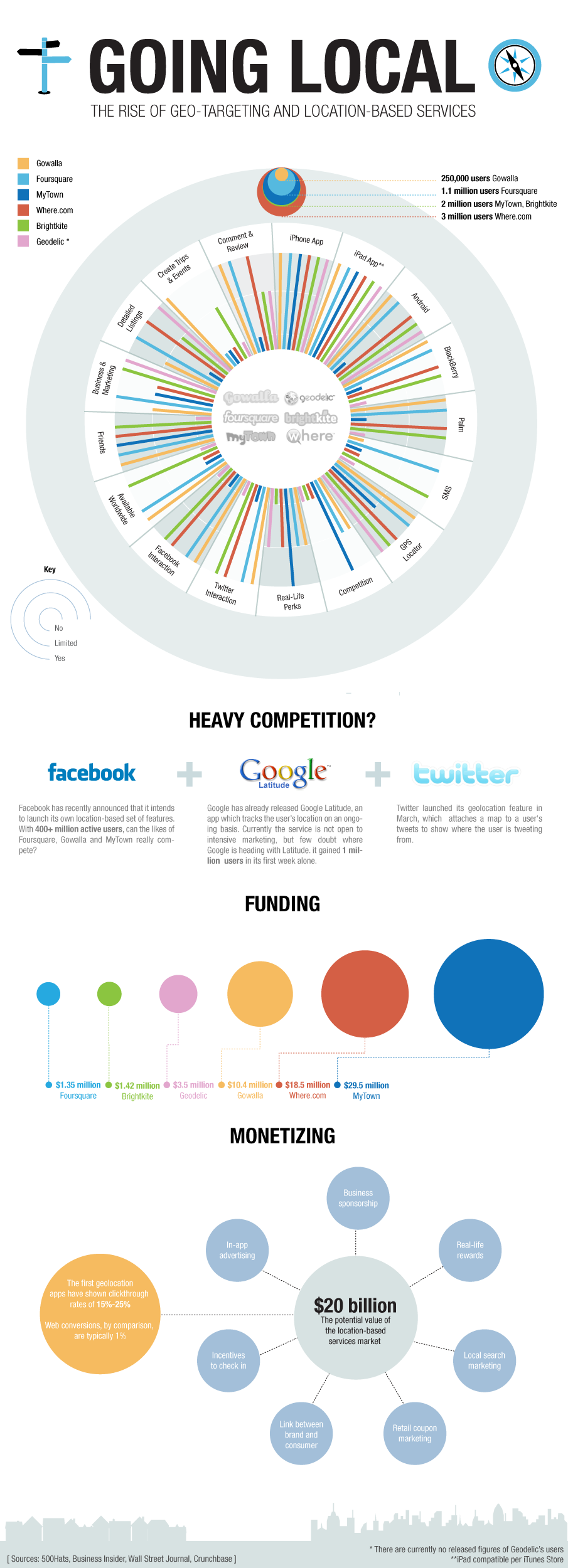
Gowalla was acquired by Facebook in December, 2011 so I’m surprised to see them still broken out separately on the infographic.
Foursquare topped 20 million users in April 2012 http://mashable.com/2012/04/16/foursquare-20-million/ so I’m not sure how the 1.1 million was arrived at (was it a snapshot of an earlier time period?)
Something doesn’t seem right to me about this infographic.
CulturalEngineer,
you may appreciate yon’ QOTD..
“Money often cost too much.” —Ralph Waldo Emerson