
Good Monday morning. Following last week’s down 4% mess, markets are set to bounce. Investors are advised to watch the quality of this bounce to discern any insights about what the near futures might hold.
Negative headlines have been driving sentiment issues — start with the Greek Exit (Grexit? Blecch) from the EU, add more chatter about the U.S. “fiscal cliff,” and not a whole lot of good news. That set up is likely enough negativity to encourage a counter trend bounce.
As to whether this is the end of the down leg or a mere interruption in the process has yet to be determined. My guess is this is merely a pause in the process, given the substantial technical damage that has been done.
As of Friday’s close, we were deeply oversold. The OB/OS oscillators, the Equity Put/Call Ratios were both heavy negative (a contrary sign). AAII’s Bear/Bull Ratio also reveals too much negativity at a 46/24 ratio. As the nearby Chart Store graphs show, a head & should top has formed. And several technicians noted a close below a significant uptrend line. Its worth watching the volume on rally attempts relative to the past 60 days.
Short term, we still have some downside work to do, with Valuation being the most bullish aspect of equity markets.
Beyond the technicals, the macro picture is another likely determiner. Watch what Policy makers responses are to ongoing weakness and credit problems. While the ECB and Angela Merkel fret, the European voters are (intelligently) tossing out advocates of the recession inducing Austerity. The problem is, they are being replaced with equally ruinous Free Lunch advocates. How the powers that be thread this needle will determine whether the Eurozone has a short sharp recession or something much much worse.
In the US, the Fed is debating itself as to whether it can do more to stimulate the economy. So far, the stimulus has fallen primarily to risk assets. The impact on actual GDP is more debatable. It is realistic to assume that, at the very least, without ZIRP, Housing would be appreciably worse, with lower prices, more foreclosures, and substantial stress on the still heavily Real Estate exposed banking sector.
Perhaps the most significant aspect of the Fed’s policy is what it has prevented: A cleansing bottom as Home prices drop below fair value and markets clear.
Be back shortly . . .
S&P500 Cap and Equal Weighted
click for full size charts
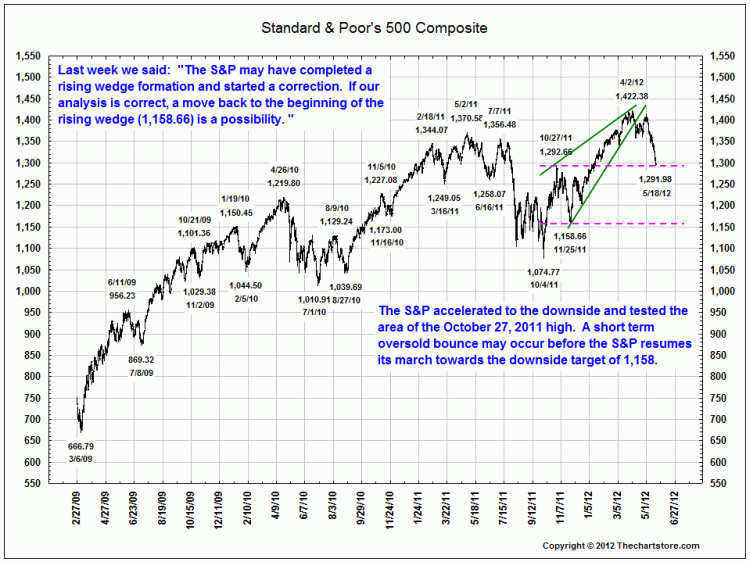
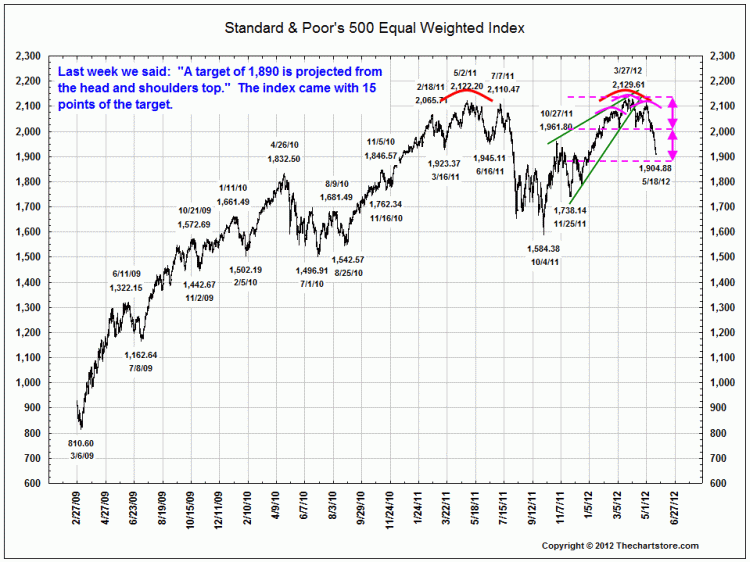
Source: Chart Store

Category: Markets, Real Estate, Technical Analysis
Please use the comments to demonstrate your own ignorance, unfamiliarity with empirical data and lack of respect for scientific knowledge. Be sure to create straw men and argue against things I have neither said nor implied. If you could repeat previously discredited memes or steer the conversation into irrelevant, off topic discussions, it would be appreciated. Lastly, kindly forgo all civility in your discourse . . . you are, after all, anonymous.


“whether the Eurozone has a short sharp recession or something much much worse”.
When unemployment has been in the 20s for two years like in Spain, this is not short, and it is not recession. This is depression and it is not the Lesser Depression as Krugman calls it. Some day they’ll find the proper name for what Europe is getting into but my guess is that they will follow the rules of grammar: Great, Greater….
RE: “My guess is this is merely a pause in the process, given the substantial technical damage that has been done.”
My analyses continue to indicate a very elevated and growing level of risk and danger both in the financial markets and the economy, with notable implications.
Here is my latest post (from Friday) on the subject of these building risks and dangers, for those interested:
http://economicgreenfield.blogspot.com/2012/05/building-financial-danger-may-18-2012.html
I can’t imagine any bounce being significant … just something to sell into.
These are the options I can think of. Some are more likely than others.
1) Greeks recognize the errors of their ways. Greece apologize for a national culture of borrowing hundreds of billions of euros without any intention of paying it back, unless someone loaned them enough money to make some payments. Agrees to tighten the national belt and go on a strict budget until creditors are happy. Result: Europe moves on with relief and markets rally.
2) Greece threatens to default on everything and leave the euro. Europe shits its pants and relents to Greek demands for loan payment moratoriums that last for several years, gives Greece more cash for necessary national expenses, and the EU ends its demands for Greeks to cut back on their lifestyle. The ECB prints vigorously and markets rally from good news plus asset inflation.
3) The Greeks vote in such a way that the future is cloudy and they get loan payments with a threat to improve or else. Markets rally until the next crisis. (most likely)
4) Greek radicals win the election and Greece leaves the euro. All Greek debt goes default. The ECB has to make a capital call since it is now essentially bankrupt. Markets dislike this event and fall. Think of Greece as Bear Stearns and the ECB as Lehman. Markets drop like 2009 followed by a monster rally caused by unlimited printing press activity. (highly possible and probable eventually)
I bailed last week when it became apparent that the commodity asset bubble burst was being taken over by the Greek crisis. I took a loss on my most recent trade but expect to make it up quickly when it’s safe to enter the waters again. The only thing I’m not planning for is a quick snap back of significant duration due to short term amnesia.
[...] Not sure if we should trust this morning's market bounce… (TBP) [...]
Wow – it’s odd for us to be in the consensus! Still, for those who would rather not rely upon someone’s arbitrarily drawn lines (*) for making investment decisions, here’s how it really looks….
* Just kidding! We at least recognize technical analysis as a weak form of statistical analysis. And for what it’s worth, statistical analysis itself can only be validly applied to stock prices when certain conditions in the market are met.
The CNBC/FB docudrama’s epilogue (with FB down 10% below the offer price) is being spun, once again, as an example to have more sweaty apes operating the market gateways as opposed to computers. Well, it looks to me like Google’s Ibankerless IPO was much better than the one that Wall Street’s wheeler dealers just mucked up.
Why don’t we go back to all-human airline reservations too, there was a screw up there last month too.
CNBC should get credit for being a job creator, their day-trading audianced got jobbed.
And so what would even lower rates mean for the downturn in stocks?
http://www.bloomberg.com/news/2012-05-21/tips-give-bernanke-green-light-to-ease-amid-record-yields.html
How much does “Don’t fight the Fed” come into play here?
I see lower rates as putting more support under stocks, while increasing the overall risk in the markets.
The market weather might be seen as merely “falling forks and spoons” rather than “falling knives”, or “raining chainsaws and anvils” (something we have not seen for a while) …
From the Comstock Partners:
“The recently reported first quarter GDP is a mere 1.3% above the amount reached at the peak of the last cycle in the fourth quarter of 2007. In eight previous post-war expansions, GDP had increased by an average of 13.3% in the 17th quarter following a peak, with the lowest being 10.5%.”
See link .
Put that in your pipe…
@ironman – IMHO, one of the best analysts using statistics as his guiding light: Tim Wood over at Cycles News andViews.
@eliz – Thanks for the pointer!
Hmm… Who does your technicals?
Looks more like 1200 or 1250 as a better target (don’t think you’ll get it… but that look better technically).
2011 did not see 2010 downside levels… why would 2012 see 2011 lower levels? Seems silly.
