
Is this the end of market weakness and the start of the next significant rally?
That’s the question on Traders’ minds in the wake of the Spanish €100 billion Euro bank bailout.
A few factors make assessing this action especially challenging. The bailout in Europe and added liquidity should add some fuel, but its offset by a slowing global economy. China, India and Europe all have seen noticeably weaker economic data the past month.
The US data has softened, but much of that is giveback for the stronger employment and retail sales data from Q1. The unusually mild winter weather likely pulled sales forwards in autos, clothing, construction and elsewhere; softer data in Q2 is the makeup for that.
Complicating this is the question of if and when the Fed will unleash QE3. As the chart below shows, the prior two QEs as well as Operation Twist all came about from much deeper oversold levels, with markets down ~20% or more.
It seems the QE drug requires greater doses administered ever more frequently, yielding an increasingly weaker liquidity high. All addicts experience this. Every subsequent hit of that sweet, sweet junk yields a less intense high. It takes more and more stuff to achieve the same effect, leading to an increasingly strong addiction to substances that are very bad for the overall health of the body, but damn, that shit feels good! At least, until the withdrawal pains kick in, followed by hallucinations. (And the dry mouth, I really hate that).
Perhaps it might be instructive to look at recent history to see how this market swing compares to others. Last week, a low put was made on Monday (June 4) culminating an 11% slide since April 2nd. European markets are up strongly, with US futures following suit. Sentiment has been rather negative, but not at the extremes that typically give way to lasting rallies.
Do not forget that Q1 was a smoking hot 12% move in the SPX. If you think of April as a consolidation of that strength, then this move up could be the continuation of that rally. The market had two 90% down days since then (May 30th and June 1st) which tend to exhaust the supply of stock for sale, at least for the short term.
What would make us more constructive on equities for the near term? Right now, the move off of the June 4th lows has the appearance of an oversold bounce. What we would want to see is greater appetite for equities beyond HFT and Swing Traders. Greater participation from institutional buyers and longer term stock accumulators like pension funds and 401ks would be a strong positive.
How can we tell if that is occurring? The data would reflect it in several significant ways: Broad buying should show strong breadth — meaning lots of stocks are participating, with many more advancers over decliners. Given the low volume this rally has had over the past year, any notable improvement should be easy to spot. Third, we would prefer to see strength in high quality names, not merely the most oversold junk that gotten beaten up in May.
Until the S&P clears 1365 with good internals — and that’s less than 4% from here — it is difficult to look at this as anything but an oversold bounce.
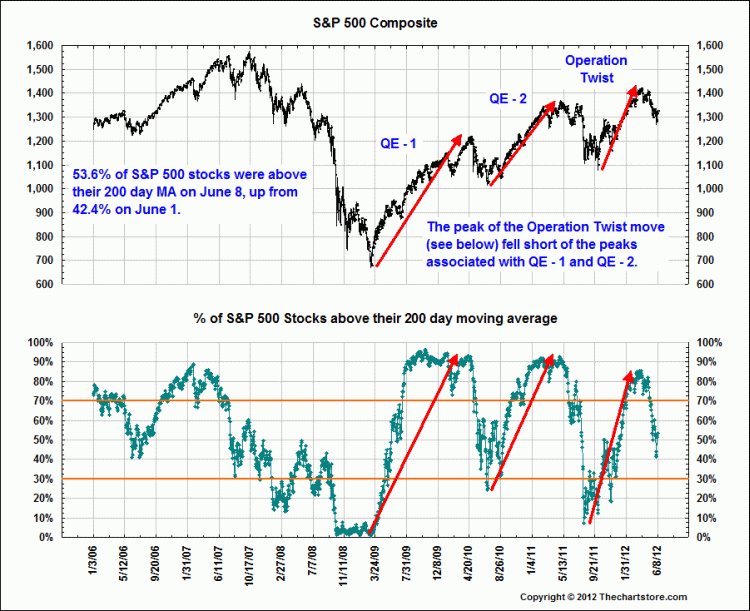
Source: The Chart Store

Category: Markets, Technical Analysis
Please use the comments to demonstrate your own ignorance, unfamiliarity with empirical data and lack of respect for scientific knowledge. Be sure to create straw men and argue against things I have neither said nor implied. If you could repeat previously discredited memes or steer the conversation into irrelevant, off topic discussions, it would be appreciated. Lastly, kindly forgo all civility in your discourse . . . you are, after all, anonymous.


Here’s what did not make the final edit:
I thought some people might not see it as a joke . . .
Turning tricks for rock is less of a joke than the proverbial 100 billion euros for Spain, which is not actually on hand, and is to come from funding vehicles that haven’t even been approved by several national parliaments in Europe.
I will gladly pay you a hundred billion on Tuesday for a bailout today!
The Rock/Tricks reference works for me in this self-deprecating context, but could really kill aimed at some of the more egregius types… lobbyists for Wall Street banks, Syrian appologists, the Ricketts family perhaps?
It seems to me that the central banks are engaged in the real-world financial equivalent of The Masque of the Red Death. The US is Prospero.
Don’t worry. It’s still contained.
Smoke and mirrors and Fool’s Gold! “It’s Mom kissing the scraped knee”, and everyone is ready to continue the game. So, are the balance sheets of the Spanish banks going to reflect the true state of “low, lower, lowest” real estate finance values on their books. We might as well ask “When are the US banks going to show more realistic values of their holdings?” Smoke and mirrors.
And in another “bubble-gum blow-up in your face”-joke there’s $500bln “missing” from the cash-hoard of corporate America??! Oops … so now all those fabulous brokers, analysts and sales-people have to “forget” that they advised me to jump the gun on “that avalanche of investment funds standing ready to come into the market and we have to buy NOW”? Smoke and mirrors. Fool’s Gold!
Cash is King – and when you’ve spent it all by hearing the sirens’ call of your broker you know that you’ve been taken. He’s off trawling for more suckers like you!
~~~
BR: Mommy kissing a boo-boo works! Releases endorphins, creates an excellent placebo effect!
In the meantime, I check the status of my 401-K, “safely” invested in a blended fund targeted for risk given my anticipated retirement date. Up 1% this year (after the bounce last week). And then I ponder all those financial planning sites that claim your little nest egg will grow at a rate of 8-10% per year. Hah, says, I. Hah, hah, hah! Sigh.
Barry Ritholtz Says:
June 11th, 2012 at 7:20 am
Rather than discuss our days of turning tricks for rock on the lower east side …
reply:
———
I forgot to ask, did your close encounter last week with Howard Stern impair your virtue? Were any French maid outfits involved? Or just stark disappointment?
Also, ZH is starting to read like a news site. This may be a good time to hide under the desk, curl up into a ball, and talk to Jesus. Remember, there are no atheists in a European financial crash.
A new SPX “Seven Year Itch” triple top in 2014 at 1550?
As much as I do not approve of bank bailouts, I do have to say that neither left nor right seem to be capable of thinking about government spending in a sensible manner.
Most of getting through depressions is just muddling through . Countries may use all sorts of sub-optimal remedies (like tax cuts for the wealthy or defense spending) to muddle through. If they muddle through and return to growth, all is well.
All government spending should be considered as an investment, which must be a good enough investment to pay off the debt incurred to do so. Does it keep kids out of jail? Keep diabetics out of emergency rooms? Keep skilled workers from losing those skills? Keep the Germans out of Stalingrad? Or even just preserve the social peace and national unity? Then the investment has a payoff, with some easier to quantitate than others.
And each investment comes with a price, amounting perhaps to a percent added to the future interest rate on debts, both public and private. That’s not a small matter for the United States. It limits future growth. The point is, if the investment reduces spending or increases revenue enough to cover increased interest (or, better yet, to outright pay down the debt), then it is a good social investment.
The problem in our politics today is that Republicans (and increasingly Democrats) deny that social spending has any payoff.
So, to return to the subject at hand: does saving the Spanish banks have a payoff? Of course. The right questions to ask are: what is the relative value of Spain remaining in the Euro (the economic efficiency effect) vs. the costs (growth limitation due to currency effect)? Is saving the banks the cheapest way to do it? (probably not. As with the US, the mortgage crisis was a small problem if dealt with properly and only became a trillion dollar problem because we used a solution that preserved shareholder value).
It’s true that QE is leaking around the edges of the compartment that Glass-Steagall created to goose the market. I have never seen a good estimate of how large the leak is. But maintaining asset valuation is part of muddling through. That asset valuation is what encourages the upper middle/lower upper classes to spend. Their spending does drive the real economy. Is this the way I would do it? No. The cheapest and simplest way to do it is to hire people to build bridges, repair highways, tear down abandoned housing, raise educational levels, do medical research, and so on. But our political system is so broken that any solution that does not pay off the rich cannot even be considered.
We have to survive the depression first. We can worry about how they did it (and the debt they piled on us to avoid doing it cheaply) later.
number2son – I hear you! The 401k I had in 1999 was supposed to double and double again by now. NOT!
it looks as if this ECB-fueled rally lasted about 1 hour in the US markets.
@deadhobo: Many days, it seems like our most serious news coverage is on the Comedy Channel, al-Jazeerah, and ZeroHedge. Even the Onion headlines are becoming hard to differentiate from CNN and Fox.
Wow, $100 billion does not go as far as it used to! It lasted just half a day at best here in Europe and an hour in the US. That means $600 to $700 billion a day just to keep the S+P stable! 150 Trillion a year to keep the market steady!
CharlesII has a valid point about government spending. It must be an investment. The return is unlikely to be directly financial. The problem is that homo politicus is no better than Homo Wall Streetus. Both are corrupt and venal. Consequently, much government spending is wasteful just as much private spending is wasteful. Both species steal but have developed a symbiotic relationship in which they share the spoils.
Today we are asked to sacrifice to save the economy for the wealthy (the 99% have nothing to lose anyway). Or we could spend, spend, spend and sacrifice our futures and children’s futures. Damned if you do, etc. I suspect we will kick the can down the road and continue to load up on debt since it is a great high and an SEP (Somebody Else’s Problem: thank you, Douglass Adams).
When we hit recession, we can’t possibly cut…we MUST be Keynesians! When we start to recover, we can’t stop pumping or we’ll stop the nascent recovery. We the economy is singing, we must not rock the boat because all this magical, free growth will save us as we grow out of our debts. Then it all blows up again.
There is no solution on the right or on the left. Frankly, I think a massive round of socialism is more fair. Let the masses have a taste before, in the immortal words of Mr Mojo Risin’, this whole shithouse goes up in flames.
Rally? We don’t need no stinking Spanish rally.
[...] Will a little bouncy, bouncy lead to something long-term? Oversold Bounce Or Return to Risk On? [...]
I suppose the question is does the Fed want Obama in for another term or not..
[...] liquidity injection into the open and hungry veins of the market. Every subsequent hit of that sweet, sweet junk yields a less intense [...]