Real Time Economics – Number of the Week: Corporations Not Hoarding Cash
$496.5 Billion:
How much less cash U.S. corporations had at year-end 2011 than previously believed.  The Federal Reserve on Thursday came out with its quarterly “flow of funds” report, which for two years now has reflected the steady increase in the amount of cash on corporate balance sheets. Sure enough, the report showed that corporate cash ticked up yet again in the first quarter of the year by around $12.6 billion, to $1.74 trillion. … In other words, the big pile of cash sitting idly on the sidelines? “Boom, it’s all gone now,” says James Bianco of Bianco Research. Mr. Bianco has long been skeptical of the cash-hoard narrative. Even before the revision, he argued that the rise and fall of the real estate bubble distorted the corporate cash picture, making cash look artificially small as a share of assets when property values were rising, and then artificially large when prices collapsed. Better, Mr. Bianco argues, to strip out real estate and look at cash as a share of financial assets, which showed a much milder run-up in cash holdings using the old data, and now shows no run-up at all. “It was slightly above average and now it’s not even that anymore,” Mr. Bianco says.

Comment

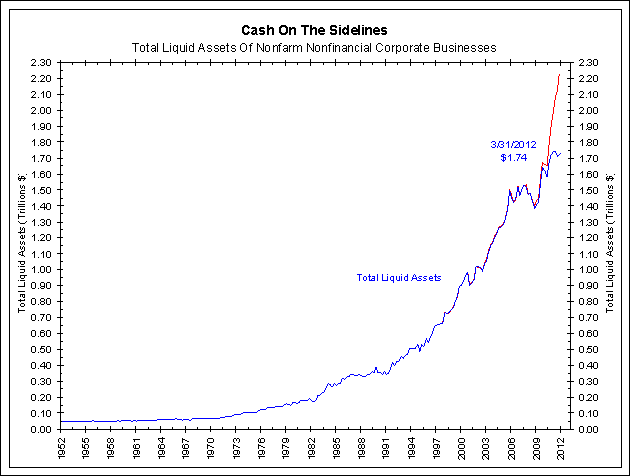
Last Thursday the Federal Reserve released its quarterly Flow of Funds data, current through March 31. One of the more popular headlines from this data concerns the record amount of “cash on the sidelines.” As the story above points out, the Federal Reserve has revised estimates of how much cash companies are holding.  The blue line in the chart below shows the latest release while the red lines shows the previous estimates.  Through Q1 2012, nonfarm nonfinancial corporate businesses held $1.74 trillion in liquid assets on their balance sheets.   In the latest revision, nearly half a trillion dollars of cash disappeared.
Where did the cash go?  It disappeared as the Federal Reserve is now saying it never existed in the first place.

Click to enlarge:

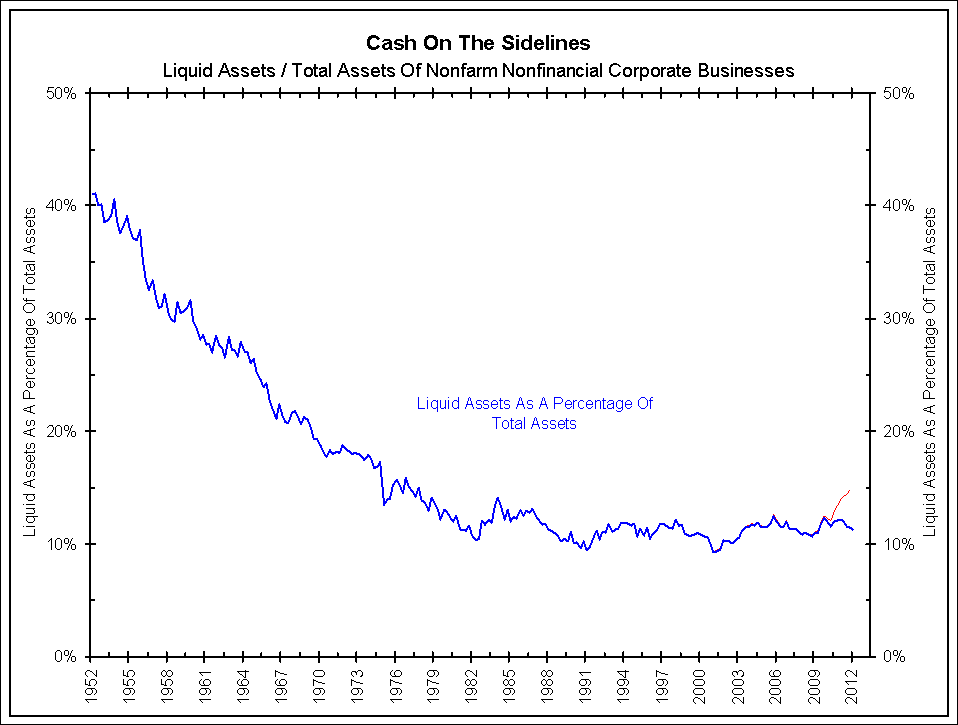
Liquid assets held on companies’ balance sheets is a nominal number, much like the nominal level of GDP, that rarely decreases.  This series must be compared to other balance sheet items for relevance. The chart below shows liquid assets as a percentage of total nonfarm nonfinancial corporate business assets since 1952. By this measure, the “cash on the sidelines” argument is far less compelling (blue line), especially after revisions (red line).
When examined over a shorter time frame, as shown below (same chart as above, shorter time frame), the percentage of cash on the sidelines was revised from the upper end of its range of the past 30 years to the middle.
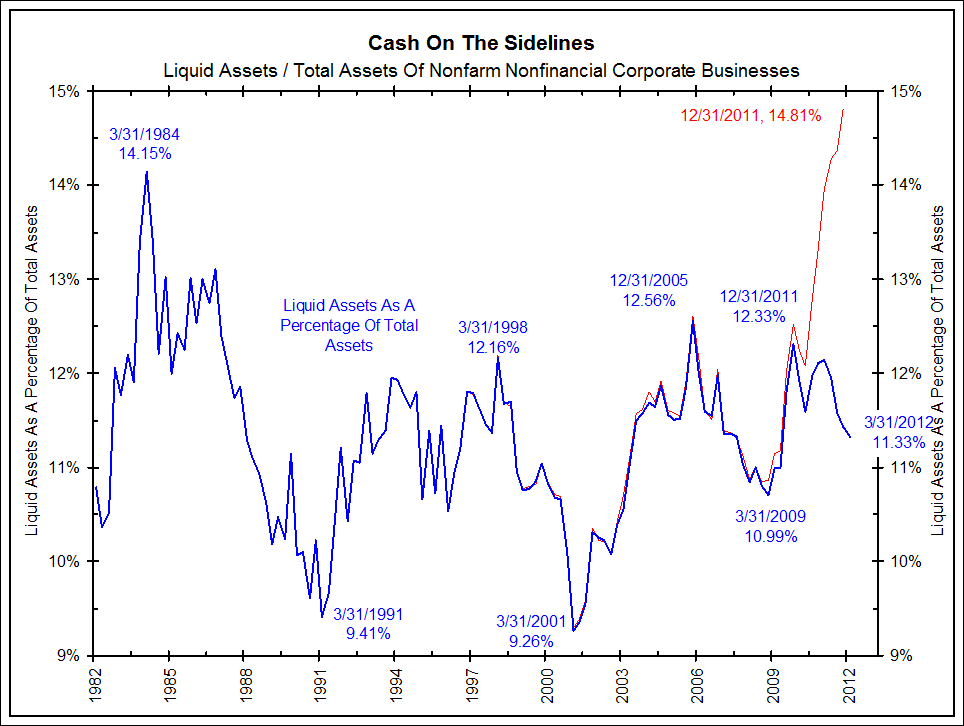
We have argued in the past that the potential of excess cash on the sidelines to help buoy the markets once invested was minimal.  After considering the latest revisions, this becomes even more true.

For an updated look at all of our charts from the Federal Reserve’s Q1 2012 flow of funds report click here.

Source: Bianco Research

Category: Think Tank

Please use the comments to demonstrate your own ignorance, unfamiliarity with empirical data and lack of respect for scientific knowledge. Be sure to create straw men and argue against things I have neither said nor implied. If you could repeat previously discredited memes or steer the conversation into irrelevant, off topic discussions, it would be appreciated. Lastly, kindly forgo all civility in your discourse . . . you are, after all, anonymous.

5 Responses to “The Myth Of Cash On The Sidelines Has Now Been Revised Away”

  1. VennData says:

    The real myth of cash on the sidelines goes like this… when you take your cash “on the sidelines” on buy someones security, you have the security and that person now has ‘cash on the sidelines.” There is no such thing as “cash on the sidelines.” More Wall Street jibberish, affecting nothing.

  2. Woj says:

    This is a perfect example of the importance in maintaining a healthy level of skepticism regarding data. That data can be revised to this degree in the US should definitely provide reason to pause when considering economic data from China, which is never revised ( http://bit.ly/LGGAuC).

  3. quantacide says:

    Alright, stop propagating this tripe. The Fed published that the data was revised, tying the figures back to the IRS SOI data published in 2012 for 2010 (http://www.federalreserve.gov/apps/fof/FOFHighlight.aspx). Furthermore, if you take a moment to actually look at the data instead of pushing more of this drivel, you’ll see that it is a reclassification of assets from “liquid assets” to “misc assets” and other categories (misc assets increased by $400B in the revision).

    This is a result of moving from public financials, which the Fed uses a broad comb to come up with the buckets to drop different assets vs. the IRS SOI. You’ve got accounting gimmickry like goodwill that make the data murky for the former.

    Both the WSJ and Bianco Research have provided myopic analysis that grabs headlines first but doesn’t paint the full picture.

  4. [...] The Myth Of “Cash On The Sidelines” | Jim Bianco Fed revised its estimates after 1q12, reducing corporate cash by 22% to $1.74t. Going back to 1970s, Liquid Assets as Percent of Total Assets hasn’t really changed (10-14%). Bank of America targets energy projects | Reuters [...]