Source: Column Five
Category: Data Analysis, Employment
Please use the comments to demonstrate your own ignorance, unfamiliarity with empirical data and lack of respect for scientific knowledge. Be sure to create straw men and argue against things I have neither said nor implied. If you could repeat previously discredited memes or steer the conversation into irrelevant, off topic discussions, it would be appreciated. Lastly, kindly forgo all civility in your discourse . . . you are, after all, anonymous.


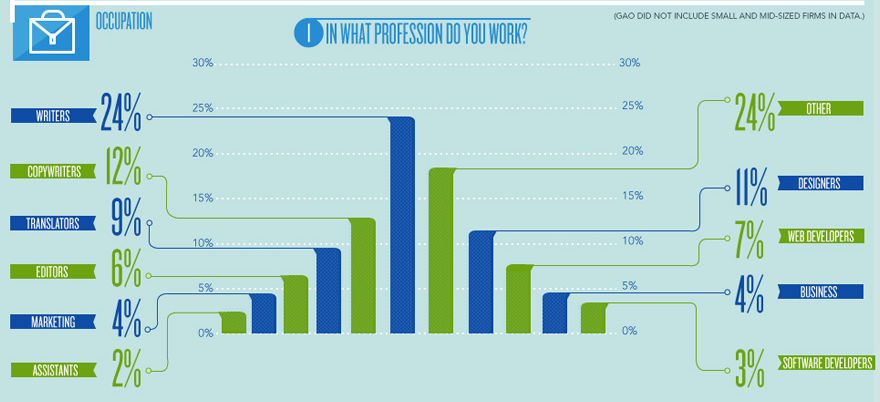
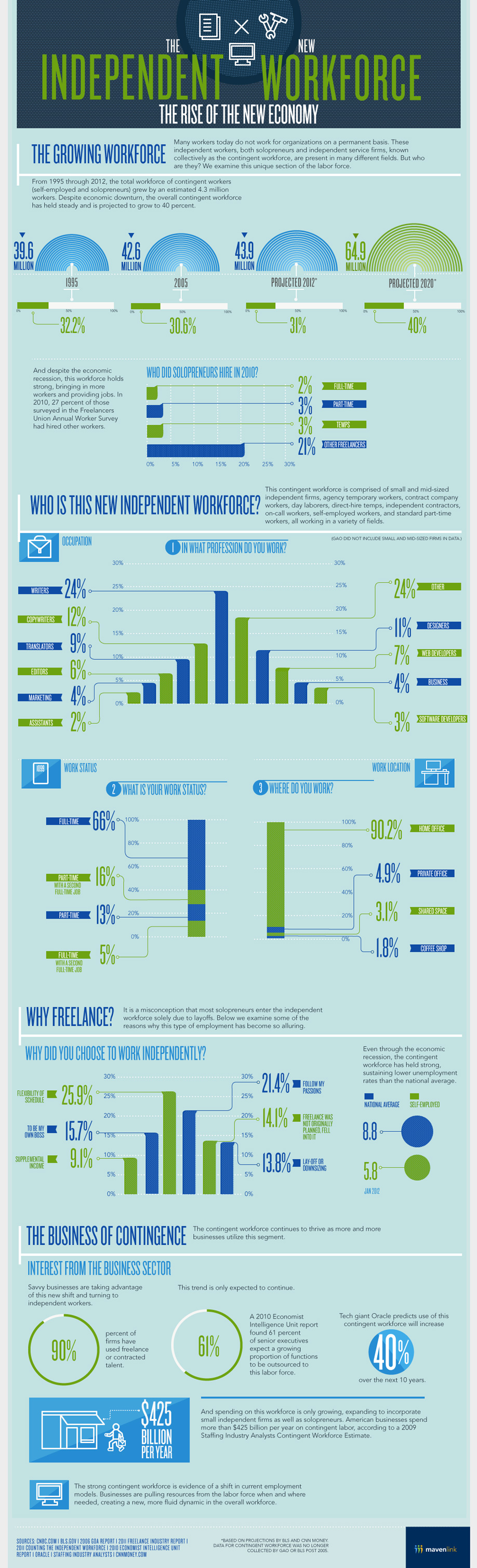
not sure they made their case that it was a conscious choice. if 55% of freelancers are in professions that lend them selves to being self employed to begin with.
From the employer’s perspective, I wonder how much of this is about health care. There are cost benefits to permanent over temp workers in training and the cost in getting some one in and ramped up. But if the cost benefit of a permanent employee is less than the cost of health care, then you are better off using temps.
The cost of our current health care system is a huge drag on the economy, especially for start ups. But you will never hear anything about this. Meanwhile, you will hear endless blather about how tweaking the capital gains rate by a few % points is life or death for the economy.
The new independent workforce is comprised of “involuntary entrepreneurs” who invented their jobs because others weren’t available.
“Goodbye, ‘Iron Rice Bowl’..”
http://search.yippy.com/search?query=Iron+Rice+Bowl&tb=sitesearch-all&v%3Aproject=clusty
The shape of employment on the ground is changing much faster than our collective understanding of what a ‘job’ is. In reality, you have workers all over the spectrum benefiting or losing from this long shift away from lifelong employment. Large numbers of tech workers, for example, are choosing contracting or solo entrepreneurship because its a fantastic, flexible, rewarding lifestyle. Some other workers are doing it because they have little choice.
As a whole, this fits with a long term shift toward individual independence and as such, there are more winners than losers. But lots of people would like to halt this trend, especially unions. And our archaic health care system which ties your ability to see a doctor with your ability to maintain a formal job doesn’t help.
More: Generation 1099: http://www.chicagonow.com/politics-in-dupage-county/2011/02/generation-1099/
a lot of this misses the point
tech and the ease of billing, hours, records, contracts, self insuring, teleworking etc etc
makes the corporate complete business and permanent hiring model less necessary and efficient.
Ultimately most workers could relate temporarily
get paid in real time
and move onwhen the project is done
the corprate virtues now are less admin virtues
Seems that companies/organizations would relish the thought of a contingent workforce – no worries about paying benefits (health care being just one cost though a substantial one) – and the employees go away on their own when the project is done. No layoff costs either.
Presumably these hired guns are expert enough in their field for the organization to not have to worry about training costs, either.
This seems like quite a win for the hiring organization, being able to further shed employment costs. For most workers I assum this is not so good, since I’m not sure how many are suited to this kind of work without benefits. I understand the attraction of “solopreneurs” to companies and there can be some to the more entrepreneurial worker who likes the freedom but it does seem like another potential step back for the American worker (not just American I suppose). YMMV.
and the cost of this to the economy is simple. if all workers are temps, they will only look for short term deals and loans. no more houses (though I suppose we could go back to the old way of home finance. where a buyer takes out a 10 year note, that only pays for a part of the house, and then has to take new loans to cover the rest. but this only works if houses are really cheap) as they took to long to pay off. and cars and other larger purchases may also go by the way side. and instead of worrying about how the ACA will impact health care (what the SCOUTS decides, or a new Congress and President, or even the current ones). worry more about this. cause if you have looked at the individual policies you discover a few things really really quickly. They cost a lot more than what you pay now as a employee, and they cover a lot less. and thats if you can even get coverage. insurance companies are pretty simple businesses. they make a profit if you pay more in premiums than they pay out in claims. and to make this really work, the majority of policy holders can not be making claims (you are very unlikely to have ever paid enough to cover you claim. but as a group of policy holders, of whom, a very small minority make claims. insurers can make a profit then and only then). and of course the standard of living will go down as consumers top buying much more than they have to, and businesses go bankrupt for lack of customers.
My daughter did freelance work because she thought she could build a business. She got by, but the freelancing business did not grow. After 5 years she gave it up and got a job. Now she works for Apple in Cupertino managing a group of website developers. She has a permanent staff of 12 people. Recently they had a bid project that needed extra manpower so she hired 10 contractors for 7 or 8 months. The job just finished and almost all of them took permanent positions with Apple. I think people are doing what ever is necessary to survive in this economy and a significant number of contractors want to be permanent full time employees.
Seems this is just the transition to a “Project Based Economy” – get used to it. This has been happening for 10+ years. Health care, training, pensions? forget it. The system serves the corporatocracy – obviously.
Due to overall labor costs the US often replaces humans with robots that are built in China by humans treated like robots.
Global labor arbitrage baby!
I think a thriving freelance industry is one of the best economic arguments for having national healthcare. (Republicans probably favored this before Obama passed it.)
Having your healthcare no longer contingent on your employer means you can be more flexible, change careers, get more educated, and do what you really want to do, making the economy more efficient.
Even if you’re not a freelancer, being able to leave a bad employer to find a better one is a benefit to the economy in so many ways besides to the actual employee!
Look Out Below.
Mark these words.
Have a good evening.
But are we subsidizing corporation for seasonal workers by unemployment benefits? Get well paid for a season – go on unemployment – go back to the same company. Who benefits – we know that corporations benefit in not have pension liabilities but are unemployment benefit as hidden subsidy?
I think the event that marks the self-destruction of one of these “solo-preneurs” is when they grow large enough that they hire an HR person … from that point onward, they will be most unlikely to encounter the types of individuals they need to continue the growth of the enterprise.
The layout is ugly chartjunk.
formerlawyer — a long, LONG time ago, I worked as an engineer in an aerospace company that lived on goobermint business, and exactly the same thing occurred there, and had been since time began, and likely still continues today … the only difference being that in those “good old days”, when engineers were re-hired, they retained their former years of service and pension contributions … it was only a means of managing the payroll expense between the fat and lean years. As the length of these layoffs was always uncertain, but also was rarely more than 18 months (matching the duration of recessions), pretty much nobody started sideline businesses, they all set aside rainy day funds to carry them across the gap, as unemployment was then (and continues to be today) insufficient to maintain a life that included mortgage payments. Back then medical expenses were not nearly as abusive as they are today, so I wonder if this pattern still persists in that industry …
I’ll bet that during the Great Depression, there was a thriving handyman industry, which is essentially the same thing in time before everything required specialists …