
Some longer form reads for your weekend pleasure:

Nov. 9, 1999: Robert Rubin Rewrites the Rules – Prescient! (MoJo)
• The End of the Euro Is Not About Austerity (Economix) see also The tragedy-of-the-commons at the European Central Bank and the next rescue (Vox EU)
Surface: Between a Rock and a Hardware Place (Daring Fireball)
• Economists find evidence for famous hypothesis of ‘comparative advantage’ (MIT News)
• The patent system is in crisis, and it endangers the future of software development in the United States. Let’s create a system that defends innovation, instead of hindering it. (Defend Innovation)
Doctor’s Orders: Vibrators and other sex toys are—no pun intended—big business (LA Mag)
Forget Edison: This is How History’s Greatest Inventions Really Happened (The Atlantic)
• Homeownership Means Little to Economic Growth (Atlantic Cities)
• Vanishing Languages: One language dies every 14 days (National Geographic)
• In Praise of Leisure (Chronicle)
‘I Just Want to Feel Everything’: Hiding Out With Fiona Apple, Musical Hermit (Vulture)

What are you mulling over this weekend?


2012 Forecasted Debt to GDP Ratio
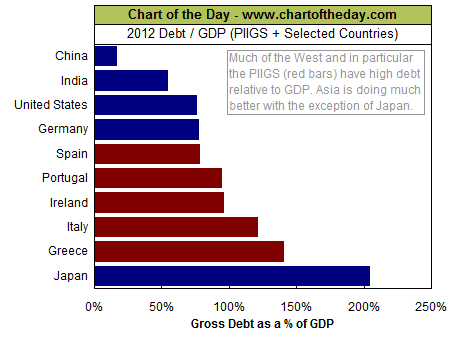
Source: Chart of the Day

Category: Financial Press

Please use the comments to demonstrate your own ignorance, unfamiliarity with empirical data and lack of respect for scientific knowledge. Be sure to create straw men and argue against things I have neither said nor implied. If you could repeat previously discredited memes or steer the conversation into irrelevant, off topic discussions, it would be appreciated. Lastly, kindly forgo all civility in your discourse . . . you are, after all, anonymous.

21 Responses to “10 Weekend Reads”

  1. ConscienceofaConservative says:

    Bronte Capital Chinese Kleptocacy and negative real interest rates.

    http://brontecapital.blogspot.com/2012/06/macroeconomics-of-chinese-kleptocracy.html

  2. VennData says:

    Data:  California, New York, Illinois, Minnesota, New Jersey, Connecticut, Massachusetts, all pay for the rest of the country…
    http://economix.blogs.nytimes.com/2012/04/27/how-richer-states-finance-poorer-ones/
    Give a neighborly “You’re Welcome’ to all those “low-tax” Red states next time you’re there or we could be like the rich Germans and enforce some gov’t-mandated austerity on them.

  3. obsvr-1 says:

    Robert Rubin Rewrites the Rules ….

    Robert Rubin should be sharing meals with Bernie !!

  4. blackjaquekerouac says:

    King Leopold.

  5. blackjaquekerouac says:

    The Second.

  6. theexpertisin says:

    Home ownership means little to economic growth.

    Perhaps the author needs to visit Realville and tell the residents their loss does not matter in the Big Picture. Good luck dodging the rakes and pitchforks.

  7. PeterR says:

    Another walnut and pea aspect?

    “A Loophole Big Enough to Lose a Billion”

    http://www.nytimes.com/2012/06/23/business/mf-globals-billion-dollar-loophole-common-sense.html?_r=1&hp

    Have a good weekend.

  8. About the MOJO piece, I can’t help but think that a conservative Susan Sontag would be right. As recently as 2008 conservatives were quoting a famous statement that the former liberal made in 1982:

    “Imagine, if you will, someone who read only the Reader’s Digest between 1950 and 1970, and someone in the same period who read only The Nation or The New Statesman. Which reader would have been better informed about the realities of Communism? The answer, I think, should give us pause. Can it be that our enemies were right?’’

    Shouldn’t some honest conservative come forward and ask:

    “Imagine, if you will, someone who read only Mother Jones between 1980 and 2000, and someone in the same period who read only The Wall Street Journal or Forbes. Which reader would have been better informed about the realities of Capitalism? The answer, I think, should give us pause. Can it be that our enemies were right?’’

  9. swag says:

    @bayoustjohndavid

    David Frum did pretty much just that:

    http://www.frumforum.com/were-our-enemies-right/

    “Imagine, if you will, someone who read only the Wall Street Journal editorial page between 2000 and 2011, and someone in the same period who read only the collected columns of Paul Krugman. Which reader would have been better informed about the realities of the current economic crisis? The answer, I think, should give us pause. Can it be that our enemies were right?”

  10. swag:

    I hate to say it, but that rings a bell. If I had stopped to think about who might have said something like that, I might have avoided the (unintentional) plagiarism.

  11. Jojo says:

    Meanwhile, on the other side of our modern world…
    ————–
    Saudi Man Beheaded for Witchcraft
    LiveScience
    Date: 22 June 2012

    Modern times are not want for witch tales nor are they lacking in some of the cruel punishments that go along with such occult claims.

    The latest comes from Saudi Arabia where, according to the Saudi Arabian news agency SPA, a man was recently executed by beheading for practicing sorcery. The man, identified as Muree bin Ali bin Issa al-Asiri, was allegedly found with occult apparatus, including “books and talismans from which he learned to harm God’s worshipers,” according to a statement released by the Interior Ministry, which added that he’d also confessed to adultery with two women.

    Many Shiite Muslims — like many fundamentalist Christians — consider fortune-telling an occult practice and therefore evil. Making a psychic prediction or using magic (or even claiming to do so) is seen as invoking diabolical forces.

    http://www.livescience.com/21131-saudi-man-beheaded-witchcraft.html

  12. Don Levit says:

    The debt for the U.S. does not include intragovernmental debt, but includes only debt held by the public.
    Whereas debt held by the public is an explicit liability, the highest form of debt; intragovernmental debt is an implicit promise, the lowest level of debt. Both are debts that need to be repaid, however.
    Don Levit

  13. James Cameron says:

    The underside of the beast . . . the company could pay its 30K retail employees 10K more a year . . . and that would still be less than 1/3 percent of the $100 billion plus they’ve socked away. It would be interesting to know what Microsoft is paying its retail employees.

    “Even Apple, it seems, has recently decided it needs to pay its workers more. Last week, four months after The New York Times first began inquiring about the wages of its store employees, the company started to inform some staff members that they would receive substantial raises.”

    Apple’s Retail Army, Long on Loyalty but Short on Pay

    http://goo.gl/LS1xF

  14. Mike in Nola says:

    Pretty thorough hands-on review of the surface. Comes across pretty nicely.

    http://www.techradar.com/reviews/pc-mac/tablets/microsoft-surface-tablet-1085839/review/page:3

    And from Digitimes, what I thought was going on:

    Impact of iPad on notebook market decreasing, say Taiwan ODMs
    http://www.digitimes.com/news/a20120621PD216.html

  15. formerlawyer says:

    The last time we drove through Las Vegas, homeless families were camped along the fences for a hundred yards or so – next to the police station. It looks like that won’t be an option in North Las Vegas in the future.
    http://www.huffingtonpost.com/2012/06/22/north-las-vegas-state-of-emergency_n_1619344.html

  16. Uchicagoman says:

    @James Cameron, ssc

    Maybe the Apple retail store employees should stay in school and read some more Mark Twain.

    Now Apple engineers on the other hand: http://www.glassdoor.com/Salary/Apple-Salaries-E1138.htm

  17. Uchicagoman says:

    Sorry to pile on more, but so many of the comments on the NYT’s Apple retail article rub me the wrong way. People really love to blame others for their problems, or what they think is a problem. I am not sure what is more scary the Cult of Mac employees or the group think disgust and protest to pay them more. O the humanity! The horror, the horror! sheesh.

  18. constantnormal says:

    While reading the “In Praise of Leisure” article, about Keynes insightful observations regarding the declining work week (which can be found on the web), I found myself wishing for some graphical treatment of the decline in the work week.

    FRED came to my rescue, with this, showing a drop in the average work week of about 14.5% from 1947 to 2012, in a more-or-less steady grinding away at the weekly grind … but then I thought, that this really is understating the effect, due to the decline in labor participation rate (which, upon looking, has declined only since 2000, something of a curiosity …).

    FRED being the handy tool that it is, I was able to easily produce a chart of the labor participation rate times the average work week, a chart that should come closer to including all those who would have worked had they been able to find jobs … but it has a distinctive bubble that defies explanation, at least for me … and shows an overall decline in the “TRUE” average work week of only about 7%, approximately half of the one that is not adjusted by the labor participation rate.

    The lower overall result is almost certainly due to the movement of women into the work force, but the rise from the late 1970s through 2000 and subsequent decline back to the trendline baffles me.

    Anyone have any thoughts on what is going on here?

  19. constantnormal says:

    Instead of “lower overall result”, I should have written “higher overall result” … a decline of 7% producing a higher result than a decline of 14.5% …