
Some longer form reads for your Sunday morning pleasure:
• Douglas Kass is Bearish on Brokers, Bullish on Housing (Barron’s)
• The Future of Manufacturing Is in America, Not China (Foreign Policy)
• Interest Rates From Sweden to South Korea Under Scrutiny (Bloomberg) see also Libor Reported as Rigged in ’08 Proving 2012’s Revelation (Bloomberg)
• The World According to Kobe (WSJ)
• Unlearning the History of Thought II (Unlearning Economics)
• Beyond 7 billion (Los Angeles Times)
• Why Amazon May Be Worth 179 Times Earnings (Institutional Investor) see also Facebook shares still way overvalued (Market Watch)
• Interesting company history: Five Guys Burgers is America’s Fastest Growing Restaurant Chain (Forbes)
• Nouriel Roubini: American Pie in the Sky (Project Syndicate)
• Does Quantum Physics Make it Easier to Believe in God? (Big Questions Online)
What are you reading?
Americans put off having babies amid poor economy
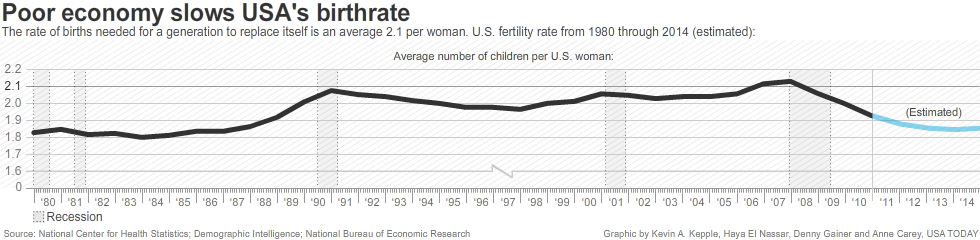
Source: USA Today

Category: Financial Press
Please use the comments to demonstrate your own ignorance, unfamiliarity with empirical data and lack of respect for scientific knowledge. Be sure to create straw men and argue against things I have neither said nor implied. If you could repeat previously discredited memes or steer the conversation into irrelevant, off topic discussions, it would be appreciated. Lastly, kindly forgo all civility in your discourse . . . you are, after all, anonymous.


Is the baby curve lagged by 15 mos (average time to conceive is around 6 months – http://www.dailymail.co.uk/news/article-1303442/Pregancy-The-average-couple-sex-104-times-conceive.html)?
If it isn’t it ought to be.
About that 83% of physcisians hate Obama are so much they will Quit, Poll…
http://www.slate.com/blogs/weigel/2012/07/09/about_that_83_percent_of_doctors_hate_obamacare_so_much_they_might_quit_poll.html
America awaits your return on the workforcere repuroposed.
Coughlin ties record for career Olympic medals without swimming relay final
http://www.washingtonpost.com/sports/coughlin-ties-record-for-career-olympic-medals-without-swimming-relay-final/2012/07/28/gJQA4iJmGX_story.html
Romney and the GOP Media Machine would say she had no one to thank.
Worth Reading:
Let’s shatter the myth on Glass-Steagall
By Steven Pearlstein, Published: July 28
Washington Post
http://www.washingtonpost.com/lets-shatter-the-myth-on-glass-steagall/2012/07/27/gJQASaOAGX_story.html
~~~
BR: Except that he (and Jason Zweig) are misstating and over-stating the impact.
As I have said repeatedly, the repeal of Glass Steagall did not cause the crisis — but it allowed banks to become much bigger, and that allowed the crisis to get deeper, bigger, and much worse
So all the manufacturing is coming back to America, bringing no jobs? Chinese workers “too expensive and demanding?” I think I’m going to cry. Who is going to buy all that shiny crap when they have no fucking job?
I feel for people who continue to listen to Wall Street and lose money.
http://finance.yahoo.com/blogs/daily-ticker/zynga-insiders-cashed-just-stock-crashed-144334658.html
These “fact free”, “don’t worry be happy” conjectures written by people who have no actual manufacturing experience drive me up a wall. Go work in a factory and take part in the economic decisions that decide how a production line gets set up before writing about manufacturing.
Unlike people, investment in robots is long term, you stop using them and you still have to continue to pay for them. Robots are very inflexible and require a dedicated long term production line…not for short production runs common to today’s product cycles. Additionally, final assembly is a small portion of capitol investment in production. Injection molds are already machined by NC mills…and China has taken almost 70% of the market share [and growing] and there are tiny amounts of labor involved.
As production has moved, so too has the intellectual work that is engineering and manufacturing.
Vivek Wadhwa may be a useful tool, but he is an un-serious man.
REF: The_Future_of_Manufacturing_is_in_America_not_China
More respectability for gold … plus FREE DATA!
FRED (Federal Reserve Bank of St. Louis) adds London gold fix data since 1968:
http://news.research.stlouisfed.org/2012/07/6-daily-gold-prices-added-to-fred/
Me like!
Algebra, destroyer of nations?
http://www.nytimes.com/2012/07/29/opinion/sunday/is-algebra-necessary.html
Venndata misstates the actual poll. The question asked was if a physician have considered leaving his practices over President Barack Obama’s health care reform law. Slate has it wrong, too.
However, “considering quitting” and “will Quit” are two entirely different things. Many people have considered quitting their jobs, but never did.
The second aspect is that it is becoming more difficult to run a successful practice. Physicians are moving toward becoming hospital employees or group practice employees and drawing a salary while not being responsible for the expenses. But, while that is “leaving their practice”, that is not the same thing as quitting the profession.
BTW, I know what a Venn diagram is. I know what data is. I know what intersection data is. But, what is “Venndata”?
I had seen that birthrate data before. We already have a demographic problem with just being at replacement value. Now we are at a level of significant population decline. Hopefully, that will only be a short term trend.
I was in Denver a couple of weeks ago. Denver is a young town, but there were a significant number of pregnant women. Maybe Denver is a leading indicator.
Unfortunately, the primary issue both historically and currently, is that the politicians care only about themselves and those who own them.
The voting public is simply too disconnected and disinterested to mount any sort of revolt.
AlterNet / By Sara Robinson
314 COMMENTS
Why We Have to Go Back to a 40-Hour Work Week to Keep Our Sanity
One hundred fifty years of research proves that shorter work hours actually raise productivity and profits — and overtime destroys them. So why do we still do this?
March 13, 2012
If you’re lucky enough to have a job right now, you’re probably doing everything possible to hold onto it. If the boss asks you to work 50 hours, you work 55. If she asks for 60, you give up weeknights and Saturdays, and work 65.
Odds are that you’ve been doing this for months, if not years, probably at the expense of your family life, your exercise routine, your diet, your stress levels, and your sanity. You’re burned out, tired, achy, and utterly forgotten by your spouse, kids and dog. But you push on anyway, because everybody knows that working crazy hours is what it takes to prove that you’re “passionate” and “productive” and “a team player” — the kind of person who might just have a chance to survive the next round of layoffs.
This is what work looks like now. It’s been this way for so long that most American workers don’t realize that for most of the 20th century, the broad consensus among American business leaders was that working people more than 40 hours a week was stupid, wasteful, dangerous, and expensive — and the most telling sign of dangerously incompetent management to boot.
It’s a heresy now (good luck convincing your boss of what I’m about to say), but every hour you work over 40 hours a week is making you less effective and productive over both the short and the long haul. And it may sound weird, but it’s true: the single easiest, fastest thing your company can do to boost its output and profits — starting right now, today — is to get everybody off the 55-hour-a-week treadmill, and back onto a 40-hour footing.
Yes, this flies in the face of everything modern management thinks it knows about work. So we need to understand more. How did we get to the 40-hour week in the first place? How did we lose it? And are there compelling bottom-line business reasons that we should bring it back?
…
http://www.alternet.org/story/154518/why_we_have_to_go_back_to_a_40-hour_work_week_to_keep_our_sanity?paging=off
July 26, 2012
Money for Nothing
By PAUL KRUGMAN
For years, allegedly serious people have been issuing dire warnings about the consequences of large budget deficits — deficits that are overwhelmingly the result of our ongoing economic crisis. In May 2009, Niall Ferguson of Harvard declared that the “tidal wave of debt issuance” would cause U.S. interest rates to soar. In March 2011, Erskine Bowles, the co-chairman of President Obama’s ill-fated deficit commission, warned that unless action was taken on the deficit soon, “the markets will devastate us,” probably within two years. And so on.
Well, I guess Mr. Bowles has a few months left. But a funny thing happened on the way to the predicted fiscal crisis: instead of soaring, U.S. borrowing costs have fallen to their lowest level in the nation’s history. And it’s not just America. At this point, every advanced country that borrows in its own currency is able to borrow very cheaply.
The failure of deficits to produce the predicted rise in interest rates is telling us something important about the nature of our economic troubles (and the wisdom, or lack thereof, of the self-appointed guardians of our fiscal virtue). Before I get there, however, let’s talk about those low, low borrowing costs — so low that, in some cases, investors are actually paying governments to hold their money.
…
You don’t even have to make a Keynesian argument about jobs to see that. All you have to do is note that when money is cheap, that’s a good time to invest. And both education and infrastructure are investments in America’s future; we’ll eventually pay a large and completely gratuitous price for the way they’re being savaged.
That said, you should be a Keynesian, too. The experience of the past few years — above all, the spectacular failure of austerity policies in Europe — has been a dramatic demonstration of Keynes’s basic point: slashing spending in a depressed economy depresses that economy further.
So it’s time to stop paying attention to the alleged wise men who hijacked our policy discussion and made the deficit the center of conversation. They’ve been wrong about everything — and these days even the financial markets are telling us that we should be focused on jobs and growth.
http://www.nytimes.com/2012/07/27/opinion/money-for-nothing.html
3D Printer Helps Make Working Gun
InnovationNewsDaily Staff
26 July 2012 12:05 PM ET
What if ordinary U.S. citizens could make their own military-grade pistols or assault rifles and forget about buying guns? That possibility has become real in one of the world’s first examples of a working gun that uses a 3D-printed part.
Gun enthusiast “HaveBlue” documented how he used an old 3D printer to create the working part of a .22 pistol from a downloaded digital file, according to The Next Web.
…
http://www.innovationnewsdaily.com/1460-3d-printer-working-gun.html
Thanks for the link BR.
Btw, I am blocked by you on twitter. We’ve never had an exchange so I can only assume that it’s a random bug I’ve seen pop up a couple of times. If so, please could you unblock me?
Thanks.
Yeah… the manufacturing article was total nonsense…I read it early this morning and was curious what the general opinion would be…my immediate reaction was where in the article was the support for the title?
rt
[...] Ritholtz, an article by Roubini: Third, the fiscal cliff would amount to a 4.5%-of-GDP drag on growth in [...]
I am unimpressed, as usual, with the Krugman article. Interest rates have not “fallen”. Interest rates have been pressed down and down by the Central Banks in an effort to make the banks profitable and to recapitalize them on the backs of savers and owners of capital. In particular, seniors who have planned to live off the earnings of their savings are ending up living off the savings and, hence, eating their seed corn. These low level of rates are also killing pension plans in general and Social Security in particular.
These forced low interest rate also make it possible for countries to increase their national debt, but eventually interest rates will return to a more normal level and there will be hell to pay. If the US reaches $ 20 trillion in debt and the interest rates return to an average of 5%, that means interest alone will be about $1 trillion a year or close to 1/3 of the annual budget. That should scare Krugman, bu he seems oblivious.
Krugman also claims the low rates means it is a good time to invest. But, as the Austrians will counter, that also means it is a great time to malinvest and to speculate. We saw what happened the last time when Greenspan had the rates down around 1%. Why does Krugman think it will be different this time?