
Some longer form columns for your weekend reading pleasure:

• Coming: The End of Fiat Money  Stephanie Pomboy, founder of MacroMavens, sees the world hurtling toward a day in which money will again be backed by gold or other hard assets. Until then, she also sees plenty of trouble  (Barron’s)
• For UBS, a Record of Averting Prosecution (NYT)
• Thomas Frank: Can Art Drive the Economy?  (The Baffler)
• When everything’s for sale (Times Literary Supplement)
• His Man in Macau: Inside the Investigation Into Sheldon Adelson’s Empire (Frontline)
• Confessions of an Ex-Mormon: A personal history of America’s most misunderstood religion. (The New Republican)
• The Truth About Human Nature (The New Atlantis)
• Dreaming of a World With No Intellectuals: Are conservative intellectuals anti-intellectual? (Chronicle)
• Who Is The Smallest Government Spender Since Eisenhower? Would You Believe It’s Barack Obama? (Forbes)
• Once Upon a Time: The lure of the fairy tale (New Yorker)

What are you reading?

>
How accurate are the IMF’s forecasts?
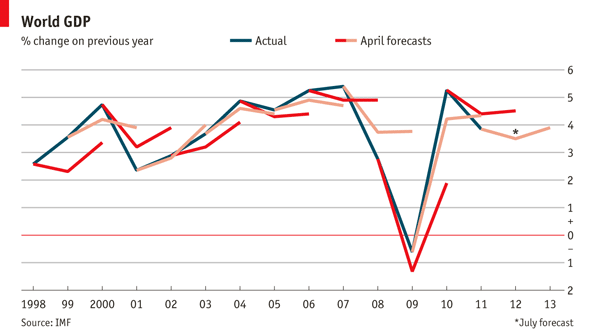
Source: Economist

Category: Financial Press

Please use the comments to demonstrate your own ignorance, unfamiliarity with empirical data and lack of respect for scientific knowledge. Be sure to create straw men and argue against things I have neither said nor implied. If you could repeat previously discredited memes or steer the conversation into irrelevant, off topic discussions, it would be appreciated. Lastly, kindly forgo all civility in your discourse . . . you are, after all, anonymous.

27 Responses to “10 Weekend Reads”

  1. denim says:

    Here we go again with the “fiat money” meme:
    “Today, Pomboy predicts something more draconian: the demise of fiat money—currencies that aren’t backed by anything other than government decrees that they have value. ” Barron’s. In a free market, gold has no minimum value. The value is zero plus any additional value that the buying pressure from those with dollars can now bid up the price way beyond its industrial and jewelry use. And those dollars can be taxed and the gold confiscated as before. Any government with enough police and military strength can effectively prevent gold from being used as money within its borders and between its international traders.

  2. Moss says:

    Concerning Gold and the whole fiat discussion, it is important to note that the ECB has recently suspended the use of Greek Sovereign Bonds as collateral. On the flip side the CME has officially said Gold is a valid form of collateral. Germany would love to have the Gold reserves of all the debtor nations in the Euro used as collateral for the bailout funds.

    It is not far fetched to envision a scenario where the only way to keep the Euro intact is the pledge of Gold by the PIIGS. Good collateral is running out. The Central Bankers are opposed to this as it would further erode the premise of the non asset backed fiat world.

  3. RW says:

    Perceptions of Climate Change: The New Climate Dice – James Hansen, Makiko Sato [NASA Goddard Institute for Space Studies and Columbia University Earth Institute] and Reto Ruedy [Sigma Space Partners]
    The greatest barrier to public recognition of human-made climate change is the natural variability of climate. How can a person discern long-term climate change, given the notorious variability of local weather and climate from day to day and year to year?

    Excerpts from the conclusion:

    Changes of global temperature are likely to have their greatest practical impact via effects on the hydrologic cycle. Amplification of hot, dry conditions by global warming is expected …unusually heavy rainfall and floods, is also expected to be amplified by global warming. The amount of water vapor that the atmosphere holds increases rapidly with atmospheric temperature, and thus a warmer world is expected to have more rainfall occurring in more extreme events. What were “100-year” or “500-year” events are expected to occur more frequently ….

    Although extreme heat waves and record floods receive most public attention …[N]atural ecosystems are adapted to the stable climate of the Holocene. Climate fluctuations are normal, but the rapid monotonic global trend of the past three decades, from an already warm level, is highly unusual. The fact that warmer winters have led to an epidemic of pine bark beetles and widespread destruction of forests in Canada and western United States is well known. …Arborists identify proximate causes (borers and other pests, fungus, etc.) in each case, but climate change, including longer summers with more extreme temperature and moisture anomalies, could be one underlying factor. The tree species in this region have existed for millennia; it is implausible that Native Americans had to water the birch trees to keep them alive, as is the case at present during summers with anomalously hot summers.

    Climate change of recent decades is also having effects on animals, birds and insects that are already noticeable. Although species migrate to stay within climate zones in which they can survive, continued climate shift at the rate of the past three decades is expected to take an enormous toll on planetary life. If global warming approaches 3°C by the end of the century, it is estimated that 21-52% of the species on Earth will be committed to extinction. …

  4. VennData says:

    Tax Loopholes Block Efforts to Close Gaping U.S. Deficit

    “… Federal tax receipts are reduced by more than $1 trillion a year by various tax deductions and credits, known as tax expenditures, often tied to a policy aim. Ending them would nearly eliminate the federal deficit, which is projected to be $1.2 trillion in the current fiscal year…”

    http://mobile.nytimes.com/2012/07/21/us/politics/in-black-liquor-a-cautionary-tale-for-deficit-reduction.xml

  5. techy says:

    Does anyone know how Romney accumulated 100 million in IRA account? can it be done using legal methods?

  6. VennData says:

    Stocks are cheap

    http://online.barrons.com/article/SB50001424053111904346504577531082699784536.html

    “… Broad-based measures of after-tax U.S. corporate profits and dividends are higher by 21% and 6%, respectively, compared to their pre-recession peaks, yet stock prices, despite having recovered as well, haven’t fully reflected the magnitude of this profit rebound. A broad-based price index (the Wilshire 5000) isn’t higher than its pre-recession peak but instead lower—by 11%. The market value of U.S. stocks peaked at $15.8 trillion in October 2007, when after-tax profits were $1.38 trillion, for a P/E of 11.5. Today stocks are only worth $14.1 trillion, despite higher after tax profits of $1.65 trillion; thus, the P/E is now just 8.6…”

  7. AnnaLee says:

    techy, Here is Bloomberg’s discussion of the possiblities:
    http://www.bloomberg.com/news/2012-07-15/the-secret-behind-romney-s-magical-ira.html

  8. Jojo says:

    Business Report
    July 2012
    The Future of Work

    In July’s business report Technology Review examines the cutting edge of automation–the jobs it is destroying and the prosperity it is creating. During the month, we’ll explore the latest in commercial robotics and reveal how IT advances are bringing automation to jobs never before done by machines.

    http://www.technologyreview.com/businessreport/the-future-of-work/

  9. Jojo says:

    So many people have compromised hearing these days…
    ———-
    July 19, 2012
    Working or Playing Indoors, New Yorkers Face an Unabated Roar
    By CARA BUCKLEY

    The waitress’s lips were moving but nothing seemed to be coming out. Hundreds of voices swallowed her words as a D.J. pumped out a ticka ticka of dance beats. The happy hour-fueled din rose with it, amplified by tin ceilings and tiled walls.

    “I’ve been getting migraines,” the waitress shouted on a recent Thursday night, leaning in to be heard. She said that she woke up with her ears buzzing, and that her doctor had recently prescribed seizure medicine: “It decreases the amount of headaches you get.”

    The restaurant, Lavo in Midtown Manhattan, is not just loud but often dangerously so. On that night, the noise averaged 96 decibels over the course of an hour, as loud as a power mower, and a level to which, by government standards, workers should not be exposed for more than three and a half hours without protection for their hearing.

    Lavo is far from alone. Across New York City, in restaurants and bars, but also in stores and gyms, loud noise has become a fact of life in the very places where people have traditionally sought respite from urban stress. The New York Times measured noise levels at 37 restaurants, bars, stores and gyms across the city and found levels that experts said bordered on dangerous at one-third of them.

    http://www.nytimes.com/2012/07/20/nyregion/in-new-york-city-indoor-noise-goes-unabated.html

  10. DeDude says:

    Hard not to read about what happened in Colorado. Predictably all the gun nuts are convinced that if just everybody were allowed to bring guns to movie theaters then lives would have been saved. Like if everybody stands up and shoot at everybody else with a gun the carnage would be less? It is not like anybody would be able to make a split second decision as to who were part of the bad guy “terrorist group” shooting at the good people and who was who was a good guy with a bad aim accidentially killing an unarmed person. As a matter of fact if all were packing heat all you need is a few blanks and then let the gun laws make it into a killing frenzy of good intentions gone bad.

  11. [...] Barry Ritholtz, a fascinating autobiography of the conversion of a family into Mormonism, its backsliding out of [...]

  12. RandyClayton says:

    I have enjoyed Stephane Pomboy’s writings and interviews over the years. However, I was surprised to read, “I have a weakness for the Laffer Curve” . Does this imply a guilty feeling?

    Although I supported the idea at the time, as far as I can tell all of the evidence shows only a fraction of the tax cuts are returned as revenue (Bruce Bartlett has been writing a lot about it). It’s a net loser. Not only do the tax cuts not pay for themselves they may return as little as $0.25 in new taxes from increased economic activity for each dollar cut (can’t find the reference on that, sorry).

    Here’s an idea: raise taxes, cut spending, get closer to budget balance and there will be no problem finding buyers for US Treasuries. Yes, it will hurt.

  13. Jojo says:

    @DeDude – there is an article/comments over here on this question. As always, the comments are required reading. As for the gun nuts, it is the usual “a gun is a solution to all ills”…
    ———–
    Could an Armed Person Have Stopped the Aurora Shooting? A Second Opinion.
    http://www.slate.com/blogs/weigel/2012/07/20/could_an_armed_person_have_stopped_the_aurora_shooting_a_second_opinion_.html

  14. RW says:

    @Jojo: I was thinking it might have reduced the body count at least if someone else was in the theater and had both the presence of mind and necessary skill (something more than a quick draw) to target and attack the original shooter before the shooter targeted him/her but the goal of NRA/2nd Amendment devotees appears to be that everyone should be armed. The notion that everyone should be trained sometimes accompanies this but I assume that doesn’t include military firefight training.

    With that goal in mind, a simple thought experiment:

    A theater with 200 patrons, all armed, trained in the handling of their weapons and prepared to defend themselves. Someone opens fire and everyone reacts more or less as they are supposed to, they don’t panic but rather crouch, draw and turn to find target. Naturally a few patrons are faster on the draw and begin firing before everyone has turned much less managed to target thus making it impossible for the ‘slow pokes’ to distinguish the original shooter from those patrons now shooting.

    In your best guestimate, will the body count be:
    (a) less than 12,
    (b) somewhere between 12 and 50,
    (c) maybe between 50 and 90,
    (d) 199 with one person left standing,
    (e) Dunno and I’m not going into that charnel house to find out.

    If you answered (d), what do you think the odds are that the one person left standing is the original shooter?

    For extra credit, explain why the outcome probably wouldn’t change significantly if the theater lights were completely on and/or smoke/tear gas was not part of the original attack and/or the original shooter was not armored.

  15. Jojo says:

    @RW-I think your questions were dealt with in the article and comments I pointed to just above.

  16. louiswi says:

    It should be obvious by now that if the Federal Government issued every law abiding adult citizen a 1776 style cap and ball musket, the second amendment would be completely satisfied and the citizens significantly safer. This provided all other firearms were made illegal just as tanks, nuclear bombs and artillery pieces are already illegal for private ownership.

  17. Joe Friday says:

    Coming: The End of Fiat Money Stephanie Pomboy, founder of MacroMavens, sees the world hurtling toward a day in which money will again be backed by gold or other hard assets.

    Heresy.

    If the U.S. had been on the gold standard when the financial collapse culminated in 2008, the national economy would have gone right over the cliff, with no possible way to rescue it.

  18. DeDude says:

    @Jojo;

    That article deals with what a certified federal firearms safety trainer would have done if he was the only other armed person in that room. The question is what would have happened if 20 armed half drunk yahoo’s had to deal with a situation where they all had drawn and started shooting their weapons (and nobody were wearing white vs. black uniforms to help figure out who was who and doing what. I don’t think anybody has an objection to an armed and trained security guard in civilian clothes being placed there to take care of things (like we do with planes). But that has nothing to do with whether we should restrict and register all sales of body armor, firearms and ammunition.

  19. Jojo says:

    @DeDude – I was not making any statements. If you read the comments of that article, you’ll see that readers addressed these questions. Bottom line, many more people would have probably been killed in the likely hail of crossfire bullets in the dark. Maybe people should carry night goggles along with their guns, just in case a firefight breaks out in the dark? :-(

  20. algernon says:

    If we had the right to use a currency backed by something rather than nothing, all of us would choose to hold the currency backed by something. But we are not free, tho’ most do not recognize it: We have a fascist system of money & banking. Fiat money cannot exist without the suppression of free-market provision of money & banking.

    All we need to prove this point is to legalize a competing currency backed by something–evolution has designated gold but I won’t. Re-legalize free market media of exchange. Eliminate the capital gains laws regarding any commodity used to back a currency. Quit arresting people who mint the money designated in the Constitution–paper money’s failure was a strong motivating factor in the adoption of the Constitution.

    Joe Friday, if we had free market provision of money in 2008, the credit bubble would not have occurred because borrowers would only have been able to borrow money that someone had saved. Banks & brokerages would have been liable up to the hilt. Before FDIC, they used to post on their window that 20% of their holdings were backed by owners’ capital, multiples of what is the fact today.

  21. DeDude says:

    @JoJo;

    Sorry, my bad. You are absolutely right. When the gun-nuts come up with their “solutions” it is always the perfect scenario of a clean shoot hitting its intended target. From the real world we know that those situations are quite rare. The statistics that I think is worth considering for anybody is that a gun in your house is 10 times more likely to kill a household member/friend/child’s friend than it is to kill an intruder. It is wonderful and empowering to imagine yourself successfully defend your family against a hostile intruder, but the higher probability is that your child get its hands on that (hidden, locked up, whatever) gun and accidentally shoot a friend or himself.

  22. Joe Friday says:

    algernon,

    if we had free market provision of money in 2008, the credit bubble would not have occurred because borrowers would only have been able to borrow money that someone had saved.

    Obviously you have no idea what occurred or why, and what you’re advocating would be economically disastrous.

    Before FDIC…

    Before the FDIC we had bank runs and many people lost their life savings.

  23. algernon says:

    Joe Friday, so freedom doesn’t work?

    Canada had no FDIC from 1900-40. Their lightly regulated banks were allowed to branch nationally–one of the failings of US banks due to regulation. Canada had no bank runs during the entire period, including our panics in 1907, 1921, & 1929-32! (Our banks also were victims of gov’t enabled/encouraged credit bubbles–esp. during WW1 & 1926-9.)

  24. formerlawyer says:

    @algernon
    Just a nit to pick – Home Bank failed in 1923.
    http://en.wikipedia.org/wiki/Home_Bank

  25. Joe Friday says:

    algernon,

    so freedom doesn’t work?

    Freedom’s just another word for nothin’ left to lose

    Canada has higher taxation of the Rich & Corporate, less inequality, less Poverty, a higher Standard of Living, a larger Middle-class, lower infant mortalities, greater longevity, as well as a tighter regulatory environment, than we do.

    Canada’s banks mostly road-out the recent financial collapse and banking crisis because they are FAR MORE REGULATED.