
Boomers Are Breaking the Deal
John Mauldin
August 25, 2012


How Are You Going to Keep Them Down on the Farm?
A College Degree Is Not Enough
Boomers Are Breaking the Deal
Two Workers for Every Social Security Recipient
Carlsbad, Palo Alto, Chicago, and Atlanta



There is something missing from this thing we are calling a recovery. For most in the US it does not feel like a recovery, and for good reason: the jobs aren’t there. But for some groups it is a recovery, and more. And that reveals an even bigger problem. Today, in a summer-shortened Thoughts from the Frontline, we look at the trends in employment as well as take note of a signpost we passed on the way to finding out that we can’t pay for all the future entitlements we have been promised. It’s a short letter but hopefully thought-provoking. At the end, I note a webinar and a few speeches I’ll be giving in the near future.

How Are You Going to Keep Them Down on the Farm?

Last spring, I mentioned I was working on a book on employment with Bill Dunkelberg, the Chief Economist for the National Federation of Independent Businesses. We were hoping to get it out by this fall. In the process of researching the topic, I began to see some new patterns in the employment trends that suggest we may be going through a generational transformation, led by both demographics and technology. And while it is ultimately positive, the transition will be harder on some groups than others. In the next few months we will take some time to explore these new trends, but let me quickly lay out a few areas for discussion.

First, we may be going through a technological shift in employment not unlike that in the Industrial Revolution. My discussions recently with Dr. Woody Brock give us some insight. In 1850 the largest group of workers in the US were on farms. By 1900 the largest group was domestic workers. (Data suggest that Great Britain had twice as many domestic workers per household as the US in 1900, and Germany some 50% more.)

“The number of people in paid domestic work increased dramatically throughout the late 19th century in most European countries. The United States experienced a similar situation, which continued into the early 1900s and was largely due to the growing number of middle- and upper-class families that wanted and could afford household help. The arrival of a great many unskilled immigrants who could find no other form of employment contributed this growth.” (Britannica online)

By 1870, one in five Chicago households employed domestic workers, who accounted for 60 percent of the city’s wage-earning women. Over the next half century, domestic service represented the leading occupation of women in Chicago and the nation.

What caused the shift from farming? It was partly technology-driven. Farming became far more productive with the introduction and improvement of the McCormick reaper, new plough designs, etc., along with the spread of railroads to bring the increased bounty to cities quickly and cheaply.

As the prices of agricultural goods dropped, smaller farms became less profitable and labor moved from the country to the city. Men generally became laborers, and women migrated to domestic work. In 1900, there were few labor-saving devices. Food had to be prepared from scratch daily. Doing the cooking, cleaning, laundry, sewing, child care, etc. made for a very full day. The growing middle class in Europe and the US employed domestic help.

A College Degree Is Not Enough

A person with a college education clearly has an advantage over those with only a high school diploma or less, but it is no guarantee of security. The Georgetown Center on Education and the Workforce published a study last week highlighting the problems.
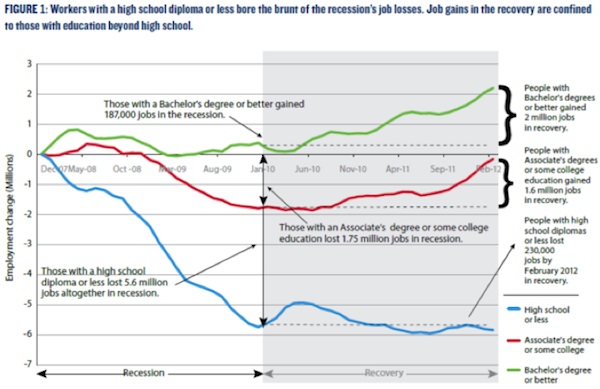
But that graph only tells part of the story. “As the Washington Post’s Dylan Matthews has pointed out, the Georgetown report misleadingly sandwiches together plain-old bachelor’s degree holders with workers who have a master’s, doctorate, or professional degree. And according to data Matthews cites from the Economic Policy Institute, between 2007 and 2011, 98.3 percent of the job gains in that combined group went to the advanced degree holders. These days, it seems we’re really in a grad school economy.” (The Atlantic)
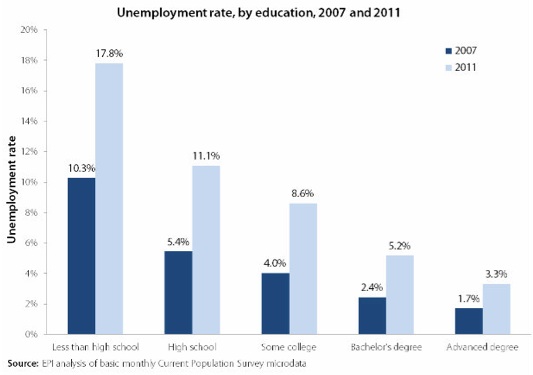
What we see is that a college degree is simply not the ticket it was when I was young. In today’s (Saturday) New York Times, they quote the Associated Press:

“About 1.5 million, or 53.6 percent, of bachelor’s degree-holders under the age of 25 last year were jobless or underemployed, the highest share in at least 11 years. In 2000, the share was at a low of 41 percent, before the dot-com bust erased job gains for college graduates in the telecommunications and IT fields.

“Broken down by occupation, young college graduates were heavily represented in jobs that require a high school diploma or less.

“In the last year, they were more likely to be employed as waiters, waitresses, bartenders and food-service helpers than as engineers, physicists, chemists and mathematicians combined (100,000 versus 90,000). There were more working in office-related jobs such as receptionist or payroll clerk than in all computer professional jobs (163,000 versus 100,000). More also were employed as cashiers, retail clerks and customer representatives than engineers (125,000 versus 80,000).

“According to government projections released last month, only three of the 30 occupations with the largest projected number of job openings by 2020 will require a bachelor’s degree or higher to fill the position — teachers, college professors and accountants. Most job openings are in professions such as retail sales, fast food and truck driving, jobs which aren’t easily replaced by computers.”

Boomers Are Breaking the Deal

I was talking with my youngest son, Trey, yesterday. I gave him my “old” car last year, which now has about 90,000 miles on it. He said he needs to have his spark system replaced. That launched me onto a nostalgic trip, telling him about how we used to replace spark plugs when I was a kid. I explained what a gapping tool was and then went on to detail the rest of the topic. After about five minutes, he remarked that it must have been expensive to have this done. “No,” I said, “we learned to do it ourselves. Everyone could. It was just part of the ritual of getting a car and growing up. Your grandpa helped me the first few times, and then I was on my own.”

Today, I could no more help Trey learn how to replace whatever they have in his car that is an ignition system, assuming I could even find it, than I could figure out how to fix my computer.

When I was young, a car with 90,000 miles on it was getting quite old, and things had to be constantly fixed or replaced. Today, 90,000 miles is just getting started. Cars don’t wear out like they used to.

And apparently the same can be said for the Baby Boomer generation. In the past, as you approached 65 you began to think about retiring. Today, not as many people are ready to “hang up their spurs.”

The next chart is from the St. Louis Fed FRED database. The blue line is the employment level of those 55 years of age and older (scale on the left), and the red line is the employment level of all workers (scale on the right.
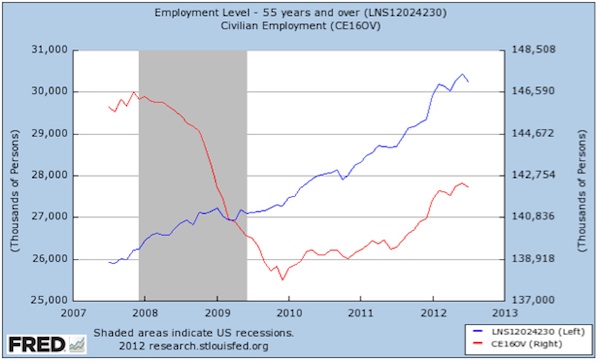
Note that the number of employed 55 and over has risen more or less steadily since before the beginning of the Great Recession, growing by over 4 million, while the number of jobs for all workers has dropped by 8 million and is still down by over 4 million.

Since the end of the recession, the number of jobs has grown by less than 3 million, all of which have been gained by those in the 55 year and older category! And then some: Boomers have taken “market share” from those who are younger.

The “deal” with previous older generations was that they would retire and move on, making way for the next generation. Boomers are breaking that deal. Not only are we working longer, but we intend to keep on working as long as we jolly well feel like it, and then live on to a ripe old age and collect all those retirement benefits. I will be 63 in a month or so and have no intention of slowing down. And few of my peers are thinking of what retirement looks like, either.
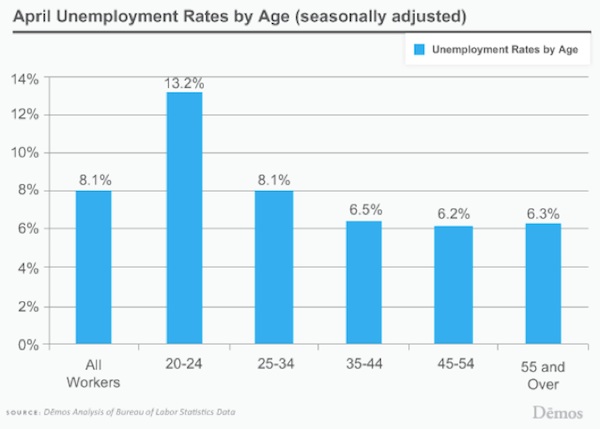
While the unemployment rate is fairly low and even for those 35 and older, younger workers are suffering more, and that partially explains the underemployment noted above. As I remember, when I was in my early 20s, you took the job you could get and then looked around for something better. But the bills got paid.

Just as employment went from the farm to the city, it now seems to be undergoing a new transition. I told my kids they needed to get a college education. As it turns out, I misled them. While a college education is important, they also now need a skill that an employer wants; a degree is not enough. And that is one of the reasons why Boomers, who have had the time to develop the skills, are taking job-market share.

Two Workers for Every Social Security Recipient

We will go into all this deeper in later letters; but before we close, let me briefly note that Mish Shedlock pointed out in his gonzo blog a few weeks ago that:

  • As of 2012-06 the civilian labor force was 155,163,000.
  • As of 2012-06 there were 111,145,000 in the private workforce.
  • As of 2012-06 there were 56,174,538 collecting some form of SS or disability benefit.
  • The ratio of SS beneficiaries to private employees has thus passed the 50% mark (50.54%).

Think about that a minute. There are now half as many people getting some kind of Social Security benefit as there are workers in private employment paying into Social Security. And the trend is clearly advancing. This cannot be sustained. And solving the Social Security problem is the “easy” part of the budget debate. Health care is far more difficult.

We read that one in eight families is now getting food stamps and that over 50% of US families get some form of government check each month, while the percentage of workers in the private workforce is shrinking. There is a limit to how much you can take from out of the private sector and still have a growing sector to take something from. But that is a topic for a later letter.

Carlsbad, Palo Alto, Chicago, and Atlanta

I will be doing an inaugural “Fireside Chat” with Barry Ritholtz on Tuesday, September 11 at 1 PM Eastern. This webinar will be hosted by my friends at Altegris Investments and will be available to accredited investors and financial professionals. If you have already registered with the Mauldin Circle (and are in the US), you will shortly be receiving an invitation to attend. If you have not, I invite you to go to www.mauldincircle.com and register today, so you can hear Barry and me discuss the latest news and, of course, touch on the election and what it means for investors.

I will be in Chicago on September 19, presenting at the RDA Financial Network Investor Forum, from 6:00 to 7:30 PM. The Forum will be held at the Chicago Marriott Oak Brook. This event is sponsored by Steve Blumenthal and my friends at CMG. (And congratulations, Steve, on your marriage last month!) If you would like to attend please email Linda Cianci at Linda@cmgwealth.com.

I will be speaking at the Casey Investment Summit in Carlsbad, California on September 7-9 and then in Palo Alto Sept. 12-13, at an investment conference again sponsored by Altegris Investments.

It is time to hit the send button. I am a little under the weather tonight, but deadlines are deadlines, so I write on. But I do see a lazy weekend in front of me, with friends, good food, and great conversation. And I hope you’re enjoying your summer, too!


Your not ready for summer to be over analyst,

John Mauldin

subscribers@mauldineconomics.com

Category: Think Tank

Please use the comments to demonstrate your own ignorance, unfamiliarity with empirical data and lack of respect for scientific knowledge. Be sure to create straw men and argue against things I have neither said nor implied. If you could repeat previously discredited memes or steer the conversation into irrelevant, off topic discussions, it would be appreciated. Lastly, kindly forgo all civility in your discourse . . . you are, after all, anonymous.

17 Responses to “Boomers Are Breaking the Deal”

  1. denim says:

    Still working some of us to an early grave…don’t think they are breaking any deal…it’s more like the reverse.

    Mortality by cause of death and by socio-
    economic and demographic segmentation
    Brian Ridsdale and Adrian Gallop UK

    article in google docs
    http://goo.gl/G0fm5

    Key words: social class Slide 8 in particular.

  2. stonedwino says:

    #1 Boomers are forced to work longer due to economic circumstances and rising costs, especially healthcare.

    #2 Gen X and Gen Y will make less, owe more, invest less, buy less cars, they will marry later, have less children and later in life, buy homes less and later in life. This will present a huge problem for the economic sustainability of this country and social programs.

    #3 Social Security has more people drawing from it and less people contributing. That will continues. The wealthy are taking a larger and larger slice of the pie in terms of income, so the simplest way to fix Social Security will be to raise the cap way up, so if a larger slice of the income is going to the wealthy, then that’s where the money is.

  3. Winston says:

    This is truly insightful work, John. I have been examining the same dynamics relating to cross-generation employment levels.

    Under the current employment climate, college graduates must compete with their parents and grandparents for jobs. Similarly, the underemployment scenario means that we have a declining population as underemployed people tend to start families later in life. Social Security benefits to current recipients due to depressed income levels from underemployment.

    An additional sad development of the Great Recession shows that many who lose their jobs in their fifties may never work again. One idea I have been playing with (and wrapping my head around the math) is the scenario in which the Social Security retirement age and Medicare benefits eligibility could be lowered under 65.

    The mechanism for promoting such an idea would be daunting -if not impossible. Nevertheless, it would be interesting to see what a mathematical model would reveal if we compare the implementation of said idea based on the similar social dynamics when Social Security began to take effect in 1935.

    Anyway – just a few thoughts.

  4. Winston says:

    Egads! Sorry about the sloppy sentence. I meant to say:

    Contributions to Social Security trust fund will probably drop due to depressed income levels from underemployment.

    The glut of people in the labor pool will depress income levels.

    As an afterthought to correcting my faux pas – I support increasing the minimum wage.

  5. DeDude says:

    @Winston;

    Lowering social security and medicare age is inevitable. Work is disappearing because automation has reduced the amount of work hours needed to make stuff. Left to its own, our malfunctioning predatory capitalism will just make things worse as it rips money away from the consumer class which is the only group that can increase demand. We neither can nor should we attempt to increase our consumption as a nation, but then the decreasing amount of work has to be distributed more in the direction of the young (that is old people need to retire earlier). But in order for that to happen we will need to get a much better income distribution; most 55 year olds simply cannot afford to retire. None of that will be easy in the current political climate, so it will probably take an “arab spring” type revolt by young unemployed people drowning in student debt.

  6. Defining Quality says:

    The entire SS -MediCare issue goes the fuck away when the Tea Party Assholes realize who the real criminals are in the world and decide to TAX CentaMillionaire$ and Billionaire$ annual incomes the same way everyone else is taxed who makes less than $105,000 per year. Total “Shit For Brains” being manipulated for the benefit of the 40,000 Malignant Narcissists and their 534 pimps in congress!

  7. ilsm says:

    Winston,

    If Maudlin is worried there are only 2 workers per each SS recipient he is rlly worrying the job creators failed to make productivity up to what is needed for the “general welfare” in the US. This failure is in large part due to squandering $26,000 or 28,000B over the past 60 years keeping the “securing” the world and enriching war profiteering.

    A couple of facts:

    US spends as much on war, more if you look at non pentagon security spending, as on social security.

    Getting war profiteering under control would free $450B a year for use in producing things not for making failed weapons to drone strike up the body count trying to keep Karzai from being hanged by his own people.

    US spends over 40% of federal outlays on discretionary things that are mainly crony capitalism and corporate welfare.

    There is nothing hard it requires the system to work for the 100% not the 1% exploiting their scam as supposed job creators.

  8. Jojo says:

    A person with a college education clearly has an advantage over those with only a high school diploma or less, but it is no guarantee of security.
    ———–
    Articles like the above always talk of the value of college degrees in a vague general sense. What is never mentioned is the age of the college degree (and by extension, the age of the person holding said degree).

    Over time, the value of a college degree becomes less as you move further from your graduation date. By the time you are in your 40′s, you need to be locked into a career with specific valuable experience and skills. Merely holding a degree from 20 or more years ago is not going to bless you with the ability to enter a new career, should you lose whatever job you are working in.

  9. Jojo says:

    Here’s a job that the internet has made available. Is this one f those “innovative” new industry jobs that are always alluded to by politicians and economists?
    ———-
    Googler Watched Child Porn And Beheadings Everyday For His Job

    * By Claire Gordon
    * Posted Aug 23rd 2012 @ 3:20PM

    There’s a lot of creepy, repulsive, morally abhorrent stuff on the Internet, and that means there are also a lot of people whose job it is to watch it, review it and get it taken down. One guy who reportedly had that job at Google — and whose identity was not revealed — describes the “scarring” experience in an interview with Buzzfeed FWD. The former Googler says that the job was made all the worse when the company denied him a full-time position, leaving him to scramble for a new job at the end of his year there.

    The ex-Google employee says that he spent his days exploring the ugly underbelly of humanity on all of Google’s products, like its search engine, Google Images, the picture-organizer Picasa and the social networking site Orkut (that has its largest fan base in India and Brazil). There were beheadings, he says, and suicides. Grotesque fetishes, mutilations and bestiality. And lots of child porn.

    http://jobs.aol.com/articles/2012/08/23/googler-watched-child-porn-and-beheadings-everyday-for-his-job/

  10. victor says:

    BR: I’ve been noticing an increase in profanity in some comments, the kind that turns decent people off. Why is it accepted on this blog?

  11. endorendil says:

    The “deal” with previous older generations was that they would retire and move on, making way for the next generation. Boomers are breaking that deal.

    Boomers are only just starting to hit retirement age, so it is too early to say that they are breaking this deal. The graph shows only total number of workers, and the baby-boom glut is still working its way through the system, so it does not prove that more people are deciding to keep working when they are over 55 (which is only three quarters through a normal working life) – the number of older workers is increasing too.

    All the graphs do point that experience and education reduce the effect of a recession on employment – greatly. To get a

  12. endorendil says:

    The “deal” with previous older generations was that they would retire and move on, making way for the next generation. Boomers are breaking that deal.

    Boomers are only just starting to hit retirement age, so it is too early to say that they are breaking this deal. The graph shows only total number of workers, and the baby-boom glut is still working its way through the system, so it does not prove that more people are deciding to keep working when they are over 55 (which is only three quarters through a normal working life) – the number of older workers is increasing too.

    All the graphs do point that experience and education reduce the effect of a recession on employment – greatly. To get a complete picture, you would also have to look at wages and hour worked – where even experience and education is less of a buffer.

    The demographics of SS benefits have long been studied, and we know that the ratio of workers to beneficiaries can become problematic. Two points: it makes no sense to keep the retirement age as low as it is now, for white-collar workers, and the systematic underpayment of SS by the income cap on the SS tax (regressive taxation) certainly made this problem a lot harder to deal with.

    Finally, it bears thinking about the meaning of social security and the way the US government has dealt with its surplus. Workers pay into the system, thereby funding the government which is supposed to invest in the economy so it can grow to support the workers when they retire. It is always possible to argue that the government could have invested more in education and infrastructure, but the fact is that when there is a “pig in the snake” of demographics, it is to be expected that no amount of investment could keep SS always in surplus. That means that the coming period – where SS is a drain on the operational budget of the state in stead of a boon – was unavoidable (barring a fairly complicated system where SS taxes would be linked to cohort size and life expectancy, or a system where SS taxes would be so high they would generate ridiculous surpluses most of the time). The scandal is really that the boomers in the US lived most of their big earning years under extreme low taxation, letting deficits accrue and investment in future generations wither. That was the Reagan deal with them, and this deal is still being defended. The younger generations might revolt against this deal as they were not party to it, but since Reagan’s time the boomers have had the political power in the system, and they will have it until a large fraction of them die off. That means that there is no change possible within the political system.

  13. AnnaLee says:

    As long as there is a standing threat to pull the rug out from under the boomer safety-nets, many boomers will feel they cannot risk leaving their jobs. Even boomers that I know with $1M or slightly more feel only one minute from seeing it dwindle to $500K or less. The funny thing is that most boomers, like those that preceded them, are just working people with little discretionary income that don’t even have savings. They aren’t the ones most affected by the “low taxes”. No, in fact, if the SS promise is broken with these people, they are the ones who paid the taxes while people with more got tax breaks because of the taxes they paid to SS as well as deficit non-investment.

  14. Rick Caird says:

    The deal changed on the bloomers, first. Defined benefit pensions went the way of the dodo bird. The savings were decimated by the 2001 and then 2008 recessions. The final blow is the Bernanke ZIRP policy which feeds the banks and devastated any income stream from savings. If anyone were to go with the 4% withdrawal plan, about 3.75% of that would be our seed corn.

    Mauldin also makes a point of the whole underlying job market changing. The US manufacturers more than ever, but it is high knowledge, high automation based manufacturing. The days of high labor content manufacturing is over the for the US. So, we really need to spend a lot of time figuring out where the jobs will come from. The blue collar tradesman is doing just fine, particularly if he can go into business for himself.. It is the guy who expected to go to work in the “plant” who is having a tough time, both for the ME and for line worker.

  15. Joe says:

    The “deal” with previous older generations was that they would retire and move on, making way for the next generation. Boomers are breaking that deal. Not only are we working longer, but we intend to keep on working as long as we jolly well feel like it, and then live on to a ripe old age and collect all those retirement benefits. I will be 63 in a month or so and have no intention of slowing down. And few of my peers are thinking of what retirement looks like, either.

    I have trouble with this in so many ways…

    I’m retiring from a blue collar job because I’ve spend my youth and my health and I can’t work any more. I’ve always been a 100 MPH WFO kinda guy and I will still be a WFO kinda guy, just a 35 MPH WFO kinda guy, doing something more cerebral becauysre I’m old. I will do pretty much what I want to do for the remainder of what I hope will be a long and healthy life because I can afford it. I prolly will produce something, but I won’t consider it work and I won’t take someone else’s employment from him….

    Mauldin will continue to do what he wants to do because he likes his job and it doesn’t “feel” like work.

    If it “feels” like work and you still are doing it in your late 60′s for income, it probably is not about fulfillment…. it’s about necessity.

    Call up the POLITICAL CALCULATIONS site and stick your yearly income in the Income Distribution tool. Then decide if your individual case of working at your publishing job is representative of the country as a whole continuing to work past retirement age.

  16. Joe Friday says:

    John,

    Think about that a minute. There are now half as many people getting some kind of Social Security benefit as there are workers in private employment paying into Social Security. And the trend is clearly advancing. This cannot be sustained.

    Nonsense.

    There will be about 79 dependents (children and retirees) for every 100 workers in 2030, compared to 95 dependents per 100 workers in 1965.

    So, back when the boomers were still children, their parents and the government found ways to adequately provide for them, build lots of new housing, build lots of new schools, and later finance expensive college educations for many of them.

    If America’s much smaller economy could sustain such a large share of non-workers almost half a century ago, the retirement of the baby boomers should be quite manageable, as long as the nation avoids the failed RightWing economic policies we’ve experienced over the past decade or so.

  17. Joe says:

    The “deal” with previous older generations was that they would retire and move on, making way for the next generation. Boomers are breaking that deal. Not only are we working longer, but we intend to keep on working as long as we jolly well feel like it, and then live on to a ripe old age and collect all those retirement benefits. I will be 63 in a month or so and have no intention of slowing down. And few of my peers are thinking of what retirement looks like, either.

    I have trouble with this in so many ways…

    And here’s another way….

    http://online.wsj.com/article/SB10000872396390444230504577615861593287688.html?mod=WSJ_hp_EditorsPicks