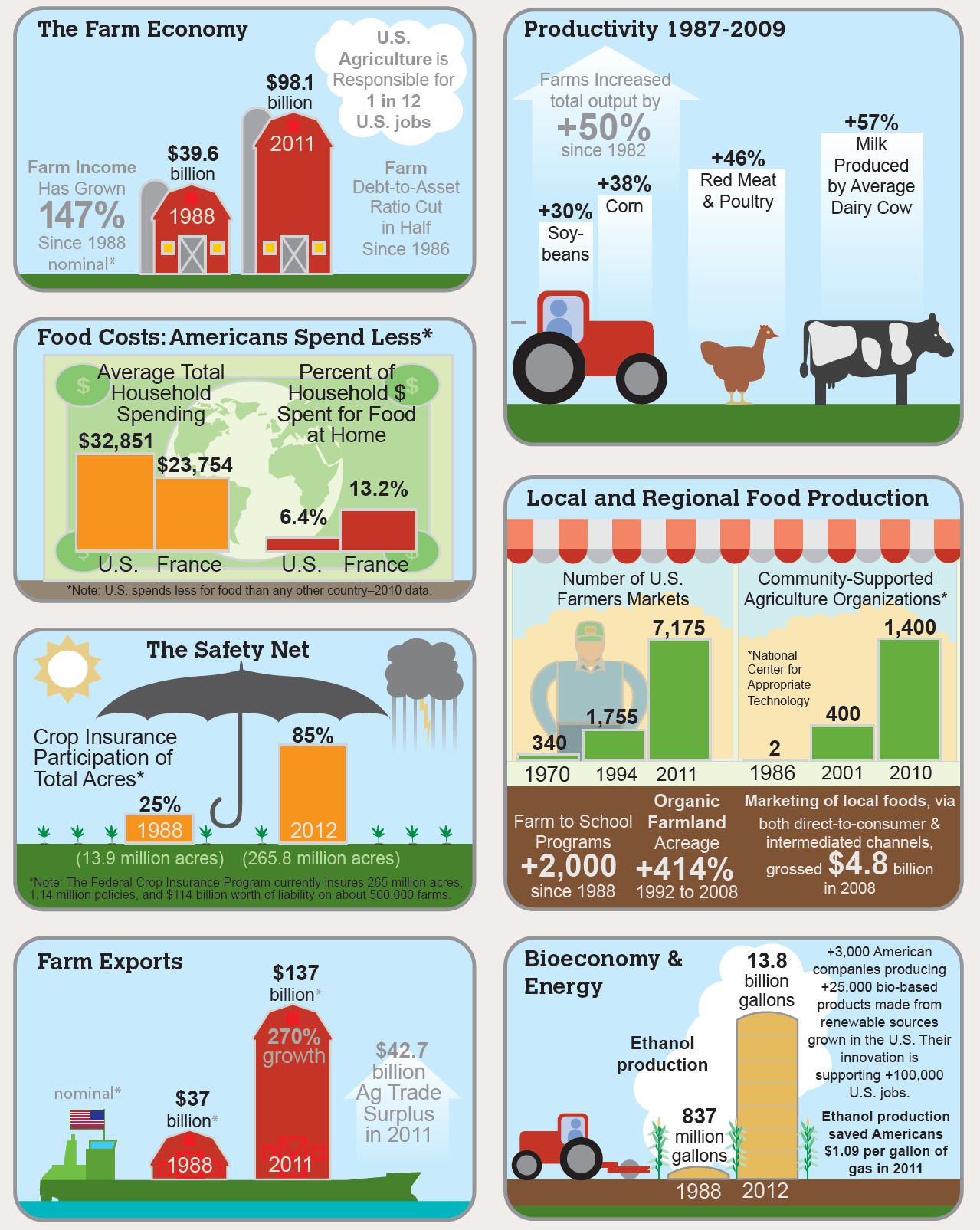
Click to enlarge:

Source:
United States Department of Agriculture

Category: Markets

Please use the comments to demonstrate your own ignorance, unfamiliarity with empirical data and lack of respect for scientific knowledge. Be sure to create straw men and argue against things I have neither said nor implied. If you could repeat previously discredited memes or steer the conversation into irrelevant, off topic discussions, it would be appreciated. Lastly, kindly forgo all civility in your discourse . . . you are, after all, anonymous.

19 Responses to “Resilience of American Agriculture”

  1. nyncboy says:

    Could that be right?

    “Ethanol production saved Americans $1.09 per gallon of gas in 2011″

  2. Oral Hazard says:

    Except French food is more than twice as good as American. So I’m really not seeing the disparity there.

  3. drocto says:

    Use of nominal income across a long time period in the first frame.
    Non-starter.
    Stopped reading right there.

    If you don’t use real, you’re probably twisting other facts or misusing data in other ways, which I don’t have time to fact check.

  4. gordo365 says:

    @drocto – can you explain thinking behind your comment. Nominal vs. real? I’m trying to teach myself how to read between lines etc. Your thoughts would be greatly appreciated.

    Gordo

  5. kek says:

    Farm Debt-to-Asset Ratio Cut in Half Since 1986….nothing like a little farmland price bubble to make things look good.

    Ethanol production saved Americans $1.09 per gallon of gas in 2011? Yeah OK.

  6. MrBean says:

    The statistics are very misleading. I live in France five months out of the year and the food prices are lower than here in the US. The French may spend 13 % of their income on food but that would include wine. If the average income in France is $35600, then they would be spending about $90 a week for a family of four. That can be easily done due to all the farmers markets. Even the large cities have such markets. One must be wary of government statistics and the motives for their use.

  7. MidlifeNocrisis says:

    Once upon a time, I was a member of the system that gathered data for the USDA. I would not put too much faith in the exact numbers………. but I do believe the general trends are shown correctly.

    The vast majority of farmers (grain farmers, hog farmers, hay producers, dairy farmers) participate in USDA programs and therefore must provide a lot of their personal information to the USDA.

    FWIW: I don’t buy the $1.09 ethanol savings statement either.

  8. JimRino says:

    You’re also forgetting we now have lower chicken, and pork prices but those come from factory farms. So, we should also look for higher pollution cost to counties, and higher rates of sickness in the population, negative externalities.

    We’re also ignoring “Global Warming” and how many productive acres have we lost?

    This chart imply’s we reached the “tipping point” 32 years ago!, with a rapid acceleration of anomalies.
    http://en.wikipedia.org/wiki/File:Enso-global-temp-anomalies.png

  9. lonr505 says:

    “@drocto – can you explain thinking behind your comment. Nominal vs. real? I’m trying to teach myself how to read between lines etc. Your thoughts would be greatly appreciated.”

    Example of nominal: my parents bought a new Olds Cutlass Calais in 1985 for $15,800. Ahh the good ole’ days when everything was affordable and great, right?

    $15,000 in 1985 = ~ $32,000 today (real, inflation-adjusted dollars) for a car that barely had 100 horsepower.

  10. tagyoureit says:

    The fact that we’ve figured out a way for a cow to produce 57% more milk than 22 years ago makes me wonder about the affect on the cows and the milk. It’s not like the cows were holding back before. The same possibly for meat production, if the increase is not due to managing more animals simultaneously. Perhaps farmers are simply exceptional selective breeders, but I worry what other genes are being passes along with the increased milk. What genetic diversity is being lost in the process?

  11. biscuits says:

    The $1.09 per gallon savings from ethanol comes from research funded by the Renewable Fuels Association, an ethanol industry trade group, hardly an unbiased source.

    MIT’s Christopher Knittell says the study is flawed:

    “A paper I just co-authored for the MIT Center for Energy and Environmental Policy Research finds that the models used to produce those claims are “driven by implausible economic assumptions and spurious statistical correlations.” In fact, we find that the effects of ethanol production on gas prices are near zero and statistically insignificant.”

    http://www.scientificamerican.com/article.cfm?id=ethanol-fails-lower-gas-prices-study-finds

  12. jimh009 says:

    I have no idea if the “ethanol number” is right or not, but I must say…this has to be one of the prettiest inforgraphics I’ve seen. Whoever is doing the graphics work for the USDA deserves a raise.

  13. northendmatt says:

    Sure it saved you $1.09/gal of gas… And cost you in higher food prices

  14. dsawy says:

    Even if we adjust for inflation, many crop prices have not regained their highs of late 1973.

    From the perspective of “what does it take to support a family with only farm income?” American farmers have been losing ground for decades. In 1973, it took only about 400 acres of land to create enough income to support a family of four. Now, many farmers are having to farm anywhere from 2,000 to 4,000 acres to consistently support a family of four.

  15. SecondLook says:

    The data presented is a bit selective. For example, compare the US to the UK instead of France. The UK spend 8.2% of household income on food, and that is with about a third of their food being imported. Their domestic production is based on smaller farms, with a shorter growing season (London’s latitude is 51°30′N, Bismark, North Dakota is 46°48′N). They spend proportionally about the same on agricultural subsidies as the US does.
    One could argue that British farms are at least as efficient as ours, if not more so, given the conditions.

    that 1 in 12 jobs number is also misleading. That includes everyone associated with agriculture, from the producers, the farmers, to the shippers, the packers and processors, and the retailers.
    The auto industry is believed to account for 1 out 10 jobs, using the same criteria, with about a fifth the number of primary people (those who build the cars, versus those who plant and harvest the crops). So, economically speaking, the auto industry is far more productive in terms of job creation.

    I could go on, but you get the general idea, the statistics quoted are designed, selected, to present the agricultural sector in the best possible light.

    Food is critical, and the quantity and quality we produce is essential, but that is a different issue than what those stats was conveying…

  16. endorendil says:

    Just start with the first graph: in 2011 dollars, farming revenue was about 75 billion. In 2011, it was 98 billion, so in 23 years, the sector gained 29%. In comparison, real GDP almost doubled. Fact is, we’ve been improving agriculture for thousands of years, and have thrown all our technological advances at it. Agriculture in the west has never been as productive. But there are two basic problems. First, we’ve pushed the land well beyond its limits with our technology, and the plants and animals we grow can only be improved so much more. Productivity gains are getting harder. Second, we push the land beyond its limits using finite resources like non-organic fertilizer and oil. Rising energy and fertilizer costs are a

  17. endorendil says:

    real danger to current productivity levels.
    Another threat to producitivity is climate change – anthropogenic or not. There will be more crop failures as the climate becomes less predictable.

  18. renegade says:

    Problem is, nice graphs by the way….Truly….The source is as far as I have to go…
    Source:
    United States Department of Agriculture

    I love your stuff Barry, we all do here…And you have over 60k readers….This kind of post is not worthy of you….Talk to some real farmers, like we do….the stark facts are very different…..The ethanol stats are from pure fiction by the way….we willbe exposing it in our next segment….commodityconfidential.com Source:Real American Farmers

  19. Greg0658 says:

    ethanol is the new starter seed OpSys to replace a century of machines running on dinosaur days of decomposing

    renegae your OpSys gene seed is evident .. Truly hope you go broke and take your seed stock to the dirt with ya .. but agree with ya on a fine graphic

    is that to crass ? must be PC – tis the times .. I’ll refute myself (some) – you can’t go broke really – this is America – just sorta broke .. so lighten up on your bookings – oil is harder & harder to come by