Very cool interactive graphic that will let you know where you are in the wage scale in the US:


Click for interactive chart:
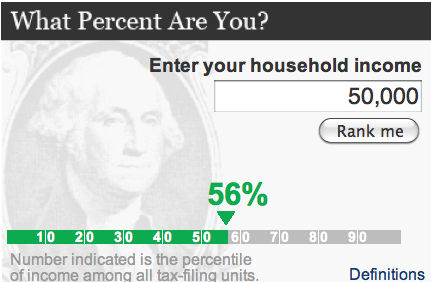
Source: WSJ

Category: Data Analysis, Digital Media, Wages & Income

Please use the comments to demonstrate your own ignorance, unfamiliarity with empirical data and lack of respect for scientific knowledge. Be sure to create straw men and argue against things I have neither said nor implied. If you could repeat previously discredited memes or steer the conversation into irrelevant, off topic discussions, it would be appreciated. Lastly, kindly forgo all civility in your discourse . . . you are, after all, anonymous.

12 Responses to “What Percent Are You?”

  1. VennData says:

    Whew, I’m glad I’m in there in the middle, however, here’s still hoping I can pay the same rate as Mitt Romney. And on a related note…

    http://www.ostroyreport.com/2012/08/guns-god-gays-abortion-and-now-rape.html

    “…It’s bizarre that the candidates who seek to legislate one tax rate for all want several levels of rape…”

  2. ironman says:

    Use this tool to do the same for your household’s total money income with respect to the distribution of income in 2010 (the WSJ’s tool is based only on adjusted gross income – and for 2007 at that!).

  3. James Cameron says:

    Not to quibble, but while this is mildly interesting it ignores other key components of income including the quality of your health care plan, company matching of 401K, and pension (if you should be so lucky). Making 100K a year but having to buy your own health care coverage is much different than making 100K a year and receiving a generous plan through an employer. That become especially apparent when you have to pay for out-of-pocket medical costs. Similarly, making 85K a year but having a generous pension that pays 60 percent of your salary after 30 years of service with cost of living adjustments may be more lucrative than 100K with no pension.

  4. AnnaLee says:

    James Cameron, Health plan perhaps but in today’s world where people want to break all “promises”, I don’t think anyone should count promises until after death.

  5. James Cameron says:

    > I don’t think anyone should count promises until after death.

    Then we shall have to defer further discussion until that time, I suppose . . .

  6. Iamthe50percent says:

    I’ll have to change my name to Iamthe58percent.

  7. gman says:

    I am always stunned by the disconnect between the 1% in income 500k and 1% in wealth 6 mil!?! Really tough to bridge that gap living in an expensive city and paying the penal taxes on WAGES! Capital gains, carried interest and offshore income are the only way to earn..if it is good enough for Mitt it should be good enough me.

    Too bad I earn via short term cap gains, wages and k-1 income and am taxed accordingly. I will never make the jump on the wealth scale. Wages are for losers like me…I will never be able to afford to “create jobs’ in equestrian/show jump/dressage industries as I had hoped.

  8. ricecake says:

    Only focus on income is one sided. Should ask people how much their monthly debt and expense beside their income. If the Outs bigger than the Ins, they are still the poor.

  9. Moopheus says:

    No, Ricecake, there are plenty of people out there (esp. in New York) who make a high salary but still complain about just “getting by,” but “getting by” includes an expensive condo/apartment, kids in private schools, new cars, etc. Choosing to live an expensive lifestyle and having no savings is different from being poor.

  10. rexx18 says:

    Income doesn’t really matter as much as wealth. The real issue is that wealth has been consolidated. Even guys like Buffett are deceitful. He wants to raises taxes…but you could raise taxes to 100% (hell, 101%!!!) and Buffet would still have 40 billion dollars.

  11. BillG says:

    ironman, please explain the difference to me. The median household income off of your calculator is $49455 and that’s the 56th percentile on WSJ’s calculator. But the top 2% on your calculator is $247K and for the WSJ’s its $365K. What’s the discrepancy? I could think maybe the WSJ is counting unearned income and the other one isn’t and that’s why its higher for the 2% but why would it then be lower for the 50%?

  12. ironman says:

    BillG,

    Thanks for your question. Here’s what you need to know for what you observed:

    The WSJ’s calculator is based on 2007 tax return data. 2007 was the last full year the U.S. economy expanded before going into recession – it peaked in December 2007.

    Political Calculations’ tool is based upon the Census’ surveyed total money income data for 2010. Incomes, especially at the very volatile top end of the income spectrum, had fallen significantly by that time.

    Another key difference between the two is the one between “tax return units” and households, so there’s a mismatch between the two at that very basic level.

    There are also differences in what income is included in each category. Here’s a description of what the Census includes in its total money income figures. The IRS’ adjusted gross income figures exclude a good portion of those income sources, but to its credit, includes income from capital gains (especially from one-time only events, such as gains from the sale of a business), which the Census’ income figures do not. Between the two data sources however, the Census’ income data provides a much more complete and what might be described as a more “typical” picture.