click for ginormous graphic


Source:
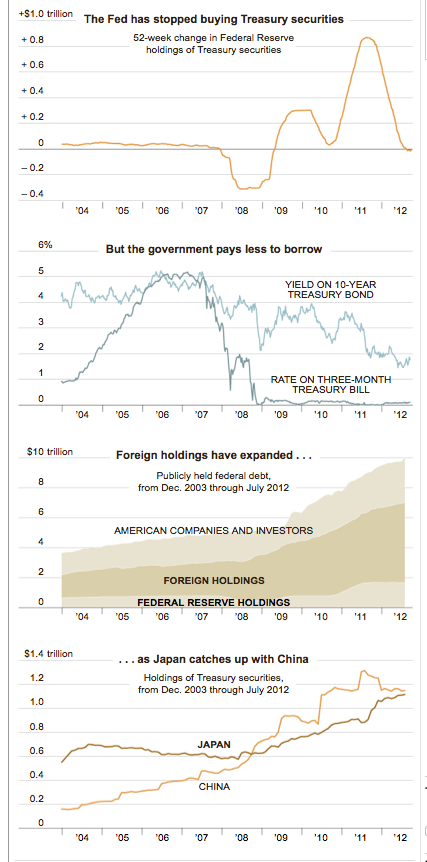
As the U.S. Borrows, Who Lends?
Floyd Norris
NYT, September 21, 2012
http://www.nytimes.com/2012/09/22/business/economy/as-the-us-borrows-who-lends.html


Category: Credit, Digital Media

Please use the comments to demonstrate your own ignorance, unfamiliarity with empirical data and lack of respect for scientific knowledge. Be sure to create straw men and argue against things I have neither said nor implied. If you could repeat previously discredited memes or steer the conversation into irrelevant, off topic discussions, it would be appreciated. Lastly, kindly forgo all civility in your discourse . . . you are, after all, anonymous.

6 Responses to “Foreign Holdings of United States Debt”

  1. RW says:

    As the Norris article makes clear, no country in a trade relationship with the USA can sell US bonds at will (and the ratings of bond agencies WRT the USA are simply drivel) but the concern trolls will still come out, clutching their pearls, with mutters about the size of foreign holdings and allusions to national security and allusions to Greece, Zimbabwe, Argentina, Weimar, etc. (mutters are at least preferable to SCREAMS).

    More seriously the thesis that there is an ongoing scarcity of safe assets does have some weight* to it but even though demand for US assets worldwide clearly remains unabated I’ve come to believe that selling safety (or seigniorage depending upon how you look at it) also allows us to coast on industrial policy and, to the degree that is actually true, I don’t believe it is a very good long-term national strategy at all.

  2. wally says:

    We will always need roads, bridges, electrical grids, public transit, sewage treatment and other infrastructure, but we will probably never have another chance to get them so cheaply from foreign lenders.
    It would also solve our unemployment problems and would enhance our GDP growth and even expand the Federal tax revenues.
    A missed opportunity – a crime and a shame.

  3. Born Again says:

    The Federal Reserve continues to buy US Treasuries. The NY Times article (graphic) is wrong: http://research.stlouisfed.org/fred2/series/TREAS10Y
    http://research.stlouisfed.org/fred2/series/TREAS5T10
    http://research.stlouisfed.org/fred2/series/TREAS1T5

    However, as the above links show, the Federal Reserve is buying securities with 5+ years to maturity while selling/redeeming those with 5 years and less. A.K.A. Operation Twist. The net value on the books has remained nearly constant since this time last year. BTW, the US Treasury has been paying lower interest rates since the early 1980′s; must be due to the credit and economic strength of the US.

  4. victor says:

    “But the government pays less to borrow”: aint that the truth! Actually it pays negative real interest rates when adjusted for inflation. But only until the creditors finally stage a revolt against the Fed’s financial oppression. With approx. one thirds owed to foreigners, one third to US companies and investors and one third to the SS trust fund, when debt servicing takes off, watch out below.

    Better live within our means, stop the borrowing party before it’s too late, but there is no Moses out there to lead us to safety. “Felix qui nihil debet”; there will be a lot of unhappy people in our Republic, I suspect the masses will (again) suffer disproportionately.

  5. James Cameron says:

    Perhaps I’m missing something . . . on the third chart publicly held federal debt is shown as $10 trillion. Norris makes the same claim in his article. US Treasury data (http://www.treasurydirect.gov/govt/reports/pd/pd.htm) shows debt held by the public was actually breached nearly 13 months ago, on September 1, 2011. On July 31, 2012, it was $11,122,281,549,948. Through September 20, it has since grown to $11,253,544,111,262, while total public debt now sits at $16,014,424,023,772.

  6. The Japanese picking up the slack may account for the resilience of US long term treasuries. In spite of all the doom and gloom, technically the treasuries are stronger than gold. Furthermore, gold is the asset class that benefited less from QE.

    Is such relative underperformance telling us that the USD and, with it, the long term Treasury bond are not ready to take a really big nosedive? Of course, things can change quickly since the vital ratio BLV/GLD might turn from long term bullish (that is bonds stronger than gold) to long term bearish (that is gold stronger than treasuries).

    So, bonds will be ready to really go down big time, when we get two technical signals from related markets:

    a) gold becomes stronger than silver and stocks, implying the QE is directly invigorating gold (kryptonite) and hence the dollar real big bear market sets in.

    b) the BLV/GLD ratio turns bearish which means that gold is stronger than bonds.

    However, not any “relative strength” reading is adequate to derive conclusions. We have to look at the right timeframe at take into account secondary reactions of the ratio. More on this here:

    http://www.dowtheoryinvestment.com/2012/09/dow-theory-spells-trouble-for-bonds.html

    regards,