
Fascinating set of cycle charts from Merrill looking at earnings, and how being too early when timing value stock purchases is even worse than being too late!
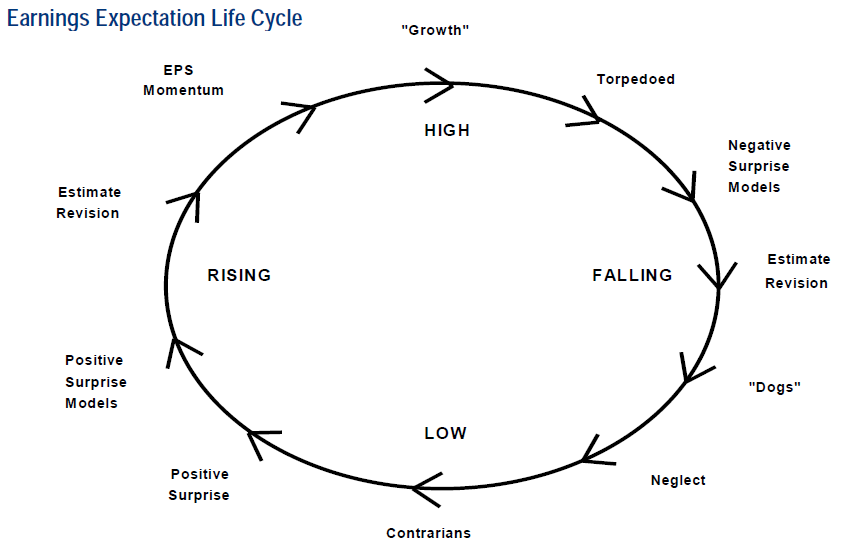
Earnings Life Cycle
Click to enlarge:
Merrill explains:
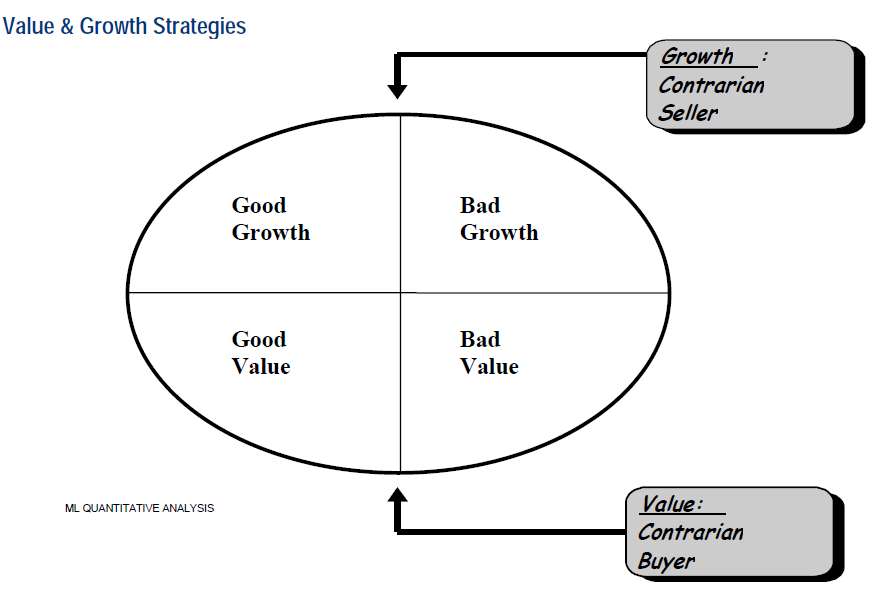
“Value traps are industries that fall into the portion of the earnings expectation life cycle labeled Bad Value. These are industries that are selling at discounts to their historical market multiples, but do not yet appear to have any suggestion of an upturn in price performance.
Our work suggests that the hardest thing for a value manager to do is to buy a stock, and good value-oriented managers are likely to be buying stocks later than their peers. Value managers often like to say that they will buy stocks early but they’ll be there at the bottom. Although that sounds encouraging, the route to value fund underperformance is to buy early too many times.”
Good Value Managers vs. Bad Value Managers
Source:
Value trap alert!
BofA/Merrill Lynch
September 24, 2012

Category: Cycles, Psychology, Valuation
Please use the comments to demonstrate your own ignorance, unfamiliarity with empirical data and lack of respect for scientific knowledge. Be sure to create straw men and argue against things I have neither said nor implied. If you could repeat previously discredited memes or steer the conversation into irrelevant, off topic discussions, it would be appreciated. Lastly, kindly forgo all civility in your discourse . . . you are, after all, anonymous.


” Value managers often like to say that they will buy stocks early but they’ll be there at the bottom. ”
Either I have serious reading skills problems (t’was a long week) or this statement is atrocious.
Are those value managers saying they are OK to buy before they’ve seen a convincing bottom ? That doesn’t make any sense. All you can achieve is to tie up your cash in a potential loser.
Say you’re looking at a stock on its way down and from the moment you buy, it turns out it had a further 10% to go down over 3 months, because of broad economic conditions. Then it recovers those 10% over another 3 months. Congratulations ! You tied up your cash for 6 months achieving 0 (zero, zilch, nada) returns while taking the risk of holding a dog whose decline, after all, was not a matter of economic conditions at large but of poor performances specific to this company. You were a lot better off waiting out those six months, safe in cash, and missing the first 10% from the bottom.
Buying after a false bottom and losing on another leg down is one thing. Bad analysis. That’s a problem of skills of a specific manager or of broad market conditions (and in this case, you’re not necessarily doing worse than the market). But that? It sounds inexcusable.
I value fundamental analysis but it’s best used for a buy and hold strategy, at least in my universe; i.e., I could never solve the timing problem in value terms and spending the time in trying to get that right could no longer be justified as a cost-effective prelude to momentum analysis. YMMD