
All the way back on September 6th, Société Générale’s Albert Edwards gave us a heads up as to what might be concerning the Fed.

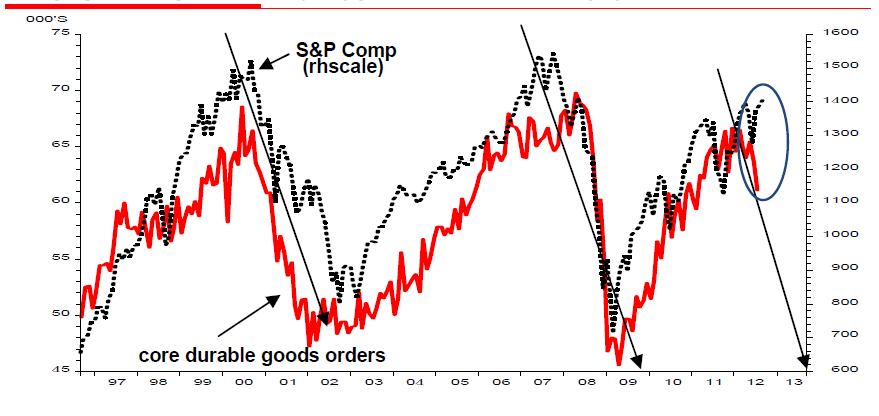
While everyone else was watching NFP data, Edwards had already observed something off with the Durable Goods Orders. They were slumping hard — indeed, as hard as often accompanies major recessions and Bear markets.

So while many were busy looking over there at Payroll data, he was looking at something that most everyone else missed. Kudos to Albert for spotting this.

I have a sneaking feeling that the Fed watches Durable Goods Orders as well. As you can see in the chart below, they seem to be telegraphing a market correction. Given how much faith — misguided IMO — the FOMC places in the wealth effect of equity markets, this may obviously have been a big deal to them.


Slumping Durable Goods Orders (Core) Go Hand-In-Hand With A Equity Bear Market
Click to enlarge:
Source:
Global Strategy
Alternative View
September 6, 2012

Category: Bailouts, Data Analysis, Economy, Federal Reserve, Markets

Please use the comments to demonstrate your own ignorance, unfamiliarity with empirical data and lack of respect for scientific knowledge. Be sure to create straw men and argue against things I have neither said nor implied. If you could repeat previously discredited memes or steer the conversation into irrelevant, off topic discussions, it would be appreciated. Lastly, kindly forgo all civility in your discourse . . . you are, after all, anonymous.

17 Responses to “Overlooked: Slumping Durable Goods Orders & QE3”

  1. dougc says:

    Industrial production and capacity utilization also confirm the slowdown, looks bad for economy but in this manipulated market it might be positive for stocks.

  2. lonr505 says:

    it also should be noted that the durable goods figures look even more disconcerting when adjusted into current dollars.

    and for more fun with stats……the number of persons employed in the US durable goods sectors are 40% below its 1980 peak…..obviously due to outsource and technology.

  3. dina says:

    iphone 5 orders are up. it will help US economy.
    http://www.cnbc.com/id/49032761

    ~~~

    BR: we mentioned that in AM READS this morning

  4. Pantmaker says:

    We are in a recession now. It will become clearer with time as recessions usually do. Barry, you will certainly take more heat on your recent “cautious on equities” statement…but you will eventually look like a rock star…put some high profile shorts out now and the village children will sing songs of praise in your name.

  5. dina says:

    @BR
    http://www.ritholtz.com/blog/2012/09/10-friday-am-reads-36/www.nytimes.com/2012/09/14/opinion/krugman-the-iphone-stimulus.html
    The AM read link is broken. I get the following

    Not Found
    Sorry, nothing was found here.

    ~~~

    BR: Oooh, good catch — I’ll fix.

  6. Equityval says:

    I think they told you they were worried about it in the release:

    “Household spending has continued to advance, but growth in business fixed investment appears to have slowed”

  7. Disinfectant says:

    The Global Wave chart here shows a very nice picture of the collapsing global economy:
    http://theshortsideoflong.blogspot.com/2012/09/precious-metals-update-part-i.html

    Barry, it’s good to see you remaining rational. You might want to have a sit-down with Josh as he sounds like a mo-mo bulltard lately on his blog.

  8. MikeDonnelly says:

    dina, durable goods have a lifespan of 3yrs or more. I don’t think the Iphone fits into that category !

  9. rd says:

    Big Ben is trying to push mortgage rates down some more with QE3. millions have had their credit trashed over the past 5 years while many more are underwater in their homes (either through first mrtgages or first mortgage + HELOC).

    How will lower interest rates help them refi or buy a new home?

    As far as I can tell, this continues to be stimulus for Wall Street to buy financial assets, including commodities.

    The good? part is that he clearly announced that rates will stay low until he sees unemployment and other GDP types of numbers improve substantially – that will provide some certainty for people trying to figure out if interest rates are likely to spike over the next couple of years. However, it also takes the urgency out of buying durable goods etc. because interest rates are still low. If your car or fridge are still working now, now you can definitely wait two more years to buy a new one with some assurance that 0.9% financing will still be there. How does that help the economy in the short-term?

  10. The US economy went into stall mode on Memorial Day – inspired not by conventional business cycle factors, but rather by an inept Congress and its irresponsible fiscal policy. Weighing all forward-looking data, the trajectory for 2012Q3 has been apparent since my June 20th TRI update: http://trendlines.ca/free/economics/RecessionIndicatorUSA/USA-TRI.htm

  11. Fritz3 says:

    This may also be a pause before the election because, as everyone keeps repeating, depending on who wins, the effect on the economy will be very different. It doesn’t hurt to wait 60 or 90 days to decide what to commit to.

  12. Agreed, Fritz. Despite GDP plunging from 4.1% last December to a mere 0.2% this month, TRI’s measure of animal-spirits-plus for 2013H1 have remained consistently quite high. This forward-looking data senses no damage via the fiscal cliff issues. Instead, it projects Q2 may be the best quarter of the current business cycle. If the fiscal cliff realities are deducted from this buoyant level rather than status quo, the USA may avert the 2013H1 Recession warned by CBO.

  13. rootless says:

    dina wrote:

    iphone 5 orders are up. it will help US economy.
    http://www.cnbc.com/id/49032761

    Why would it? I don’t see that this is necessarily happening. Selling more Apple products will help Apple by increasing Apple’s market share. At the expense of other producers. Good for Apple and investors in Apple.

    But why is aggregate spending supposed to go up, except perhaps for a short-term boost at the expense of future spending? Most people still won’t have more money they can additionally spend.

  14. iamtheonepercent says:

    Total durable goods orders have recovered nicely since recession lows, and have stayed consistently above $200 billion per month since July of last year, from recent cycle low of $141 billion monthly avg in 2009. Source data is US Census Bureau, M3 series here: http://www.census.gov/manufacturing/m3/historical_data/index.html.

    Cute graph from SG, but I don’t believe the Fed is looking at correlations between S&P and various economic time series. I tend towards Occam’s Razor’s as an explanation – that they are focused on understanding drivers of employment and inflation. This stock-durable goods relationship seems like it’s 2 or 3 hops away from the monetary policy to employment/price stability relationship that the Fed tries to manage.

    Aside from the Fed’s dashboard, would I trade off this graph? Probably not. It looks like a co-integrated series over very long time frames, but my guess the correlation is very low to short-dated returns.

    At this point, I’m not overthinking the Fed’s motivation. I think it is as simple as they say – QE until employment improves … unless inflation goes > 2% then recalibrate. From there, I think about what that means to money flows, market portfolio balances, then ultimately price action.

  15. Futuredome says:

    Sorry, but the “slowdown” in durables is Asian related. There is nothing to see there. Considering the expansion of the service sector, the government is in data failure mode right now. They can’t keep up with the pace.

  16. gkm says:

    I love this wealth effect nonsense. 1) the majority of money in the market is supposed to be there for wealth accumulation ie there’s an expectation it should go up over time and that doesn’t mean you go out and spend it tomorrow because 2) the volatility involved discounts the probability that it will be permanent or wiped out by a real rise in food and energy prices.

    What it does do is keep the financial leeches at bay for another day and that’s what matters to a bankster.