
My afternoon train reads:
• Bye-Bye, PCs (Barron’s)
• U.S. Stocks Top All Other Assets for First Time Since ’95 (Bloomberg)
• Countdown to change at the Fed (Market Watch)
• John Paulson Doubles Down on Real Estate (WSJ) see also Doubts About Independent Foreclosure Review Spread (ProPublica)
• When Banks Were Able to Print Their Own Money, Literally (Echoes)
• IMF’s epic plan to conjure away debt and dethrone bankers (The Telegraph) see also Will central banks cancel government debt? (FT Alphaville)
• You Don’t Work as Hard as You Say You Do (Economix)
• The Voter-Fraud Myth (The New Yorker)
• Apple Sees Schools Buoying Tablet Lead With iPad in Class (Bloomberg) see also Small iPad may be big problem for Kindle (Market Watch)
• These Pictures May Give You Nightmares About The Canada Oil Sands (Business Insider)
What are you reading?
The Once-Mighty U.S. Consumer Awakens
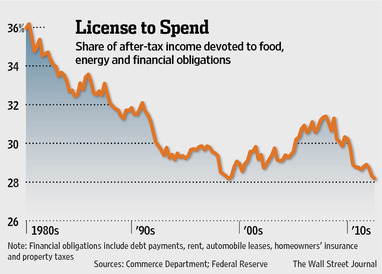
Source: WSJ

Category: Financial Press, Markets
Please use the comments to demonstrate your own ignorance, unfamiliarity with empirical data and lack of respect for scientific knowledge. Be sure to create straw men and argue against things I have neither said nor implied. If you could repeat previously discredited memes or steer the conversation into irrelevant, off topic discussions, it would be appreciated. Lastly, kindly forgo all civility in your discourse . . . you are, after all, anonymous.


Bye-Bye, PCs (Barron’s)
Not so fast. Computers need input, your personal input. Is it going to listen to you speak in a library or other socially quiet environment? Do you want to blab your most confidential info to the listening world? The PC is the natural evolution of a typewriter. I don’t have to change the ribbon or buy paper for my PC, but the thing is my typewriter on steroids when connected to the internet…and the screen is big.
http://www.feasta.org/wp-content/uploads/2012/06/Trade-Off1.pdf
Trade-Off
Financial System Supply-Chain Cross-Contagion:
a study in global systemic collapse.
David Korowicz
Overview
This study considers the relationship between a global systemic banking, monetary and solvency
crisis and its implications for the real-time flow of goods and services in the globalised economy. It
outlines how contagion in the financial system could set off semi-autonomous contagion in supplychains
globally, even where buyers and sellers are linked by solvency, sound money and bank
intermediation. The cross-contagion between the financial system and trade/production networks
is mutually reinforcing.
It is argued that in order to understand systemic risk in the globalised economy, account must be
taken of how growing complexity (interconnectedness, interdependence and the speed of
processes), the de-localisation of production and concentration within key pillars of the globalised
economy have magnified global vulnerability and opened up the possibility of a rapid and largescale
collapse. ‘Collapse’ in this sense means the irreversible loss of socio-economic complexity
which fundamentally transforms the nature of the economy. These crucial issues have not been
recognised by policy-makers nor are they reflected in economic thinking or modelling.
As the globalised economy has become more complex and ever faster (for example, Just-in-Time
logistics), the ability of the real economy to pick up and globally transmit supply-chain failure, and
then contagion, has become greater and potentially more devastating in its impacts. In a more
complex and interdependent economy, fewer failures are required to transmit cascading failure
through socio-economic systems. In addition, we have normalised massive increases in the
complex conditionality that underpins modern societies and our welfare. Thus we have problems
seeing, never mind planning for such eventualities, while the risk of them occurring has increased
significantly. The most powerful primary cause of such an event would be a large-scale financial
shock initially centring on some of the most complex and trade central parts of the globalised
economy.
The argument that a large-scale and globalised financial-banking-monetary crisis is likely arises
from two sources. Firstly, from the outcome and management of credit over-expansion and global
imbalances and the growing stresses in the Eurozone and global banking system. Secondly, from
the manifest risk that we are at a peak in global oil production, and that affordable, real-time
production will begin to decline in the next few years. In the latter case, the credit backing of
fractional reserve banks, monetary systems and financial assets are fundamentally incompatible
with energy constraints. It is argued that in the coming years there are multiple routes to a largescale
breakdown in the global financial system, comprising systemic banking collapses, monetary
system failure, credit and financial asset vaporization. This breakdown, however and whenever it
comes, is likely to be fast and disorderly and could overwhelm society’s ability to respond.
(78 pgs.)
The Italian courts are something else! Failure to forecast is a crime.? Well, according to this ruling, downplaying risk is.
http://www.scientificamerican.com/article.cfm?id=italian-scientists-get
“Six Italian scientists and a government official have been sentenced to six years in prison over statements they made prior to a 2009 earthquake that killed 309 in the town of L’Aquila.”
Think they have it backward about the Kindle/iPad relationship. The Kindle is hurting the iPad, forcing Apple to move downmarket to give the Fanbois something to buy with the Apple logo on it.
And if anyone thinks that Apple can undercut Amazon on textbooks, they deserve to lose all the money that they will on that bet.
http://online.wsj.com/article/SB10000872396390444358404577604793015067990.html
It seems Japan has had a trade deficit for at least the 2 years – which is a big change from the way things seemed inevitably to be not too long.
Also, sets one to thinking about the sustainability of the export-led development model. It can leave a country rich, which is good at a first approximation, but then stuck in a rut. Although I’m not sure what worked for 120 mln Japanese is going to work the same for more than 10X that number in the form of 1.3 bln Chinese.
It’s increasingly clear that some of the people making the most money off of China (and perhaps Japan too in the past) are the US elites. E.g. Apple.
Before there was Diamond and “Collapse” there was Tanner and “The Collapse of Complex Societies”. One point Tanner asserted is that in the decline period, the elites will sell out their own country.
“The Once-Mighty U.S. Consumer Awakens”
riiiigggghhhhtttt, believe that propaganda and I’ve got some prime real estate for you in Las Vegas, Phoenix, and most anywhere in Florida and California that are underwater with chain of title issues but are expected to rise in value 20% yoy. It’s never been a better time to buy!
John Hussman, Oct. 22, 2012: “The Data Generating Process”
http://www.hussman.net/wmc/wmc121022.htm
Black hole spews out 2-million-light-year-long stream of WTF
http://www.theregister.co.uk/2012/10/23/supersonic_cosmic_jet_spotted/
After the universe falls back into one big black hole, the black whole will begin the process of reconstituting the universe with a similar jet of WTF. Meaning that’s what probably “happened last time,” so to paraphrase Carl Sagan, we’re all made out of WTF.
Apple’s stupid patent that screwed Samsung is invalidated.
http://appleinsider.com/articles/12/10/23/uspto-invalidates-apples-rubber-banding-patent-asserted-against-samsung
The engineers will role the lawyers eventually. Keep on… Keep the faith. Oh and Four more years.
US may soon become world’s top oil producer
http://enews.earthlink.net/article/top?guid=20121023/3d431edd-0333-4e21-93cd-8d1be56cf8a9
This can’t be. Obama hates energy. That’s why he went into politics.
— Jack Welch
If the NFL wants to grow, they will slap down on players like Suh and Cortland Finnegan.
http://www.suntimes.com/sports/15918252-419/was-the-ndamukong-suh-hit-on-jay-cutler-a-dirty-one.html
Ultimate Fighting will be where the loons go, for the family game, the big market, people want a clean game.
Mauled by Ads, Incumbents Look to Declaw Outside Groups
“…An expansive onslaught of negative political advertisements in Congressional races has left many incumbents, including some Republicans long opposed to restrictions on campaign spending, concluding that legislative measures may be in order to curtail the power of the outside groups behind most of the attacks….”
http://www.nytimes.com/2012/10/24/us/politics/incumbents-hit-hard-by-attack-ads-considering-tightening-campaign-finance-laws.html
Well… now this is different… I didn’t know liberals had any money…