
This time of year, newspapers and magazines are filled with predictions and stock recommendations and trading ideas. I have repeatedly explained why these are terrible ideas and you should ignore them.
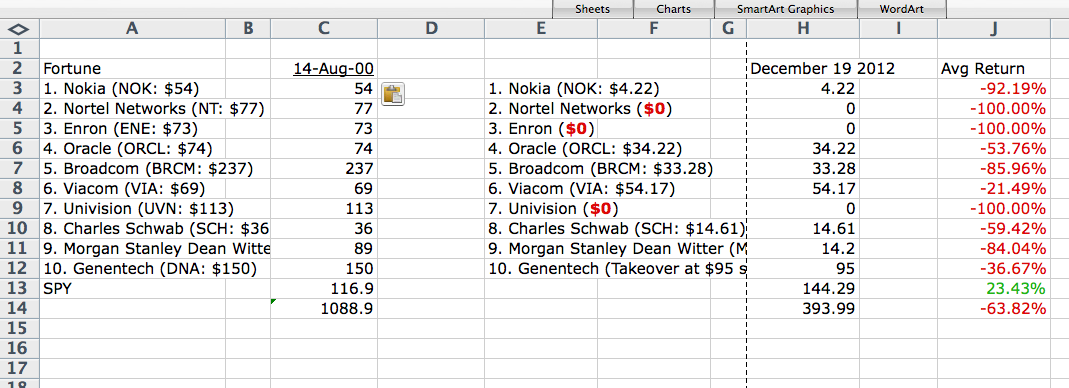
Sometimes, you just have to let the performance speak for itself. And for that, I present Fortune: 10 Stocks To Last The Decade A few major trends will likely shape the next ten years. Here’s a buy-and-forget portfolio to capitalize on them.
August 14, 2000
1. Nokia (NOK: $54)
2. Nortel Networks (NT: $77)
3. Enron (ENE: $73)
4. Oracle (ORCL: $74)
5. Broadcom (BRCM: $237)
6. Viacom (VIA: $69)
7. Univision (UVN: $113)
8. Charles Schwab (SCH: $36)
9. Morgan Stanley Dean Witter (MWD: $89)
10. Genentech (DNA: $150)
Closing prices December 19, 2012:
1. Nokia (NOK: $4.22)
2. Nortel Networks ($0)
3. Enron ($0)
4. Oracle (ORCL: $34.22)
5. Broadcom (BRCM: $33.28)
6. Viacom (VIA: $54.17)
7. Univision ($? )
8. Charles Schwab (SCH: $14.61)
9. Morgan Stanley Dean Witter (MWD: $14.20)
10. Genentech (Takeover at $95 share)
The portfolio managed to lose 74.31%, with 3 bankruptcies, one bailout, and not a single winner in the bunch. Even the Roche Holdings takeover of Genentech was for 37% below the suggested purchase price. The lesson is that valuation matters.
(Update: Forgot about Univision takeover — I’ll pull the TO price and recalculate when I get into the office)
(Update 2: Yeah, I forgot about Oracle 2 for 1 split — I’ll adjust that as well Broadcom 3 to 2 split)
Had you merely bought the S&P500 index via the Spyders, you would have seen a gain of 23.43%.
Have fun forecasting!
Previously:
Apprenticed Investor: The Folly of Forecasting (TheStreet.com, 06/07/05)
2008 Investment Guides Are HILARIOUS (December 31st, 2008)
UPDATED: Worst Predictions for 2008 (December 31st, 2008)
Investing in 2012: Get ahead of forecaster folly (WaPo, December 30 2011)
Source:
10 Stocks To Last The Decade
By David Rynecki FORTUNE Magazine, August 14, 2000
http://money.cnn.com/magazines/fortune/fortune_archive/2000/08/14/285599/index.htm
Category: Financial Press, Investing, Really, really bad calls, Valuation
Please use the comments to demonstrate your own ignorance, unfamiliarity with empirical data and lack of respect for scientific knowledge. Be sure to create straw men and argue against things I have neither said nor implied. If you could repeat previously discredited memes or steer the conversation into irrelevant, off topic discussions, it would be appreciated. Lastly, kindly forgo all civility in your discourse . . . you are, after all, anonymous.


So I guess the thing to do is shorting those lists and make a lot of money?
I believe Jim Cramer had a similar list.
And Liz Ann Sonders touted JDSU for the long run.
Both Oracle and Broadcom had splits in that period so the numbers aren’t quite as bad as it would appear for those. But they still both lost over the period. Oracle was the only one of the bunch that retained much of its value, down only 8%. But your point is still well taken.
And Apple . . . . .?
Yowza!
[...] Buy and Forget Portfolio: 10 stocks to last the decade (TBP) [...]
Univision was bought out by an LBO firm at a price of about $36 per share in early 2007 (I owned the stock when it was bought out). I believe it later ran into financial stress because of too much debt…but your overall point is well taken.
[...] No matter what you do, don't read any newspaper or magazine "10 Stocks for 10 Years" lists. (TBP) [...]
sobering, very sobering. And nauseating. I am nauseated.
This is what happens when people confuse ‘entertainment’ with ‘advice’. If you have to shill for advertisers (think Walter Updegrave) then you are not in a position to give good, honest advice.
A really sobering post. Kudos!
Valuation matter for the very long term and I’d add that some timing sense doesn’t hurt either.
Regards.
I finally (long overdue) completed Benjamin Graham’s ‘Intelligent Investor’.
After more than 500 pages of reading, the final lesson is: 99% of retail ‘investors’ should buy index funds / ETF’s.
I strongly recommend it to any interested investors.
Most of the lessons are timeless. One important lesson relates to homework, a term the bulk of the population despises. No small wonder why Mr. Buffett is one of the world’s richest men, and the majority of us are not.
As Barry shows, ignore market pundits and stick with the basic indexes. Only accept the level of risk that aligns with your goals (assuming you have any). And sleep better.
By happy coincidence I wrote about that same article (and others) — my piece was published in MarketWatch today: http://www.marketwatch.com/story/story/?guid=96198326-0516-4707-853b-e10774e561b6
“Buy and hold” is dead as an investment strategy. In this yoyo market you have to be long on the upside and short on the downside. I use index ETF’s for that. Then I try to goose my gains by getting into (and out of) select momentum growth stocks (mostly small/mid caps) based on volume/direction metrics.
How about the “Nifty Fifty” from 40 years ago? A lot of them have survived and done pretty well, some have merged or been acquired, and a few were dogs like Kodak, Kresge, MGIC, Xerox, etc.
There’s no official list but Wikipedia cites this group:
American Home Products
American ly Corp.
AMP Inc.
Anheuser-Busch
Avon Products
Baxter International
Black & Decker
Bristol-Myers
Burroughs Corporation
Chesebrough-Ponds
The Coca-Cola Company
Digital Equipment Corporation
Dow Chemical
Eastman Kodak
Eli Lilly and Company
Emery Air Freight
First National City Bank
General Electric
Gillette
Halliburton
Heublein Brewing Company
IBM
International Flavors and Fragrances
International Telephone and Telegraph
J.C. Penney
Johnson & Johnson
Louisiana Land and Exploration
Lubrizol
Minnesota Mining and Manufacturing (3M)
McDonald’s
Merck & Co.
MGIC Investment Corporation
PepsiCo
Pfizer
Philip Morris Cos.
Polaroid
Procter & Gamble
Revlon
Schering Plough
Joe Schlitz Brewing
Schlumberger
Sears, Roebuck and Company
Simplicity Pattern
Squibb
S.S. Kresge
Texas Instruments
Upjohn
The Walt Disney Company
Xerox
Maybe they meant something else by buy-and-forget: forget you ever had that money?
Well, six of the ten DID last the decade.
Most importantly, does the guy that picked those ten still work there and can we get another ten out of him?
Clarification: Genentech (DNA) split twice (10/4/2000 and 4/16/2004). The adjusted price in August 2000 would have been $42.50. DNA was acquired 9 years later at double the Aug 2000 price.
Looks like ORCL (2:1, on 9/14/2000) and BRCM (1.5:1 on 1/26/2006) also had stock splits. Though small overall, it mitigates the loss calculation a little.
its an interesting philosophical statistics question
whether someone trying to be right
can be not just randomly wrong
but systematically wrong–every one wrong is pretty good
but you would have to see more and a multi year
before doing something like shorting
going the other way and betting against
its hard
may not even by possible to be systematicalyy wrong with consistency,
but i have a a few pundit candidates
[...] Why you should ignore stock recommendations in magazines and newspapers. (Big Picture) [...]
C’mon people: Buy index funds/ETFs? Sure you might make a little, but boooooring. I have a better plan: investing for excitement. Take money you don’t mind losing, and put it all on a carefully researched severely beaten up stock. Then watch it drop another 50%, recover, drop again, triple in 2 weeks, go bankrupt… Sure you may lose money, but who ever wanted to ride a flat 5 MPH roller coaster anyhow?
For those keeping score — MS shareholders now hold DFS directly.
MWD ($89) is now MS ($19) + 0.5 * DFS ($38) = $33. -63%. Congratulations.
Reading that list nearly gave me a nosebleed. It strikes me as a stupid list, structured to find the 100-bagger. But what would have happened if they’d recommended large, dominant companies that might have been boring, but weren’t likely to go away? Like this ten: 3M, Johnson and Johnson, Caterpillar, John Deere, McDonalds, Coca-Cola, IBM, Gillette, General Electric?
It’s not like people won’t need sandpaper, drugs, food, razor blades…None of those companies (except possibly GE) are doing anything especially revolutionary, that brings risk, nor are they likely to be quickly overtaken by competitors.
I don’t have the research facilities to figure out what such a portfolio would have done, but I think it might have done all right. And I think it’s probably do well in the next ten years, also.
Hmm. The “list of ten” I just submitted has only nine entries…so throw in IBM.
Whoops…
MS is trading at $19. So MS($19) + 0.5DFS($38) = $38. -57%.
Interesting that fully 50% of MWD (MS+DFS) value is the credit card company. 4th (last) place credit card company at that.
GB Says:
“Interesting that fully 50% of MWD (MS+DFS) value is the credit card company. 4th (last) place credit card company at that.”
The spread should widen premium DFS since the secular cliff of ZIRP flattening Credit Risk. Risk edge is not being rewarded and properly punished so MS as purveyor has lots of bullets to be using, but no game worth hunting. Credit card companies get paid well for the risk they know directly and ZIRP works for them.
Sure top 10 lists are a terrible way to invest, but come on Barry,
you cherry picked the worst list only 4 months from the internet bubble peak!
~~~
BR: Fair enough — Randomly pick any 10 best 10 lists you like and see how they work out . . .
[...] Fortune‘s ’10 stocks for the decade’ lost a bucket – The Big Picture [...]
[...] http://www.ritholtz.com/blog/2012/12/10-stocks-to-last-the-decade/ [...]
[...] 7) http://www.ritholtz.com/blog/2012/12/10-stocks-to-last-the-decade/ [...]
[...] saw this recent post by Barry Ritholtz harkening back to a sweeping prediction made in 2000. Fortune magazine [...]
[...] http://www.ritholtz.com/blog/2012/12/10-stocks-to-last-the-decade/ [...]
