NYTimes Takes on “The Big Lie”

Email this post Print this post
By Barry Ritholtz - December 24th, 2011, 12:08PM

I am please to report that calling out the Big Lie has now gone fully mainstream.

Recall last month, I had two Big Lie columns in the Washington Post:

What caused the financial crisis? The Big Lie goes viral.

Examining the big lie: How the facts of the economic crisis stack up

The first column was the most popular article on WashingtonPost.com for a full week. It generated nearly 1845 comments.

Since then, both Bloomberg.com and Reuters each have picked up the Big Lie theme. (Columbia Journalism Review as well).  In today’s NYT, Joe Nocera does too, once again calling out those who are pushing the false narrative for political or ideological reasons in a column simply called “The Big Lie“.

Nocera details exactly how its done:

“So this is how the Big Lie works.

You begin with a hypothesis that has a certain surface plausibility. You find an ally whose background suggests that he’s an “expert”; out of thin air, he devises “data.” You write articles in sympathetic publications, repeating the data endlessly; in time, some of these publications make your cause their own. Like-minded congressmen pick up your mantra and invite you to testify at hearings.

You’re chosen for an investigative panel related to your topic. When other panel members, after inspecting your evidence, reject your thesis, you claim that they did so for ideological reasons. This, too, is repeated by your allies. Soon, the echo chamber you created drowns out dissenting views; even presidential candidates begin repeating the Big Lie.

Thus has Peter Wallison, a resident scholar at the American Enterprise Institute, and a former member of the Financial Crisis Inquiry Commission, almost single-handedly created the myth that Fannie Mae and Freddie Mac caused the financial crisis. His partner in crime is another A.E.I. scholar, Edward Pinto, who a very long time ago was Fannie’s chief credit officer.”

Longstanding readers of TBP may recall the genesis of my interest in this:  When I was writing Bailout Nation, I did lots and lots of research into exactly what it was that led to the housing boom and bust, the stock market crash, and the Great Recession.

The answer was “its complicated.” There were many many factors, lots of bad ideas, plenty of poor judgement all around.

I summarized these into 7 broad categories. The incomparable Jess Bachman (of Wall Stats) created this fantastic graphic that is the centerfold of the book:

>

anatomy-of-a-crash

>

The perpetrators of the big lie all have something to hide. Whether they voted for more deregulation or passed the ridiculous the CFMA or supported the repeal of Glass Steagall or cheered Alan Greenspan’s monetary policy, the Big Lie supporters all bear some resposibility.

In the case of Peter Wallison, he was the Co-director of AEI’s financial market deregulation project. That was scrubbed from his AEI bio.

Ed Pinto has taken a different approach to trying to deflect the blame from the blameworthy. He has continually thrown shit against the barn wall to see what will stick. Originally, it was the fault of the CRA. When that argument failed, he blamed Acorn.  And now its the GSEs. Wallison and Pinto have had their greatest success with this — its now a talking point amongst many of the GOP contenders for the Republican niomination for President.

~~~

With this post, we move Peter Wallison an Edward Edward Pinto into the UnGuru category, where they can join the likes of Ben Stein, Elaine Garzerelli and Meredith Whitney as “Ungurus.” All posts that prominently mention these people include the category Unguru.

>

Source:
The Big Lie
Joe Nocera
NYT, December 23, 2011  
http://www.nytimes.com/2011/12/24/opinion/nocera-the-big-lie.html

I agree with Michele Bachmann

Email this post Print this post
By Barry Ritholtz - November 21st, 2011, 7:30PM

Well, at least about this one thing:

She and I are quite sympatico — at least when it comes to criticizing the Bush troika (Bush/Paulson/Bernanke) for the absurd bailouts of failed banks:

“The Bush administration … was embracing a kind of ‘bailout socialism,’ ” wrote the Minnesota congresswoman, who is running for the GOP presidential nomination. “It was painful to find out John McCain too favored the TARP bailout. … Here was no ‘maverick’ moment. The same disappointing stance was taken by the Republican leadership in the House.”

“I knew there was no way I could vote for it, because I couldn’t find authority for it in the Constitution,” Bachmann continued. “As a constitutional conservative, I put principle over party.”

Source:
Michele Bachmann says Bush, GOP embraced ‘bailout socialism
Seema Mehta
Los Angeles Times November 20, 2011
http://www.latimes.com/news/politics/la-pn-bachmann-book-20111120,0,2416841.story

Government Blameless in Bubble/Bust/Bailouts?

Email this post Print this post
By Barry Ritholtz - November 11th, 2011, 1:00PM

Reason has a critique of The Big Lie column. It was so disingenuous, I did something I rarely do: I sent an email to the author and editors at Reason. It went something like this:

I was disappointed to read your comments about my “Big Lie” column. You seem to have completely misread who I was blaming and what the Big Lie actually is.

Only one of two explanations suffice: Either I did a poor job communicating what the issue was, or you purposefully mischaracterized what I wrote.

On the possibility it’s the former and not the latter, allow me this further explanation.

The quote that I critiqued was Mayor Bloomberg’s whopper that the crisis was caused by Congress forcing banks to make ill advised loans to unqualified people. That statement is demonstrably false, and it is what I wrote in the WP. Not, as you described, that government was blameless.

Indeed, beyond the Post column, I have pointed a finger at Washington DC repeatedly. From the very early stages of the collapse, I have stated DC was a significant contributor. Indeed, early in the crisis, I described the government as “Uncle Sam the enabler.” (A Memo Found in the Street, Barron’s September 29 2008).

In the Big Picture blog, I made a list of the top blamees (Who is to Blame, 1-25, June 2009) It is dominated by government players, including the Fed, Congress, SEC, various Senators and Presidents, two FOMC chairs, the OCC, OTS, Treasury Secretaries, as well as private bankers and organizations.

And in Bailout Nation, I clearly detail how Congress did the bidding of Wall Street to allow special exemptions, waivers, and new legislation that contributed to the credit crisis, housing boom and bust, and Great Recession.

Your cartoonish argument is reductio ad absurdum – nowhere in the WP article do I remotely suggest the “big lie” was that Washington, DC played no role. But I do call out the nonsense Bloomberg was peddling, and you are pushing, that banks and Wall Street were merely innocent bystanders in all of this, and somehow were forced into these bad loans.

I would love to see any evidence you can muster that government forced banks to stop verifying employment and income, mandated no credit checks, eliminated debt servicing review, forced 120% LTV lending, or somehow pushed 2/28 ARM mortgages.

Less silly, please.

P.S. The print edition of the article, as well as my online edition, has 12 points numbered, not bulleted. That’s either a font or a browser issue on your end.

As William James noted, “a great many people think they are thinking when they are merely rearranging their prejudices.”

UPDATE: November 11, 2011, 11: 45

Tim prints my response, and adds to the discussion here.

WSJ: Fact Checking Romney

Email this post Print this post
By Barry Ritholtz - November 11th, 2011, 6:00AM

The WSJ called out Mitt Romney for repeating the Big Lie in the CNBC Presidential debate:

“Markets work. When you have government play its heavy hand, markets blow up and people get hurt,” Mr. Romney said, blaming Democrats for rules that he said force banks to make ill-advised loans.

Some conservative academics have said that Fannie Mae and Freddie Mac fueled the financial crisis because they had to meet federal quotas to finance low- and moderate-income homeowners.

But academic research has shown that those mandates didn’t spur the types of exotic lending at the heart of the subprime-loan crisis. Many of the worst mortgage lenders weren’t banks and weren’t subject to federal regulation. (emphasis added)

-Debate on Economics Turns to Character, WSJ, November 10, 2011

An honest debate is possible only if we maintain a pressure on key parties to stay reality based, avoid false narratives, and stop pandering to the lowest common denominator.

Kudos to the WSJ.

Banking’s Self Inflicted Wounds

Email this post Print this post
By Barry Ritholtz - October 4th, 2011, 7:24AM

Morgan Stanley in a free fall. Goldman Sachs at multi-year lows. Citigroup looking Ugly. Bank of America off 50% from recent highs.

You may be wondering what is going on with the major firms in the financial sector. While each of these firms have different problems — vampire squids to Countrywide acquisitions — they all have something in common: Their balance sheets are opaque.

This is no accident. Indeed, it was by design that execs in the banking sector, and their outside accountants, hatched a scheme in 2008 to hide their balance sheets from public view. The bankers had been lobbying the Financial Accounting Standards Board to change the rules that governed “Fair Value Measurements” also known as FAS157 (September 2006).

You may recall during 2008 this was referred to as “Mark-to-market” accounting.

Banks loved m2m during a boom period. M2M made the more unusual balance sheet holdings  — derivatives, the mortgage-backed securities (MBS), exotic liabilities, and other assets — look fantastic. The fair value measurements of these items — essentially, yesterday’s closing price — allowed the accounts to show enormous profits. Those were the underlying basis for huge bonuses, stock option grants and of course, company share prices.

The reality was quite a bit different. These were not equities or treasuries or corporate bonds — they were thinly traded items whose prices were ramping upwards on a sea of delusional optimism. As soon as the credit bubble ended and housing began to retreat, these assets would free fall like an Acme anvil in a Roadrunner cartoon — and the bankers were the Coyote.

Uh-oh, this was gonna be a problem. So the bankers began to lobby FASB to change the rules governing Fair Value Accounting. Sure, it was hugely helpful on the way up, but now, reporting actual holdings — previously marked at all time highs — was becoming problematic.

To their credit, the accounting board resisted. What Bankers were proposing — marking to their models — was patently absurd. These were the models that told them these purchases were good ideas in the first place. Changing Mark-to-Market to Mark-to-Model was a free pass to practically allowed banks to NEVER have to write down their liabilities. Some people began calling the proposed accounting changes  Mark-to-Make-Believe.”

In the midst of the 2008-09 collapse, however, Congress was in a panic. They mandated that FASB accept Mark-to-Make-Believe accounting in the Emergency Economic Stabilization Act of 2008. It gave the Securities and Exchange Commission the authority to “Suspend Mark-to-Market Accounting.” In March and April of 2009, that is precisely what occurred.

It was yet another example of an industry lobbying Washington, D.C. to get precisely what they want — and then having that legislation blow up in their faces. (I detailed other examples of this in a chapter of Bailout Nation — you can see that chapter here: Strange Connections, Unintended Consequences).

The bottom line is this: Investors do not really have a clear idea of how healthy any of these banks truly are. We do not know the state of their balance sheets. We do not know what their exposures are to mortgages, to Europe, to Greece, etc. They could all be technically insolvent, as far as any investor can tell.

And that is exactly how the bankers wanted it.

But given the trouble in Europe, and the likely problems in housing if the US goes into a recession, Investors have decided they cannot take the risk of a holding an opaque, possibly under-capitalized probably over-leveraged financial firm blindly. They are telling the banks no thanks, we are not interested, we are going to be prudent and we have to assume the worst. Hence, for the second half of 2011, they have been selling off their holdings in these opaque, potentially insolvent too big to succeed entities.

Bankers, enjoy your beds. You made them, now lay in them . . .

Bailout Nation, Chapter 12: Strange Connections, Unintended Consequences

Email this post Print this post
By Barry Ritholtz - October 4th, 2011, 6:50AM

Here is Bailout Nation, Chapter 12: Strange Connections, Unintended Consequences:

~~~

Bailout Nation, Chapter 12: Strange Connections, Unintended Consequences

Forget TARP: Wall St Borrowed $1.2 Trillion from Fed

Email this post Print this post
By Barry Ritholtz - August 22nd, 2011, 11:30AM

>

I continue to be of the mind that the Wall Street Bailouts were misguided, and that a massive Swedish style reorg would have been the best thing for the nation and the economy in the long run. Both Uncle Sam and the Fed would have provided the broad based debtor in possession financing required, and the losses would have fallen where they belonged — on the Shareholders and Bond Holders — and not the taxpayers.

The latest evidence of this: Data obtained by Bloomberg News through Freedom of Information Act requests, followed by months of litigation, and eventually, an act of Congress. (Wall Street Aristocracy Got $1.2T in Loans)

And the data ain’t pretty.

We knew that Citigroup (C), who borrowed $99.5 billion, and Bank of America (BAC), who took loans of $91.4 billion, were in trouble. I’ve been saying for the better part of 3 years now that they were, and likely still are mostly insolvent. But the surprise data point was Morgan Stanley (MS), got as much as $107.3 billion in loans, with no strings attached.

What should have happened?

Imagine if the government and the Federal Reserve were run not by knaves and fools and Wall Street sycophants, but instead, were run honestly for the benefit of the taxpaying voter. Imagine the goal was saving the banking system (not the banks), and the financial rescue was for the benefit of the taxpayers, not the bondholders. Naive thoughts, I totally understand, but hear me out.

A person who truly understood what had happened and why would have considered the following actions. Note these are not ideas come about with the benefit of hindsight, but what a small band of insightful people were saying at the time.

An honest broker of the situation would have:

1. Fire the senior management of the banks (see this)

2. Banned all lobbying activity as a condition of any aid (see this)

3. Forced a Swedish style prepackaged bankruptcy (see this and this)

Instead, we bailed out the bondholders and management, choking off hope for a robust recovery. We are in fact slowly turning Japanese, awaiting the next recession (and the next and the next).

>

Source:
Wall Street Aristocracy Got $1.2T in Loans
By Bradley Keoun and Phil Kuntz
Bloomberg, Aug 21, 2011 7:01 PM ET
http://www.bloomberg.com/news/2011-08-21/wall-street-aristocracy-got-1-2-trillion-in-fed-s-secret-loans.html

Previously:
The Moral Hazard of the “Bad Bank” (January 2009)
FDIC Bair: Bank Chiefs Need to Go (May 2009)
Report: Paulson Lied to Congress, Public (October 2009)
Banking Sector Remains (literally) Unchanged (January 2010)
Elections: Money Talks Louder Than Ever (October 2010)
Too Bad Banks Missed Out On the GM Treatment (November 2010)
BofA Freddie Mac Putbacks Resolved for 1¢ on $ (January 2011)

Robin Hood in Reverse: Bank Bailout Bonanza Heats Up

Email this post Print this post
By Barry Ritholtz - August 12th, 2011, 11:06AM

~~~

Source:
“Robin Hood in Reverse”: Bank Bailout Bonanza Heats Up (Again)
Aaron Task
Daily Ticker, August 12, 2011
http://finance.yahoo.com/blogs/daily-ticker/robin-hood-reverse-bank-bailout-bonanza-heats-again-134220127.html

How the Fed Got Itself Boxed In

Email this post Print this post
By Barry Ritholtz - August 10th, 2011, 7:20AM

Yesterday morning’s comments (Random Thoughts: Recent Trading/Market Activity) began with this bullet point:

“This entire crisis traces itself back in large part to then FOMC chair Alan Greenspan not allowing markets and the economy to flush themselves clean after the dot com collapse. It seems that nearly every Fed/Government policy action has been a response to the problems that error led to.”

Quite a few people responded, seeking clarification, and so I wanted to briefly address this issue.

The Federal Reserve (unlike most other central banks) has a dual mandate: Maintain full employment and keep inflation at bay. History informs us that these two factors are often opposed to each other: Growth begets price rises, and excessive price elevation retards growth.

Hence, for the Fed to do its job well, they have a neat balancing trick to perform.

We can trace the origin of the current Fed situation to a drift away from those two mandates. This occurred sometime in the 1990s, when then FOMC chair Alan Greenspan somehow began focusing on markets, asset pricing and a nonsensical catchall “investor confidence.”

It wasn’t long after that when traders deduced that the Greenspan was their bitch. It soon became apparent that at the first sign of trouble, the Fed stood ready to flood the system with liquidity. In just 4 short years, markets saw the Fed respond massively to the Asian Contagion (1997), Russian bond default, Long Term Capital Management Collapse (1998), Y2K bug (1999), Dot Com implosion (2000), 9/11 (2001).

There was no small irony in that Greenspan, Mr. Free Market himself, had become Mr. Centrally Planned Economy. This was not lost on the Wall Street community, whose jobs were to figure our where the best and most lucrative opportunity lay. Liquidity driven asset prices was the answer to that question.

Following the Y2K cash infusion on October 22, 1999, the Nasdaq doubled from 2500 to 5100 over the next 6 months. The 78% collapse it suffered overstates what should have been a more typical 50% crash (lets call it 2500 down to 1250) had the Fed intervention not occurred.

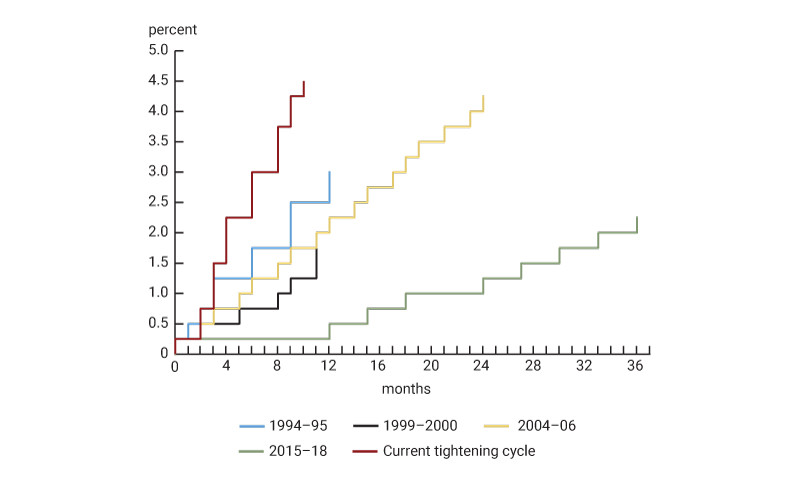
With the Fed Funds rate at 6% in late 2000, the Fed began slashing rates in January 2001. They made 8 rate moves between January and August 2001, cutting rates in half to 3%. Note this was all prior to 9/11. I believe Greenspan panicked, taking rates all the way down to 1.25% following the attacks.

At the time, it was unprecedented to have rates below 2% for three years, and at 1% for a year.

The net results of this action were enormous. Bond managers scrambled for yield, ultimately finding AAA rated mortgage backed junk product. The dollar plummeted 41% over the next 7 years. Anything priced in dollars skyrocketed, and inflation went screaming higher. Housing took off, loan standards collapsed, credit quality suffered.

There were many other factors involved: Radical deregulation, Globalization, diminishing incomes, labor restructuring.

But imagine what might have been if the 1990s/early 2000s Fed had been more circumspect. If you bought Russian bonds, and they defaulted, you were supposed to lose your money. Bought into a bad hedge fund that blew up? You took the hit! The DotCom collapse should have led to a flushing out recession and market crash that took a few years to recover from.

Instead, the Fed gave us a hair of the dog that bit us: More cheap money, and another liquidity driven rally.

Many of the subsequent ills this economy has suffered through derive from those decisions a decade or more ago. They have certainly been compounded by a variety of other really bad calls. But much of this traces itself back to the Greenspan Fed.

There is a reason I noted How easy money corrupted Wall Street and shook the world economy — it was a prime spark to the conflagration. Had we had a more normalized Fed policy, much of what took place in the 2000s very well would have gone down quite differently. We would likely have had a deeper, more painful recession, but we would have been on the path to recovery today.

Instead, we are like the late night reveler who forestalls the hangover by having another drink. And another. And another until we discover that we are alcoholics.

Hence, yesterday’s Fed announcement is the product of these earlier errors. The Fed cannot raise rates, lest they cause another recession. And the Fed cannot keep rates here, lest they admit their own policy failures, debase the currency further, and send oil over $100 and gold towards $2500.

They are boxed in. And they have no one to blame but themselves . . .

Harvey Pitt, Regulatory Expert

Email this post Print this post
By Barry Ritholtz - July 12th, 2011, 8:00PM

Here is a laugher: Dealbook is reporting that former S.E.C. Chairman Harvey Pitt is now criticizing Dodd-Frank. The giant SEC FAIL of the past decade traces, in no small part, to the great work of Mr. Pitt.

As a reminder of Pitt’s sterling ethics and his service to the investing community, I give you this brief Bailout Nation excerpt:

“Over the course of two terms, Bush appointed three SEC Chairmen, each ill-suited for the position. It was a veritable parade of poor choices for the role of regulating stock markets. His first appointment, Harvey Pitt, was a securities industry defense attorney and was wholly unsuited to the position. Instead of representing the interests of investors, Pitt was an industry lapdog. Pitt pledged a “kinder and gentler” SEC just when the opposite was needed in the midst of a huge run of corporate misfeasance.

In an era of corporate accounting scandals, Pitt had close ties to the accounting industry. And for inexplicable reasons, Pitt met with the heads of companies under active SEC investigation. As a Wall Street lawyer, Pitt had “recommended that clients destroy sensitive documents before they could be used against them – advice that seemed to find echoes in the SEC’s investigations into Enron and its shredder-happy auditor, Arthur Andersen.” Pitt had to recuse himself from many of the SEC’s votes — they were frequently about the clients he had represented as a defense attorney. By July of 2002, Senator (and future GOP presidential candidate) John McCain was calling for Pitt’s resignation.

Pitt, not surprisingly, demoralized the agency. To investor advocacy groups, having Pitt as SEC chief was like putting Osama bin Laden in charge of Homeland Security. . .”

Listening to Harvey Pitt discuss securities regulations is like taking trading advice from Nicholas Leeson . . .

44 queries. 0.522 seconds.