Dividends Are All The Rage – The Clamour For Equity Yield

Email this post Print this post
By Barry Ritholtz - February 7th, 2012, 12:30PM

Nice SocGen expression of how the search for yield has manifested itself in different asset classes:

>
Click to enlarge

Source:
Societe General – Cross Agent Research
The Global Income Investor
January, 30, 2012

In Search of Yield & Dividends

Email this post Print this post
By Barry Ritholtz - January 21st, 2012, 3:00PM

From this weekend’s Barron’s, a look at stocks that do — and don’t — have decent dividends:

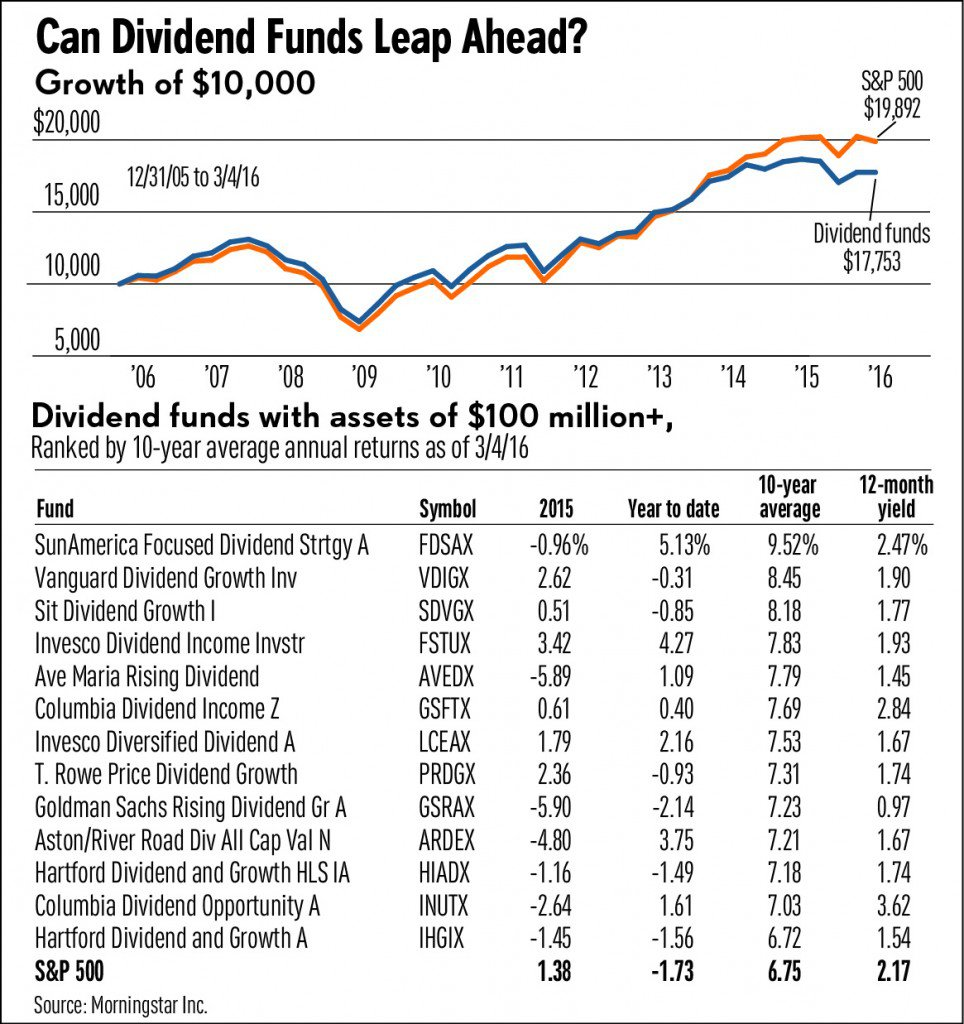
“The benchmark Standard & Poor’s 500 index has a dividend yield of just 2%, one of the lowest of any major global market. European stocks yield an average of nearly 5%, and even the historically low-yielding Japanese stock market pays 2.5%.

American companies have the wherewithal to raise dividends because profits are at record levels and the payout ratio—the percentage of profits paid out in dividends—is near an all-time low at 28%. It has averaged 40% over the past 20 years.” (emphasis added)

That is an astonishing stat . . .

>

Strong Dividends

~~~

Weak Dividends

>

Source:
In Search of Yield
ANDREW BARY
Barron’s JANUARY 21, 2012
http://online.barrons.com/article/SB50001424052748704900804577170672872489942.html

Dividend-Paying Stocks

Email this post Print this post
By James Bianco - December 22nd, 2011, 8:30AM

The Wall Street Journal – Dividend Stocks Become the Heroes

This year, the 100 stocks in the Standard & Poor’s 500-stock index with the highest dividend yields are up an average of 3.7% before dividend payouts, according to Birinyi Associates. The 100 lowest-yielding stocks are down an average of 10%. Dividend yield is calculated by dividing a company’s annual per-share dividend by share price. In the third quarter, share-price returns on high-dividend payers exceeded those of lower-paying companies by 17 percentage points, AllianceBernstein calculates. Investors hungry for stock-price gains have been barreling into dividend-paying shares, long regarded as “widow-and-orphan stocks” because of their steady but stodgy performance. Some analysts say such stocks are the most “crowded” trade around these days. Investors have been dazzled by dividend yields of more than 4% on many utilities, household-goods manufacturers and telecommunications companies. That is twice as much as recent paltry yields on 10-year Treasurys. Dividend-stock fans say the unusually strong performance is likely to last as long as volatility driven by Europe’s debt crisis and the global economic fits and starts continues to grip financial markets. Stocks that pay steady dividends tend to fall less than others when times are tough.

Comment

We offered our thoughts on dividend-paying stocks in an October post:

In our current uncertain and volatile environment, investors are seeking safety. So, it should come as no surprise that dividend stocks have gained in popularity especially since many blue-chip stocks pay higher dividend yields.

However, any case for a new era of dividend investing may be a bit overstated. Dividend stocks should simply be viewed as a slightly less risky form of stock investing. As such, we should expect dividend-paying stocks to outperform during bear markets and underperform during bull markets.

By comparing the S&P Dividends Aristocrats Total Return Index and the S&P Equal Weight Total Return Index, we can see this is indeed the case. The S&P Dividends Aristocrats Index measures the performance of stocks in the S&P 500 that have consistently increased dividends for at least 25 consecutive years. The index is equally weighted, so we compare its total return to that of the S&P 500 Equal Weight Index.

During the bear market from October 11, 2007 to March 6, 2009, dividend-paying stocks outperformed the S&P 500 Equal Weight Index by 11.6%. On an annualized basis, dividend stocks returned -35.74% versus -46.10% for the S&P Equal Weight Index.

Click to enlarge charts:

During the bull market from March 6, 2009 to May 2, 2011, dividend-paying stocks underperformed the S&P 500 Equal Weight Index by 42.4%. On an annualized basis, dividend stocks returned 44.38% versus 56.64% for the S&P Equal Weight Index.

Finally, during the bear market from May 2, 2011 through last yesterday’s close, dividend-paying stocks outperformed the S&P 500 Equal Weight Index by 10.56%. On an annualized basis, dividend stocks returned -3.25% versus -13.81% for the S&P Equal Weight Index.

To be sure that these past few bull/bear markets were the rule and not the exception, we also compared total returns of these two indices on all days when the S&P Total Return Index was up versus all days when the S&P Total Return Index was down. With data going back to the beginning of 1990, dividend-paying stocks returned an average of 66 basis points per day on days the stock market was up. The S&P Equal Weight Index returned an average of 77 basis points per day on those same days. On days the stock market was down, dividend-paying stocks returned an average of -67 basis points per day. The S&P Equal Weight Index returned an average of -80 basis points per day.

Rather than being concerned with reaching for yield, the charts and data above suggest dividend stocks outperform during bear markets and underperform during bull markets. However, if investors are savvy enough to know which way the market was heading in general, why even bother distinguishing between dividend-paying stocks and non-dividend-paying stocks?

Source: Arbor Research

Dividend Investing

Email this post Print this post
By James Bianco - October 13th, 2011, 8:30AM

Seeking Alpha Why Dividends Matter In A Changing Market
Lately, it seems that dividend investing has become all the rage. Articles are being written at just about every financial site, talking about dividends. When you look at Money Watch, MSN Money, Kiplinger, Money Magazine, Forbes, Smart Money, and even here at SA, there is no shortage of dividend investing commentary…Mark Hulbert has written an article that I think you might find interesting. He says:

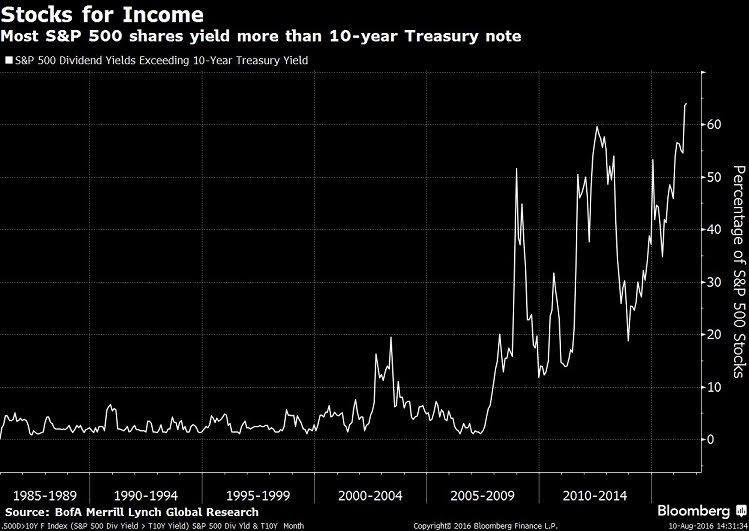
Believe it or not, the stock and bond markets are behaving in a way that, with only one exception at the depths of the 2008-2009 credit crisis, they have not since 1958—53 years ago: The stock market’s dividend yield is now above the interest rate on the 10-year Treasury note.

With dividend yields outpacing the 10 year Treasuries, perhaps we are beginning to see a paradigm shift back to that pre-1958 market model. Investors can now find companies that have a history of paying dividends, companies that are increasing those dividends annually, and companies that have the earnings power to continue making those dividend payments. Dividend investing may very well become the norm moving forward.

Comment

In our current uncertain and volatile environment, investors are seeking safety.  So, it should come as no surprise that dividend stocks have gained in popularity especially since many blue-chip stocks pay higher dividend yields?
However, any case for a new era of dividend investing may be a bit overstated.  Dividend stocks should simply be viewed as a slightly less risky form of stock investing.  As such, we should expect dividend-paying stocks to outperform during bear markets and underperform during bull markets.
By comparing the S&P Dividends Aristocrats Total Return Index and the S&P Equal Weight Total Return Index, we can see this is indeed the case.  The S&P Dividends Aristocrats Index measures the performance of stocks in the S&P 500 that have consistently increased dividends for at least 25 consecutive years.  The index is equally weighted, so we compare its total return to that of the S&P 500 Equal Weight Index.
During the bear market from October 11, 2007 to March 6, 2009, dividend-paying stocks outperformed the S&P 500 Equal Weight Index by 11.6%.  On an annualized basis, dividend stocks returned -35.74% versus -46.10% for the S&P Equal Weight Index.
.
.
During the bull market from March 6, 2009 to May 2, 2011, dividend-paying stocks underperformed the S&P 500 Equal Weight Index by 42.4%.  On an annualized basis, dividend stocks returned 44.38% versus 56.64% for the S&P Equal Weight Index.
.
.
Finally, during the bear market from May 2, 2011 through last Thursday’s close, dividend-paying stocks outperformed the S&P 500 Equal Weight Index by 8.19%.  On an annualized basis, dividend stocks returned -18.34% versus -34.30% for the S&P Equal Weight Index.
.

To be sure that these past few bull/bear markets were the rule and not the exception, we also compared total returns of these two indices on all days when the S&P Total Return Index was up versus all days when the S&P Total Return Index was down. With data going back to the beginning of 1990, dividend-paying stocks returned an average of 66 basis points per day on days the stock market was up.  The S&P Equal Weight Index returned an average of 77 basis points per day on those same days.  On days the stock market was down, dividend-paying stocks returned an average of -67 basis points per day.  The S&P Equal Weight Index returned an average of -80 basis points per day.

Rather than being concerned with reaching for yield, the charts and data above suggest dividend stocks outperform during bear markets and underperform during bull markets.  However, if investors are savvy enough to know which way the market was heading in general, why even bother distinguishing between dividend-paying stocks and non-dividend-paying stocks?

Source:
Bianco Research, LLC.
October 10, 2011

QOTD: Valuation Driven by MegaCaps

Email this post Print this post
By Barry Ritholtz - July 13th, 2011, 10:30AM

Mike Santoli disusses valuation in this weeks Barron’s:

“With those earnings coming, the question is whether the market has already paid for good results in returning to the upper end of its 2011 range. That’s another way of asking how stocks are valued here. The answer probably is fairly at best, and thus the market has at least put a generous down payment on imminent earnings.

Sure, the S&P 500 multiple on the next 12 months’ forecast earnings is below 13, thus seemingly cheap. Yet the biggest 30 mega-cap stocks are so inexpensive and scorned that the other 470 together trade right at their long-term average, notes Morgan Stanley strategist Adam Parker. And Ned Davis Research notes that the median stock has a trailing multiple above 18, above the 42-year median and “neutral at best.” (emphasis added)

Santoli notes the positive: Fed money is still free, corporate deal-making is “percolating” and investors are not yet excessively sanguine (i.e., too bullish).

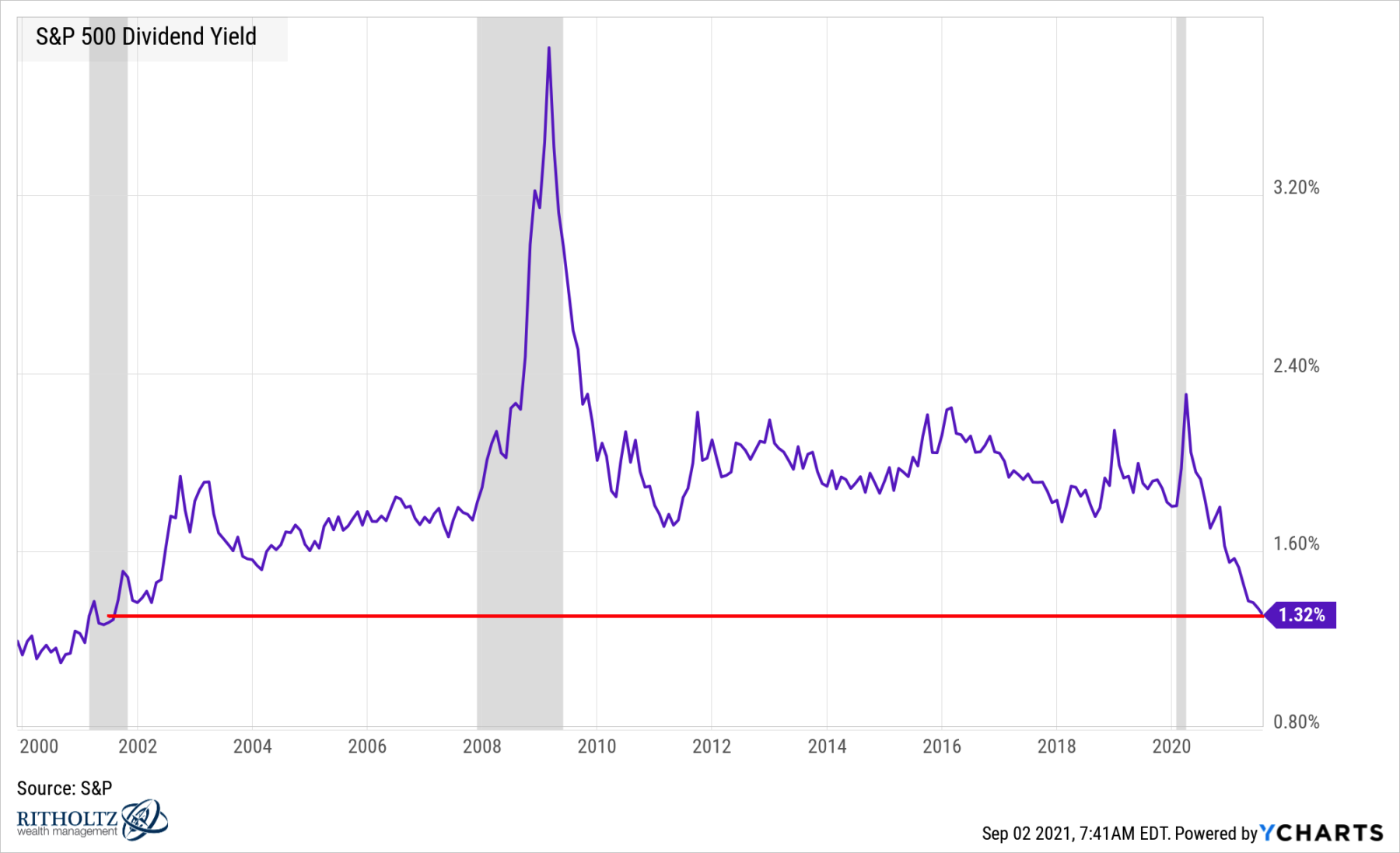
But the fact that “Traders have built up calluses” to this year’s bad economic news is a negative, not a positive in my book. It means they are ignoring risk and potential downside. And while stocks ain’t terribly pricey, they ain’t cheap either. Have a look at Jim Bianco’s long term dividend chart; its more supportive of a cyclical rather than secular rally.

>

Dividend Yields Back to 1970

BofA = Broken Stock?

Email this post Print this post
By Barry Ritholtz - March 30th, 2011, 6:31AM

Financials were largely left out of Tuesday’s rally. Are the banks telling us this bull market is broken? Find out from Fusion IQ CEO Barry Ritholtz.

BANK OF AMERICA AS MARKET BAROMETER

If Banks Can Resume Dividends, Can the Fed Resume Normalized Rates?

Email this post Print this post
By Barry Ritholtz - March 18th, 2011, 2:17PM

The Fed is giving the green light to banks to resume paying divvies. I guess this means things are okay, everything is getting back to normal. This must also mean their extraordinary accommodation via zero interest rates should be ending soon as well, right?

“The Federal Reserve cleared some of the 19 largest U.S. banks to increase dividends, buy back shares or repay government aid after “significant improvement” in their capital and the economy.

The banks, including firms such as Goldman Sachs Group Inc. and JPMorgan Chase & Co., have increased common equity by more than $300 billion from the final quarter of 2008 through the end of 2010, the Fed said in a paper released today in Washington on its most recent review of bank capital.”

Here is the punchline to the joke:

“Overall, both the quantity and quality of capital at many large bank holding companies have improved since the financial crisis,” the Fed said. “The return of capital to shareholders under appropriate conditions is a step in the process of improvement in the financial sector and will help to promote banks’ long-term access to capital.”

If I didn’t see the humor, I might end up crying . . .

>

Source:
Fed Says Some Banks Can Resume Dividends After Stress Tests
Craig Torres and Josh Zumbrun
Bloomberg, March 18 2011  
http://noir.bloomberg.com/apps/news?pid=20601087&sid=a7BT9GzEj0.E&pos=1

Do Dividends Matter? Maybe Not!

Email this post Print this post
By James Bianco - October 3rd, 2010, 9:30AM
  • MarketBeat (WSJ Blog) – Here’s Why You Should Care about Dividends: ‘Bladder Theory’
    A particularly pesky commenter has been tagging some our recent flurry of dividend-focused posts with this question: “Why do people care about the dividend yield? Doesn’t Modigliani-Miller imply we shouldn’t care except for tax reasons? And for tax reasons, it seems no dividend is better since you can choose when to realize a capital gain, but not a dividend.”…The theory suggests investors should be agnostic as to how stocks generate return. For instance, if a stock yields 10% a year, 3% might be in dividends and 7% might be capital appreciation. But if the company, had not decided to pay that money out in dividends that that cash would still belong to the shareholder. It would just be sitting on the balance sheet of the company instead of in the shareholder’s pocket. That cash balance would be incorporated into the market’s view of the company’s prospects, likely raising the capital appreciation component of its total return over time. That’s the theory at least. But in practice there’s an emerging sense it’s not always a good thing for companies to be rolling in cash. Some argue it might be a good discipline for management to be forced to pay out dividends.
  • MarketBeat (WSJ Blog) – BofA Quant: Dividends Strongest Performing Theme This Year
    Savita Subramanian, quantitative strategist for Bank of America Merrill Lynch says that dividend-oriented strategies have delivered the most consistent returns in 2010, but dividends are still an unloved part of the market:

In 2010, dividend oriented strategies have offered the strongest and most consistent returns despite the “risk-on / risk-off” nature of the market, and dividend yield and dividend growth are strategy leaders in the year to date. However, our work suggests we’re still in the early stages of building interest, given that dividend yield still remains a somewhat underutilized investment theme. Fund manager holdings show that Utilities, Staples and Telecom Services – sectors with the most attractive yield – are the most hated sectors, and have been for quite some time.

Comment

The table below breaks down the performance of the S&P 500 stocks by dividend yield:

  • The top of the table shows the performance of the 135 stocks that do not have dividends
  • The middle of the table breaks down 365 stocks stocks that do have dividends by quintile (1 =73 lowest dividend yielding stocks, 5 = 73 highest dividend yielding stocks)
  • Since these measures are calculated on an equal weighted basis, the bottom of the table shows a proper benchmark, the S&P 500 equal weight index
  • April 23, 2010 was the S&P 500′s 2010 high (1217.28)

What we found is rather surprising:

  • Year-to-date, owning dividend yielding stocks versus non-dividend yielding stocks has not mattered.  The differences shown are not material. This stands at odds with the comments highlighted above.
  • Since the high of the year, however, higher dividend yielding stocks (quintiles 4 and 5) have materially outperformed the lower dividend yielding stocks (quintiles 1 to 3) and non-dividend stocks.
  • Similarly, from December 31, 2009 to April 23, 2010, lower dividend yielding stocks (quintiles 1 to 3) and non-dividend yielding stocks outperformed the higher dividend yielding stocks (quintiles 4 and 5).

Conclusion

When the market is rallying (through April 23), the more speculative non-dividend and lower dividend yielding stocks outperform the more conservative higher dividend yielding stocks.  When the market is moving sideways-to-lower (since April 23), higher dividend yielding stocks outperform.

This is not new and not unique to this environment.  Instead this is fairly typical market action.  It suggests the opinion that dividend yielding stocks present a unique opportunity is not supported by market returns.

James Montier on the Importance of Dividends

Email this post Print this post
By Barry Ritholtz - August 25th, 2010, 3:04PM

JM Man Different Time 8-23-10

Stocks vs Bonds

Email this post Print this post
By Barry Ritholtz - August 14th, 2010, 11:30AM

My disdain for the efficient market hypothesis came about by observing the difference between the stock and bond markets.  It was apparent that the Fixed Income traders were of a “rational” mindset so often lacking in the equity world.

Indeed, I have frequently called Bonds the market that acts as “Adult Supervision.”

So I got a kick out of Mike Santoli’s reminder this morning in Barron’s:

“It’s for good reason the stock market was dubbed “the bond market’s idiot kid brother.”

Mike also points out an interesting data point regarding the Industrial’s dividend yield:

“Telling a similar story in a different way, the dividend yield of the Dow Jones Industrial Average components, at 2.65%, is essentially equal to the 10-year Treasury yield. The folks at Morgan Stanley note that over the past 50 years the Dow’s yield has exceeded that of the 10-year Treasury for only one period—the end of 2008 into early 2009, as the financial crisis climaxed.”

Idiot kid brother indeed.

45 queries. 0.440 seconds.