Apple’s Superlatives Amongst Superlatives

Email this post Print this post
By Barry Ritholtz - January 25th, 2012, 11:35AM

By now, everyone knows that Apple had a blowout quarter: Q1FY12 sales of $46.33 billion, profits of $13.1 billion, with gross margins of 45%, translates into EPS of $13.87.

But the data points that surround the company today are simply astonishing. Consider these astounding Apple facts:

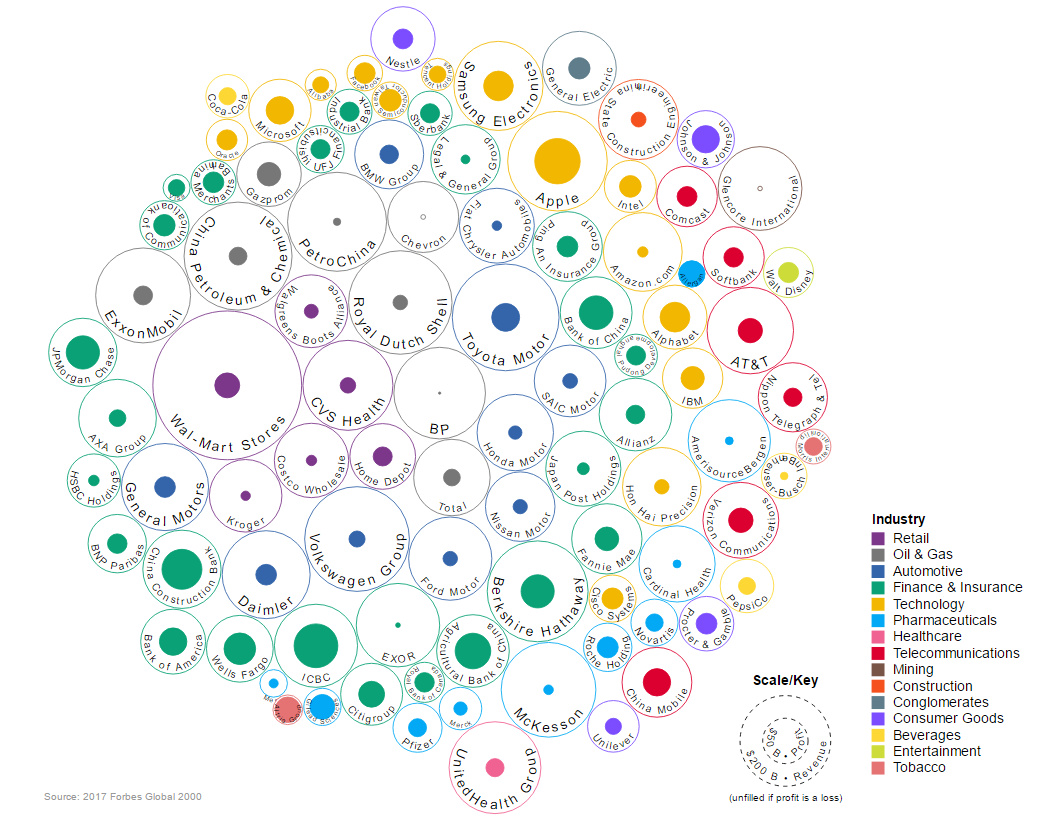
• Apple reclaimed the title of the world’s most valuable company $415B vs Exxon Mobil’s $413B (Yahoo Finance)

• The $97.6 billion in cash that $AAPL has is higher than the market value of 448 of the companies in the S&P 500. (Capital IQ)

• This was the 2nd highest profit quarter of any company ever. ExxonMobil’s Q3 08 profit of $14.8 billion needed $147 barrel oil and $140 billion in revenue. (WSJ)

• Sales rose 73% to $46.3 billion — so much for the law of big numbers working against them (CNN/Money)

• In 2009, Apple sold more iPhones than it did in 2007 and 2008 combined. In 2010, Apple sold more iPhones than it did in 2007, 2008, and 2009 combined. Last year, Apple sold 93.1 million iPhones, slightly more than it did in in 2007, 2008, 2009, and 2010 combined (Matt Richman)

• Apple’s profit of $13.1 billion was equal to their revenue in Q4 2010

• If Apple was a country, its market cap would make it 29th biggest nation, its annual revenue would make it the 52nd, its cash position 66th, and its earnings 79th, in terms of GDP  (Global Macro Monitor)

• Apple’s profits ($13 billion) exceeded Google’s entire revenue ($10.6 billion)  (Manjoo)

• Apple has now sold 315 million iPhones, iPads and iPod Touch devices running its iOS software (CNN/Money)

• Google would activate 59,653,187 Android-based devices during Apple’s fourth calendar quarter. Apple has said that iPod touch sales make up more than half of all iPod sales. That means Apple sold at least 7.7 million iPod touches. And that number, plus 37.04 million iPhones and 15.43 million iPads, means iOS outsold Android last quarter. (Matt Richman)

• Apple sold three times as many iPads as Amazon sold Kindle Fires (Tech Crunch)

Last, my favorite chart set, via Dan Frommer:

>

Apple’s BIG Beat

Email this post Print this post
By Global Macro Monitor - January 25th, 2012, 6:46AM

It is truly amazing how the world’s largest company can still grow revenues by 73 percent y/y and earnings by over 100 percent.   Apple blew away analyst estimates in today’s release by almost 40 percent, earning $13.87 in fiscal Q1 2012.  They also beat the Street’s revenue estimates by a margin larger than Nicaragua’s 2011 GDP!  Big numbers.

Our priors were that much of the revenue growth would come from Asia.  Not true.  In fact, Asia revenue growth was the lowest at just over 50 percent, which makes us even more bullish as China’s pent up demand will be saved for later quarters.

Still not  impressed?  Apple grew revenues in Europe in the quarter ending December 31 by 52 percent during the worst of the sovereign and banking crisis all while fighting the headwinds of a soaring dollar.    Stunning!

The company now holds around $103 in cash with no debt.   Maybe the market will, at last, put a decent multiple on Apple’s earnings, one that it has earned and deserves,  as the company continues to lead the world from the Information Age into the Wireless Age.   It’s that epic, folks, and not many recognize it.

Also, back by popular demand is the Apple GDP metric.

(click here if chart is not observable)

Breaking Down Google’s Earnings by Industry (2011)

Email this post Print this post
By Barry Ritholtz - January 23rd, 2012, 4:30AM

What Industries Contributed to Google's Billion in Revenues? [INFOGRAPHIC]

© 2012 WordStream, a Provider of AdWords and PPC Management Software.

WSJ Earnings Tracker

Email this post Print this post
By Barry Ritholtz - January 19th, 2012, 6:44AM

Nice graphic from the WSJ showing earnings hits and misses:
>

click for interactive graphic

http://graphicsweb.wsj.com/documents/earnings/CorporateEarningsWSJ.html

Whalen: Size Counts, Small Banks Are King

Email this post Print this post
By Barry Ritholtz - January 18th, 2012, 11:35AM

Source: Size Counts: Small Banks Are King, The Big Guys Still Have Lots of Problems, Says Whalen

Earnings Estimates

Email this post Print this post
By James Bianco - January 11th, 2012, 12:00PM

The Wall Street Journal – Earnings Pessimism Could Be Overdone
Alcoa is the Iowa of companies. But like the decidedly mixed verdict from the first Republican caucus, its bellwether status these days is questionable. The aluminum giant kicked off earnings season Monday night with a fourth-quarter loss. That, though, has more to do with structural overcapacity in its industry. So the result offers limited guidance to markets. Granted, the result does reflect the gloomy mood hanging over earnings season. Alcoa was just one company to see its estimates slashed in the run-up to results. As of last Friday, S&P 500 fourth-quarter earnings per share were forecast at $24.31. That would represent 7.8% growth year-on-year, according to Thomson Reuters, down from an expected 15% at the start of October. What’s more, analysts expect earnings in the last three months of 2011 to decline quarter-on-quarter. That would be rare: S&P 500 fourth-quarter operating earnings have risen sequentially 80% of the time since 1948, according to Citigroup. Even stripping out volatile financial-sector results, it is unusual for fourth-quarter earnings to fall this way. As bad as that sounds, it may actually be a sign the pessimism surrounding earnings is overdone. Yes, uncertainty abounds about the strength of the economic recovery. But the fourth quarter was hardly a washout.

MarketBeat (WSJ Blog) – Herd On The Street: Company Analysts All In This Together
Is this what they mean by “consensus estimates”? Company analysts aren’t generally known for sticking their necks out, but this is getting ridiculous. In the lead-up to fourth-quarter earnings reports, analysts are more clustered than ever in their profits estimates, says Savita Subramanian of Bank of America-Merrill Lynch. According to her calculations, estimate dispersion for S&P 500 company earnings are now down below 10% — the lowest that figure has been since at least Feb. 1986 (check the chart). In other words, it’s been at least 25 years since analysts were in such close agreement about where earnings are likely to land. This unusual state of affairs suggests one of two possibilities:

(a) Wall Street analysts are so certain, and prescient, about where earnings are going to be that they’ve all naturally clustered around the correct figures; or

(b) Wall Street analysts have no idea what’s going to happen, given the magnitude of macroeconomic uncertainties, that they’re all cribbing each other’s notes and/or going with the safest, most middle-of-the-pack estimates they can muster.

Comment

There is an option (c).  Companies are so good at guidance that analysts wait for investor relation departments to tell them what to estimate and follow their lead.  This would be our choice.

FactSet Research Systems Inc. – Earnings Insight

Comment

The chart above shows the percentage of S&P 500 companies that report earnings above estimates in the earnings “pre-season” (cyan).  The final percentage of S&P 500 companies that beat earnings estimates once all the number have been reported is shown in dark blue.  The earnings “pre-season” takes place before Alcoa reports each year (which happened yesterday), the unofficial start of the earnings season.

A FactSet Research Systems Inc. research report dated December 23, 2011 noted that, of the 21 companies who actually report “pre-season” earnings, 57% beat the mean estimate for Q4 2011.

As the chart above shows, this is the lowest percentage since the end of the 2007 to 2009 “Great Recession.”  FactSet also notes (page 4):

…. However, there is one trend in the data that may offer some predictive value for the Q4 2011 earnings season. In the nine quarterly “pre-seasons” where the percentage of companies reporting actual EPS above estimated EPS was below 80%, the final percentage of companies beating estimates was higher than the “pre-season” percentage for each quarter.

If history is any indication, we should expect the final number to be higher, but only marginally so.  This suggests that this earnings season will have the smallest actual number of earnings beats since the end of the recession three years ago.  In other words, this metric is suggesting a relatively poor earnings season.

Source:
Earnings Estimates
January 10, 2012
Bianco Research, L.L.C.

S&P Composite Earnings, Long Term P/E

Email this post Print this post
By Barry Ritholtz - January 4th, 2012, 12:30PM

Long term look at Composite Earnings and P/E, using 10 year average:

>

click for ginormous version

All charts courtesy of Bianco Research

Bank Earnings Forecast: +57%

Email this post Print this post
By Barry Ritholtz - January 4th, 2012, 7:00AM

Today’s howler comes from the fundamental banking analyst community. Recall that this is the group who once existed to help investors decide where to place their monies. When that did not work out, their bosses morphed their business model towards generating IPO and syndicate business. When that failed, they moved towards driving short term institutional trading.

Today, I have no idea what their business model is.

Despite having missed 2011′s declining earnings per share for the biggest U.S. banks, they are forecasting an even bigger profit surge for 2012, according to Bloomberg:

“The six largest lenders, including JPMorgan Chase & Co. (JPM), Bank of America Corp. (BAC) and Goldman Sachs Group Inc. (GS), may post an average profit increase of 57 percent this year, according to 184 analysts’ estimates compiled by Bloomberg. A year ago, analysts predicted profit at the banks would climb 32 percent in 2011. Instead, earnings per share probably fell 18 percent as the economic recovery analysts counted on never took hold.

Improved trading results, more investment-banking deals, expense-cutting measures and lower credit costs will lead to the increase in earnings that didn’t materialize last year, analysts say. That may provide a boost to stock prices after financials were the worst-performing industry in the U.S. in 2011.”

Exactly how does one forecast improved trading results? “I really feel these guys are not only going to have a better trading environment in 2012, but they are going to get better insight, cleaner executions and be a whole lot luckier than they were in 2011” said no one at all.

Its not just the Bank Analysts who stunk up the joint. Wall Street Market Strategists did not do much better, as this WSJ graphic shows:

The takeaway is you better have your own approach for investing and trading, rather than relying on 3rd party guesses . . .

>
Sources:
Bank Earnings Jump 57% in Analyst Forecasts
Michael J. Moore and Dawn Kopecki
Bloomberg, Jan 3, 2012  
http://www.bloomberg.com/news/2012-01-04/bank-earnings-increase-57-in-analyst-forecasts-which-proved-wrong-in-2011.html

Street Wary on Its Random Walk
Strategists, on Average, See 6.1% Rise in S&P 500 for 2012 as Worries Abound on Europe, Earnings
STEVEN RUSSOLILLO
WSJ, JANUARY 4, 2012
http://online.wsj.com/article/SB10001424052970204368104577139023088982182.html

Global Earnings Estimates Analysis

Email this post Print this post
By Barry Ritholtz - December 22nd, 2011, 6:24AM

Facinating piece from SocGen’s Cross Asset Research looking at expectations for global earnings in 2012. It is subtitled “Death by a thousand cuts; double digit downgrades for Eurozone and Japan” — so do not expect cheerleading.

The highlights:

• Recent earnings forecasts cut by 4.9% and 6.9% for 2011 and 2012, respectively.

• Severe downgrading of both 2011 and 2012 consensus forecasts, with Japan and the Eurozone seeing double-digit percentage cuts to
next year’s earnings;

• US stands out with only minor cuts to 2012 forecasts.

Note that on an ex-financial basis, US 2012 forecasts have seen just a 2% cut, which SocGen describes as “hardly consistent with a recessionary or low growth outlook.”

So either we will miss a recession in the US, or analysts are too optimistic.

>

Global earnings revisions and historical earnings growth
click for ginormous chart

>

Source:
Global Earnings Estimates Analysis: Death by a thousand cuts; double digit downgrades for Eurozone and Japan (PDF)
Societe Generale, December 22, 2011  
www.sgresearch.com

Are Earnings Cyclical?

Email this post Print this post
By James Bianco - November 29th, 2011, 8:30AM

Bloomberg.com – Grantham Calls Margins ‘Freakishly High’ That Doll Says Are Here to Stay

U.S. companies are the most profitable in more than 40 years, and some of the best-known stock pickers are divided over how long that will last. Bob Doll, chief equity strategist at BlackRock Inc. (BLK), said low labor costs and cost-saving technology will allow companies to keep up their profitability. Jeremy Grantham, chief investment strategist of Boston-based Grantham, Mayo, Van Otterloo & Co., said margins will send stock markets tumbling when they eventually revert to their mean. “The implication for the stock market is ugly, because it means earnings are unsustainably high,” Grantham’s colleague Ben Inker, GMO’s director of asset allocation, said in a telephone interview. GMO, an investment manager that oversees $93 billion, puts the fair value of the Standard & Poor’s 500 Index at between 950 and 1,000, compared with the 1,158.67 level at which it closed last week. U.S. companies’ ability to squeeze more profit from each dollar of sales is pushing earnings higher, even as the economy has grown at a below-average clip since the recession ended in June 2009. Grantham, who called corporate profits “freakishly high” in an August commentary, sees wide margins as an aberration. Some of his competitors say changes in the economy and the way firms operate could keep them near peak levels for another year or two.

Comment

Everyone agrees that earnings are cyclical except when they are at a high.  So are earnings at a peak?

The first chart below shows S&P operating earnings (red line) and 12-month forward forecasts  shifted ahead 12 months.  The second chart shows the difference between the forecasts and actual releases.  The shaded areas highlight official recessions.

Wall Street is one of the few places where practice does not make perfect. Notice that every subsequent recession sees larger earnings error rates than the previous recession.

During the 1990/1991 recession, top-down forecasters (strategists) were too optimistic by 10%.  Bottom-up forecasters (adding up the 500 company forecasts) were too optimistic by 25%.

During the 2000/2001 recession, top-down forecasters were too optimistic by 25%.  Bottom-up forecasters were too optimistic by 23%.
During the 2007/2009 “Great Recession”, top-down forecasters were too optimistic by 39.6%.  Bottom-up forecasters were too optimistic by 40%.

Also notice the difference between the top-down and bottom-up forecasts.  Strategists are getting significantly worse at predicting earnings than their 1980s and 1990s counterparts.

What Does This Mean?

If the economy goes into recession, earnings forecasts are not 10% to 12% too high.  Instead they might be 20% to 40% too high.  In other words, if the economy goes into recession, the earnings forecasts are horribly wrong.   They might be so wrong that one can make the case that the market might be overvalued. We believe this is part of what is bothering the markets, the epiphany that the economy is much weaker than expected and a recession will blow a hole in earnings forecasts to the point that the market might not be cheap anymore.

Source: Arbor Research

51 queries. 0.472 seconds.