Crawling Out of a Very Deep Hole

Email this post Print this post
By Barry Ritholtz - April 8th, 2012, 1:00PM

~~~


>

No need to even excerpt the text — the charts tell the entire story . .

>

Source:
Still Crawling Out of a Very Deep Hole
TERESA TRITCH
NYT, April 7, 2012   
http://www.nytimes.com/2012/04/08/opinion/sunday/still-crawling-out-of-a-very-deep-hole.html

It’s All About Jobs

Email this post Print this post
By John Mauldin - April 7th, 2012, 1:00PM

It’s All About Jobs
John Mauldin
April 7, 2012

>

Just Trying to Keep Up
Participating in the Labor Force
Some Good News on Employment
San Francisco, Denver, Austin, Philadelphia, Washington DC, Fort Lauderdale, etc.

>

Today’s employment numbers were decidedly soft, but the unemployment rate went down anyway, and that is about the best you can say. And this being a holiday weekend, it provides us an opportunity to look deep into the employment numbers, while we put off thinking about Spain for at least a week. And who knew that being an unmarried Asian-American in the US was a risk for unemployment? Plus a few other interesting items will make for an interesting letter.

Just Trying to Keep Up

March saw “only” 120,000 jobs created. Expectations were for 200,000 new jobs. It wasn’t all that long ago that any positive number would have been seen as good, but with the last six months averaging 200,000 jobs, this was disappointing. It gives force to the worry that once again we could see the employment numbers get soft during the spring and summer. And adding to interest in the topic, the employment numbers will take on a decidedly political tone this summer, as every poll shows that jobs and the economy is the #1 thing on voter’s minds. This will be underscored only four days before the presidential election on Tuesday, November 6, as the jobs report for October is scheduled to be released on Friday, November 2. Think that one won’t be analyzed more than usual? I keep writing that the current release is adjusted so often that it is hard to see more than a trend in the actual monthly releases, but that will not keep pundits from using the release to support their candidate with all the spin they can muster.

There is reason to believe that today’s lower number was partially due to the weather being so good in the earlier part of the year, so that what is usually seasonal employment started earlier than is typical; so it might be better to average the last two months, which is still disappointing in that it barely stays ahead of population growth. At this rate it will be another three years before we get back to new employment highs, and that does not factor in any population growth. And it also assumes there is no recession in the meantime. Given that the US must start at some point to get its budget balanced, there is little hope that more government spending (aka stimulus) is on the way.

The Bureau of Labor Statistics churns out a massive amount of data each month. Let’s look at one table and then discuss what we see. This is Employment Situation Summary Table A of the Household Data report, seasonally adjusted.

First, the unemployment rate fell by 0.1%, to 8.2%. But we see that the number of people who are actually employed dropped by 31,000, so how can the unemployment rate fall? Because the number of people looking for a job dropped by 164,000. If you aren’t looking for a job, you are not considered unemployed. Thus the participation rate, or the number of adults either working or looking for work, dropped by 0.1% to 63.8%.

Note that this table shows 133,000 new jobs. This is the HOUSEHOLD report, which is the report created from a survey of households. The 120,000 new jobs number is from the ESTABLISHMENT report, which is a survey of established businesses, plus a guess as to the number of jobs created from new businesses that have been born in the last month, also known as the birth/death ratio. This month the birth/death number added 90,000 new jobs to the total number. The B/D ratio is a very volatile number. It is based on data from the last five years and is projected forward. Again, the unemployment number is taken from the household survey, and the new jobs number is taken from the establishment survey. While you can get a new jobs number from the household survey, it is notoriously volatile and essentially useless as a month to month indicator. As an example, it was 428,000 in February. Variations can run in the high hundreds of thousands month to month.

But over time the household survey gives a pretty good picture and eventually comes quite close to the establishment survey, although there are often some major adjustments after a year or more that help bring the numbers into alignment with the actual numbers that come in from tax data.

Now, let’s look at a few other items. You can find employment by age, race, education, and gender. This page has a summary, although you can get very detailed data if you want to. For instance, this month we find that those with a college degree have a 4.2% unemployment rate, while 12.6% of those who did not finish high school did not have a job. Teenagers have a 25% unemployment rate. That number falls with each ten-year increase in age, until we get to those who are over 55, who are down to only 6.2% unemployed. Women have a lower unemployment rate than men at all ages.

Married men and women (spouse present) seem to fare better, with an average unemployment rate of 5.2%. The graph below shows us that married men tend to lose jobs faster during a recession but also get back to work quicker. I guess it helps you find a job if you have someone reminding you to go to work every morning.

If you had never been married you had a 12.5% chance of being out of work in March. For what it’s worth, Asian-Ameroicans seem to do slightly better in most categories than whites, while African-Americans have almost twice the unemployment levels. Hispanics are about halfway between whites and blacks across the board. One odd thing that stuck out was that married white couples have a lower rate (5.3%) than Asian couples (6.2%) while never-married whites are unemployed at 10.5% and Asians at 9.2%. I am sure my readers, both Asian and white will have all sorts of anecdotal reasons for this, but even though I have Asian daughters and black sons (adopted, for those who wonder how), I don’t get that one. You can find more data than you want to think about at http://www.bls.gov/web/empsit/cpseea10.htm .

Read the rest of this entry »

U.S. Employment Situation – March 2012

Email this post Print this post
By Global Macro Monitor - April 7th, 2012, 12:00PM

Nonfarm payrolls disappointed in March, posting a 120K increase.   Retail took a huge hit, losing 34K jobs and the construction industry, traditionally the lead driver out of recession, has yet to gain any real traction in creating jobs.

The BLS release notes,

Nonfarm payroll employment rose by 120,000 in March, and the unemployment rate was little changed at 8.2 percent, the U.S. Bureau of Labor Statistics reported today. Employment rose in manufacturing, food services and drinking places, and health care, but was down in retail trade.

The economy has a long way to go in recovering the 8.8 million jobs lost during the financial/economic crisis.  Even with the 3.6 million gain in NFP since March 2010,  cumulative job creation since February 2008 is still a hugely negative 5.2 million.   Moving in the right direction, yes,  but not even close to claiming victory.

>

Today’s Employment Report, also, Europe

Email this post Print this post
By David Kotok - April 6th, 2012, 7:23PM

Today’s Employment Report, also, Europe
David R. Kotok
April 6, 2012

~~~

Some holiday-weekend observations in bullet form.

1. The Jobs report was a disappointment to markets and to forecasters. Many of the components were negative surprises. In fact, little in it was positive. Stock futures sold off immediately. What happens by Monday’s opening is another matter. Government job losses seem to have run their course and are flat.

2. There is an issue in the number crunching. Stan Shipley of ISI summed it up well: “The contentious issue of the birth/death model has reappeared. This adjustment by the BLS is designed to capture newly established businesses that are missed in the survey. The problem with that adjustment is that there is no cyclical factor. New business formation sinks in a recession and rebounds sharply as the economy recovers.” Note that the birth-death adjustment does not capture these inflection points with any meaningful benefit.

3. Oil prices keep “hanging in.” It is not clear that the oil price has peaked. The US price reference is WTI; its distortion continues from inventory issues and pipelines running in the wrong direction. Eventually that will neutralize, and then we will again have a better US oil-price reference. Meanwhile, Brent stays in the low to mid 120s. Worldwide demand for oil is rising and production capacity is following slowly. Thus, the tightness in the oil market is likely to continue for a while.

4. Europe “ain’t over.” It is worsening. We have written about Spain and Portugal; see www.cumber.com. The socialist candidate (Hollande) in France has called for a 75% tax rate on the wealthy and a penalty on those citizens who wish to leave. He is ahead in the polls. France has a two-step election process. It will be interesting.

5. Note that France, a birthplace of liberty, now wants to force citizens to stay. So does the US. Ask your accountant about US tax code treatment of departing citizens. Key here is to distinguish between countries that say, “Come here because you want to” and those that say “Stay here because you have to.”

6. Greece is in a downward death spiral. The private losses on Greek debt are mostly taken. The government/institutional/official losses are in the hands of politicians and still lie ahead. The Greek economy shrinks as the debt burden grows. This perpetual subsidy from others is on an unsustainable collision course with eventual Greek financial collapse. Meanwhile, 92 members of the Greek parliament have offered amendments to water down the austerity budget (hat tip to Barclays). The Greek prime minister vows to defeat all of them. Next week Greece will announce its bank recapitalization plan. Those banks that are deemed “viable” will be able to gain financing from the ECB. Those that are not will need to fund liquidity from the Greek central bank under the Emergency Liquidity Assistance (ELA) program (hat tip to Credit Suisse). Note that ELA lending is central bank advances with lower-grade collateral. The Greek tragedy continues.

6. We are tracking ELA balances in every euro zone country. It is not easy to do. The central banks of the 17 euro zone nations do not break it out in a single available figure. They also report with a lag. There is little reporting consistency among them. Greece has only revealed its ELA balance through November. We estimate it was about 40 billion euros then, up from about 7 billion in July. We have no idea what the balance is today. The European Central Bank could separately identify each country’s ELA balance but chooses not to do so. Why not? Consider this: would you deposit your money in a bank that was in a national system with rising ELA? Not if you are sane. The flip side is that Eurozone folks have to guess. So they move money faster than they otherwise might and cause a bank run and an increase in that country’s ELA. It is always better to cut off a small loss and be forthright about it than to maintain a growing loss and try to hide it. But politicians do not know how to learn that lesson.

7. Fed Chairman Bernanke speaks at the opening dinner of the Atlanta Fed conference. Every word he utters on Monday night will be parsed. He is supposed to take some questions that have been pre-sorted or screened. This forum gives him an opportunity to offer an updated view of monetary policy after digestion of the weaker than expected employment report.

8. Also, note that Bill Dunkelberg’s NFIB survey data is coming on Tuesday. It offers clues into the job situation in the private, non-publicly traded half of the US economy. NFIB members are the job-creating engine. Their hiring plans are instructive. We will look for Dunk’s newest numbers.

This is a powerful weekend for Christians and Jews. Today is Good Friday; this year it coincides with the first day of Passover. In Jewish tradition, the day starts at sunset. The Last Supper was a Passover Seder. The greatness of the western freedom-loving heritage is rooted in the Exodus from Egypt and in the rejection of slavery. We should all celebrate that tonight.

In the modern era, slavery comes in many forms. Not all taskmasters carry whips. There are those who use words to deceive us. Sadly, we elect some of them.

We wish our readers all the best for their holiday celebrations, whatever their form. For our country and others in the freer portions of the world, we wish and pray for the preservation and defense of those special liberties we enjoy every day. We are so very lucky to have them. Most of the world does not.

Happy holiday.

David R. Kotok, Chairman and Chief Investment Officer

Good Friday NFP Day

Email this post Print this post
By Barry Ritholtz - April 6th, 2012, 7:52AM

Today we get the Non Farm Payroll data for March. Expectations are for 205,000 net new jobs, with Unemployment ticking down slightly. Unemployment benefits have dropped to the lowest level in four years, although long term unemployment remains a stubborn problem. And one of the drags on NFP data — government layoffs — may have run their course for now.

The key question for the report: Seasonal weather factors. Exactly how many jobs did the unusually warm weather in January and February pull forward from March (and April). The sectors likely to be influenced are construction, auto sales, transportation, and even retail shops like Home Depot and Lowes. I have heard some people suggest even hospitality and food service gained from the record high temperatures.

As an investor, I am keying in on two factors: What Does this mean for the possibility of Recession? And how does the Federal Reserve react to better or worse numbers?

While most of the Street has already moved past a possibility of any economic contraction, a few laggards (notably, ECRI and John Hussman) still are maintaining their recession vigils. A fourth month of 200k+ job creation makes those positions much less tenable; however, a major disappointment puts the economic bear back in play.

As far as the Fed is concerned, too good a number puts the probability of QE3 into further doubt. That is significant, as monetary stimulus have been a major catalyst to equity price rises. A strong number raises the bar for more stimulus. If that were to happen, equities are going to have be priced based on their earnings and growth prospects.

Imagine that . . .

>

Jobs News Could Be So Good That It’s Bad

Source: WSJ

>
See also:
Jobs News Could Be So Good That It’s Bad (WSJ)

Jobless benefits claims drop to lowest levels since 2008 (WaPo)

Payrolls in U.S. Probably Expanded by 205,000 Last Month (Bloomberg)

Conclusion: How Low Will the Unemployment Rate Go?

Email this post Print this post
By Guest Author - April 4th, 2012, 8:30AM

How Low Will the Unemployment Rate Go?
Jonathan McCarthy, Simon Potter, and Ayşegül Şahin
April 02, 2012

~~~

A major theme of the posts in our labor market series has been that the outflows from unemployment, either into employment or out of the labor force, have been the primary determinant of unemployment rate dynamics in long expansions. The key to the importance of outflows is that within long expansions there have not been adverse shocks that lead to a burst of job losses. To illustrate the power of this mechanism, we presented simulations in a previous post that were based on the movements in the outflow and inflow rates in the previous three expansions. These simulated paths show the unemployment rate declining to a level well below current consensus predictions over the medium term.

In this post, we run these simulations to their natural conclusion to see what happens to the unemployment rate if the current expansion lasts as long as any of the three most recent expansions. Recall that in these simulations, we assume that the inflow and outflow rates change at the same pace as they did in the expansions following the 1981-82, 1990-91, and 2001 recessions starting at thirty months into the expansion (roughly the point where we are now in the current expansion) through the start of the next recession (see the Okun’s Law post in this series for the length of each expansion). The simulated unemployment paths based on the three different scenarios are shown in the chart below.

The simulations demonstrate the importance of expansion length in reducing unemployment. Under the flow dynamics of the record-long 1990s expansion, the simulated unemployment rate falls to 4.7 percent, 5.3 percentage points below the peak unemployment rate observed in the recession period. For comparison, the actual unemployment rate fell to 3.9 percent in the 1990s expansion, 3.9 percentage points below its peak. The simulation using the flow rates in the 1980s expansion gives very similar dynamics: the simulated decline is 4.9 percentage points, whereas the unemployment rate actually fell 5.8 percentage points in the 1980s expansion to 5 percent. Consistent with the shorter duration of the 2000s expansion, the simulation based on the flow rates from that expansion has a minimum unemployment rate of 6 percent and the unemployment rate begins to rise toward the end of the simulation.

Three-Alt-Paths

Prospects for Flow Rates: What Do They Imply?
The importance of the outflow rate in unemployment rate dynamics during long expansions prior to the 2000s was virtually assured. In those periods, the rate of inflow to unemployment from nonparticipation was mainly driven by long-term trends, particularly the entrance of married women into the labor force (see the labor force participation post in this series). In most expansions, there have been temporary surges in the flow from nonparticipation to unemployment as job market prospects brighten. This was the case in February of this year, when the unemployment rate didn’t decline despite strong growth in employment because many prospective workers moved from being out of the labor force into unemployment.

Read the rest of this entry »

Prospects for the U.S. Labor Market

Email this post Print this post
By Barry Ritholtz - March 30th, 2012, 4:30AM

Prospects for the U.S. Labor Market
Jonathan McCarthy and Simon Potter

The unemployment rate in the United States fell from 9.1 percent in the summer of 2011 to 8.3 percent in February. This decline, the largest six-month drop in the unemployment rate since 1984, has surprised many economic forecasters. The decline is even more surprising because recent real GDP growth appears to have been around trend at best, whereas in early 1984, growth was more than 7 percent. Our next six posts in Liberty Street Economics will discuss prospects for the U.S. labor market given this surprisingly quick decline in the unemployment rate. In this opening post, we outline some of the themes examined in this series and provide a brief summary of our conclusions. But first we develop a simple framework to place the unemployment rate in context with the rest of the labor market.

The Framework
The relationship of and flows between unemployment, employment, and labor force participation will be at the center of our discussion. Often, discussion of employment focuses on the number of jobs added each month, as measured by the payroll employment change; for example, see this recent post in the Atlanta Fed’s macroblog. A different but very much related measure is the number of employees relative to the working-age population, known as the employment-to-population ratio. Even though it receives less attention, this measure is more closely related to overall economic growth relative to trend than is the payroll employment change. For example, consistent with recent GDP growth being around trend, the employment-to-population ratio has risen modestly over the past six months. In contrast, in the early 1984 episode, the employment-to-population ratio increased much more robustly as the unemployment rate declined, thus providing considerable impetus to growth.

To clarify the relationship of unemployment, employment, and labor force participation, we need a little math. First, we can express the employment-to-population ratio as

1_eqline1

The first term on the right-hand side of this expression is the definition of (1 – unemployment rate), and the second term is the definition of the labor force participation rate.  We then can rewrite the expression as:

1_eqline4

We then construct a decomposition of labor market changes by taking the logarithmic changes in the employment-to-population ratio (recall that the log of the product is the sum of the logs):

1_eqline5
where we have used the approximation that the logarithm of (1-unemployment rate) is the negative of the unemployment rate. (This approximation is better at lower levels of unemployment, but even for the recent higher data it is quite accurate: -log[1-0.083]+log[1-0.091]=-0.00876.)

The first figure shows how these three labor market variables evolved over the four post-1973 business cycles (excluding the short 1980 cycle), along with developments in the Great Recession and current recovery. We start at the lowest level of the unemployment rate before the recession and then follow the changes for three years after the rate reaches its maximum level. For the current expansion, the maximum unemployment rate occurred in October 2009.

The employment-to-population ratio displays a classic V-shape recession and recovery pattern in the 1970s and 1980s. In the recession and recovery of the early 1990s, however, the employment-to-population ratio instead displays a U shape, only returning to its pre-recession level three years after the peak in the unemployment rate. In the recession and recovery of the early 2000s, neither the participation rate nor the employment-to-population ratio returns to its previous level, so we see an incomplete U-shape pattern. In the most recent cycle, the employment-to-population ratio traces out an L shape, but the unemployment rate falls because the participation rate declines substantially (a much more gradual decline was expected by many given the aging of the baby boomers); in other words, a larger share of the population is out of the labor force rather than participating and being unemployed.

Labor_market_indicators_ALL

Upcoming Posts in the Series
The next five posts in this series will address the following questions:

  • How tightly linked to GDP growth is further improvement in the unemployment rate?
  • What do recent labor market flows—especially flows into employment from unemployment—tell us about recent labor market dynamics? How important is the flow rate from nonparticipation in the labor force to unemployment?
  • Are patterns of labor market flows in earlier business cycle expansions relevant in projecting flows in the current labor market? In particular, is this expansion different because of
    • high structural unemployment, especially because of the depressed  construction industry, and/or
    • changes in the labor market behavior of women?
  • If this expansion shows labor market flow patterns similar to those in previous expansions, how low could the unemployment rate go? Will a low unemployment rate necessarily imply that the employment-to-population ratio is close to its pre-recession level?

Many of the conclusions in this series can be foreshadowed using the information in the chart below, which contrasts short (lasting less than four years) with long (lasting more than four years) expansions. We average the path of the unemployment rate in long and short expansions separately and normalize the unemployment rate to the business cycle trough so that the relative rates of the decline in the recoveries can be seen. The percentage decline in the unemployment rate at this stage of the current expansion (thirty-two months) is close to the average percentage decline in the unemployment rate from the trough. It is also around this point that the paths of the unemployment rate in the two types of expansions start to diverge as the short expansions become recessions and the flow dynamics of declines in the unemployment rate are interrupted by large flows from employment into unemployment. In the long expansions, the improvement in labor market flows has not yet been interrupted by a recession.

Unemploy-Evolution

Many economists use Okun’s law to predict unemployment using forecasts for GDP. According to this “law,” substantial declines in the unemployment rate require above-potential economic growth. However, one implication of the unemployment path in long expansions is that the absence of a recession is more important than above-trend growth. In the second post, co-authored with Ging Cee Ng, we find substantial evidence for this point, especially in the two most recent expansions.

In the third post, Ayşegül Şahin and Christina Patterson examine how labor market flows, particularly outflows from unemployment, dominate the short-run dynamics of the unemployment rate. The outflows from unemployment can be either to nonparticipation or to employment. They find that much of the decline in the unemployment rate since October 2009 can be predicted by the outflow rate to nonparticipation in the labor force and by improvements in the outflow rate to employment. They use the pattern of improvement in previous long expansions to show that despite current low levels of flows in the labor market, the unemployment rate will continue to decline if there is a recurrence of this pattern. Indeed, the rate of decline will be quicker than the average rate of decline for long expansions.

Of course, many have questioned whether such improvements in labor market flows are possible given the large structural changes that have taken place during and after the Great Recession. In the fourth post, Richard Crump and Ayşegül Şahin present some estimates of “mismatch” or structural unemployment. These estimates, contrary to some conventional wisdom, show that structural unemployment has fallen in the recovery. To confirm this conclusion, they examine in detail the labor market flows of construction workers, a group that is commonly thought to suffer from high structural unemployment because of the housing boom and bust. They find that the dynamics of labor market flows have been very efficient in reducing structural unemployment for construction workers.

A different type of structural change came about from the entry of married women into the labor force from the 1960s to the 1990s. This long-term trend started to reverse in the late 1990s. In the fifth post, Stefania Albanesi, Ayşegül Şahin, and Joshua Abel examine how much of the recent decline in female labor force participation is structural and how much is cyclical—a difficult issue. Although the authors do not reach definite conclusions on that particular issue, they do find that many of the recent differences in the dynamics of the unemployment rate and of the employment-to-population ratio can be traced to women dropping out of the labor force. Since many of these female “dropouts” are highly educated, understanding the reasons for the decline in participation is crucial for a wide range of economic policies.

In the final post, co-authored with Ayşegül Şahin, we bring the analysis together to examine the implications of a very long expansion for the unemployment rate. We find that although the unemployment rate was more than 2 percentage points higher at the start of the current expansion than at the beginning of the 1990s expansion, it would decline to less than 5 percent in 2017 if labor market flows improve in a manner similar to the 1990s. This projection can be contrasted with recent Blue Chip long-run consensus forecasts that assume positive GDP growth through 2023 but project that the unemployment rate will not dip below 6 percent until 2018 and will not go below 5.5 percent.

This final post then goes on to provide a number of indicators that can be tracked to reveal whether labor market flows are improving in a way consistent with the 1990s. In analyzing some of these indicators, we present evidence that the improvement might be quicker than in the 1990s expansion. However, it is unclear from these indicators whether such improvement in the unemployment rate would be matched by comparable improvements in the employment-to-population ratio.  If the employment-to-population ratio continues to be sluggish as the unemployment rate declines (suggesting that flows to nonparticipation are important in driving the unemployment rate decline), then the unemployment rate will emerge as an increasingly less reliable measure of the health of the labor market.

Seasonal Adjustments: Fun With Numbers, Redux

Email this post Print this post
By Invictus - March 20th, 2012, 12:00PM

There are three types of people in the world: Those who understand Statistics, and everyone else.

>

Why do so many fund managers underperform? Our host and overlord frequently references cognitive issues, but I am beginning to suspect the problem is simpler: An glaring lack of fundamental math skills.

Those of us who stress data points in our analysis are bumping up against a legion of people — including strategists, commentators and economists — who seem unable to perform simple statistical analysis. Indeed, the willingness to misuse and abuse numbers makes me wonder whether they are polticially motivated. It goes far beyond the “Lies, damned lies, and statistics” to a point that is, to be blunt, embarrassing.

Last month, we watched Zero Hedge and Rick Santelli demonstrate their seeming innumeracy. The Census adjustment is painfully easy to understand, unless you are a) rooting for the end of the world; or 2) a partisan hack.  The combination of armageddon/hackdom sent the “1.2-million-people-dropped-out-of-the-labor-force” story viral.  Of course, that was embarrassingly wrong, but made its way thru the media, including to a White House press briefing. (BTW, have the sources of that misinformation ever posted a correction or retraction? Or are they standing pat with “Duh“?)

The latest innumerate silliness comes to us via an abuse of seasonal adjustment. This time, it is “on a Not Seasonally Adjusted basis, we’ve lost 1.8 million jobs since December!

This story has been floated around in many guises, but I first saw it via the estimable Art Cashin, who channeled The King Report, quoted here at Business Insider (emphasis in original):

Even more disturbing to us was word from a friend who subscribes to The King Report.  He says the newsletter says that without the filter of seasonal adjustment, so far in 2012 nearly 1.8 million jobs have been LOST.  Wow!  We’ll try to check that out.

I submit that this is, in fact, a perfect example of why we have seasonal adjustments in the first place.  People get hired going into the holiday season and are subsequently laid off or quit after the holidays.

By how much? On an Non Seasonally Adjusted (NSA) basis, from August through November 2011, the economy added…wait for it…1.89 million jobs. Retail and Shipping account for the lion’s share of these, with Bar & Restaurants also significant. After the holidays, 95% of these disappear in January and February.  That is why they call these “seasonal jobs.”

But more to the point, let’s take a look at the stunning NSA loss of 1.8 million jobs since December in the context of the previous decade, shall we?  Here’s the February print minus the previous December’s print for the past 10 years:

2003 -2273
2004 -2050
2005 -1880
2006 -1728
2007 -2105
2008 -2519
2009 -3939
2010 -2432
2011 -2037
2012 -1801

Which one of these is not like the others?  To my eyes, it’s the 3.9  million that printed for the similar period in 2009.  But that might tell a different story.  I suspect, perhaps, that this is not about innumeracy, but rather about folks who should know better yet choose to use numbers to mislead and deceive.  It is, frankly, unconscionable.

Folks, this is Statistics 101. There are plenty of things to criticize about various BLS models — this isn’t one of them . . .

Behind America’s Unemployment

Email this post Print this post
By Barry Ritholtz - March 19th, 2012, 3:54PM

Visual Economics points us to this Ginormous infographic, The Truth Behind America’s Unemployment.

click for full size graphic

>

All its enormity is after the jump . . .

>

Read the rest of this entry »

Where Will the Jobs Come From?

Email this post Print this post
By John Mauldin - March 17th, 2012, 11:15AM

Where Will the Jobs Come From?
John Mauldin
March 17, 2012

>

Getting Back to Full Employment
Who’s Participating in Employment?
4 Million New Jobs a Month!
Where Will the Jobs Come From?
Stockholm, Paris, San Francisco, and New York

>

“Six years into our global data collection effort, we may have already found the single most searing, clarifying, helpful, world-altering fact.

“What the whole world wants is a good job.

“This is one of the most important dsicoveries Gallup has ever made. At the very least, it needs to be considered in every policy, every law, every social initiative. All leaders – policy makers and lawmakers, presidents and prime ministers, parents, judges, priests, pastors, imams, teachers, managers and CEOs – need to consider it every day in everything they do.

“That is as simple and as straightforward an explanation of the data as I can give. Whether you and I were walking down the street in Khartoum, Cairo, Berlin, Lima, Los Angeles, Baghdad, or Istanbul, we would discover that the single most dominant thought on most people’s minds is about having a job.

“Humans used to desire love, money, food, shelter, safety, peace and freedom more than anything else. The last 30 years have changed us. Now people want to have a good job. This changes everything for world leaders. Everything they do – from waging war to building societies – will need to be in the context of the need for a good job.”

- From The Coming Jobs War, by Jim Clifton, Chairman and CEO of Gallup

>

Each month investors and politicians in countries all over the world obsess over the release of the monthly employment numbers. Even though these numbers are likely to be revised significantly from the original release, the markets can’t help responding to the variations from the expected number. Why the focus on numbers that are likely to be proven wrong in the coming years? Because the single most important factor in the direction of an economy is employment. Consumer spending, personal income, tax revenue, corporate profits, and a host of other variables all swing on rising and falling employment.

This week we begin a series of letters on employment. I have been researching the topic more than usual for the book I am writing with Bill Dunkelberg (the Chief Economist of the National Federation of Independent Businesses) on the entire employment issue. We will look at why employment is so critical. How are jobs created and what policies can be adopted to help foster more jobs? Should the US try and keep jobs that are going overseas, or develop whole new industries? Who exactly is the competition globally for jobs?

We will find that billions of jobs will disappear in the coming decades and even more will be created. There are today some 1.2 billion good jobs, but 1.8 billion people want them. Over the next 30 years the world economy will double and then almost double again. Where will the new jobs be and who will get them? What should you and you children be doing today to be sure that you have jobs in the future?

In order to try to answer these questions, we will start with a general view of the employment situation in the US. What has it looked like in the past and where is it going? Today, we will look at the direction of employment in the US and then focus on both what employment is likely to be in the next few years as well as the dynamics of the labor market. There is a lot to cover. (This letter might print a little longer, as there will be lots of charts.)

Getting Back to Full Employment

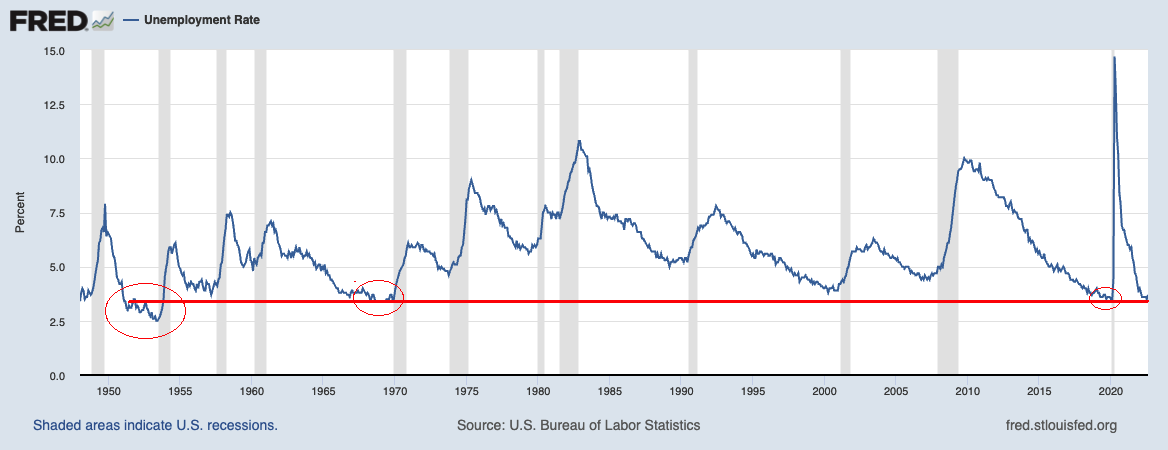
The headline unemployment rate is 8.3%, down from 10% only a couple years ago. But ten years ago it was less than half that, and at the beginning of the last decade it was less than 4%. 60 years ago it was less than 3%! Employment is a very volatile number, and as we have seen, it can rise substantially before and during a recession. The first graph we will look at is the unemployment rate, from the FRED database created by the St. Louis Federal Reserve.

Notice how much unemployment fell after the recession that followed World War II, during the ’60s, and then in the Reagan and Clinton years. What kept it from rising in the last decade less than after almost any previous recession, and what caused it to rise more following the recent recession than in any since WWII? We’ll look at that later, but for now let’s just get the lay of the land.

Read the rest of this entry »

57 queries. 0.554 seconds.