Employment Chart Palooza
Today’s Employment chart madness from Ron Griess of the Chart Store.
>
˜˜˜
~~~
~~~
More charts after the jump
Today’s Employment chart madness from Ron Griess of the Chart Store.
>
˜˜˜
~~~
~~~
More charts after the jump
Despite the cries of the permabears and Rick Santelli, this was unequivocally a strong NFP report. The headline numbers were 243,000 net jobs, as unemployment dipped to 8.3%. The Labor Pool increased — suggesting that the improvement was not the usual employee retirement and discouraged worked giving up looking for work.
When we go beneath the headlines, we usually see the data’s warts — not this time. Across the board this was a surprisingly strong report. BLS called described job growth as “widespread in the private sector, with large employment gains in professional and business services, leisure and hospitality, and manufacturing.”
As noted earlier, no single month matters as much as the overall trend — and the trend is unequivocally upwards for the better part of 3 quarters now.
Lets go to the details:
• Total nonfarm payroll employment rose by 243,000 in January. Private-sector employment grew by 257,000;
• Unemployment rate declined by 0.2 percentage points in to 8.3%; Its down by 0.8 point since August.
• The Household survey, used to measure Unemployment rate, added a whopping 491,000 jobs.
• The number of unemployed persons declined to 12.8 million, from over 16 million at the recession peak.
• Employment-population ratio rose to 58.5% in January (Seasonally adjusted)
• The average workweek for production and nonsupervisory employees on private nonfarm payrolls edged up by 0.1 hour to 33.8 hours.
• Average workweek for all employees was unchanged in January, but the manufacturing workweek increased by 0.3 hour to 40.9 hours (likely multi shift auto mfr); Factory overtime increased by 0.1 hour to 3.4 hours.
• Average hourly earnings for all private employees rose by 4 cents (0.2%) to $23.29. Over the past 12 months, average hourly earnings have increased by 1.9%
• November NFP was revised from +100,000 to +157,000; December NFP was revised from +200,000 to +203,000.
• Benchmarks were also revised upwards — as of December 2011, total employment was raised by 266,000 (231,000 NSA)
The Negatives?
• Unemployment rates for teenagers 23.2%; for blacks is 13.6%; Hispanics 10.5%
• Long-term unemployed (jobless for 27 weeks +) was little changed at 5.5 million — thats 42.9%
• Persons employed part time for economic reasons, at 8.2 million, changed little in January; 2.8 million persons were marginally attached to the labor force, and 1.1 million discouraged workers, essentially unchanged from a year earlier.
• Employment in information declined by 13,000, including a loss of 8,000 jobs in the motion picture and sound recording industry
• Employment in construction increased by 21,000 in January, likely a temporary blip caused by unusually warm weather — 206,000 people were unable to work due to weather, well below normal for this time of year.
The one dark spot is the nagging, persistently long-term unemployment data. I suspect that is as much due to secular trends than cyclical recovery and is unlikely to improve anytime soon.
All told, its tough not to like this NFP report. Markets surely do, with the Dow up 140.
>
Sources:
Employment Situation Summary
BLS, Friday, February 3, 2012
Did Economy Really Create 500,000 Jobs?
Real Time Economics February 3, 2012
http://blogs.wsj.com/economics/2012/02/03/did-economy-really-create-500000-jobs/
Today we find out just how seasonal those 200,000 new jobs were in December 2011. Consensus is for employment to grow by 140,000 — about par with population growth. Unemployment is expected to be unchanged at 8.5%.
As I am so fond of writing, no single month’s NFP matters all that much — focus on the overall trend to see what is significant. By way of the two charts below, the major overall trends have been improving. New Jobless claims have been ticking downwards since May of 2011. (Benchmark updates could be significant also).
We have seen a variety of retail sales disappointments — notably, Amazon.com (AMZN) and Ambercrombie & Fitch (ANF). Without more hiring and wage gains, higher consumer spending is going to be a difficult challenge to meet.
From a trading perspective, weakness would be problematic. With earnings slowing, the aforementioned soft retail, and the markets as overbought as they have been in a few months, the bulls don’t really need a weak number today.
From an investing standpoint, the outliers are where the risks lay: Too strong number (rather unexpected) might increase pressure on the Fed to end Operation twist and postpone QE3. A too weak number raises the possibility of a recession — currently thought of as not likely amongst most economists. A few observers — ECRI, Hussman, Rosenberg, Shilling, Faber, Rogers — think a recession is highly likely (For the record, I am still at 50-60% chance of recession, but willing to take that lower if the mixed data improves).
Hence, your reaction to today’s numbers should be a function of your positioning, holdings, timeline, and your risk management.
Employment situation report released at 8:30am
~~~
>
Initial Jobless Claims (2/2/12)

>
NFP (December 2011)

All charts courtesy of Barron’s Econoday
>
General Butler addressed the Bonus Army in Washington D.C. in 1933, as they “occupied” D.C. to demand compensation for their service to the country:
Smedley Butler from Louis Proyect on Vimeo.
General Butler invoked the 99% movement, telling the veterans:
We are divided, in America, into two classes: The Tories on one side, a class of citizens who were raised to believe that the whole of this country was created for their sole benefit, and on the other side, the other 99 per cent of us, the soldier class, the class from which all of you soldiers came. That class hasn’t any privileges except to die when the Tories tell them. Every war that we have ever had was gotten, up by that class. They do all the beating of the drums. Away the rest of us go. When we leave, you know what happens. We march down the street with all the Sears-Roebuck soldiers standing on the sidewalk, all the dollar-a-year men with spurs, all the patriots who call themselves patriots, square-legged women in uniforms making Liberty Loan speeches. They promise you. You go down the street and they ring all the church bells. Promise you the sun, the moon, the stars and the earth,–anything to save them. Off you go. Then the looting commences while you are doing the fighting. This last war made over 6,000 millionaires. Today those fellows won’t help pay the bill.
Indeed, veterans today support the 99% movement. They understand … just as General Butler understood.
As Butler wrote:
WAR is a racket. It always has been.
It is possibly the oldest, easily the most profitable, surely the most vicious. It is the only one international in scope. It is the only one in which the profits are reckoned in dollars and the losses in lives.
A racket is best described, I believe, as something that is not what it seems to the majority of the people. Only a small “inside” group knows what it is about. It is conducted for the benefit of the very few, at the expense of the very many. Out of war a few people make huge fortunes.
In the World War [i.e. WWI] a mere handful garnered the profits of the conflict. At least 21,000 new millionaires and billionaires were made in the United States during the World War. That many admitted their huge blood gains in their income tax returns. How many other war millionaires falsified their tax returns no one knows.
How many of these war millionaires shouldered a rifle? How many of them dug a trench? How many of them knew what it meant to go hungry in a rat-infested dug-out? How many of them spent sleepless, frightened nights, ducking shells and shrapnel and machine gun bullets? How many of them parried a bayonet thrust of an enemy? How many of them were wounded or killed in battle?
Out of war nations acquire additional territory, if they are victorious. They just take it. This newly acquired territory promptly is exploited by the few — the selfsame few who wrung dollars out of blood in the war. The general public shoulders the bill.
(Watch an actor read Butler’s dramatic speech.)
No wonder the 1% persecute pacifists: they threaten the world’s most profitable game.
No wonder – as Nazi leader Hermann Goering noted – the war profiteers are always trying to trick the people into supporting war:
Why of course the people don’t want war … But after all it is the leaders of the country who determine the policy, and it is always a simple matter to drag the people along, whether it is a democracy, or a fascist dictatorship, or a parliament, or a communist dictatorship … Voice or no voice, the people can always be brought to the bidding of the leaders. That is easy. All you have to do is to tell them they are being attacked, and denounce the pacifists for lack of patriotism and exposing the country to danger. It works the same in any country.
Interesting discussion at Economix looking at the top economic strata:.
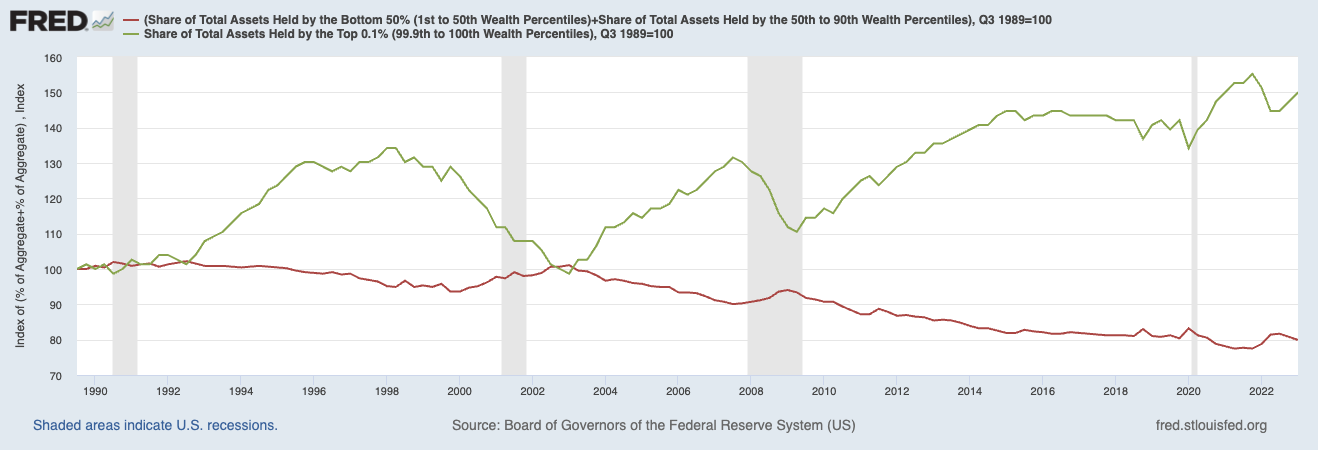
Instead of using income (as the Census does) to measure wealth, what if we looked at Assets instead (as the Federal Reserve’s Survey of Consumer Finances does)?. No surprise, the wealth gap as measured by net worth is much more extreme than that measured by income.
- Estimates for top 1% is a household income of about ~$380,000; ~7.5 times median household income.
-Net worth, top 1% = $8.4 million — 69 times median household’s net worth of $121,000.
-Wealthiest 1% received 16% percent of income — 8% of salaries and wages, but 36% self-employment income.
-1% controls a third of the nation’s financial assets (equities, private investments), and 28% of nonfinancial assets (RE, cars, jewelry, etc.).
-About 90% of the 1 percenters describe themselves as being in excellent or good health, vs 75% for the rest opf the country.
-Nearly half of the 1 percenters own two or more pieces of real estate vs just 5% for the rest of population.-1 in 5 of the wealthiest Americans say they have a boat, plane or helicopter, compared with 1 in 22 in other households.
-75% of wealthy spent less than they earned last year, vs 44% of everybody else.
Fascinating stuff . . .
>
Source:
Measuring the Top 1% by Wealth, Not Income
ROBERT GEBELOFF and SHAILA DEWAN
New York Times, January 17, 2012
http://economix.blogs.nytimes.com/2012/01/17/measuring-the-top-1-by-wealth-not-income/
Last month, I noticed this WSJ article, Merrill’s 2012 Pay To Drive Advisers To Richer Clients.
I didn’t think much about it over the holidays, but it started gnawing at me. Perhaps it was reading a draft of Josh Brown’s book, Backstage Wall Street over the weekend that started me thinking about that piece. This may be a little Inside Baseball for those of you who do not work in the industry, but bear with me. It is rather instructive of a certain mindset that has broader implications.
The article notes that Bank of America’s Merrill Lynch division will no longer pay its advisers on business done in new relationships they establish that are under $250k. Previously, the cut off was $100,000 dollars. What this means, quite simply, is that no Merrill adviser is going to pursue such business.
Note that the firm did not say they won’t accept such accounts; they are happy to take them and the 2% fees they generate. What they are saying is that they just won’t pay their employees on these accounts — which amount to 4% of the $2.2 trillion in client assets managed by 15,000 financial advisors.
A quick back of the envelope calculation is that this is $88 billion in assets that are no longer generating fees for employees. That is $1.76 billion is payouts that the bank has just decided to keep for itself, screwing their own employees of their fees. (UPDATE: No it is not; See details below)
I have spoken to a few Merrill employees, and they are livid. This is not policy, they inform me, it is simply a billion dollar theft. A few gents I spoke with are already looking at other shops. Another told me he considers this voiding his employment contract, and is speaking to his attorney about his options. This could end up being a recruitment windfall for Morgan Stanley and UBS.
Regardless, it is yet another example of what happens when incompetent institutions are kept alive by government bailouts, instead of the preferred route of prepackaged bankruptcy reorganization.
I expect two current trends to continue:
1) The exodus of advisors from the big bulge bracket wirehouses towards smaller independent firms;
2) Clients and their assets (regardless of size) will continue to gravitate away from big firms and towards do it yourself discount brokers and independent advisors.
Regardless of the outcome of this foolishness, it is rather telling about the state of Bank of America’s (BAC) finances. A stupid idea this short term and self-destructive can only mean their financial position is even more precarious than I previously believed . . .
>
UPDATE: January 9th, 2012 10:12am
Merrill Lynch tells me that the existing accounts are grandfathered — they will continue to be paid on. The new accounts are the problems MER reps have been screaming about.
>
Source:
Merrill’s 2012 Pay To Drive Advisers To Richer Clients
Jennifer Cummings
WSJ, December 23, 2011 http://blogs.wsj.com/financial-adviser/2011/12/23/merrills-2012-pay-to-drive-advisers-to-richer-clients/
Exactly 5 years ago today, the WSJ published this post (Plutonomics) about a rather fascinating study on wealth inequality.
It was written by of all folks, Citigroup global strategist Ajay Kapur. In 2005, Kapur’s research team “came up with the term ‘Plutonomy’ in 2005 to describe a country that is defined by massive income and wealth inequality. According to their definition, the U.S. is a Plutonomy, along with the U.K., Canada and Australia.”
What are the basic characteristics of Plutonomies? According to Kapur:
1. They are all created by “disruptive technology-driven productivity gains, creative financial innovation, capitalist friendly cooperative governments, immigrants…the rule of law and patenting inventions. Often these wealth waves involve great complexity exploited best by the rich and educated of the time.”
2. There is no “average” consumer in Plutonomies. There is only the rich “and everyone else.” The rich account for a disproportionate chunk of the economy, while the non-rich account for “surprisingly small bites of the national pie.” Kapur estimates that in 2005, the richest 20% may have been responsible for 60% of total spending.
3. Plutonomies are likely to grow in the future, fed by capitalist-friendly governments, more technology-driven productivity and globalization.
Kapur also noted the impact massive income and wealth inequality had on other aspects of the economy: Savings rates, national debt level, spending patterns, reaction to high commodity prices, and more. All of these, he claimed are substantially affected by the ultra wealthy.
Note that this was from 5 years ago today — circa January 2007 was, ten months before the market peaked, 11 months before the Great Recession began, and 15 months before Bear Stearns, 21 months before Wall Street (AIG BAC C FNM LEH, etc.) collapsed, and about 55 months before Occupy Wall Street began.
Quite fascinating . . .
>
Source:
Plutonomics
Robert Frank
WSJ, January 8, 2007
http://blogs.wsj.com/wealth/2007/01/08/plutonomics/
Interesting observation:
“Disdain for the uber-rich was unthinkable until —
“It wasn’t the crash of 2008 that led to their fall from grace, nor exposure of the greed and stupidity that required a massive public rescue. It was their graceless reaction to the bailouts: no apologies, remorse or gratitude — even faked; just more arrogance, bonuses, takeovers, foreclosures. Wall Street begged to be occupied. The Unrepentant Financier could have been Time’s Person.”
-Rick Salutin, The decline of deference, Toronto Star, Thursday, Dec. 29, 2011.
Rather intriguing . . .
All of the Big Picture conference videos are now available.
Here is the latest video posted: The One Percent: Breaking Down US Wealth Distribution.
~~~
Watch all of the Big Picture Conference for $39.95 or choose just the speakers you want to see on FORA.tv