The Merrill Lynch Cramdown

Email this post Print this post
By Barry Ritholtz - January 9th, 2012, 7:20AM

Last month, I noticed this WSJ article, Merrill’s 2012 Pay To Drive Advisers To Richer Clients.

I didn’t think much about it over the holidays, but it started gnawing at me. Perhaps it was reading a draft of Josh Brown’s book, Backstage Wall Street over the weekend that started me thinking about that piece. This may be a little Inside Baseball for those of you who do not work in the industry, but bear with me. It is rather instructive of a certain mindset that has broader implications.

The article notes that Bank of America’s Merrill Lynch division will no longer pay its advisers on business done in new relationships they establish that are under $250k. Previously, the cut off was $100,000 dollars. What this means, quite simply, is that no Merrill adviser is going to pursue such business.

Note that the firm did not say they won’t accept such accounts; they are happy to take them and the 2% fees they generate. What they are saying is that they just won’t pay their employees on these accounts — which amount to 4% of the $2.2 trillion in client assets managed by 15,000 financial advisors.

A quick back of the envelope calculation is that this is $88 billion in assets that are no longer generating fees for employees. That is $1.76 billion is payouts that the bank has just decided to keep for itself, screwing their own employees of their fees. (UPDATE: No it is not; See details below)

I have spoken to a few Merrill employees, and they are livid. This is not policy, they inform me, it is simply a billion dollar theft. A few gents I spoke with are already looking at other shops. Another told me he considers this voiding his employment contract, and is speaking to his attorney about his options. This could end up being a recruitment windfall for Morgan Stanley and UBS.

Regardless, it is yet another example of what happens when incompetent institutions are kept alive by government bailouts, instead of the preferred route of prepackaged bankruptcy reorganization.

I expect two current trends to continue:

1) The exodus of advisors from the big bulge bracket wirehouses towards smaller independent firms;
2) Clients and their assets (regardless of size) will continue to gravitate away from big firms and towards do it yourself discount brokers and independent advisors.

Regardless of the outcome of this foolishness, it is rather telling about the state of Bank of America’s (BAC) finances. A stupid idea this short term and self-destructive can only mean their financial position is even more precarious than I previously believed . . .

>

UPDATE: January 9th, 2012 10:12am

Merrill Lynch tells me that the existing accounts are grandfathered — they will continue to be paid on. The new accounts are the problems MER reps have been screaming about.

>

Source:
Merrill’s 2012 Pay To Drive Advisers To Richer Clients
Jennifer Cummings
WSJ, December 23, 2011 http://blogs.wsj.com/financial-adviser/2011/12/23/merrills-2012-pay-to-drive-advisers-to-richer-clients/

Plutonomy

Email this post Print this post
By Barry Ritholtz - January 8th, 2012, 6:30PM

Exactly 5 years ago today, the WSJ published this post (Plutonomics) about a rather fascinating study on wealth inequality.

It was written by of all folks, Citigroup global strategist Ajay Kapur. In 2005, Kapur’s research team “came up with the term ‘Plutonomy’ in 2005 to describe a country that is defined by massive income and wealth inequality. According to their definition, the U.S. is a Plutonomy, along with the U.K., Canada and Australia.”

What are the basic characteristics of Plutonomies? According to Kapur:

1. They are all created by “disruptive technology-driven productivity gains, creative financial innovation, capitalist friendly cooperative governments, immigrants…the rule of law and patenting inventions. Often these wealth waves involve great complexity exploited best by the rich and educated of the time.”

2. There is no “average” consumer in Plutonomies. There is only the rich “and everyone else.” The rich account for a disproportionate chunk of the economy, while the non-rich account for “surprisingly small bites of the national pie.” Kapur estimates that in 2005, the richest 20% may have been responsible for 60% of total spending.

3. Plutonomies are likely to grow in the future, fed by capitalist-friendly governments, more technology-driven productivity and globalization.

Kapur also noted the impact massive income and wealth inequality had on other aspects of the economy: Savings rates, national debt level, spending patterns, reaction to high commodity prices, and more.  All of these, he claimed are substantially affected by the ultra wealthy.

Note that this was from 5 years ago today — circa January 2007 was, ten months before the market peaked, 11 months before the Great Recession began, and 15 months before Bear Stearns, 21 months before Wall Street (AIG BAC C FNM LEH, etc.) collapsed, and about 55 months  before Occupy Wall Street began.

Quite fascinating . . .

>

Source:
Plutonomics
Robert Frank
WSJ, January 8, 2007
http://blogs.wsj.com/wealth/2007/01/08/plutonomics/

Decline of Deference, Disdain for Über-Rich

Email this post Print this post
By Barry Ritholtz - January 4th, 2012, 11:00AM

Interesting observation:

“Disdain for the uber-rich was unthinkable until —

“It wasn’t the crash of 2008 that led to their fall from grace, nor exposure of the greed and stupidity that required a massive public rescue. It was their graceless reaction to the bailouts: no apologies, remorse or gratitude — even faked; just more arrogance, bonuses, takeovers, foreclosures. Wall Street begged to be occupied. The Unrepentant Financier could have been Time’s Person.”

-Rick Salutin, The decline of deference, Toronto Star, Thursday, Dec. 29, 2011.

Rather intriguing . . .

Inside the 1% (Big Picture Conference)

Email this post Print this post
By Marion Maneker - December 16th, 2011, 6:30PM

All of the Big Picture conference videos are now available.

Here is the latest video posted: The One Percent: Breaking Down US Wealth Distribution.

~~~

Watch all of the Big Picture Conference for $39.95 or choose just the speakers you want to see on FORA.tv

Inside the 1%

Email this post Print this post
By Barry Ritholtz - December 16th, 2011, 7:47AM

The One Percent: Breaking Down US Wealth Distribution from The Big Picture Conference on FORA.tv

Do We Face “A Japan-style Era of High Unemployment and Slow Growth”?

Email this post Print this post
By Invictus - November 19th, 2011, 1:00PM

Invictus here.

Interested parties were treated to a fascinating debate on the evening of November 14, as the Munk Debates assembled four estimable economic minds to debate the following resolution:

Be it resolved North America faces a Japan-style era of high unemployment and slow growth

Arguing the pro side of the resolution were David Rosenberg and Paul Krugman.  Arguing the con side were Lawrence Summers and Ian Bremmer.  Should the video be made available for replay, I’d suggest it’s well worth ~90 minutes of your time to watch.  Felix Salmon posted on the debate here, and Paul Krugman made mention of it on his blog here.

The results tell us that Summers/Bremmer swayed the undecideds to their side:

Personally, I went in on the “pro” side and came out unpersuaded by Summers/Bremmer.

My take on the essence of each debater’s arguments:

• Krugman – There are solutions to our current issues, but our political system is — and will remain — too dysfunctional to enact them.
• Rosenberg – We are undergoing a massive, wrenching deleveraging that must run its course, notwithstanding monetary/fiscal policy.
• Bremmer – Essentially argued that the US will always be the least dirty shirt in the hamper.
• Summers – His most persuasive argument, I thought, was his closing comment that pessimism can be a self-fulfilling prophecy.  The audience seemed swayed by this rhetorical flourish, though we certainly all know by now that hope is neither a plan nor a solution.

Rosie was clearly the most fact-based debater.  The arsenal of facts he has at his disposal is simply mind-boggling.  He could likely tell you the unemployment rate in April 1955 as easily as he could tell you his youngest son’s name.

The sad truth of the matter, though, is that we’re already mired in an “era of Japan-style era of high unemployment and slow growth.”  The only real question for debate is how much longer it will last.  Consider:

The unemployment rate has been above 7 percent since the end of 2008.  The Fed, which has done nothing but downgrade its economic assessments for quarter after painful quarter, did so again earlier this month:

(Click through for larger)

(Source: FOMC release November 2, 2011)

Note the drastic uptick in their assessment of the unemployment rate over the next few years, and the introduction of a forecast for 2014.  Here’s a graphic representation that metric:


(Source: FOMC release November 2, 2011)

If they’re right — and they’ve been too optimistic all along — and we see a 6.8% unemployment rate in 2014 (best case), that will take it down to a level last seen in November 2008, a six year round-trip up to 10.1% and back.  And, by the way, let’s not even kid ourselves that 6.8% is anywhere near acceptable.

In metrics that matter most to Americans, we are simply not moving the needle.  Or, more accurately, we’re moving it in the wrong direction.

(Click through all for larger)

(Source: Census.gov, Household Tables, H-6)

Takeaway: Well over a decade of stagnant incomes.


(Source: St. Louis FRED, Series SPCS20RSA)

Takeaway:  Home prices are at mid-2003 levels, so we’re where we were 8+ years ago.


(Source: St. Louis FRED, Series USPRIV)

Takeaway:  Private Payrolls are at about the same level they were at in late 1999 — well over a decade of stagnation here while the population has done nothing but go up.

I’ve already gone over poverty and food stamp statistics — the trends there are downright depressing, as were last week’s Census releases on children in poverty.  Of the myriad statistics I look at, analyze, and digest on a regular basis, nothing saddens me more than stats on children living in poverty, be it in the United States or elsewhere.  Many studies have shown that it is virtually impossible to overcome such an early disadvantage, and we should be doing all we can to eradicate this problem and ensure that our children begin their lives on a solid footing.

Bottom line:  Had I been drawing up the debate resolution, I would have written it as follows: “Be it resolved North America faces an ongoing Japan-style era of high unemployment and slow growth.”

Next month will mark the fourth anniversary of the beginning of our Great Recession — December 2007.  The progress we have made since then has been painfully slow and many metrics, some of which I display above, are still at levels first seen years ago.  Given the glacial pace at which things have been improving, it’s hard to argue that the answer to the original debate resolution — or my modification of it — is anything but “yes.”

Meritocracy vs. Plutocracy

Email this post Print this post
By Invictus - November 9th, 2011, 11:30AM

Invictus here, folks:

Occupy Wall Street has been the subject of debate with friends and colleagues. Some confusion and misconceptions are out there regarding the protesters’ message: I’ve heard that the OWS movement is anti-capitalist, anti-Semitic, Pro-Socialist, Pro-Marxist, or a combination thereof. Or that they’re just — as Atrios re-popularized the phrase long ago — Dirty F*ckin’ Hippies.

As Barry has described it, “there is an unfocused financial rage in the United States” — and you see it in both the Tea Party and the OWS movement. Rather than mischaracterize why so many Americans — on the Left and the Right — are unhappy, let’s go to the actual data to see what is underlying this negative general sentiment:

Gini Index

Let’s start with the Gini Index, “the degree of inequality in the distribution of family income in a country.” Here’s our place in the world:


Source: CIA Factbook
>

By way of comparison, Germany is #126 (of 136) with a Gini Index of 27, and Japan is #76 at 37.6.

Within the United States, this is what income inequality looks like from a Gini Index perspective:


Source: Census.gov, Table H.4
>

Well, How’d the Gini Index Get So Out of Whack?

In brief (footnotes removed):

In recent decades, CEO pay has grown dramatically in the United States. Between the 1930s and the 1970s, CEOs of the largest companies received approximately $1 million in total annual compensation (adjusted for inflation in year 2000 dollars). During this period, the ratio of CEO-to-worker pay narrowed as workers’ wages grew and CEO pay rose modestly. By the 1990s CEO pay grew dramatically. Business Week estimated that CEO pay at the largest companies grew from 42 times the average worker’s pay in 1980 to 531 times the average worker’s pay in 2000. In 2010, large company CEOs received $11.4 million, or 343 times worker pay, according to calculations by the AFL-CIO’s Executive Paywatch website.

Here are some additional tables on how executive compensation has skyrocketed over the past few decades. Additionally, I’m sure Warren Buffett’s quote resonates with OWS (frankly, it should resonate with everyone — Tea Party included): “Too often, executive compensation in the U.S. is ridiculously out of line with performance. Getting fired can produce a particularly bountiful payday for a CEO. Indeed, he can “earn” more in that single day, while cleaning out his desk, than an American worker earns in a lifetime of cleaning toilets. Forget the old maxim about nothing succeeding like success: Today, in the executive suite, the all-too-prevalent rule is that nothing succeeds like failure.”

A $1MM reduction in a CEO’s pay could be used to fund 13 jobs at $75k/year; nothing too complex about that math. Here are other jobs that could be created if we addressed the disparity.

Meanwhile, while CEOs and other executives have feathered their nests — largely by exploiting overly-friendly relationships with all-too-compliant boards to negotiate outrageous compensation and severance packages — things have not been going quite as well for the rest of the country, as those at the top continue to rise while the remainder continue to drift:


>

Read the rest of this entry »

Global Wealth Distribution

Email this post Print this post
By Barry Ritholtz - November 1st, 2011, 11:30AM

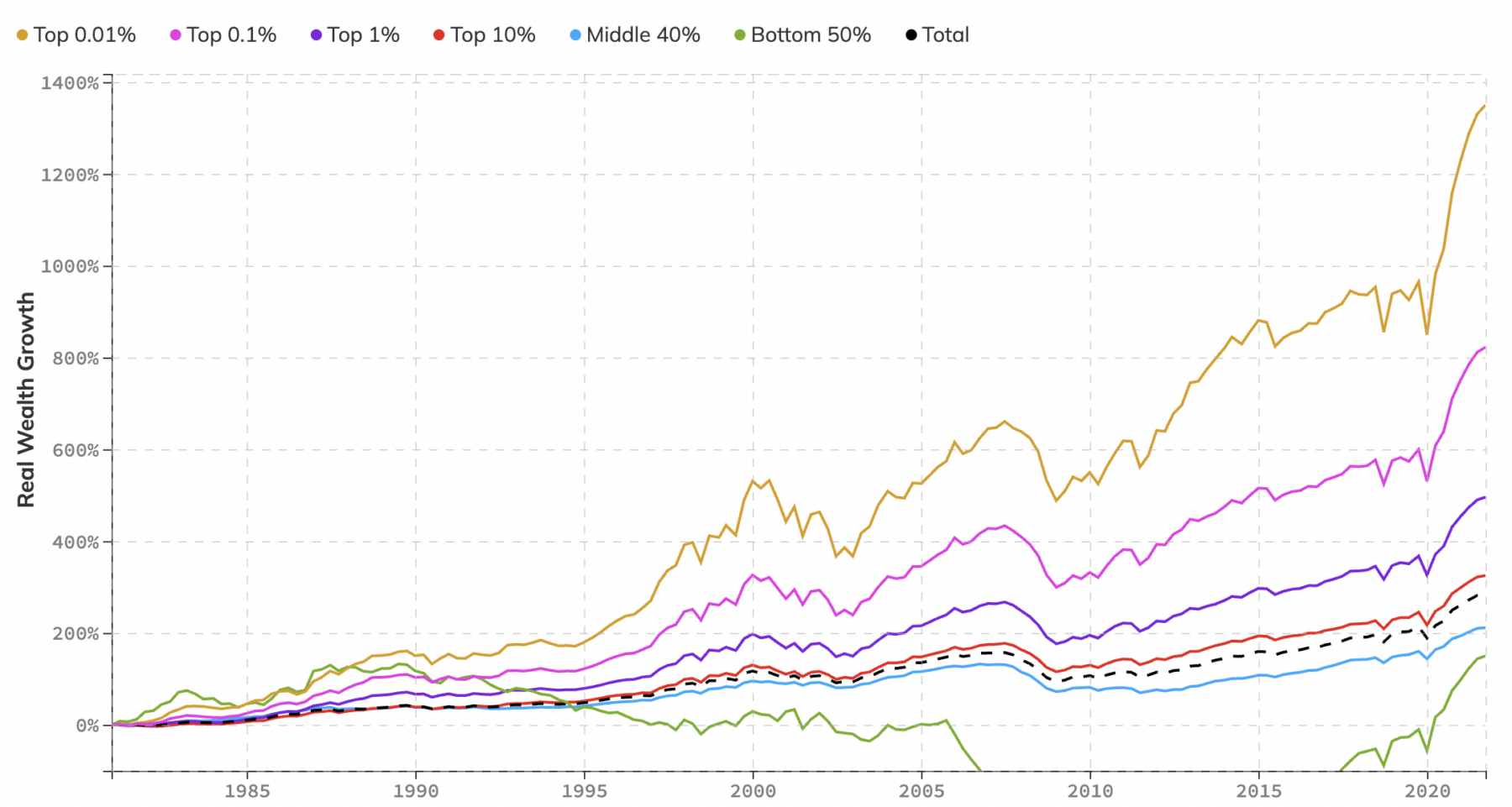
As we have discussed, from 1979 to 2007, inflation-adjusted incomes of the top 1 percent of households increased significantly versus the rest of the wage earners (i.e., the remaining 99%). Those even better off, the top 0.1 percent (the top one one-thousandth of households), saw their incomes grow 390%.

In contrast, incomes for the bottom 90 percent grew just 5 percent between 1979 and 2007. All of that income growth, however, occurred in the unusually strong growth period from 1997 to 2000, which was followed by a fall in income from 2000 to 2007.

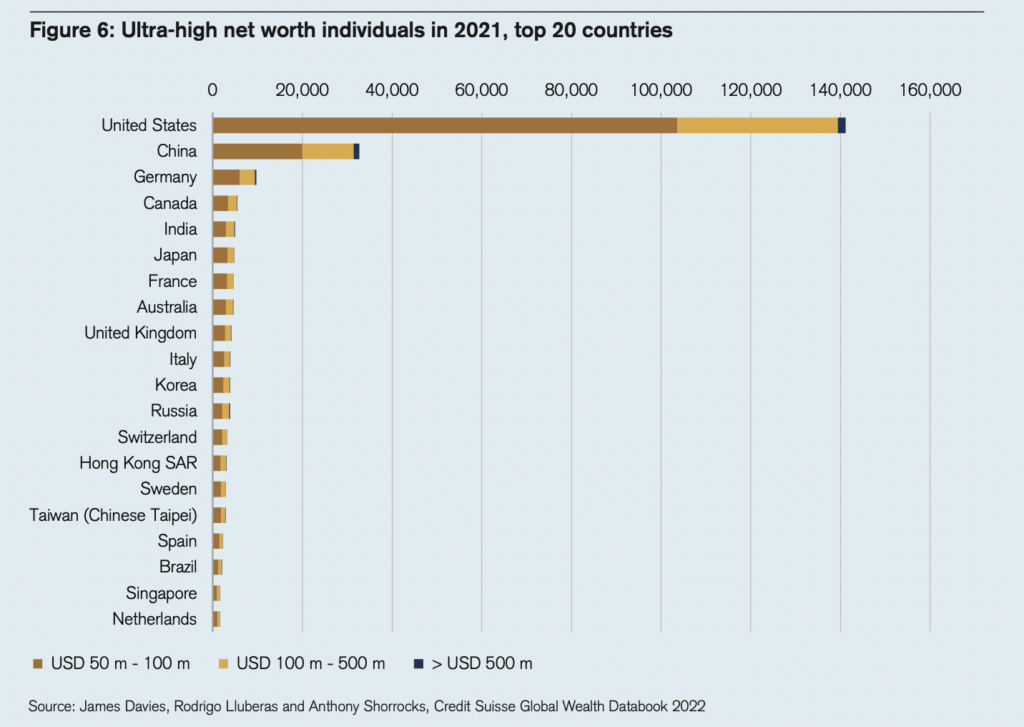
Is this wealth concentration a global phenomena, or is it a US centric? Lets go to the global data, via Credit Suisse Research Institute’s Global Wealth Databook:

>

>

>


Source: Credit Suisse, Research Institute

>

And as a reminder, here is the recent growth in the US data, via EPI:

Source: Economic Policy Institute

~~~

UPDATE: November 1 2011 12:51pm

David Wilson of Bloomberg News points out that a rising Misery Indexes worsens the  income-gap effect:

Accelerating inflation and historically high unemployment are magnifying the economic effects of income inequality, according to Sean Darby, a global equity strategist at Jefferies & Co.

The U.S. misery index, which increased in September to its highest level since May 1983. The indicator is calculated by adding the 12-month percentage change in the consumer price index to the jobless rate, as compiled by the Labor Department.

Darby cited the gauge and its U.K. version in a report yesterday. In September, the U.K.’s index rose to its highest reading since March 1992 after more than doubling in the last two years.

>

Has America Become an Oligarchy?

Email this post Print this post
By Barry Ritholtz - October 31st, 2011, 12:30PM

Source: Has America Become an Oligarchy?
Spiegel Online, October 28, 2011

Who Is Getting Richer ? Poorer? A LOT Richer?

Email this post Print this post
By Barry Ritholtz - October 27th, 2011, 12:00PM

That the rich get richer and the poor get poorer. At least, that is what most people believe.

That cliché is not quite accurate. The data on this subject, as detailed by the CBO and reflected in the charts below, reveals that over the past three decades, the poor got a little bit richer, the rich got a lot richer, and the most rich got phenomenally richer.

That may not fit on a bumper sticker, but it is the simple fact.

We learn these details from a newly released report on real (inflation-adjusted) average household income in the United States from the non-partisan Congressional Budget Office, titled Trends in the Distribution of Household Income Between 1979 and 2007.

The rich got richer — almost three times as rich — over that time period:

For the 1 percent of the population with the highest income, average real after-tax household income grew by 275 percent between 1979 and 2007 (see Summary Figure 1).

>

>

The very rich — the top 1% — captured the lionshare of the growth of total market income:

As a result of that uneven growth, the share of total market income received by the top 1 percent of the population more than doubled between 1979 and 2007, growing from about 10 percent to more than 20 percent. Without that growth at the top of the distribution, income inequality still would have increased, but not by nearly as much. The precise reasons for the rapid growth in income at the top are not well understood, though researchers have offered several potential rationales, including technical innovations that have changed the labor market for superstars (such as actors, athletes, and musicians), changes in the governance and structure of executive compensation, increases in firms’ size and complexity, and the increasing scale of financial-sector activities.

>

>

And as we showed the other day (see Forget the top 1% — Look at the top 0.1% and PPT presentation), the income inequality was skewed to an even greater degree amongst that top 1% — the top 0.1% and the much wealthier 0.01% is where all the big bucks are.

This matters a great deal — but not for the silly political reasons you have been led to think. No, its not about class warfare. No, its not about redistributing the wealth.

The reason this matters is quite simple: Healthy societies have modest, but not extreme wealth and income inequalities. There are inequalities because not everyone has the same skills and capabilities, and some inequality in wealth and income provides an incentive system.

However, massive, widely disparate economic inequality has historically led to bad — and in some cases, extremely bad — outcomes. It contributes to social unrest, excessive political populism, and mob violence.

I write this as someone who, due to a fortuitous combination of luck and work, developed a skill set that is highly valued by modern society. This is in part to an accident of birth, to have an excellent education, to some serendipity. Overcoming some adversity didn’t hurt; figuring out how to turn some deficits to an advantage was hugely beneficial. Thus, I find myself in that top 1% economically; but I know deep down in my soul that if I was born 100 years earlier — and maybe even 30 years earlier — I would not have been. This makes me acutely aware of the risks and dangers of our current wide disparity of wealth and income.

Healthy societies allow their citizens to have a realistic chance at fulfilling their potential. This is done through a combination of economic freedom, enforcement of laws and contracts, legitimate democratic elections, basic education for its citizens, tax fairness, regulatory oversight of influential corporations an other entities, and the institutional value of protecting individual liberty.

Where is the United States falling short?

~~~

Summary of CBO paper after the jump; full paper here.

~~~~~~~~~~~~~~~~~ Read the rest of this entry »

51 queries. 0.463 seconds.