
More Employment Charts

Email this post Print this post
By Barry Ritholtz - January 11th, 2010, 10:00AM

A few new charts hit my inbox since yesterday’s NFP data was released. These put the current state of the job market into greater perspective. (Click on charts to enlarge)

>

Monthly Changes in Non Farm Payroll, 2004-09:

This is a simple chart, showing the gains or losses each month over the past 5 years:
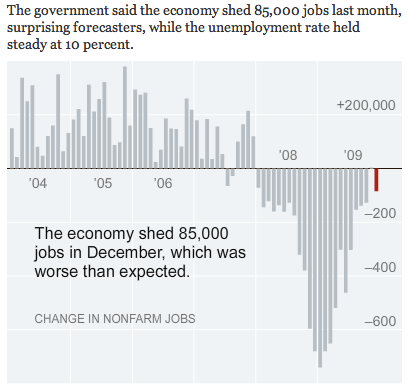

Chart courtesy of NYT

>

THE EMPLOYMENT RATE IS NOW AT 58.2% —  LOWEST RATE SINCE AUGUST 1983

This to me is a devastating picture of the workforce in the US — at its lowest level in nearly 3 decades:
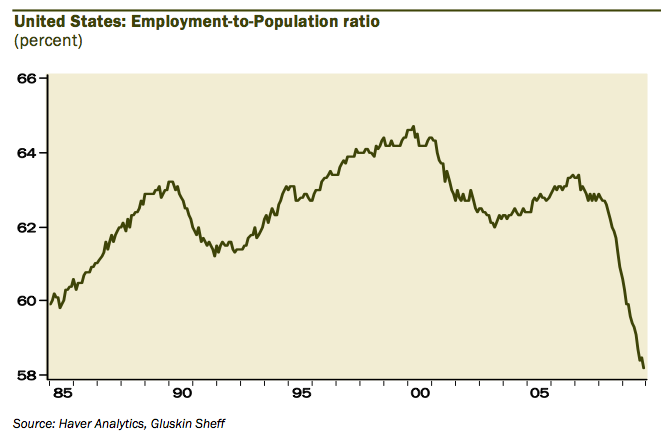

chart courtesy of Gluskin Sheff

>

Temp Help is Improving

Its not all glum — Temp help is improving, and tends to be a good early indicator of more hiring to come:
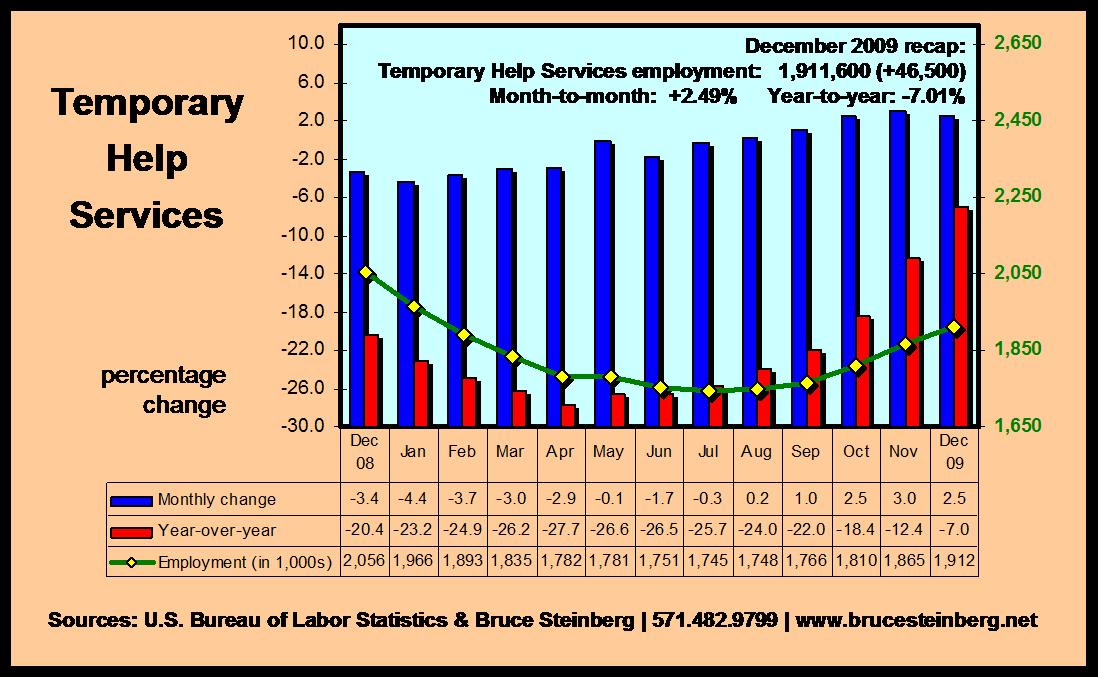

chart courtesy of Bruce Steinberg.net

>

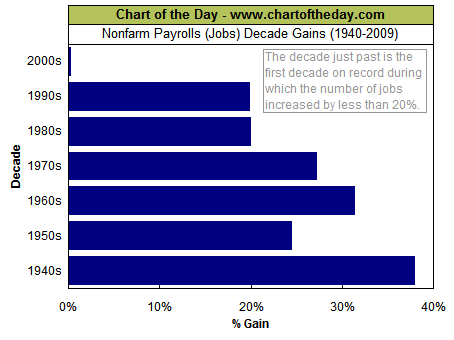
The 2000s were a bust:  Nonfarm payrolls gains by decade (data to 1939).

Straight forward chart showing the lost decade of the 2000s in terms of US job creation:
>

THE PERCENT OF THOSE UNEMPLOYED  27 WEEKS AND OVER IS NOW AT 40%

Another ugly chart: The unemployed are not easily finding new jobs:
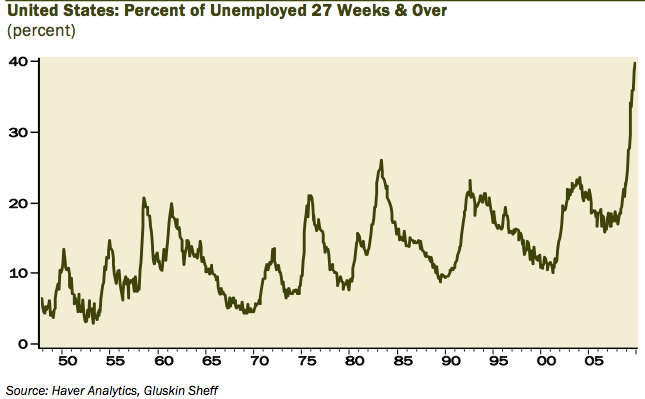

chart courtesy of Gluskin Sheff

>

Percent Job Losses in Post WWII Recessions

Here is what the 2007-2010 Recession looks like in terms of recovery of jobs lost:
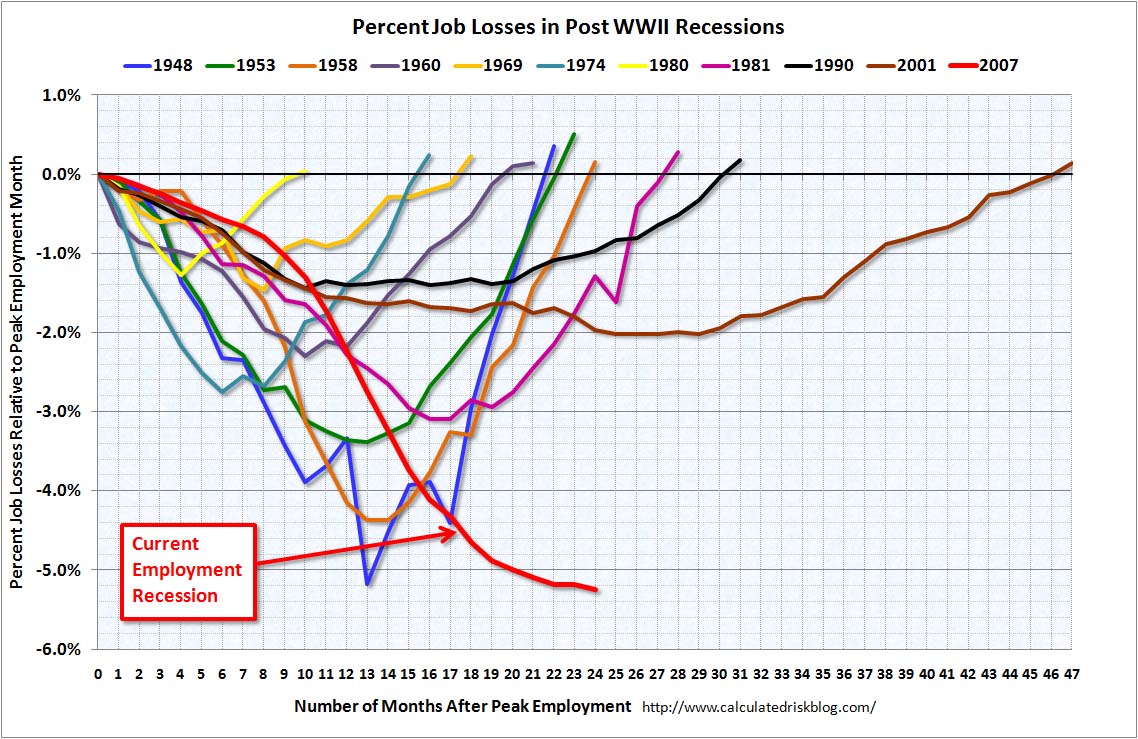
courtesy Calculated Risk

21 Responses to “More Employment Charts”

  1. hgordon Says:

    Good graphics.

    Here’s that employment-to-population ratio going back a further 30 years –
    http://img.skitch.com/20100108-dki8b6s2c31shpcrj6chd4kbkt.render.png
    (from http://delong.typepad.com/sdj/2009/12/employment-to-population-ratio-among-men-25-54-hit-all-time-low-in-november—the-curious-capitalist—timecom.html)

    The men-without-jobs chart is another interesting look at the data –
    http://timecuriouscapitalist.files.wordpress.com/2009/12/men2.jpg?w=470&h=324
    (from http://curiouscapitalist.blogs.time.com/2009/12/07/another-sobering-slice-of-the-jobs-data/?utm_source=feedburner&utm_medium=feed&utm_campaign=Feed%3A+timeblogs%2Fcurious_capitalist+%28TIME%3A+The+Curious+Capitalist%29)

  2. km4 Says:

    > THE EMPLOYMENT RATE IS NOW AT 58.2% — LOWEST RATE SINCE AUGUST 1983

    Since 1983 almost 30 yrs of outsourcing and downsizing + better educated countries and global competition combined with an economic policy of deficits don’t matter, asset bubbles, faux GDP growth, and ponzi schemes has pretty much created a dysfunctional US economy where employment rate is trending down.

    What a double whammy and there will be no quick fixes no matter what politicians and MSM clowns says.

    And over next decade US publicly held debt is forecast to more than double to 85 per cent of gross domestic product – the highest rate since the second world war.

    The gubmit and MSM will continue to try and sell ‘extend and pretend’ but the reality of the matter is more Americans sense further erosion of their standard of living in 2010 e.g. a Gallup Poll near the end of the year found 25 percent of people — just one in four — feeling satisfied with how things were going in the United States.

  3. VennData Says:

    They may be unemployed, but they had a helluva a lot of fun in college.

  4. Steve Barry Says:

    Read this in Barron’s today:

    “Back to Reality
    U.S. employers cut 85,000 jobs in December, surprising economists, who had forecast payrolls to be unchanged. The unemployment rate held steady at 10%. Strategist T.J. Marta said the report was weaker than it looked; without the birth/death model, payrolls fell 406,000.”

    Anybody know where he got that B/D number? Boockvar had B/D at +59K…Marta implies a much bigger number.

  5. Steve Barry Says:

    I think this is the best jobs chart, from Calculated Risk. It seems the last 3 recessions took longer to recover jobs each time. This one is in a class by itself…saying 3 years to go is being terribly upbeat.

    ~~~

    BR: Good one — I used it last month — I’ll add . . .

  6. franklin411 Says:

    Two more pluses: The average manufacturing work week has gained 1 hr since May, and overtime hours worked increased as well. If sustained (particularly with a decently-sized government program to reinvest in American infrastructure) that will turn into hiring.

    Why did some see it as OK to use American taxpayer dollars to build bridges in Iraq, but not OK to do the same here?

  7. Greg0658 Says:

    hgordon at 2:50 pm says “Good graphics. Here’s that employment-to-population ratio going back a further 30 years” .. (see posters link)
    a better graphic would be .. you know how you folks put volume in bars at the bottom of this type of graph .. volume would be bodies in this case .. and with the population growth over them years .. I suspect the volume bars would look like /

  8. Greg0658 Says:

    um correction – I see again it was employed not un-employed .. so looks like / is a NOT …
    probably more of a steady rise .. living bodies need stuff and when stuff gets made it creates commerce
    .. point made both ways

  9. ancientone Says:

    As to the lack of jobs creation chart for the last decade, perhaps it would look better if one counted all the low wage off-the-books jobs that were held by illegal aliens; but they’re all probably gone by now.

  10. Calvin Jones and the 13th Apostle Says:

    ancientone:
    You mean “employed” by all the home builders? Because that’s who a lot of them were employed by.

  11. crosey Says:

    Temp labor will dominate the US workforce over the next decade, and beyond. Top 3 advantages:

    At-will employment
    Healthcare costs carried by others
    Higher-level/broader skillsets now available on an (affordable) hourly basis

    Seen this develop over the last 5 years. It’s real, and here to stay. But incomes will remain unstable, and thus, consumer spending will be lower and savings will be higher. Home ownership will continue to drop, rentals will increase.

  12. ALAN ABELSON Says:

    WE HESITATE TO OVERBURDEN you with mournful numbers on jobs, but we think Dean Baker of the Center for Economic Policy Research has some interesting stuff in his latest commentary. He notes that although the current data still show a 378,000 job gain for this century’s opening decade, that 378,000 is due to shrink by some 824,000 when the benchmark revision makes its appearance in January’s employment report. And while the current data also show a loss of 1.5 million private-sector slots in the decade, the benchmark revision will swell that figure to more than 2.4 million.

    Dean expects employment to turn positive sometime next year. The catch is, he doubts it’ll be fast enough to make a real dent in the unemployment rate.

    At the very least, it seems to us, the dreary digits in the jobs report and the problematic employment outlook make all that talk about the Fed raising rates and the like way too premature. In our jaundiced view, they also suggest that the prices and multiples built into equities by the riotous rally and fired by expectations of an economic surge are way too rich.

  13. letitride2 Says:

    There is little chance the fed can raise rates during deflation. If you trade bonds you will see how tenuous the few bids are these days and there is no rush of new government dealers. Stock prices have clearly been propped as have the many failed “TBTF” entities, many now government sponsored. We will have a massive decline and of course another rally but the trend has been down, for stock prices arguably since 1998 and bear markets average 15 years. The current condition will inevitably pass and from a duration perspective we have endured better than 2/3rds of the time required. However as Robert prechter pointed out long ago the price destruction has yet to really sink it’s teeth into our collective conscious. Those calling for higher rates to “defend the US Dollar” are forgetting 1989-present Japan and Paulson is betting the expansion in the monetary base will find its way into the monetary supply. During deflation that does not occur. Housing is still dead unless you want to fool yourself with comparisons to North Dakota, where prices didnt rise much or employment gain or consquently drop. We need to build ( our troops can make fine roads and replace the Stickel Bridge for starters ) and we can save taxation when people can least afford it by bringing those troops home, ex Afghanistan or Iraq if you must. we need to return to a preeminent manufacturing economy rather than the service economy which we can longer export. Education and family are our remaining assistants. Anything that aids the latter will help America return to excellence.

  14. adbutler007 Says:

    What is interesting about the final chart of unemployment in past recessions is the symmetry of the curve. The right half of the curve mimics the right half to an incredible degree. A quick observation of the data suggests that, if unemployment bottoms next month at current levels, it will be at least another two years before the labor market equalizes at 2007 levels. Of course, given the structural problems as a result of the credit deflation, fiscal and demographic issues, there is no guarantee that we will see unemployment bottom any time soon.

  15. Steve Barry Says:

    @adbutler,

    Don’t forget that the chart will be quite WORSE looking in one month when the benchmark revision subtracts another 850K jobs.

  16. Greg0658 Says:

    the 2010 Predictions thread I started a post .. then/well forgotaboutit
    the stock market of corporates will rise to the point of traders & mom&pops seeing this point as the last hurah before the boomers want the cash to buy real stuff with .. at which time a 2nd crash towards 667 will begin .. sucking the non-existant backed up #s from accounts so people need to work till death do them part from this world .. perpetuating the situation .. corporations or the real bag holders will reposses the manufacturing and take the industries private .. and won’t even say thank you for making them TBTFight

  17. ashpelham2 Says:

    adbutler007: That’s just the thing that is most troubling. Of course, we know unemployment won’t bottom next month, but even if it did, there might not be a normal return of demand, as seen in previous job recoveries. Heck, for all intents and purposes, 2001′s jobless recovery was just a precursor to this one. Even returning to 2007′s employment picture is asking a lot, as retirements pick up, demand simply dries up. Can’t buy much on a fixed income. Little credit available right now to consumers or small business to spur demand. There is simply no way that we could return to 2007 employment in only 2 years, if even in 10 years. It’s a very bleak picture. It’s a generational change.

  18. James Says:

    What I find particularly intriguing is the “THE PERCENT OF THOSE UNEMPLOYED 27 WEEKS AND OVER IS NOW AT 40%” chart. Over the last half century there is a clear, indeed, strong uptrend in this statistic. Is this an artifact of the way in which the data is being gathered/reported, or are we to believe that we slowly becoming a nation of long-term unemployed?

  19. willid3 Says:

    a different view on unemployment?
    http://econompicdata.blogspot.com/2010/01/alternative-unemployment-rate.html

  20. batmando Says:

    “Temp help is improving, and tends to be a good early indicator of more hiring to come”
    so i have understood to be the case, but just wonderin’, is contract labor considered temp help?
    just read earlier today (can’t recall where, too many blogs, so little time), that contract labor in Japan has risen during their lost decades to where it is now 30% of the labor force.
    just sayin’, it could be different this time?

  21. Are equities getting long in the tooth? - The Macro Market Monitor - InvestorsInsight.com | Financial Intelligence, Advice & Research / Investment Strategies & Planning for Individual Investors. Says:

    [...] http://www.ritholtz.com/blog/2010/01/employment-charts/ [...]

77 queries. 0.395 seconds.