Steve Keen on the modern economy and the outlook

Email this post Print this post
By Barry Ritholtz - January 7th, 2010, 2:00PM

Outstanding discussion from a top Economist in Australia

click for video
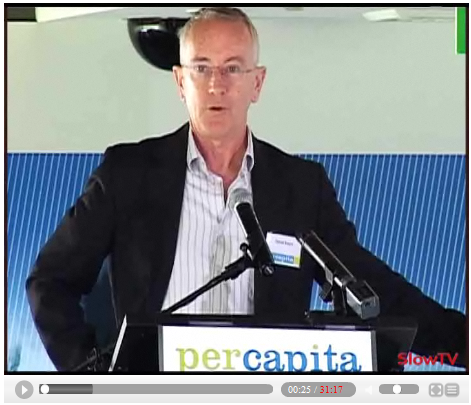

Hat tip Carey

Comments

Please use the comments to demonstrate your own ignorance, unfamiliarity with empirical data, ability to repeat discredited memes, and lack of respect for scientific knowledge. Also, be sure to create straw men and argue against things I have neither said nor even implied. Any irrelevancies you can mention will also be appreciated. Lastly, kindly forgo all civility in your discourse . . . you are, after all, anonymous.

7 Responses to “Steve Keen on the modern economy and the outlook”

  1. Goldilocksisableachblond Says:

    U.S. policymakers should start the new decade by forgetting everything they thought they knew about economics , and ignore everything Bernanke , Summers , and the Banksters say , and instead absorb the simple truths presented in this video. Once they recognize the difference between artificial , debt-fueled economic growth and real , sustainable growth , and the difference between investment ( human capital and capital equipment , R&D , etc. ) and speculation ( chasing asset bubbles ) , they have a chance to put this country back on the right track.

    Current policy aims for a return to the status quo ante , aka ‘extend and pretend’ , which will only lead to ‘no gain , more pain’.

  2. Tom Hickey Says:

    Steve has it essentially correct, IMHO. Policy makers and economists need to go back and read Keynes (carefully and with an open mind), as well as Irving Fisher’s theory of debt deflation and Hyman Minsky’s financial instability hypothesis, and pitch REH and EMH.

    For those who wish to pursue Steve’s thinking and related matters, his Debunking [Neo-Classical] Economics (2001) is a good read that is accessible to non-economists.

    As Steve said, he is a Circuitist. Circuitism deals with the non-government financial sector and its impact on the real economy through money creation by lending. As Steve pointed out, all transactions of the commercial banks net to zero in that loans create deposits and loan repayment extinguishes loans. This means that commercial lending increases the money supply (M1, M2, M3) but does not affect non-government net financial assets at all.

    Neo-Chartalists study the vertical relationship of government finance to non-government finance. Only government can increase non-government net financial assets (through spending) and decrease NFA through taxation. Government borrowing reduces bank reserves by substituting one kind of asset (tsy’s) for another kind (bank reserves). Borrowing is therefore net zero and does not affect NFA.

    The important point that most people fail to grasp is that since Nixon shut the gold window on August 15, 1971, the world is on a non-convertible floating rate system. In such a system, a government that is sovereign in its own money is the monopoly provider of its currency of issue. As such, it is not financially constrained and does not need to tax or borrow to fund spending. In addition, it doesn’t need to borrow at all, since it can manage bank reserves and the overnight rate simply by paying interest on reserves instead of going through the step of issuing debt to accomplish the same thing. This means that the government can always make up for reduction in nominal aggregate demand (NAD) when the public and business wishes to save more or deleverage, by compensatory spending into the economy to maintain output at capacity, with full employment and price stability — and without the need for government borrowing. However, borrowing adds interest to the economy, increasing NFA in the same way spending does.

    This is a very important difference between the common understanding, even of top economists, and how the monetary system actually operates. This is set forth in Understanding Modern Money: The Key to Full Employment and Price Stability (1998) by L. Randall Wray, available at Google Books. This is written for non-economists, so it is quite accessible for most people that would be interested. Wray, Bill Mitchell, Scott Fulwiler, Warren Mosler, Marshall Auerback and other also blog on this. Bill Mitchell’s “Stock-flow consistent macro models” is a good brief introduction.
    http://bilbo.economicoutlook.net/blog/?p=4870

    An interesting debate was recently held between Neo-Chartalist Bill Mitchell and Circuitist Steve Keen. Anyone interested in pursuing this can find the links at here:

    “In the spirit of debate”
    http://bilbo.economicoutlook.net/blog/?p=5194

    “In the spirit of debate … my reply” [Part 1]
    http://bilbo.economicoutlook.net/blog/?p=5199

    “In the spirit of debate … my reply Part 2″
    http://bilbo.economicoutlook.net/blog/?p=5224

    “In the spirit of debate … my reply Part 3″
    http://bilbo.economicoutlook.net/blog/?p=5234

    Since I stumbled on this a few months ago my entire thinking about economics, finance and markets has changed radically. It’s an eye-opener. And it also shows how current policy is based on the wrong footing.

  3. johnny Says:

    this guy has been a real eye opener for me. most economics has been overly simplistic and artificial. Reading his piece called the ‘roving cavaliers of credit’ I could only describe as an epiphany of sorts. We live in a non linear dynamical system where equilibriums may not be possible. we cannot paper over problem here. Personally I think debt is retarded, it steals from the future so no value can be created. But value and wealth can be created out of thin air. The financial system of debt is in contradiction with reality.

  4. Forbes Says:

    this vid has been around a while – some good stuff but he does need to get his Theology correct

  5. Moss Says:

    All the current critics and rigid ‘school’ based pundits and opinionators should listen to him.

    Debt bubbles, either private or public is the issue. The Austrian, Supply Side, Keynesian, Monetarism, bullshit pissing match, is doing no one any good.

  6. Simon Says:

    To say Steve Keen has got some good stuff is like saying Newton was quite a bright guy. Look at the chart showing deleveraging in the 1890′s and 1930′s. Do we rally need to see the big dip of the 2010′s to be sure of what will happen when debt repayment cost exceed income available for payment?

    There is, as pointed out by Chris Martinson a good reason why the present bubble has been sustainable for so long. Cheap energy in combination with advancing technology which increased productivity allowing everyone to consume more giving the requisite GDP growth and income growth to pay for the increased debt.

    We saw the peak in this dynamic in 2000 with oil at around $30/barrel and the nazdax at around $5000. I don’t the exact figures but very low and very high is what they were.

    Since then we have had and will continue to have speculative bubbles appear and burst as the excess money that is no longer needed but is willingly provided by central banks tries to find a home, wrecks havoc in the process and burdens already overburdened taxpayers with liabilities that can never be met.

    Are there going to be new energy sources and technology to rescue us from what happens when an irreversible process stalls and faulters allowing us to resume consuming with gusto and provide the necessary GDP growth so essential to our so called economy? It would be nice but I find the chance of serious pain in the near future much more likely.

  7. damo Says:

    I like his stuff, and think he has some good differentiated analysis, but wanted to put his recent track record into perspective for anyone who doesn’t read the Australian press regularly.

    In 2008 Steve Keen urged Australians to sell their family homes as values were going to drop 40% and took a high profile bet with a leading investment bank strategist to walk from our nations capital to the top of our highest mountain if prices went the other way. Prices have in fact risen and he will be walking in April.

    While I don’t have a problem with people giving investors advice on investments, I think you have to be very careful about telling average punters advice on what to do with where they live – especially as transaction taxes on property in Australia are often in the range of $10-20k.

    I also find it interesting that his views often get a lot more airplay internationally than what they do in Australia where he may end up being the boy who cried wolf… if you had of told Americans in 2005 to sell their family home because of a housing crash you would have spent 3 years being made fun of on CNBC – timing is everything…

60 queries. 0.357 seconds.
