End of the Bond Secular Bull Market?
Last week, we discussed the issue of where there was a greater chance of a bubble: Stocks or Bonds?
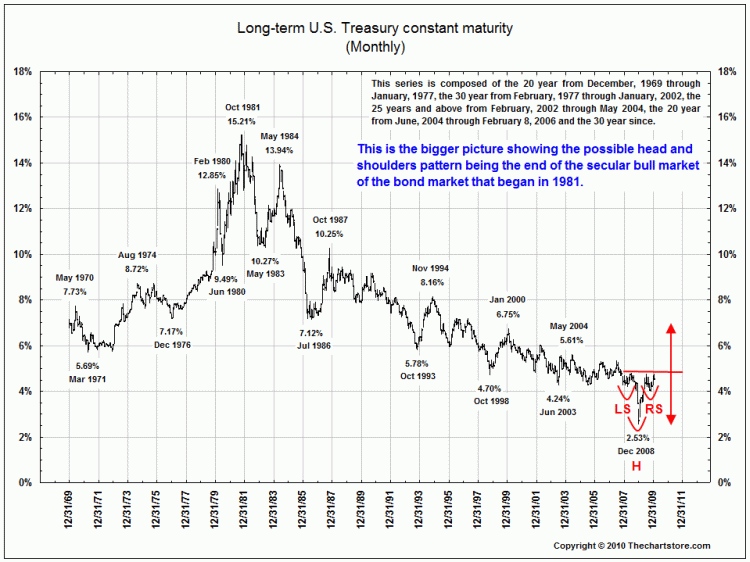
This week, we look at a possible end to the Secular Bull Market in bonds:
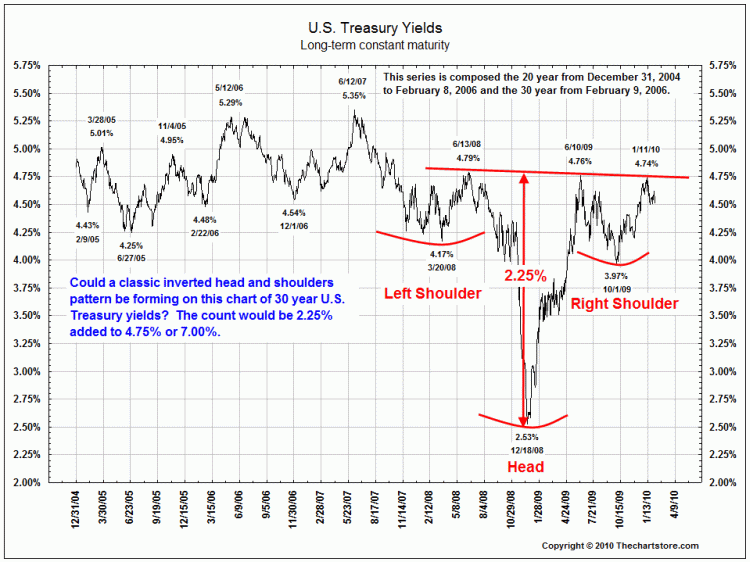
Charts via Ron Griess of The Chart Store


Tweet
Facebook
Reddit
Digg this!


February 8th, 2010 at 11:46 am
So, a measured move would bring us up to 7%. That would be interesting.
February 8th, 2010 at 11:59 am
Bet somebody said the same thing in Japan… in 1994.
Chart patterns like this dont help when all the fundamentals continue to point in the long-term secular trend. The driving forces of low-low rates include: wealth level, risk aversion, slowing population growth, lower war expenditures. All of these look set to continue.
And with the Fed at 0%… a “short 10-yr” trade is basically saying… I want to pay 3.73% on swap carry, earn 25 bps in cash. So it has 3.50% negative carry, plus it rolls-down the curve. You need 50 bps /yr higher rates just to break even! Its even worse in 3yr rates bc the roll down is much faster. Tough trade.
February 8th, 2010 at 11:59 am
Duh????!!!!!
Even Homer Simpson could figure this one out.
If interest rates are -0- short term and money is practically free long term, when comparing on a historical basis, then they really have nowhere else to go. Zero percent is as low as the price of money can go.
For those who are reading this who don’t know bond math, bond prices rise when rates fall. To earn capital gains, you need to buy at a higher interest rate than you sell at. Since interest rates are as low as it is possible to mathematically make them go, then yes, bonds have nowhere to go but down.
Unless you are buying with the intent to hold until maturity, cash in a tin can buried in the back yard is a far better investment since bonds are a certain money loser. Capital losses are a certainty to the same extent that gravity is a certainty. It’s only a matter of when.
Since the desperate money is going into bonds from stocks, they can expect, with certainty, to see the rest of their stash evaporate eventually. Even Bernanke can’t stop this, no matter how much money he prints to buy down long term investment rates. All interest rates are as low as they will ever go within the lifetime of anyone reading this, their children, or any descendant of those children.
February 8th, 2010 at 12:22 pm
“Bet somebody said the same thing in Japan… in 1994.”
Similar pattern then, too. But it never broke long-term trend.
February 8th, 2010 at 12:30 pm
[...] Is the secular bull market in bonds coming to an end? (Big Picture) [...]
February 8th, 2010 at 1:24 pm
The real key to the long bonds is that a rise in interest rates would doom any recovery because costs of borrowing money long term for the government is crucial. Therefore look for a range of interest rates between 3.75 and 4.75 for as far as the eye can see. The only real threat to the range is an increase in retail sales that can be maintained by the unemployment rate dropping below 8%.
Otherwise…stuck in a range.
February 8th, 2010 at 1:45 pm
the question is when exactly. Marc Faber called 30 year the short of the century or some such – about a year ago. I thought it was a good idea when the last administration was blowing war and tax cut deficit bubbles. Once burned, twice willing to take the middle of the trend not call the turn.
February 8th, 2010 at 1:50 pm
This has been the most pre-announced bear market in history. Good luck with that.
February 8th, 2010 at 2:02 pm
Regarding-
“Taleb: ‘Every Human’ Should Short U.S. Treasuries”
talk about a crowded trade
February 8th, 2010 at 2:05 pm
It’s ALL a bubble – TOO MUCH LEVERAGE!
All these hedge funds are levered up 2:1 – 4:1 or more and just by virtue of the fact that they are IN the markets in general means the value of anything hedge funds like to own is inflated.
30 yr bond should be above 5.5% and DIJA should be below 9K for starters. Even then – there’s be a lot of leverage keeping prices higher than they’d be with none.
February 8th, 2010 at 2:17 pm
“bonds have nowhere to go but down.”
Agreed, Hobo but the $64K question is when – tomorrow, six months, or a year from now? What with sovereign debt issues and a host of possible black swan events looming, investors may crave the safety of treasuries for the first half of 2010 at least.
When the bond market cracks it will be epic but as always the question is when.
February 8th, 2010 at 2:21 pm
The right shoulder is always a stretch, as in the resurrection theme/redemption songs ; however, the neck mo-mo has secular mo-jo.
February 8th, 2010 at 2:42 pm
I love the people that believe government debt such as that of the US Gov is risk free… Without them, we would not have bubbles and ignorance to laugh about.. everything would be so much more stable and boring..
From Taleb’s book.. Just because the Turkey see’s some farmer feed him food and take good care of it for all of the 365 days of the year, it does not mean this will keep going on for the rest of the life of the turkey.. Some day, a surprise happens, and it was the most simple and logical one for everyone except for the turkey..
February 8th, 2010 at 2:48 pm
UST debt is just cash writ large.
If you have $500, you keep it in bills in your wallet. These pay 0% interest.
If you have $500M, you keep it in USTs. Bills at 10 bps, Notes at 1-2%, or Bonds at 3-4%.
The only other choice… is to spend the money and buy something (stocks, corp bonds, commodities, bank deposits, etc).
February 8th, 2010 at 2:53 pm
I think earning 3.73% in a DE-flationary environment is a stone cold bargain.
“BUT the guvmint is printing money!!!” you say?
Yes but about 99% of this freshly printed dough is going towards padding the balance sheet of the banks, in some fashion. Launched into a money sucking abyss known as deflation. Never finding its way into the real world of money supply.
The deflationary collapse that is occurring needs alot more than 1 or 2 trillion before the banks will lend again, and that money finds its way into the market, and then inflation may begin.
I’ll give you this though, our GOV would love a little bit of inflation, but it ain’t happening any time soon.
People’s savings rates have adjusted, risk profiles, aging population, declining real wages, declining asset prices all are pointing to deflation. And so is the bond market.
I think Faber and Taleb are like 15 years early on this call. Watch out if fiscal “conservatives” take some seats in 2010. Rally ho!
February 8th, 2010 at 2:54 pm
Just for fun, I posted this in a forum some tima go and I haven’t updated it for 2009 yet, but the picture certainly has not improved. Would you buy this stuff???
I have found this company with securities that seem to be highly overvalued considering the fundamentals. I have written below various details about this company. The numbers are not the actual ones, since it would make it too easy to find out which company it is, instead I took the actual ones and multiplied/divided them to have the figures below, and therefore they are proportionately correct. Do you know which company I am taking about?
This is a major global company with most operations in North America. The company has a widely diversified portfolio of products and services and revenues are quite stable, but have of course been impacted by the recession/depression. In particular, revenues are affected quite negatively by unemployment.
Revenues and Net Income
From 1998 to 2001, the company was relatively profitable. Revenues were stable in the $1-1.1bn area during these years and Net Income was 50m to 100m. Debt levels remained stable during these years, with some small reductions.
Between 2004 and 2007, revenues increased modestly by c.80m, but the company generated an annual net loss averaging $175m. Debt during these years grew at a rate of c.$275m per year.
During FY2008, the business generated revenues of $1.25bn. The industries in which it operates are quite mature and hard to grow in. They could raise prices, but the problem is that customers would be very upset, and managers tend to monitor customer surveys quite often, and only raise prices levels to increase revenue in cases of extreme need. The company could grow in other sectors, and is actually already trying to do so, but historically, they are quite inefficient at growing into new areas. In FY2008, the company generated a net loss of $225m, and debt increased by almost $500m. An important portion of the difference was spent in dubious investments during the last half of 2008, which in an optimistic scenario will break even.
As of March 31 2009, outstanding debt was at $5.45bn, yes, billion, and this company did not have that much cash on balance sheet to lower Net Debt.
For 2009, the business is expected to generate a loss of $500m and increase debt by a whopping $1.25bn. In addition, debt levels are expected to rise at a rate of $450m per year over the next years. Quite an amount considering the company´s past track record. Obviously, profits are not forecasted for the foreseeable future.
Total Debt should reach $6.7bn at the end of 2009. Based on its revenues, this is a leverage of 5.36x revenues. It is better not to look at the EBITDA debt multiple, especially when this company is not known for turning profits.
Assets
This company has many valuable assets in real estate, patents, equipment, etc. but disposable and core assets are much smaller in value than the liabilities. The company is still afloat because the market still believes in the cash flow story that it will be able to repay its debt or continue to refinance the existing portion and issue more, even if past performance has not been great. The company has not defaulted to date, even considering such tough situation since it has been able to finance itself by issuing more and more debt, but eventually this might change if confidence disappears.
In addition, although the assets might be substantial, a significant sale of these would put an important downward pressure on the price, lowering recoveries. In addition enforceability of security over the assets is quite limited.
Rating
Well, you might be shocked about how bad the financial situation of this company is, but guess what the rating agencies have to say? This company is ranked at the top of the Investment Grade table by all of the rating agencies. Certainly their work should not be taken into account before any investment since they ranked various CLO tranches as AAA to later discover that the default ratios and severity were more in the CCC area. They were also ranking Lehman as A, and now the bank debt is traded at 10 cents on the dollar. No need to mention the ratings of FNM, FRE, BSC, ML, etc.
Price
I would not focus on the equity, I think the real opportunity here is in the debt, which is clearly a problem. The short term debt pays very little and trades around par, while the longer term debt (10 Years) is below the 5% area. Shorting these bonds, which trade close to par, represents a very interesting opportunity to me. I am not sure if a default will happen, but eventually the market should price the risk and rates are most likely to increase due to fundamental issues, lowering the price of the bond.
Now.. do you know which company it is? Would you buy or sell the bonds?
PS: Solution: Just multiply the numbers x 2000 and you have the right ones..
February 8th, 2010 at 3:30 pm
Regardless of the technical indicators, what is holding the bond market up is the baby boomer generation saving for retirement. What happens as all of those savers start to retire and become sellers. Interest rates appear artificially low because of all of the current savings, but I see huge and increasing sovereign debt and deficits that will be difficult to finance.
Money is like any good subject to supply and demand, when the supply goes down, the price rises. The price of money is the interest rate, and I see it going up, and when interest rates go up, bond prices fall. I have to agree with Taleb on this one as well.
February 8th, 2010 at 3:41 pm
We are clearly in a High Yield bubble. But where’s all that money gonna go when they realize those high yield bonds are likely to default?
February 8th, 2010 at 4:24 pm
Ha ha ha… Faber and Taleb are indeed early on the call.
Mike, Patrick and scharfy are correct. The rest of you need to be able to think about more than one instrument at a time. The credit markets operate through spreads against the safer instruments, in this case Treasuries.
Long before there is a Treasury bond crash, spreads will widen as investors flee higher-risk instruments such as junk bonds, muni bonds (yes, they really can default, my dear!) and dodgy bonds from countries with Mickey Mouse governments (it’s all relative…). All of that money flows into lower-risk instruments – like Treasuries.
If you want to see a bond market collapse, you’re looking in the wrong place. Greece, Japan, UK are all way ahead of the US in the evolution of the bond market. We will get a sneak preview from the JGB market soon.
The liquidity trap is like a black hole, sucking in capital that can’t escape and destroying it or sequestering it in places where it cannot be used, like the US banks. Hence there will be no inflation. Capital cannot get out past the event horizon, which in this case is 4% on the 10y, and 5% on the 30y.
As the black hole sucks in more and more capital, it shrinks, and the event horizon shrinks with it – look at the low low yields on JGBs – until it eventually reaches a singularity. At that point anything can happen as a Big Bang creates devaluation, inflation or even a new currency. Watch Japan. This will be interesting.
February 8th, 2010 at 4:51 pm
LB @ 4:24
Maybe so.
Also true, however, is that an exceptionally low tide often precedes a tsunami.
February 8th, 2010 at 5:25 pm
Lefty: how can you be so damn articulate?
February 8th, 2010 at 5:52 pm
you don’t really believe that ‘head and shoulder’ are any good at predicting. especially before they form. they look meaningful in hindsight.
February 8th, 2010 at 6:01 pm
You have to own long term treasuries here (TLT). When you have deflation you come after any interest rate. Ben is printing to fill the credit bubble. As he fills the hole the money disappears. US is the next Japan. Look at the Japan long term rate.
February 8th, 2010 at 6:12 pm
Finance is so weird. The massive imbalances are obvious to everyone and yet there is huge debate about how they will resolve.
I will try to give my 2 cents worth.
The root cause of the problem are the huge foreign reserves built up by over productive undervalued currencies, and for arguments sake I will lump China and Japan together in this even though their bubbles have occurred many years apart. Both China and Japan have beaten American manurfactures successively on the head. What has kept the American economy going is the steadily lowering of interest rates which I think somehow replaces labor with capital although I don’t understand this. Anyway what is easily understood is that GDP and employment have been kept up in America by using other peoples money (Japan and China) to consume and build. This was enabled by lowering interest rates and facilitated by the creditor nations through their willingness to lend at those rates.
Now it looks like this process is coming to an end and I think that we should not look to the past twenty years as a guide to what will happen now because there are too many differences. Globalization is now pretty mature. Accordingly and to make my argument as simple as possible the world should be considered as a single economic unit and now I’m heading in the direction of Reinhart and Roghoff sp? although I have not read their book. But consider this. The savers of the world the Chinese and Japanese have nice looking credits on their investment statements. BUT the statements ultimately represent loans made to their governments. In the case of Japan much of the loans made by the people to the government were spent by the government in Japan to prop up the economy for the past decade or so. In the case of China the loans made to the government have been used by the Peoples Bank of China to buy US treasuries in order to maintain their currency peg.
So globally what we have is a situation where vast amounts of private savings have been entrusted with domestic or foreign sovereign debt programmes and probably all somehow leveraged 10x. Well! you might say what is so unusual about that! And I would say nothing except that the debts are so large and are sustainable only at low low interest rates. I would ask what happens if there is a crises of confidence in sovereign debt?
Remember how subprime was going to be so easy to contain? Lets hope that the emerging sovereign debt crises in member countries of the EU IS contained! The possibility of a global sovereign debt crises is to horrible too imagine. We won’t be merely worried about capital gains or losses on our bonds. Return of funds in a stable currency may be of a greater concern. Crikey now I’ve got myself all worried again.
Feel free to correct criticise or enlarge.
February 8th, 2010 at 6:19 pm
When you see a Train with Dynamite apporaching, do you wait until the last second before getting out of the way? Faber might have been a bit early for a while, but with the government spending at this rate, it wont take too long for the US to get into a debt crisis. 2-3 years, in 2011, the Debt/GDP already reaches 95% with the current estimates, which are always understated…
True though, others are even further ahead, and the US has the special historical too big to fail and massive confidence shield built up over years, but eventually the domino starts falling. And if X was also A or AAA, or AA and starts falling, maybe the US AAA is not so good after all..
February 8th, 2010 at 6:32 pm
Bonds (market determined interest rates) run in a cycle of ~ 60 yrs duration — 30 up, 30 down. We’ve enjoyed the 30 run on falling interest rates, so it is about time for the turn and a 30 year run of increasing rates. Presently, by historical norms, yields on government treasuries are low due to (1.) monetary policy, and (2.) fear of anything else. Fundamentals that consider long-term government borrowing and the real possibility that monetary policy will turn from massive liquidity stimulation to trying to drain the swamp and keep inflation under control also suggest the turn is near. Crowded trade? Not hardly, at least yet.
February 8th, 2010 at 11:32 pm
“This has been the most pre-announced bear market in history. Good luck with that.”
Just because something is obvious doesn’t make it wrong. See: housing bubble.
February 9th, 2010 at 9:56 am
I think there is a lot of truth in this. The bull market may indeed by over. One thing I believe for certain that atleast in the short term, interest rates are headed up, and for a long time too…
February 10th, 2010 at 1:47 am
mguerreiro…My guess is General Electric. And, you are dead on with this. They are in big time trouble.
February 10th, 2010 at 3:01 am
[...] – End of the bond secular bull market? [...]