Psychology Cheat Sheet

Email this post Print this post
By Barry Ritholtz - June 29th, 2010, 4:00PM

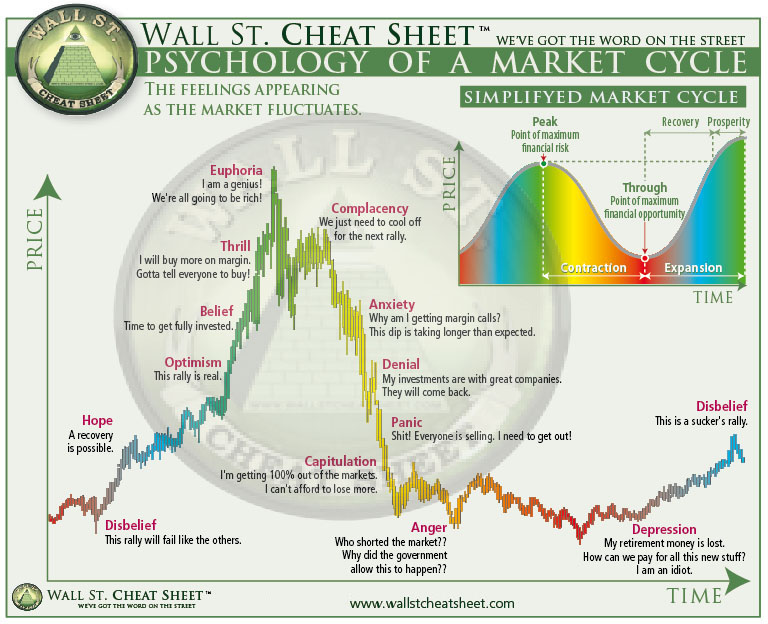
Today’s infoporn comes to use via the  Hoffman Brothers at Wall Street Cheat Sheet: Its a pretty variant on the psychological cycle charts we have shown in the past:

>
Comments

Please use the comments to demonstrate your own ignorance, unfamiliarity with empirical data, ability to repeat discredited memes, and lack of respect for scientific knowledge. Also, be sure to create straw men and argue against things I have neither said nor even implied. Any irrelevancies you can mention will also be appreciated. Lastly, kindly forgo all civility in your discourse . . . you are, after all, anonymous.

17 Responses to “Psychology Cheat Sheet”

  1. rob Says:

    Nice chart. So true except for the typo of “through” should be “trough”

  2. dsawy Says:

    OK Barry – where on that chart do you think we are?

  3. Mannwich Says:

    I think we skipped optomism, belief, thrill, euphoria, and complacency. We’re now back to anxiety. Boy, that recovery recovery and expansion period was quick.

  4. call me ahab Says:

    odd that I’m euphoric when the market tanks-

    the chart is obviously written by a bull

  5. Robespierre Says:

    That chart would have some validity if it were also showing the market during the depression. But as always we pick what we want to see.

  6. The Curmudgeon Says:

    How does a “market” become euphoric or despondent? Does a market comprised of human actors become like its own separate human organism, such that human attributes like fear, greed, etc. can be wholesale applied to it?

    That’s a round-a-bout way of saying what Ahab said. For every euphoric human that’s playing in the market, there’s another that’s full of fear and despair. It’s a bit unwise to overly anthropormorphise what amounts to an abstract entity. Markets don’t have personalities, and the indices used to measure them are just models that may or may not reflect the personal state of mind of the market participants.

  7. bergsten Says:

    “My” version of the chart would look the same, only ALL of the points would be labeled “disbelief.”

  8. bergsten Says:

    Speaking of disbelief — <a href="http://www.zerohedge.com/article/hft-fat-digital-finger-breaks-citi-stock-shares-halted-circuitbreaker-triggered-stock-plungi" HFT Fat Digital Finger Breaks Citi Stock, Shares Halted As Circuitbreaker Triggered With Stock Plunging 20%

  9. louis Says:

    “For every euphoric human that’s playing in the market, there’s another that’s full of fear and despair.”

    Absolutely Curmudgeon. The guy buying a house in 10/11 will think alot different than the one that bought in 05/06.

  10. bergsten Says:

    Sigh. Speaking of fat fingers — HFT Fat Digital Finger Breaks Citi Stock, Shares Halted As Circuitbreaker Triggered With Stock Plunging 20%

  11. Cleodus Says:

    more red and a looooong sloooow climb. i’m girding my loins for more of what we’ve had (well into the teens). when its all said and done, it’ll be a 10-year run: 2007-17. lost decade indeed….

  12. Patrick Neid Says:

    Same shape as most bubble charts.

  13. TakBak04 Says:

    That Chart was good for a Laugh….but interesting in many ways.

  14. Captain Jack Says:

    For every euphoric human that’s playing in the market, there’s another that’s full of fear and despair. It’s a bit unwise to overly anthropormorphise what amounts to an abstract entity.

    With all due respect, I completely disagree.

    What you just described — a market which registers a balance between fear and greed — represents equilibrium conditions. The whole point of analyzing sentiment, i.e. taking the emotional measure of the market, is getting a bead on when the market is experiencing “far from equilibrium” conditions.

    Take two extreme examples: The height of the dotcom bubble and the depths of the Lehman panic. Both of those represented “far from equilibrium conditions,” in which the market mood was clearly, and dramatically, tilted in an extreme direction.

    Michael Mauboussin talked about this a little bit in his book “More Than You Know.” I’ll probably mess it up in the retelling (as I last read the book years ago), but one of his points is that the market mechanism only works when there is a diverse mix of opinions.

    In contrast, when an abnormal concentration of market participants winds up on one side of the boat — i.e. a critical mass of folks experiencing excessive fear or greed — the normal capacity of markets to act as an efficient pricing mechanism gets thrown out of whack.

    Mr. Market is very much an emotional dude. It’s just that, most of the time, his “normal” moods are not all that discernible, and the value of parsing such emotions comes in at the extremes. You want to pay attention when the crowd is feeling manic (or manically depressed).

    p.s. I think you meant anthropomorphize ;-)

  15. eurostoxx Says:

    i thought bull and bear markets take place in long term secular trends… that chart wouldn’t have looked so great in the 80′s and early mid 90′s when everything went straight up, when it was a smart thing to buy on anxiety or fear…you would have missed a lot and been waiting for the crash with prechtor for 10 years.. time nor price should be thought of as lying in linear scales.. my 2 cents

  16. k2 herb Says:

    I love the disbelief part. I feel that most of us might be in that boat right now.

  17. Psychology of Market Cycle « MJ Says:

    [...] Source: 1] http://www.ritholtz.com/blog/2010/06/psychology-cheat-sheet/ [...]

74 queries. 0.346 seconds.

