
Chart of Day: $4 Trillion Hangover
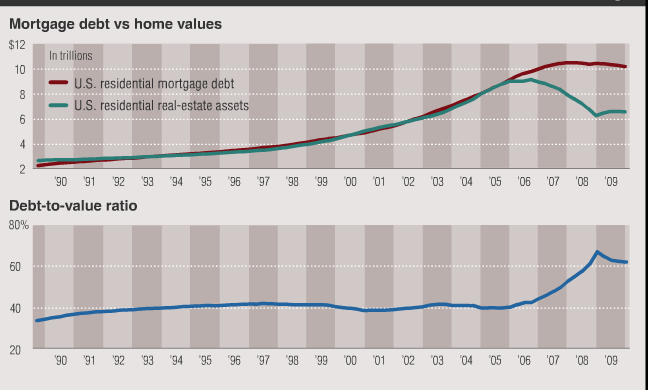
Last week, we looked at London based hedge fund RAB Capital Chief Strategist Dhaval Joshi’s The $4 Trillion Dollar Question.
It turns out that is now a Bloomberg Chart of Day!
>
>
Source:
U.S. Housing Bubble Leaves $4 Trillion Hangover: Chart of Day
David Wilson
Bloomberg, July 16 2010
http://noir.bloomberg.com/apps/news?pid=newsarchive&sid=aE_Yf1qMj5NQ



Tweet
Facebook
Reddit
Digg this!


July 19th, 2010 at 1:02 pm
Wow, in this case a picture (or two of them) if worth a thousand, no, $4 Trillion, words, or dollars.
July 19th, 2010 at 1:22 pm
Hi Mr. Ritholtz,
I really really enjoy your column. Maybe there is a very good side to this chart, a glass half full scenario. The fact that so much money is tied up in a dead asset gives the Fed a lot of leeway to keep interest rates low for quite some time which will help to maintain weak economic growth, implying low inflation, low interest rate for quite a few years, as long as the export market holds up. Well, I think we have not by a very long shot seen the furiously rabid speculative bubble associated with topping global economy. This nightmare appears some years away.
That’s my view.
Best of luck.
JR
July 19th, 2010 at 1:31 pm
I am unsure of his numbers. He shows residential real estate at 6 or 7 trillion, total? Huh?
Gotta figure 80,000,000 or so homes, at say $150,000 on average? those numbers are guesses, but within15%, I’m sure. So, that would yield a range of around 10 trillion to over 15 trillion in value.
July 19th, 2010 at 1:59 pm
Jim, if you look at the original article where this data comes from, you see that the “US Residential Real Estate Assets” line should actually be labeled “US Residential Real Estate Assets Multiplied by 0.4″.
http://www.ritholtz.com/blog/2010/07/the-4-trillion-dollar-question-2/
July 19th, 2010 at 2:55 pm
JR: I think the argument that is concerned over inflation is slowly slipping into an argument that fears deflation, which may be even more insidious. I respect your theory that a lot of money/debt is tied up in illiquid assets, and that is a new way of looking at this dilemma, to me anyways.
However, deflation of those assets probably has a much more devastating effect as those held assets, often with debt attached, provides less security for those on fixed incomes, or reduced incomes.
While inflation looks like an obvious solution to this printing machine that we’ve been paying for a couple years now, deflation looks to be a real possibility as well.
July 19th, 2010 at 3:20 pm
ashpelham2 Says:
“However, deflation of those assets probably has a much more devastating effect as those held assets, often with debt attached, provides less security for those on fixed incomes, or reduced incomes.”
I think the curve is telling that deflation of those assets has happened already. Debt on the other hand has not “deflated” and it needs (will?) to.
July 19th, 2010 at 3:42 pm
They are apparently only looking at the housing stock with debt which is a bit less than 70% of the total housing stock.
I think this explains it a bit better:
“”So now the flow of funds accounts tell us that the total value of residential real estate is $16.53 trillion. The share owned by households with a mortgage is probably $10 trillion to $11 trillion. Total mortgage household debt now stands at $10.3 trillion. In effect, for all households with a mortgage taken in the aggregate, their loan-to-value ratio is now close to 100% and perhaps close to half of them have a zero to negative equity.”"
http://www.calculatedriskblog.com/2009/12/feds-flow-of-funds-now-using-case.html
Basically the homes with debt on them are in a very bad way.
July 19th, 2010 at 3:53 pm
I’m sure there is a victory for the bulls in there somewhere.
July 19th, 2010 at 3:55 pm
yup — unfortunately no one likes to use or hear the ‘D’ word —
The bubble was formed by the artificial inflation of home prices and the financial crisis was caused by the deflation of the underlying assets in the RMBS portfolios, magnified by the synthetics (CDOs) — All of those excessive bonus pay outs and unjust enrichment of bad actors across the mortgage industry can be found in the area under the home value curve.
July 19th, 2010 at 4:16 pm
Correction: All of those excessive bonus pay outs and unjust enrichment of bad actors across the mortgage industry can be found in the area between the Red (Debt) and Green (home asset value) curves.
July 19th, 2010 at 4:39 pm
One should mention that the 4 trillion dollar black hole is in large part on the balance sheets of Government sponsored entities Fannie and Freddie. It has been rumored that the taxpayers will need to bail them out in the tune of 1-3 Trillion Dollars to prevent their impending insolvency.
This should be the first example of the end of too big to fail policy ending. Let the sick go through bankruptcy court!
July 19th, 2010 at 4:44 pm
BR, the $4 trillion blog entry states: “I recognized the credit bubble and inevitable bust long before most other analysts/strategists/economists did.” hmmm……. Jim Cramer wrote on April 1st, 2008: “Was there anyone out there who more loudly announced this credit crisis before it happened than I did? ” I guess Cramer was one of the few who was blazing trails on this issue even before you were, right? : )
~~~
BR: I think Jim was wildly wrong on Housing for a long long time
July 19th, 2010 at 4:59 pm
Kinda pointless unless you look prior to ’91, when the last foreclosure explosion ocurred.
From 86-90, did the same type of gap appear ?
How long did it take to close the gap ?
July 19th, 2010 at 5:45 pm
This isn’t keeping the banksters from trying to bring back jumbo loans.
http://www.cnbc.com/id/38310197
Hope springs eternal in the hearts of banksters hoping to make a buck. I suppose they are hoping to dump them off onto someone else.
July 19th, 2010 at 6:55 pm
@Charlatan Says: … Jim Cramer
I like Jim Cramer, some of the time — he also said housing would start to boom in June 2008 (oops)
http://nymag.com/news/businessfinance/bottomline/49938/
Our resident financial expert calls the end of the housing-market free fall—to the day.
* By James J. Cramer
* Published Sep 7, 2008
…. Of all the areas I expect to boom next June, New York looks to be the most attractive because buyers from overseas will flock to it—even more than they already have. Just as the dollar appears to have bottomed, European real estate is starting to collapse. Foreigners will flee to this market as a safe haven, one that has already experienced the decline that they are just beginning to see. If you’re a seller, hold tight if you possibly can. You’re almost—almost—through the worst of the downslide. If you’re a buyer, use the time between now and next June to scout in which neighborhood you might want to buy. On June 29, call your broker.
July 20th, 2010 at 2:51 pm
“The fact that so much money is tied up in a dead asset gives the Fed a lot of leeway to keep interest rates low for quite some time which will help to maintain weak economic growth, implying low inflation, low interest rate for quite a few years, as long as the export market holds up. ”
The FED has subverted economic democracy by front-running cash through its member banks and crowded out any but de minimus returns for all the real savings of the people. The Failed State has withdrawn Enforcement like ignoring Harry Markopolis’s plea to stop Bernie Madoff in 2005.
We don’t need 2300 pages of FinReg to parse about while the Goldmans get away with a statutory pass from civil suits by settling on a mistaken omission in the prospectus. Sweeet!!
BTW..Jim Cramer single-handedly reduced property values in San Miguel de Allede by trumpeting his acquisition of three properties. I crossed that place off my list to revisit. Ocean Grove was similarly poisoned. What a scary thought seeing that entertainer outside of suburban NJ wher he ought never leave. More to the point here, he says everything and can always point to being right. ..last week RIMM wss pronounced DEAD..I will soon hear how he bought the low.