
Google Trends – A fresh look at search frequency
Dan M is a buyside analyst at a small macro hedge fund. He had the following observations regarding the significance of Google search data.
My personal views of contrary indicators are more nuanced, but I thought this was a very interesting approach to looking at Google trend. It is a decidedly different perspective, one worth thinking about.
Enjoy:
~~~
A popular meme these days has been to look at sentiment as a contrary indicator. I personally have used this argument many times, the theory being that when *everyone* feels a particular way, then the market has likely overpriced that in due to the “dumb money” pushing that meme too far as is always the case. The argument goes that the opposite is then prone to occur, because the dumb money always loses.
I had a fresh contrary look at this as reflected in the frequency of searches on Google via Google Trends (link), based on a few examples.
• Positive correlation w/ economic activity
• But does this work w/ price behavior?
• “stock market crash” was a leading indicator
• “Housing bubble” was a leading indicator
• “housing crash” was a leading indicator
• Relevance now – “double dip” implies double dip recession
• Relevance now – “hindenburg omen” implies … ?
• Relevance now – “bond bubble” implies Treasuries are rich?
>
Positive correlation w/ economic activity.
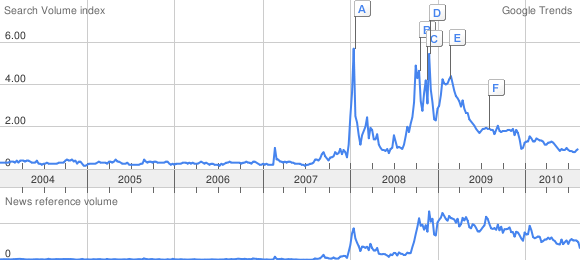
For one, there is the fact that economic activity actually has had a *positive* correlation to search term frequency. We have detailed at length this in the past – one example of this is search frequency for the term “recession”, which showed a clear initial peak in January 2008, a mere one month after the recession began (chart):
>
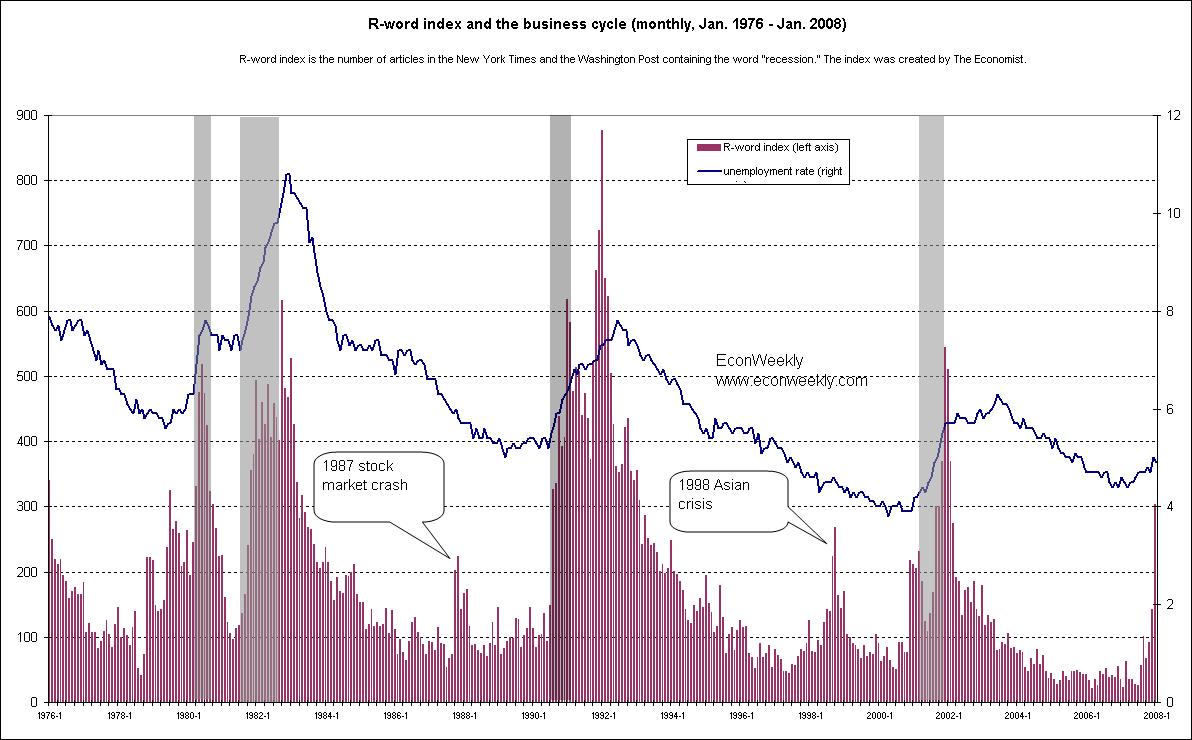
We have also shown charts that detail how this has also been the case as far back as 1980 onwards (chart:).
>
But does this work w/ price behavior?
One could say that economic activity is different from price behavior. Price behavior is based on the interaction of buyers and sellers, while economic activity is not zero sum at all.
“Stock market crash” was a leading indicator.
An interesting case study of this is a search for the term “market crash” or “stock market crash”, backed up to the very start of the market crash itself.
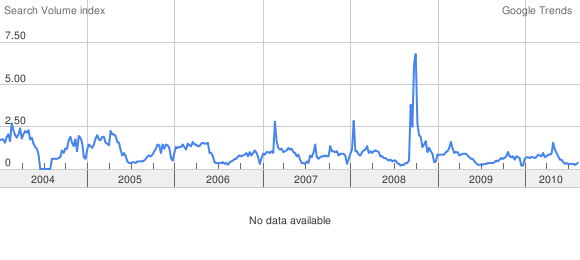
This is the graph of search frequency for “stock market crash”, which is largely similar to that for “market crash” (chart):
>
Note the clear peak in September 2008, with nothing really before that. The January 2008 spike was largely the same as what we saw in ~February 2007.
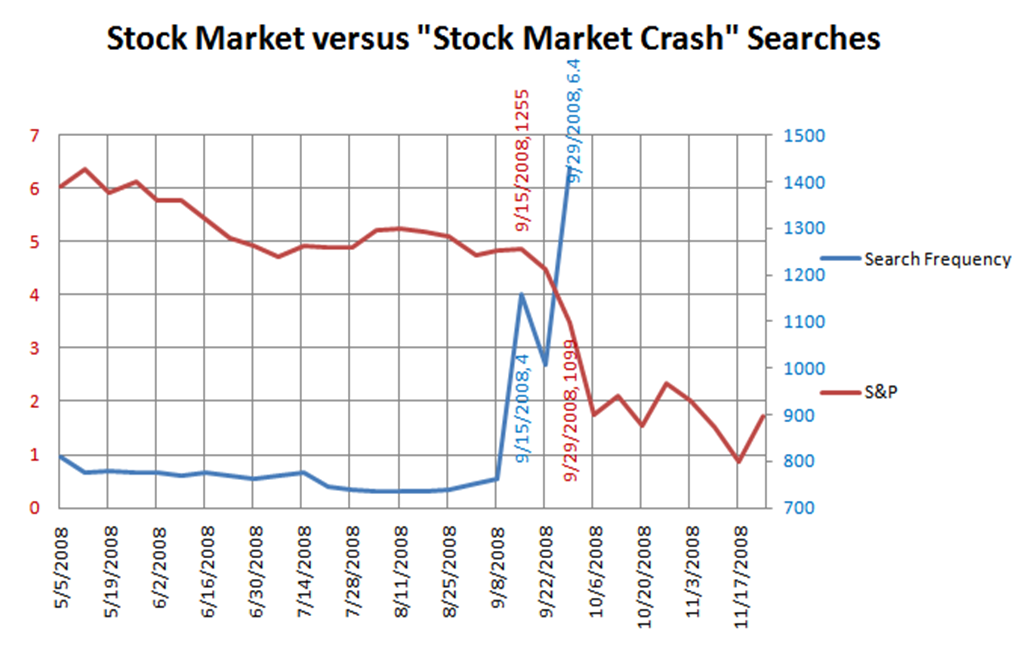
The simple response to this is “oh yeah, this simply peaked while the crash was happening”… but that might be a false assumption. Digging into the weekly data seems to paint a different picture, interestingly enough. We got a reading of 4 in the chart above on … September 15th 2008 (chart):
>
On September 14th, the S&P was at 1255. Heck, even when Search Terms went to 6.4, the S&P was still at a fairly rich 1099.
In other words, a spike to 4 actually *led* the crash, and was *not* a lagging indicator after the fact.
“Housing bubble” was a leading indicator.
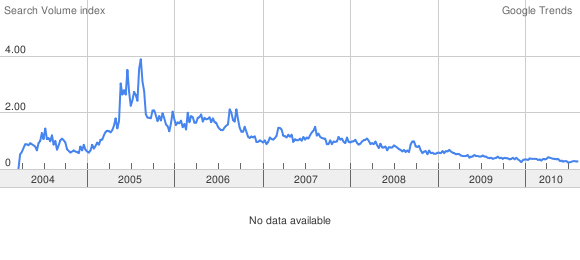
If this was the only example, that would be one thing. However we see the same pattern with search frequency for the term “housing bubble”. Search frequency for the term “housing bubble” spiked in May 2005 and peaked in August 2005 at 3.74 (chart):
>
>
This August 2005 peak is fairly remarkable, given that new home sales itself peaked in April 2005, with a retest of the highs in October 2005, before the secular decline:
>
So interest in the term “housing bubble” peaked 2 months before the effective high for housing activity, followed by a sharp decline in activity and a decline in home prices thereafter. So even in this market of buyers and sellers, we nevertheless saw the economic top coincide with search terms indicative of a market top.
As with the terms “recession” and “stock market crash”, it appears the threshold SVI is say, 3.7 and above, give or take, with a strong indicator being 4+.
“housing crash” was a leading indicator. Here is the same chart for the term “housing crash”:
>
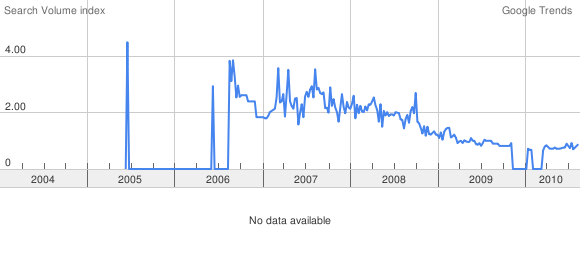
Less applicable due to a lack of searching for this term early on, creating some herky jerky action in early 2006… but once again we did not cross 4, or even 3.7 for that matter, until August 20th 2006. By August 2006, new home sales were off 26% from the October 2005 peak, while Case Shiller home prices peaked in July 2006, just one month earlier (chart):
>
In other words, there is more than tangential evidence that strong search frequency is indicative not of the *contrary* move being likely, but of *self fulfilling prophecy*.
So this is all well and good, but where does it leave us now?
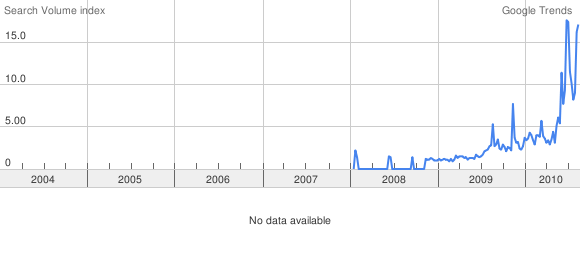
Relevance now – “double dip” implies double dip recession. Well, the term “double dip” has retested its highs lately. Once again, I believe this is indicative of growing fears over the economy. These fears should translate much in the same way they did for the term “recession” back in January 2008 (chart):
>
>
We have blown away readings of 4 and are presently north of 15. We registered this not once but twice. Anecdotal evidence abounds, as we have heard the likes of Greenspan and many, many others using that specific term “double dip” (link). Some say it can’t happen, while others say it’s possible (link) or likely (link), while still others say we’re already in it (myself, Mish), but the common denominator is that people are talking about it. The term “double dip” appears to have entered the collective psyche much the same way “recession” did back in 2008.
I will post the caveat, though, that we registered north of 5 around July 2009 and again in September/October 2009. We are well above that now, but back then, someone would have been suckered by a false positive relative to the data points above.
Relevance now – “hindenburg omen” implies … ?
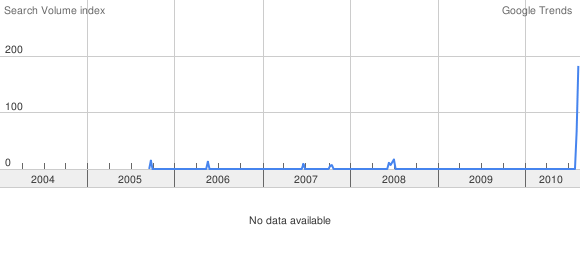
Interest in the term “hindenburg omen” has been amazingly strong as well (chart):
>
These readings are a bit unreal, having registered a whopping 172 on August 15th 2010. Note that we registered a confirmed Hindenburg in June 2008 – you see that blip of activity when that happened?
To put a reading of 172 in context, consider that “BP spill” registered no higher than 57 on May 30th 2010, at the very peak of searches for this term (Google). Keep in mind that these charts are showing *relative* search frequency – how much something is being searched for relative to its own past, not relative to anything else. One would have thought it’d be tough to go much higher than “BP spill”‘s reading at the height of the concern over what has become the 2nd biggest oil spill in the history of the world, but “hindenburg omen” did.
I had been saying that such interest in a statistical indicator of not-so-good relevance was indicative of a reversal higher being possible or even likely, before a shakeout. Money manager Barry Ritholtz seems to agree, calling it an example of “recession porn” (Ritholtz). Now I am not so sure, given the data shown above.
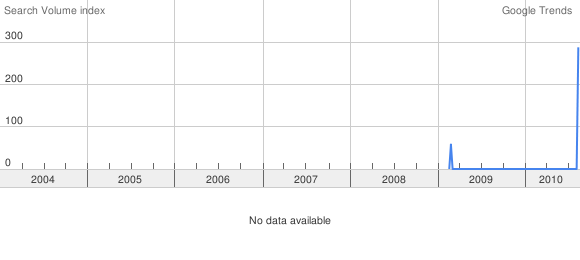
Relevance now – “bond bubble” implies Treasuries are rich? I did find one term that beat out even “hindenburg omen”. Yep… here is the chart for the term “bond bubble” (chart):
>
After nothing but insignificant readings, we hit a whopping 288 on August 15th 2010. All readings had been statistically insignificant until now, the Google data would have us believe (I am sensing that there are some possibly serious issues with their service though which could render much of this analysis less useful (ref1, ref2)).
Very interesting seeing real live quantification of herd behavior and its relation to markets and economic activity. Something tells me we’ll be seeing more of this going forward. Maybe at some point we will actually learn something.



Tweet
Facebook
Reddit
Digg this!


August 26th, 2010 at 12:30 pm
I would note that the market was down 25% by the time the spike was midway thru — it seems more coincidental to me than leading or lagging
August 26th, 2010 at 12:36 pm
Thanks for this.
August 26th, 2010 at 12:51 pm
Since no one is talking about COMMERCIAL R E:
http://www.mybudget360.com/the-trillion-dollar-bailout-you-didnt-hear-about-cre-real-estate/
August 26th, 2010 at 12:53 pm
But how many false positives are there? This is interesting, but anecdotal.
August 26th, 2010 at 1:13 pm
In other words, there is more than tangential evidence that strong search frequency is indicative not of the *contrary* move being likely, but of *self fulfilling prophecy*.
interesting-
possibly it is that someone has a feeling something isn’t right or can’t continue as it is and tries to find other voices who may have the same view-
I do that all the time- for instance- let’s say I had the feeling that Israel was going to strike Iran- I may google “Isreal to strike Iran”- just to find others who have that view and what they have to say-
by no means does it indicate that its going to happen- but- if it does happen- and you back test it- you may find a spike in queries on the subject before it actually happens
August 26th, 2010 at 1:40 pm
http://www.google.com/trends?q=Barry+Ritholtz&ctab=0&geo=all&date=all&sort=0
August 26th, 2010 at 2:28 pm
So now that a somewhat larger set of people are aware of this, to what degree does than make it weaker?
And does this mean that it is not Goldman Sachs that is gaming the markets, but Google? Is there, in fact, a mammoth Google Data Center sitting right next door to the NYSE trading servers, mining their data on query sentiment to front-run the markets?
August 26th, 2010 at 3:09 pm
@mathman Says:
Since no one is talking about COMMERCIAL R E:
— Reply
There are spotty discussions of CRE, last year it was all over the press as ‘the next shoe to drop’.
Unfortunately when the backdoor bailouts emerge and continue there is not a push of Outrage by the media — just the way the Fin Industry and Gov’t wants to see it play out.
It is a “Shadow” for the reason of lack of transparency — need to shine the light of disclosure on it, what is needed is a return of the “Fleecing of America” broadcast nightly to shine the light on back room and shadow activities.
August 26th, 2010 at 4:28 pm
i with BR as mostly coincident.
might have led a little, so what do the “who could have known” crowd say to that?
contrarian theory a little silly,
low sentiment can reverse or go higher. So can the low stock market thats tracking it. Does not answer when or how low the turn. Low sentiment and low market good time to buy. LOWER sentiment and market even better time to buy. OOps!
i think like the author, that sentiment can sometimes lead the stock market a little. But how quick are you getting that weekly sentiment to use? Sentiment is statistically proven to be one variable leading the economy. By more like months, not days. Stock market also leads the economy, sort of, not that reliably
August 26th, 2010 at 5:54 pm
WOW thanks for this article. First let me say that I am a co-founder of ProofTrader (prooftrader.com) and I found your essay via the comments on this PT article:
http://prooftrader.com/symbol/QID/643/Hindenburg-Omen-Myth-Reality-or-Both
But aside from plugging my site here, I want to say that this is a topic I always wanted to research, and I hoped to write some test coverages based on the findings. Aside from overall market trends, do you think you can predict spikes in individual stocks based on certain search trends? e.g. a spike in searches for mobile apps could lead to an increase in $ARMH (maker of many mobile CPUs) earnings?
I am familiar with the traditional view of semi-strong market efficiency, and I realize that there are legions of experts scrutinizing nearly every security worth considering. However, we seem to be in an age where the quantity of available information tests the limits of the efficiency and arbitrage; and to add to the entropy, more and more social factors are affecting sentiment as retail investments churn. I think this is partly explains why certain extremely popular stocks like $AAPL continue to trade within bands, seemingly despite the news and fundamentals.
It would seem that search trends — effectively “crowd-sourcing” a virtual forecast of the demand — could be a good way to exploit this in certain circumstances. And precisely because so much retail/amateur money has left the market in recent years, I think this approach may be effective, because it’s so much easier for people to search around for buzz on a crash than to actually prepare their portfolio (if they even still have one) for it.
Still, I wonder how much of this is blurred by the scale of the data. Even a week’s view might not be enough to get the full picture. For example, on the graph there appears to be a dramatic uptick in searches for “stock market crash” between 9/8/08 and 9/15/08, but in reality, most of that probably occurred ON 9/15/08, a day in which the S&P lost nearly 5%. Surely there are plenty of headlines announcing a “stock market crash” on any day with that much of a decline, and in fact I remember it being a buzz term of the day. I’d like to see more of this with more specific search terms and higher granularity, as applied to individual securities. I think I will look into that and let you know if/when I write a coverage on it. Again, nice work!
P.S. I agree on the housing bubble trend, although that may be explained by the low liquidity (and therefore inefficiency) of that market. The question is, were the search terms extracting information that was already there, or creating new information?
August 26th, 2010 at 6:09 pm
I would note that the market was down 25% by the time the spike was midway thru — it seems more coincidental to me than leading or lagging
The question is, how would that spike have been interpreted on 9/15/2008, when the majority of the crash was dead ahead? I can easily imagine the BR post about how the market was unlikely to crash so soon after a 4x spike in Google searches for “stock market crash.”
August 26th, 2010 at 7:50 pm
A search for the term “recession” shows a declining trend. Does this mean that in contrast to the “double dip” search that a recession is less likely … or are people so accustomed to the idea that we are in recession (and have not emerged) that they are not as interested in searching the term “recession”.
Seems like an interesting field of research for the quant data miners …
August 26th, 2010 at 9:20 pm
The last thing we need is for our already inefficient and irrational markets to have some algo feedback factors based on the ef’in internet….
If I post DJIA 3600 all over, someone is going use that to wager ?
Good luck with this stuff, Sorcerer’s Apprentices !
August 27th, 2010 at 12:45 am
Aside from being anecdotal and (probably) riddled with false positives, as others have noted, this analysis just fails the red faced test. Do we really believe the wisdom of the crowd? I would think that the readers of BP are the last people to believe in this. In my opinion, there is little or no chance that the googling masses are capable of predicting anything interesting.
But in order to actually prove this, you need to mix up your analysis with events that did and did not occur, at the very least, and some measure of the lag between the peak or maximum search rate, normalized to all internet traffic, and the event in question. You should probably do this randomly.
August 27th, 2010 at 2:31 am
@gloppie, you act as if you do not understand why $GOOG is worth over $100B. Google Trends is not about the internet, it’s about what people are interested in. Or maybe you are just disgusted at the prospect that this article might actually be on to something, I can’t tell from your comment.
All my education (and peer pressure) keeps bringing me back to EMH. All the reality brings me back to little more than organized chaos.
While most people will be correct with their stock picks about as often as they can randomly flip a coin to land on heads, I do not think it is out of the realm of possibility that a select few with the right tools can make money by recognizing opportunities hidden in the data.