
US Map: Rent vs. Buy
By the time Case Shiller drops today at 9am, I will be very busy (lounging on the beach). Expections are for the biggest drop in home prices a year.
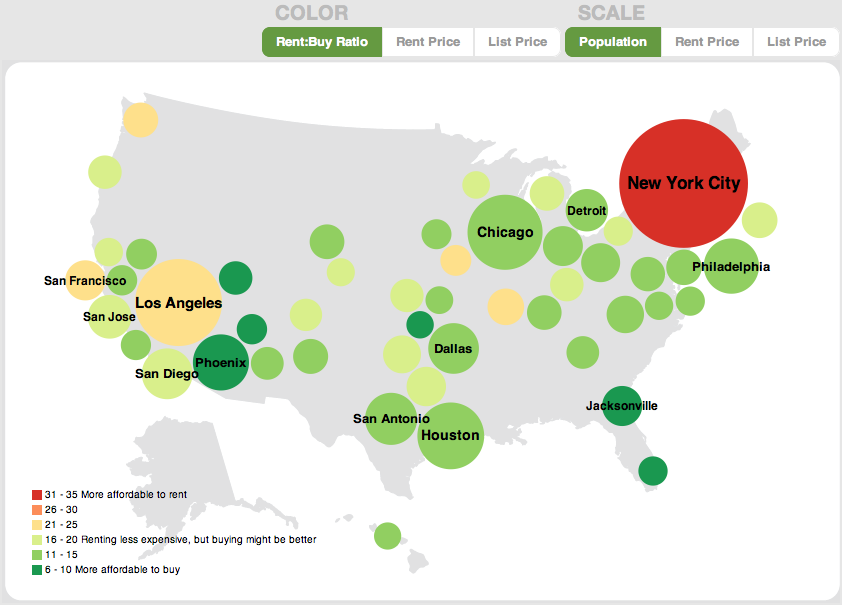
In the meantime, you can check out this cool interactive Housing map, via Trulia. As you click around in this map, keep in mind the 4 key factors that determine the advantages of Renting vs Buying: Home Prices, Rental Prices, Mortgage Interest Rates, and RE Taxes. We can also add Personal Income and Inflation as the 2 wild cards.
>
click for interactive graphic
>
Previously:
Cost of Ownership: Buy vs Rent (June 2010)
NYT: The Housing Bear Case (September 2010)


Tweet
Facebook
Reddit
Digg this!


February 22nd, 2011 at 8:32 am
BR has been declared a genius! http://www.marketwatch.com/story/market-crash-2011-it-will-hit-by-christmas-2011-02-22
Thaler’s a quant, speaks mostly in cryptic algorithmics. So if you really want to know how Wall Street’s con game works on you, Barry Ritholtz, the financial genius behind “Bailout Nation,” recently summarized it in the Washington Post: “Humans make all the same mistakes, over and over again. It’s how we are wired, the net result of evolution. That flight-or-fight response might have helped your ancestors deal with hungry saber-toothed tigers and territorial Cro Magnons, but it drives investors to make costly emotional decisions.”
Humans have something “akin to brain damage,” says Ritholtz. “To neurophysiologists, who research cognitive functions, the emotionally driven appear to suffer from cognitive deficits that mimic certain types of brain injuries. … Anyone with an intense emotional interest in a subject loses the ability to observe it objectively: You selectively perceive events. You ignore data and facts that disagree with your main philosophy. Even your memory works to fool you, as you selectively retain what you believe in, and subtly mask any memories that might conflict.”
February 22nd, 2011 at 8:38 am
“keep in mind the 4 key factors that determine the advantages of Renting vs Buying: Home Prices, Rental Prices, Mortgage Interest Rates, and RE Taxes. ”
You forgot #5 – Mobility. Renters can get up and move across the country for that new career move. Try that with your Trulia approved purchase in a still falling market. (isn’t it their business to help the grease the home market?)
February 22nd, 2011 at 9:14 am
This chart shows the wrong impressions you can get depending on what segment you look at. Trulia is comparing apartments, townhouses and condos.
If you want a condo, that’s fine, but there are plenty of condos on the ropes here. You can get one cheap as long as you don’t want to sell it in the next 5-10 years, or maybe longer. The townhouses they are citing must be either in the far burbs or you need to carry a gun when you walk outside.
Houses are a different picture. Inside the loop, house prices have taken a hit, but are still more thant double the range they cite. And that’s the lower end. Part of it may be due to the realtors’ gimmick of not haveing to report real sale prices and there are lots of listings just sitting. Houston’s property taxes are very high and likely going higher because of the pension burdens on the city. Taxes and insurance alone will run $10k/year on a less expensive ranch style inside the loop. Yet, if you look around you can rent a whole house for not much more than the rent they are quoting for apartments.
BTW, have been seeing a lot of “For Sale or Lease” signs for awhile as owners and builders got more desperate. Saw a new one in front of a McMansion yesterday. It only had the agent’s contact info and the word “AVAILABLE” in large letters. Is this some new classification invented by the NAR to lower the months of supply? The houses will no longer be listed as “for sale” but will only be “available.”
February 22nd, 2011 at 9:14 am
“keep in mind the 4 key factors that determine the advantages of Renting vs Buying: Home Prices, Rental Prices, Mortgage Interest Rates, and RE Taxes. ”
__________________
Keep in mind the bottom line factor that determines the ability to Rent or Buy: Income.
Do you honestly think there are enough credit worthy folks out there to buy homes instead of renting? How about homes that are worth the mortgage balance (as a matter of security for the lender)? I’ve been doing a LOT of actual research into the mid-Atlantic housing market for the past several months (“actual,” as in driving to new communities and their surrounding areas to survey the damage on the ground), and the reality of our situation belies any housing recovery meme.
For example, in the linked chart, Raleigh, NC, is listed as a good place to buy. I’ve been to Raleigh, recently. Primarily a restaurant/strip mall/consumer services economy. Plenty o’ houses moldering. The knives are still falling. Affordability might be good when viewed through the lenses of current vs. bubble prices or mortgage vs. rent, but vs. income and/or credit and/or housing supply, prices are still waaaaay too high and supply is growing.
Every house on the market would sell today if the price was right. That ain’t happenin’.
February 22nd, 2011 at 9:52 am
http://blogs.wsj.com/developments/2011/02/18/all-real-estate-is-local-think-again/
February 22nd, 2011 at 10:56 am
http://www.youtube.com/watch?v=ydY1JzXb4PM
February 22nd, 2011 at 11:04 am
I am only familiar enough with two of the areas on the map’s real estate to judge the accuracy of this graph, but I can say that of those two (South Florida and Bay Area California) it is right about one and misleading about the other. South Florida is correctly labeled “cheaper to buy” for pretty much every market segment, but from the San Jose and San Francisco spheres you would get the impression that it is pretty much cheaper to buy, or at least close, in the Bay Area. That is wildly inaccurate. If you want to live in the worst areas or the most distant areas it is still not cheaper to buy than to rent, but it is getting pretty close. But if you want to live anywhere near where the jobs are (Silicon Valley= west of San Jose and south of Palo Alto) the prices are still very high. Not anything close to buy/rent parity. And even anything that is a reasonable commute (everything in San Mateo or western Santa Clara county that is safe and on the Bay side of the mountains) is still way more expensive to buy (e.g. $450k to buy, $2k to rent). If you are talking about East Bay or inland somewhere, then the prices are definitely going down. But the ripple effect hasn’t made its way to the coast, and won’t unless the tech or biotech sectors sag more.
February 22nd, 2011 at 12:36 pm
Sorry, I had originally mentioned I was in Houston but somehow edited it out.
February 22nd, 2011 at 1:46 pm
aypay – around Houston it is somewhat similar. If you’re willing to drive 45min to an hour, you can easily get a pretty decent house in the $150-200 range. To avoid that commute, you pay at least double.
February 22nd, 2011 at 4:30 pm
I own one unit in a 3 unit building in San Francisco that I bought in 2006 near the peak. Could not sell it without taking over a 20% loss. Rented it for about 95% of the mortgage/taxes and it would cash flow easily for a 2011 buyer.
Another unit in our building was rented for 102% of mortgage/taxes. If he sold, the new buyer would turn a nice profit on the rental.
February 22nd, 2011 at 4:32 pm
Petey Wheatstraw,
I want to agree with you about knives still falling in Raleigh, but you saying it is “Primarily a restaurant/strip mall/consumer services economy” seems incorrect, and that personal impression probably leads to a different view of the entire picture.
Raleigh has the state capital, has NC State Univ, a host of other small university’s, but most importantly it borders the research triangle park – one of the most thriving tech, biotech, pharm and research spots in the country. The triangle as a whole, including Cary, Durham/Duke, Chapel Hill (the research hospitals are huge) is doing pretty well economically compared to the rest of the nation. I can’t name a personal connection that is unemployed.
Despite the economic ‘decency’, prices are still falling here. They didn’t fall much in 08/09 compared to the rest of the country, because our bubble curve wasn’t sharp They haven’t fallen much overall, still only 12-14% since the mid-2000 highs. But if this place isn’t recovering yet then I have trouble seeing other places bottom.
February 22nd, 2011 at 5:18 pm
It’s hard to see Birmingham, AL home prices maintain their levels for much longer either. But, as with many metro areas, there are pockets of depression-level homes and neighborhoods, always have been, and other areas where demand is high and home prices are steady. It’s the same theme in many, if not all, metro areas. I can’t speak to rural mid-west or places like that. Most parts of Alabama, except the coast, never really saw the housing boom. Sure, a lot of houses were built, but the gains were marginal. Still, this is a place where a million bucks is a lot of money. Much better to buy than rent for the most part in Alabama, but credit and income remain a problem, and that’s not a new problem.
What you think you know about Alabama is still basically true, minus the “whites only” water fountains and possum-eaters. It’s still a poor state, with its priorities out of place, from it’s governor’s office down to the lowliest welfare recipient. Football receives too much attention, and the children’s education receives too little. This is a place where Weight Watchers and a mexican restaurant will occupy the same space.
And the reasons I am here are too complicated and numerous to even mention :(.