
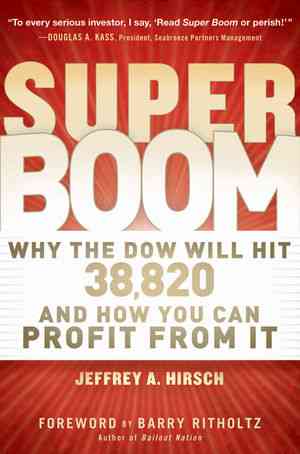
Super Boom: Why the Dow Jones Will Hit 38,820 and How You Can Profit From It
About 8 months ago, I was intrigued by the prospects of 500% market gains being a regular cyclical phenomena.
The first post was titled “Hirsch’s WTF Forecast: Dow 38,820” and filed under the category “Really, really bad calls.” (I’ll mea culpa if we come anywhere near 30,000 by 2025). I thought my old pal Jeff had lost his mind.
But then I spoke with Jeff. He explained his reasoning. He sent me his fathers infamous 1977 500% call. I ended up doing a new post “War & Peace + Inflation + Secular Bull = Dow 38K ?“ The more I looked into it, the more it seemed like an ingenious piece of history repeating.
I became impressed enough the methodology that I agreed to write the forward! I have no idea if we will see Dow 38820 in 2025, but the thesis is both intriguing and defendable . . .
Some notable reviews follow:
“As someone who views the investment glass half empty, I would normally treat a forecasted price target for the Dow Jones Industrial of 38,820 as hyperbolic and outlandish. That is, unless the forecaster is Jeff Hirsch! Jeff is ‘bred in the purple’ and has royalty in his investment blood as his legendary dad, Yale Hirsch, was the dean of all technical analysts (and was the first of his kind to accurately predict the roaring Bull Market of 1974-1990). More importantly, Jeff’s rationale for another super boom is well articulated in his own unique set of facts, figures and dissection of history. To every serious investor I say, Read Super Boom or Perish!”-Douglas A. Kass, President, Seabreeze Partners Management Inc.
“Jeff Hirsch delivers a 500% effort in Super Boom. Unless you’re closed minded or comatose there is a lot, lot more here than any investment reader can normally hope for. The visuals and data alone are worth many times the price.”
-Ken Fisher, Founder and CEO, Fisher Investments, Forbes “Portfolio Strategy” Columnist, 5-time New York Times bestselling author“Super Boom reminds the reader of the power of compounding. DJIA 38,820 by 2025 might sound like an outrageous level, but the implied sub-9% compound annual growth rate (following a decade of decline) makes the target appear more attainable. Within these pages, Jeff demonstrates that he has learned a lot from his father and has inherited the reputation as a renowned and respected market historian.”
-Sam Stovall, Chief Investment Strategist, Standard & Poor’s Equity Research“As a kid I taught Jeff how to catch big rainbow trout in Montana. In Super Boom, he’s returned the favor by showing us how to catch a monster stock market move. A must-read book.”
—Larry Williams, trader
Chapter 5 excerpt after the jump
Super Boom: Why the Dow Jones Will Hit 38,820 and How You Can Profit From It


Tweet
Facebook
Reddit
Digg this!


April 12th, 2011 at 9:36 am
A really good trader has an open mind and the ability to see all possibilites. The Dow could easily see 38k. It could see 2500.we don’t need to know where the market is “going” to make money. What matters is where it is right now.
Predictions are good for selling books but worthless to trade off of.
All that being said a 9% return isn’t that hard to fathom.
April 12th, 2011 at 10:43 am
A few years of 10% inflation and we’re there…
April 12th, 2011 at 10:51 am
He might be right! When we come full cycle from the Fed printing money to fund the debt, what will the dollar be worth.
April 12th, 2011 at 10:52 am
?
April 12th, 2011 at 10:55 am
Oops, I’m assuming the dollar will still be the reserve currency, not the rimnby.
April 12th, 2011 at 7:24 pm
So what’s it going to be in 2016?
April 12th, 2011 at 8:28 pm
i’m guessing blindly optimistic predictions were similarly made in the early 1930s…but i’m sure it’s different this time
~~~
BR: You are missing the point — this is not a blindly optimistic forecast, it is based on strong inflation and ezxcess government stimulus.
April 13th, 2011 at 10:10 am
If Yale Hirsch’s call included the year 1974, you would have been underwater in August of 1982 if you followed his advice at the beginning of ’74 and used a buy and hold strategy. The biggest part of the move occured in August of ’82 through 1990, with the 1987 crash in between. You would have been better off owning gold between 1973 and 1980. As James Dines pointed out in his book “The Invisible Crash”, the inflation adjusted returns of the Dow were extremely negative during that period.
What are the inflation adjusted returns for the Dow in Jeff Hirsch’s latest predictions?
April 13th, 2011 at 3:12 pm
[...] here. PERMALINK Category: [...]
April 13th, 2011 at 3:37 pm
As long as we keep printing….the higher she goes!!!
April 14th, 2011 at 2:47 am
Typically, the big booms occur after the inflation episode has run its course. The 1982-2000 boom was during a time of consistently declining interest rates. Interest rates peaked in 1981 and once Volker killed the inflation monster, the stage was set for a boom.
We haven’t had our big inflation episode yet. Obama has been trying to kick it off, but he is too incompetent to make the proper case to the public, or to implement properly consistent policies. Printing money is not sufficient to kick start inflation. Commodity prices can both boom and crash, but it is the stickiness of wages that makes price increases permanent. To inflate away current debt levels will require a truly massive inflation, carrying prices up by at least 3x. To get inflation going now it is necessary to bid up wages in a time of high unemployment, and this requires a large increase in unionization.
April 28th, 2011 at 10:43 am
[...] it in their back-and-forth way. I think that’s something happens between 2015 and 2020. The guy who is calling for 38,000 on the Dow by 2025 isn’t as crazy as he [...]