
CRA Thought Experiment
Given how thoroughly the “CRA caused everything” meme has been debunked, you have to wonder why some poor souls are still pushing this discredited political talking point (other than as linkbait).
I’ve already spilled too many pixels debunking Phil Gramm’s attempt to shift blame from his radical deregulation to other parties (see partial list at bottom). Oh, and I dropped another 322 pages explaining the actual causes of the crisis.
And yet, these attempts at misplaced fault continue.
So this morning, I want to try a completely different approach — the opposite of our usual data driven, analytical framework. Rather than show more facts, data and specific details, instead, I want to do a little thought experiment.
Imagine, if you will, that the discredited far right meme is actually correct: Assume that the CRA was a prime cause of the mortgage, credit and housing related crises.
Yes, he typed, it was all the CRA’s fault. (Stay with me here).
Assume arguendo that CRA legislation forced banks into making high risk, ill advised loans. And, let’s further assume a huge percentage of these government mandated mortgages have gone bad. The buyers who could not legitimately afford these homes or otherwise qualify for other mortgages have defaulted, and these houses are either in default, foreclosure or REOs.
What would this alternative nation look like?
Given the giant US housing boom and bust, this thought experiment would have several obvious and inevitable outcomes from CRA forced lending:
1) Home sales in CRA communities would have led the national home market higher, with sales gains (as a percentage) increasing even more than the national median;
2) Prices of CRA funded properties should have risen even more than the rest of the nation as sales ramped up.
3) After the market peaked and reversed, Distressed Sales in CRA regions should lead the national market downwards. Foreclosures and REOS should be much higher in CRA neighborhoods than the national median.
4) We should have reams of evidence detailing how CRA mandated loans have defaulted in vastly disproportionate numbers versus the national default rates;
5) CRA Banks that were funding these mortgages should be failing in ever greater numbers, far more than the average bank;
6) Portfolios of large national TARP banks should be strewn with toxic CRA defaults; securitizers that purchased these mortgages should have compiled list of defaulted CRA properties;
7) Bank execs likely would have been complaining to the Bush White House from 2002-08 about these CRA mandates; The many finance executives who testified to Congress, would also have spelled out that CRA was a direct cause, with compelling evidence backing their claims.
So much for THAT thought experiment: None of these outcomes have occurred.
Zero.
In reality, the precise opposite of what a CRA-induced collapse should have looked like is what occurred. The 345 mortgage brokers that imploded were non-banks, not covered by the CRA legislation. The vast majority of CRA covered banks are actually healthy.
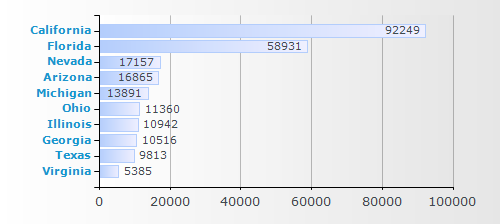
The biggest foreclosure areas aren’t Harlem or Chicago’s South side or DC slums or inner city Philly; Rather, it hs been non-CRA regions — the Sand States — such as southern California, Las Vegas, Arizona, and South Florida. The closest thing to an inner city foreclosure story is Detroit – and maybe the bankruptcy of GM and Chrysler actually had something to do with that.
~~~
I spent a year of my life researching and writing in painstaking details what the actual causes of the crisis were. I put together all of the moving parts as to what the actual causes were — and wrote them up in Bailout Nation, to wit: Irresponsibly ultra-low rates that led to a huge housing boom; a failure by the Fed to supervise non-bank lenders; An abdication of lending standards by both banks and non-banks; Radical deregulation of financial markets; the now discredited belief that markets can self-regulate; a shadow derivative market allowed to operate unlike every other financial product; Compensation schemes that rewarded short term risk taking over long term profitibility; Increases in leverage to the major investment houses from 12-to-1 to 35-to-1; These were the causes of the collapse — not some 1977 legislation.
Its not simply that the overwhelming amount of evidence points to many factors outside of the CRA, the actual results of CRA were minor. Relative to these other ginormous factors, the CRA impact is all but irrelevant. And to date, nobody has produced any data based evidence that the CRA was relevant to the crisis. Not one shred.
Until that evidence is produced, the CRA remains a marker, one that separates proponents of intellectually honest debate versus the parrots of partisan talking points, not worthy of your time or effort.
>
Previously:
Kroszner CRA & the Mortgage Crisis (December 3rd, 2008)
http://www.ritholtz.com/blog/2008/12/kroszner-cra-the-mortgage-crisis/
Federal Reserve Director on the CRA (October 4th, 2008)
http://www.ritholtz.com/blog/2008/10/federal-reserve-director-on-the-cra/
FDIC Chairman Sheila Bair on CRA: NOT Guilty (December 5th, 2008)
http://www.ritholtz.com/blog/2008/12/fdic-chairman-sheila-bair-on-cra-not-guilty/
Misunderstanding Credit and Housing Crises: Blaming the CRA, GSEs (October 2nd, 2008)
http://www.ritholtz.com/blog/2008/10/misunderstanding-credit-and-housing-crises-blaming-the-cra-gses/
George Bush: Goal Increase Minority Homeowners by 5.5 Million in a Decade (October 14th, 2008)
http://www.ritholtz.com/blog/2008/10/goal-increase-minority-homeowners-by-55-million-in-a-decade/
How Lending Standard Changes Led to the Housing Boom/Bust (October 21st, 2008)
http://www.ritholtz.com/blog/2008/10/how-lending-standard-changes-led-to-the-housing-boombust/
Other Sources:
Subprime Suspects
Daniel Gross
Slate, Tuesday, Oct. 7, 2008, at 2:08 PM ET
http://www.slate.com/id/2201641
National Real Estate Trends
1,962,567 Foreclosure Homes | $172,170 Average Foreclosure Sales Price
http://www.realtytrac.com/TrendCenter/default.aspx
http://www.realtytrac.com/states/index.html



June 25th, 2009 at 10:48 pm
No, I don’t point to linkbait articles –
But last night, I did point to Felix’s take down.
June 26th, 2009 at 6:45 am
… firms that provide products and services provided to CRA-housing residents would be way down as opposed to firms like Saks, Saab, Sullivan’s steak house would be doing great.
June 26th, 2009 at 6:46 am
… as opposed to McDonalds, Wal-Mart et al would be collapsing.
June 26th, 2009 at 7:28 am
Barry –
You are using facts and logic. That means the people who are pushing this argument won’t understand it.
June 26th, 2009 at 7:30 am
Barry, Barry, Barry…..
You actually ASSume that those is power want the real reason for the meltdown to be known!
Then you ASSume, that those that should know…have more than 5watts of computing power between their ears!….
We really do appreciate all that you do… but the doctors are ‘concerned’ for your safety….and Obamacare will fix everything…while giving you the ol’ cap-n-trade….
harharhar
June 26th, 2009 at 7:31 am
Sorry, but I am reality-, data-, and fact based.
Its the only world I have ever known . . .
June 26th, 2009 at 7:32 am
I don’t understand why you get so upset over thi CRA stuff. The logic is so far off that it is not even worth arguing with them. There will always be people who’ll insist that 1+1=3 and there is nothing you can do about it. And no matter how much you argue your points, you will never win them over.
Remember, everyone thinks they are of above average intelligence.
June 26th, 2009 at 7:45 am
Maybe it was not the CRA, but government intervention through lower borrowing cots and lower capital requirements for Fannie and Freddie are almost certainly behind the price inflation in housing. After all they funded half of the 11 trillion dollar mortgages.
More on this at How GSEs and Marking to Market Accounting Created and Spread the Subprime Crisis and What to do About it
~~~
BR: I am no fan of Fannie or Freddie; And if you recall this 2007 post, we were short the shares from $40 onward:
However, it is a stretch to claim that Fannie, around since 1938, is a top 10 or even top 20 cause of the collapse because a) Fannie has been around since 1938. Why (after all of the reasons I list above and in the book) did they suddenly cause a problem in 2005? and 2) There are simply too many nations without Fannie or Freddie that had a similar boom and bust . . .
Until you can explain those two factors, you are baerking up the wrong tree.
June 26th, 2009 at 7:57 am
Everybody knows (that is everybody that watches Fox) that Freddie and Fannie caused the economic collapse. I’m not even sure how the CRA/Freddie/Fannie thing all fits together or even if they do. The common thread seems to be they are all things that could be hung on the Democrats.
All I know is that I am continually told that the cause of the collapse was Freddie and Fannie by the Fox News watchers.
Anyone care to explain to me the relationship between Freddie/Fannie/CRA if there is one. Also am I the only one that continually gets told that all of our economic woes are the result of Freddie and Fannie.
June 26th, 2009 at 8:00 am
Barry:
Brilliant analysis that would win in court. Will have no impact on my wingnut brother in law. What are facts and logic against oxycontin generated rhetoric?
June 26th, 2009 at 8:12 am
Great post.
June 26th, 2009 at 8:21 am
Barry,
I must disagree with some comments above. While I’m sure it’s true that you can’t win over most of the partisans that have reasons for not listening to logic and reason over CRA, it’s nevertheless VERY important that you (and others like Salmon) keep debunking these meme(s). If the crazies keep the message out there and it goes unchallenged, it begins to unfortunately take on an air of credibilty. And fortunately, intelligent fact-based people like you have the energy, “patience”, and proper outlet for countering this foolishness. Thanks, Barry.
June 26th, 2009 at 8:23 am
By the way, Bloomberg radio this morning mentioned your “scathing entry on CRA”. Made we want to go right to it to see what you said.
June 26th, 2009 at 8:25 am
Let me stipulate that I accept Barry’s statistical analysis.
Here’s the “possible” unmeasurable contribution of CRA to the financial crisis.
Having been on the board of a small bank , I can promise you firsthand that CRA was a big hot button issue for regulators and scared managements half to death with fear of costly investigations and examinations. While the dollar amounts were quite small, the threats and time expended were severely disproportionate.
Given the finite manpower and time of regulators, I am willing to assert that every minute spent on a CRA exam or analysis was time wasted while banks were loading up on the real dollar problems that we all know about now.
So its main contribution could be described as indirect, if you accept this assertion.
I think CRA is bad policy, as is 99% of government policy. I don’t think its contribution is zero, but as BR points out, making it the #1 whipping boy is intellectually dishonest.
June 26th, 2009 at 8:28 am
Barry Ritholtz Says:
June 26th, 2009 at 7:31 am
Sorry, but I am reality-, data-, and fact based.
Its the only world I have ever known . . .
reply:
———————
When cold hard cash is involved, facts are not an asset. With respect to the CRA and most other things, including green shoots, unfiltered facts are unacceptable and cost people money. Reality needs to be defined properly. Facts just make a mess of things.
June 26th, 2009 at 8:55 am
I’m guessing Barry is concerned how the right-wing mewling over CRA affects the debate on regulating the financial sector. Hence, the repeated shotgun blasts to the head of the monster-that-will-not-die.
June 26th, 2009 at 8:56 am
CRA is not the “cause” of the melt down; there were many causes.
BUT CRA was one of the key contributors!
CRA helped set the tone for the acceptability for high risk lending practices being the norm in the mortgage market. It’s influence was much broader than just the origination of high risk sub-prime loans. The spirit of CRA (high risk mortgages are fine) overlaid onto the mortgage business model (of more loans means more profits), helped to drive higher risk loans across the whole spectrum of mortgage lending, and maybe even non-mortgage lending to a certain extent.
June 26th, 2009 at 8:56 am
All I know is that I am continually told that the cause of the collapse was Freddie and Fannie by the Fox News watchers.
——–
Oh that darn GD1! It’s all its fault we’re going into GD2
June 26th, 2009 at 8:57 am
Barry,
You should stop wasting your time with these idiots still trying to make CRA the problem.
On another note maybe CRE should start being the focus. It looks like lots of cracks are starting to show up:
http://www.denverpost.com/business/ci_12683690
I’ve been burned twice though this year thinking this way and playing in SRS, thank god for stops.
June 26th, 2009 at 9:00 am
If the crazies keep the message out there and it goes unchallenged, it begins to unfortunately take on an air of credibilty. And fortunately, intelligent fact-based people like you have the energy, “patience”, and proper outlet for countering this foolishness. Thanks, Barry.
————–
Facts only win when the crazies have finally cannibalized themselves.
June 26th, 2009 at 9:03 am
Facts only win when the crazies have finally cannibalized themselves.
———————
Or when they suit the crazies purposes… Obviously they currently don’t.
June 26th, 2009 at 9:09 am
CRA helped set the tone for the acceptability for high risk lending practices being the norm in the mortgage market. It’s influence was much broader than just the origination of high risk sub-prime loans. The spirit of CRA (high risk mortgages are fine) overlaid onto the mortgage business model (of more loans means more profits), helped to drive higher risk loans across the whole spectrum of mortgage lending, and maybe even non-mortgage lending to a certain extent.
It was part of a systemic shift from low risk to high risk. It was a influence, as was the level of leverage allowed at financial institutions. To say that CRA was not a factor in the meltdown, is the same level of wrongheadedness as to say it caused the meltdown.
~~~
BR: Then you have to explain why there was no issue from 1977 forward — as opposed to the full list above, starting with the ultra low rates of from 2002 forward.
June 26th, 2009 at 9:12 am
BR,
CRA, certainly, wasn’t ‘the whole Pie’, but, it was a ‘Slice’..
arogersb, above, points to a decent piece that delineates its additive impact.
and, with Point 1) , above, those markets needn’t have led the the National home market higher, or be responsible for a greater % increase of Sales..
for the Program to be effective, all they had to do was stimulate activity at the bottom so that that ‘trade-up’ activity led the ‘early adopters’ into the meme of: “Now, is a Great Time to Buy!”
Though, to reiterate, I think you’re Correct, CRA wasn’t the Prime Culprit, though, it was a Piece of the Problem.
Those that hanging CRA are, more than likely, working for those that, in *Reality, should be stretching Rope.
~~~
BR: Then show me some evidence!
June 26th, 2009 at 9:13 am
“Bailout nation” identifies “An abdication of lending standards by both banks and non-banks” as a cause of the crisis. CRA was part of the abdication of lending standards by both banks and non-banks. It was the gov’t endorsement, even the gov’t enforcement of lower lending standards.
To say it is the cause is subterfuge, to say it didn’t matter is dishonest.
~~~
BR: Let’s put some context around what the CRA was and wasn’t:
June 26th, 2009 at 9:23 am
A few years ago, I made a presentation with facts, charts and data explaining why we were in bubble mode. Suffice it to say, it did not get any traction.
When I complained to a colleague that I could not understand how no one could see it having proof right under their eyes, he quickly told me that my problem is that I talk too much. He told me that the golden rule is to keep it short and sweet, no more than 3 variables. More than that and you become background noise and they start day dreaming about the great weekend they had using their toys bought with bubble money.
I was annoyed because in my mind there was no way you could understand what was really going on if you stuck to 3 variables. It was a multi-variate equation and to see the bubble, you had to see that the equation was not linear.
And for most people, 3 variables were even too much. There was only one: low interest rates. Don’t fight the Fed.
In my mind, those who focus on the CRA are probably those who can not carry more than a few variables in ther line of thinking. And you’re fighting a losing battle.
June 26th, 2009 at 9:24 am
Ben,
Thank god for stops!
Me too on srs.
June 26th, 2009 at 9:24 am
Barry,
The weapons of mass destruction are there. They are buried in the desert because he knew we were coming. And it’s better to fight them there than to fight them here.
I know this is drivel, but it is drivel that is pushed in order to back an agenda, and to get the people to accept a policy or action.
I personally tried to convince people that if Hans Blix and a team of PhD scientists, standing on sand in Iraq can’t find them, then you should not believe someone on the other side of the planet who says “We know where they are.” I was unsuccessful.
Ending the long analogy, you just cannot convince some people of what they want to believe. That is, for CRA, it’s all the minorities’ fault. And therefore, they should get less help in the future. That’s what I think this is about.
I understand you drive for the truth though. Like you, I have science undergrad, then law school. Two different kinds of study, but both based on evidence and proof …and stuff.
Oh, yeah, and the people who died in New Orleans, they were dumb, and it’s their fault they died because they didn’t own a car. (sarcasm)
I just don’t speak to those people anymore.
June 26th, 2009 at 9:27 am
danm,
More like one variable. For fun, turn on the local news and see if they run a story that cannot be explained in a two or three word sentence. House on fire. Man shot. Woman died. Dog lost. Dog found. Rain tomorrow. Home team wins etc.
If you see something that takes multiple sentences to explain…. you’re probably reading a blog.
cjc
June 26th, 2009 at 9:28 am
Danm,
Those who focus solely on CRA….
It’s produced by the propaganda machine, and parroted by the 3 variable or less crowd (3VOLC).
The propaganda machine starts with someone who knows the truth, but panders to the 3VOLC.
June 26th, 2009 at 9:32 am
hopeImwrong Says:
right on.
but the masses won’t listen to Barry (too many arguments to understand). the masses will only cling to Barry’s arguments when someone in the propaganda machine finds a benefit to using 1 and only 1 of Barry’s arguments (if it ever happens)!
June 26th, 2009 at 9:34 am
Clearly, the CRA was not the primary cause of the mortgage meltdown.
Clearly, it played a part.
Arguing that it had zero impact is as intellectually dishonest as arguing that it, and it alone, caused the problem.
~~~
BR: You (and others like you) have made a claim that the CRA was a major contributor.
I keep asking for evidence — facts, data, figures — show me the money! The foreclosures, toxic CRA assets, broken banks!
YET NONE YOU SEEM CAPABLE OF PRODUCING PROOF —
NO EVIDENCE = YOU LOSE THE ARGUMENT
June 26th, 2009 at 9:34 am
The wing nuts MUST somehow find a government entity to blame. Be it CRA, Fannie, Freddie, to justify and attempt to propagate their bankrupt ideology. It is impossible for them to see the facts since it is against their religion, blasphemy if u will to put any blame on anyone except the government. The claims will never change since they are fanatical. It would be akin to them having a sex change operation.
June 26th, 2009 at 9:37 am
Blaming the CRA for the mortgage mess is like saying that micro-lending institutions making $20 loans to Bangladeshi women to buy goats with social collateral changed the risk and incentive structure in the world to the point that banks in the US HAD to offer credit to Americans who wanted to buy 60″ plasma TVs. The Bangladeshi women, by the way, have the lowest default rate in the world, since their neighbors have to sign the loan with them, and if credit is scarce, why would anyone abuse it?
June 26th, 2009 at 9:37 am
Sucks to be you, Cranky Quixote.
(Cranky Quixote is your newest nickname after Barry the Commie, Republican Ritholtz, Ritholtz the Republican, Ritholtz the Libertarian, Barry W. Ritholtz, and Cranky. Did I miss any?)
Cranky, I admire your never-ending crusade for “reality-, data-, and fact based”. This is why I play Sancho Panza – albeit handsome, fit, literate, and worldly – to your Quixote. You are so virtuous in your fact-basedness that you even challenged your own faithful sidekick to provide evidence for his emo or indie mtheme: http://www.ritholtz.com/blog/2009/06/friday-night-jazz-madeleine-peyroux/#comment-182778
Unfortunately, Cranky, reality has a left-wing bias, and this country is far right of center. Ignorance and arrogance are celebrated in America. We may grumble about our students lagging in math and science, but really we aren’t that concerned. Education and intellectual achievement are not that important here, so who cares about data and facts? The peeps on your blog love you, but they are lonely men – and I do mean men – out of touch with their surroundings, pariahs in their own land.
Keep up your crusade, Cranky, but you are tilting at windmills. Sucks to be you.
Sucks to be us.
June 26th, 2009 at 9:42 am
[...] Ritholtz poses a thought experiment to test the notion that Community Reinvestment Act was “a prime cause” of the financial crisis: Given the giant US housing boom and bust, this thought experiment [...]
June 26th, 2009 at 9:43 am
[...] The CRA was largely irrelevant to the housing/mortgage crisis. (Big Picture) [...]
June 26th, 2009 at 9:43 am
I had asked previously when zero down loans had originated in the US. Tranzor confirmed that prior to the 1990’s, the only way to get them was from the VA (he referenced a bill, I can’t remember offhand what it was).
During the 1990’s, the Clinton administration pushed for more minority home ownership. To accomplish this, they pushed FMm and FRm to offer lower down loans.
This is not speculation, these are facts.
At the signing of the repeal of Glass-Steagal, Sen Sarbanes said that one of the administrations goals for the bill was that it not impact the CRA. Again, this is part of the written record.
In 1999, I believe, BofA offered the first 500million in zero down loans to low and middle income borrowers.
Now, since the bubble was just getting going, zero down would seem to make sense. Since the government was pushing for access to housing, low down and no down loans would seem to make sense. And since nothing collapses immediately, the false sense of security brought about by the seeming ability of folks to repay/refinance these loans would support a housing bubble.
Until it broke.
The CRA didn’t create the bubble, but it helped create the mindset that the bubble could be maintained. Those of us who lived through a bubble knew that we were in one, however we weren’t the ones making the bonuses on the loans.
~~~
BR: How about some data and context? Your argument is of the “I know I guy who ate an orange and he died, so Oranges are poisonous” variety.
You refuse to provide data or any context.
You give the fact that the USA offers veterans returning from war, after getting paid low military wages while serving their country no-money-down mortgages as a cause?
Aside from the social good encouraging of giving incentives to an underpaid all volunteer military —
BUT the existence of these loans is not proof of any causation. How many of these mortgages defaulted? What percentage relative to the total?
June 26th, 2009 at 9:45 am
And, Cranky, as a registered Republican, I have long known that the best way to fight the fact-empty arguments of the right is through my own fact-empty arguments, hyperbole, outright lies and rumors. Fight fire with fire.
For example, if I would like to snipe away at the family values hipocrisy of my political party, I could make up and spread fictitious rumors of, say, Mark Sanford having an affair with a woman in Argentina.
What?
June 26th, 2009 at 9:46 am
BTW, Br, I have never claimed that the CRA was the major contributor to the problem. I’ve looked into it, and it’s impact is part of a larger mess that the government created.
Backstopping mortgages, reducing down payment terms, pushing for higher levels of home ownership. All things that the government should not be invovlved in.
June 26th, 2009 at 9:47 am
I agree with the CRA piece of teh pice aspect–but there are so many pieces of the pie.
The other aspect of the problem is founded in my business operation background.
The bigger problem was known to many-many in DC and across the country. While some stood up to it they were ineffective for whatever reason.
Thats the real problem.
Just like this health care, cap and trade, more power to the Fed plans are proceeding–someone has to be effective in standing up to the problem.
I cannot think of who that will be. There is no effective debate, discussion or even education of how any of this will unfold. Just another series of grand ideas with no implementation plan and no success measurement plan.
A hell of a way to run a business.
And our society.
When is California officially bankrupt–next week.? They sure managed that crisis well, huh?
June 26th, 2009 at 9:48 am
@kstills says
“At the signing of the repeal of Glass-Steagal, Sen Sarbanes said that one of the administrations goals for the bill was that it not impact the CRA. Again, this is part of the written record. ”
I’m sure we could also find a statement that the Gramm-Leach-Bailey act must not impact the US Constitution. Does that make the US Constitution culpable for the mess?
June 26th, 2009 at 9:49 am
kstills – I agree with you.
On the lighter side, you have to blame CRA because you can’t blame GS, after all, GS is part of the SOLUTION, not part of the problem.
June 26th, 2009 at 10:03 am
8. CRA was implemented C. 1982, which means many of these loans would all have been making payments for ten and twenty years, and *then* went bad in 2008?!? Please.
June 26th, 2009 at 10:19 am
BR, apparently you are so engrossed in proving that the CRA had zero impact that you misread the posts I’ve been making.
No, I am not accusing returning veterans of causing the problem. Good grief, my father served in WWII (Italy, radar). What I asked was at what point in time zero down loans became commonplace in the US. I asked that to establish the timeline of when mortgage standards started to deviate from conventional, 20% down to unconventional.
Until the 1990’s, zero down mortgages appear to have been very restricted. Low down loans, outside of government sponsored loans, appear to have been restricted.
The Clinton administration, with HUD leading the way, started pushing FNMa to offer lower down loans to minorities. This data point fits in with the Clinton admins admitted focus on the CRA.
It did not create the bubble.
The morphing of zero down loans into the more lucrative markets of CA, Las Vegas, Atlanta and Phoenix is what caused the bubble.
But for my money, the genesis of the relaxation of loan standards originated with the government.
Fannie Mae and Freddie Mac appear to have done a great job for as long as they maintained the lending standards they had originally been mandated to maintain. It wasn’t until they got involved in the subprime mess that they blew up.
20% down mortgages may have prevented this bubble from forming. But folks had access to easy money (Fed), had reasons to lend into the housing market (government promotion) and had reason to believe the loans would not adversely affect the banks balance sheets (stress tests run back to the 1990’s).
June 26th, 2009 at 10:21 am
Great stuff, Barry. I’m saving this for use in the course I’m teaching this summer on the history of the US since 1960. One of my major themes is going to be “how we got here:” I’m going to cover the so-called “tax revolt” of the 1970s, the glorification of deregulation, and the rise of free market fundamentalism. This will do nicely.
Here’s another great article on why blaming the CRA is incorrect. And nobody can accuse this one of a “liberal” bias: it comes from the *conservative* Orange County Register:
Sunday, November 16, 2008
Most subprime lenders weren’t subject to federal lending law
By RONALD CAMPBELL
THE ORANGE COUNTY REGISTER
Did a 31-year-old law giving poor people a break at the bank accidentally break the bank?
A lot of opinion leaders think so. From the editorial pages of The Wall Street Journal to talk shows to the op-ed page of The Register, people are charging that the Community Reinvestment Act of 1977 forced banks to make bad loans, leading to financial Armageddon.
There’s just one problem: It isn’t true….
http://www.ocregister.com/articles/loans-subprime-banks-2228728-law-lenders
June 26th, 2009 at 10:22 am
Barry,
Re: your 9:09 and 9:13 responses.
Thanks for responding. There may be things I don’t know about this which could make me think CRA had no impact. And since I cannot provide the proof of “definitive impact to the crisis”, you win for now. I need more banker friends to get first hand information on the impact of CRA and how it evolved over time.
It just seems like the reality is, CRA helped legitimize lower lending standards. CRA alone cannot result in the credit bubble (housing bubble) we had. That’s why 1977 didn’t matter. CRA is not a bad idea, the implementation seems to have had issues. Also, I’m sure the program evolved in implementation and enforcement over time.
It took a general societal/cultural shift from low risk to high risk financial behavior to create the bubble(s). CRAs implementation followed this higher risk path (along with many things). You could ask, was it a symptom, or a cause? Maybe a little bit of both. You could ask that about many things which are being identified as causes of the bubble.
Maybe the bottom line is, it wasn’t CRA at all. But the behavior of implementors and enforcers of CRA that matched the cultural move to higher risk over time. But then, it is the cultural move to high risk which caused the bubble(s). Everything else is a symptom.
June 26th, 2009 at 10:29 am
BR,
you, yourself, described the difference between “Redlining” (no loans), and “CRA” (loans).
It is a given, almost a priori, that “Credit availibility” increases final transaction Price.
Thereby, CRA was additive to the cumulative “Housing Bubble”.
and, again, to mix metaphors, was CRA the largest Hose filling the Pool? No, but it, certainly, helped fill it faster..
also, as I referenced, above, the art. posted by arogersb, is a good one..
June 26th, 2009 at 10:30 am
BTW – IMO CRA is not THE cause of the bubble(s). There is no single cause. But it is so consistent with the theme of higher and higher financial risk through the late 90s and 2000s (which caused the crisis) that it would be one hell of a coincidence if it just happened to be moving along the same risk path at the same time as everything else which help build the financial crisis, but still had “NO IMPACT.”
June 26th, 2009 at 10:40 am
@kstills at 9:43 am:
If you’re going to quote me or paraphrase me, get it right please. Your breezy vagueness only makes Barry’s point about having a lack of facts/data to support your position.
Here is my comment in response to your open question about early examples of zero-down:
http://www.ritholtz.com/blog/2009/06/warranty-fix-for-mortgage-securitization/#comment-184111
Note that absolutely nothing in my comment purported to be a blanket statement about availability of zero-down prior to the 1990s.
——————–
@kstills:
The biggie was the GI Bill of 1944, which provided guaranteed zero down mortgages for WW II veterans.
Garn-St Germain Act (1982) permitted ARMs.
Notable for not passing: Zero Downpayment Act of 2004, provided FHA guaranties for zero-down mortgages. Oddly enough, was supported by NAR and home builders across the land.
——————–
The gauntlet has been thrown to show a statistical correlation and not just faulty causation analysis. IMO Barry’s points #2 and #5 are particularly strong ones.
The Ahmadinejead/Khameni camp in Iran claims that abnormally high voter turnout in traditionally low-turnout areas was caused by the mobilization of a “silent majority” of conservative voters. As the statistical whiz kids from St. Andrews showed, if that were the case you would expect to see the surge in turnout disproportionately benefit Ahmadinejead. Didn’t happen. No correlation. Just across-the-board ballot box stuffing that doesn’t hold up under analysis.
Same thing with CRA impact. All you need to show to support your claims is some kind of correlation between CRA lending and increased property prices, failed local banks — something. So put up or shut up.
Otherwise, this is all just thinly veiled race baiting.
June 26th, 2009 at 10:46 am
Lol,
Race baiting.
Please.
Look at it this way. Social Security is a good idea IF you have an expanding pool of workers, and your demographics don’t deviate from the actuarial tables you use when you set up the program.
How is that working out for Europe and Japan about now?
Backstopping mortgages is a great idea also….until, like above, things change.
The problem all along has been government intervention into areas it has no business being a part of. Whether it is providing for peoples retirement or whether it is making sure they can afford a home. Soon, we will control the carbon output of industry, and at no cost to the US taxpayer.
I suppose, if you try, you can spin that dialogue into a racial attack of some kind, however one has to have the propellar going full throttle in order to make it stick.
BTW, you’re response to my post merely confirmed what my limited research had already found out. It was not meant to be taken as a be all end all affirmation of zero down financing.
June 26th, 2009 at 10:53 am
My wife caught a commericial for Faber’s report “House of Cards” as she was flipping through channels and told me that she wanted to watch it last night. Honey, are you feeling okay?? So we did. Most of us on here know what caused “the mortgage, credit and housing related crises”. During the program it did mention that Fannie and Freddie were late to the housing party. And apparently were coerced into it because of all the money which was being made around them. If you watched the program and paid attention you’d come to the conclusion that three causes were found to be at the heart of the problem; loose monetary policy, lack of regulatory oversite and greed. It’s the same conclusion she arrived at.
June 26th, 2009 at 10:56 am
Good article by the Dallas Fed on CRA delinquency rates.
http://www.dallasfed.org/ca/bcp/2009/bcp0901.cfm
June 26th, 2009 at 10:56 am
well, no that ‘racebaiting’ has entered the Fray (wtg, TZ)
I’ll be clear, “redlining” should be understood.
It, like nothing else, should be noted, and well understood, as one of the great accelerants of the AMC ‘pipe-dream’.
and, with that, no, I’m not going bother to explain..do something novel, see for yourself..
June 26th, 2009 at 11:00 am
The CRA argument has mostly been racist politics by those on the right seeking to deflect blame from the banks.
OT: As I pointed out a few weeks ago, the Death of Treasuries may have been announced prematurely.
We are closing in on 1.00% on the 2-yr, 2.50% on the 5 yr and 3.50% on the 10-yr.
Somewhere in there is a commentary on the current status of the deflation-inflation debate.
Alternatively you can read this as a seasonal move into vanilla assets or as a return of the flight to safety trade.
The $ is stubbornly refusing to collapse.
June 26th, 2009 at 11:04 am
@Transor
I agree that there is an element of white paranoia implicit in many of the rhetoric against the CRA. The idea seems to be that there was nothing fundamentally wrong with most of the system. The CRA supposedly caused banks to make bad loans to bad borrowers, who were invariably depicted as non-white. The story goes that these non-white borrowers were spending like crazy on jet skis and HDTVs, and this tiny cohort of CRA borrowers managed to bring down the entire global financial system. Never mind that 70% of subprime borrowers were white!
June 26th, 2009 at 11:04 am
We are all just mere anchovies in a very large school of anchovies. We don’t need to think to survive we merely need to go with the flow. Sure the odd sucker on the edge may get taken out but the rest of us swim on oblivious.
Uncle Sam knows what’s best for us, and Uncle Sam thinks a V shaped recovery is best and no amount of fuckin logic or facts is going to change that.
June 26th, 2009 at 11:06 am
kstills Says:
“But for my money, the genesis of the relaxation of loan standards originated with the government.”
_____________
No doubt, you are correct in this. But the finer point is that “relaxation of loan standards” is also known as deregulation. Deregulation is the cornerstone of “conservative” governmental ideology. Deregulation was supported fully by the industry that would derive the most from it.
Was Clinton involved? To a degree, he was. Clinton was not daft to the benefits of bipartisanship. However, the ideology that underpins the derailing of our economy — deregulation — is clearly “conservative” in origin (sorry for using the quote marks, but what we call “conservative” is actually uber liberal, when it comes to business interests).
That said, there is not one law, executive order, or policy statement on the books that requires a bank (ANY bank) to lend to an unqualified borrower. Bad loans are solely the responsibility of the lending institution that made them.
Lastly, it’s always important to question motives. Why would any bank knowingly seek permission (that is, to push for deregulation) to make bad loans, or to actually make bad loans, whether regulated or not? The answer is found in all of the toxic MBSs and CDOs that directed revenue in one direction and risk in another — something that could not have happened if the creation of these noxious products was adequately regulated in the first place.
Deregulation of our banking and financial industries, not relaxed loan standards, is government’s contribution to what got us here.
June 26th, 2009 at 11:06 am
Here’s some writeups from back in the day:
http://pqasb.pqarchiver.com/chicagotribune/access/24120513.html?dids=24120513:24120513&FMT=ABS&FMTS=ABS:FT&date=Aug+18%2C+1994&author=Robert+J.+Bruss%2C+Tribune+Media+Services.&pub=Chicago+Tribune+(pre-1997+Fulltext)&desc=METHODS+TO+BUY+A+HOME+FOR+LITTLE+OR+NO+CASH+UNDERSTANDING+CREATIVE+FINANCING+WILL+EASE+THE+PURCHASING+PROCESS&pqatl=google
http://pqasb.pqarchiver.com/washingtonpost/access/26818331.html?dids=26818331:26818331&FMT=ABS&FMTS=ABS:FT&type=current&date=Feb+28%2C+1998&author=Kenneth+R.+Harney&pub=The+Washington+Post&desc=For+Qualified+Borrowers+or+Refinancers%2C+A+Loan+Without+a+Down+Payment&pqatl=google
http://www.city-journal.org/html/10_1_the_trillion_dollar.html
http://www.accessmylibrary.com/coms2/summary_0286-17982697_ITM
The first is an abstract of the programs by FNma to increase low down loans to minorities, as mandated by congress in 1994. The battle was being waged by HUD, who wanted more loans of this type, and FNMa, who at the time did not want to relax their standards. HUD won.
The second is an abstract of BofA’s first 500mill loan into the zero down market (1998, sorry I got the date wrong from above). As the post notes, it was the first large scale zero down plan, targeting those hurt by traditional lending practices.
The third is Husock on the CRA. It, more then anything, probably created the false impression that the CRA was THE cause of the problem. However, if one thinks logically, even if every CRA loan went bust, the impact on the greater mortgage market in the US would probably be negligible. The information that is of interest is how the Clinton admin put teeth into the enforcement of the CRA for the first time.
The fourth (and there is a You tube vid of his speech) is Bush promoting zero down, government backed loans in 2004. The guess at the time was that it could cost up to 500million dollars of taxpayer money if the loans defaulted in a downturn.
Those were simpler times…….
~~~
BR: Not to defend W or Clinton (both of whom I trash in the book) , but show me evidence THOSE loans they was promoting went bad!
The blatherings of public officials, while annoying, don’t cause the issues. Show me where the CRA mandated loans were made to people who defaulted — and in large numbers.
Those of you whose stock in trade is rhetoric seem to have a hard time distinguishing between words and deeds. You remind me of the Rooster who believes it is his crowing that causes the sun to rise . . .
June 26th, 2009 at 11:16 am
@Franklin (10:21)
“I’m saving this for use in the course I’m teaching this summer on the history of the US since 1960. One of my major themes is going to be “how we got here:”"…
I’m guessing that you must just wet your pants day after day knowing that you have the position to teach YOUR OWN PERSONAL VIEW of how some complex combination of events beyond ANYONES ability to fully fathom resulted in “how we got here”…
Not to burst your bubble, but I’d also guess that 99% of your liberal arts students don’t give a FF…They’re most likely occupied during your lecture texting & twittering on the pot they can score for tonights party…or who they’re going to screw…(The other 1% is simply hungover from last night)…
I understand teaching too Franklin…I have been a “teacher” most of my life (albeit group fitness)…I don’t want to get into the complexities of having to be able to communicate while moving and being involved in exertion at the same time, but the common thread is “communicate”, and that’s where I want to focus…
The main DIFFERENCE in communication is that my business is a science with a solid basis for “what is” & “what isn’t”…A “hinge joint” (like a knee or elbow) which only is designed to flex and extend is just that…whereas a “ball and socket” joint (like a hip or shoulder) can flex, extend, hyperextend, abduct, adduct, circumduct, and rotate…It is perfectly clear what the function of each is, and how that related to biomechanics, kinesiology, motor skills, & locomotion…
I sleep at night knowing that my communication message TO OTHERS adhere to facts (not my interpretation of them)…
Although I suppose if you KNEECAPPED someone, you could turn a hinge joint into a ball & socket type…
June 26th, 2009 at 11:21 am
Since race is on the menu, I will add a little anecdote.
Cranky, I have been watching C-SPAN listening to DEMOCRATS – apparently African-American small business owners from Michigan – calling in how the House climate and energy bill will cause higher tax bills, higher energy bills, massive job losses, more foreclosures, yada yada yada. Never mind that nothing from this bill will come into effect until 2016 because Congress has given just about every concession to industry on carbon allowances and to the Southern states on renewable standards.
It’s all crap. None of these people have read the bill nor kept up with the mark-ups. But when you have black Democrats doing the work of Republicans, Exxon, and Peabody Energy, you really have an eternally right-of-center nation that is built on ignorance and misinformation.
Sucks to be you, Cranky. Sucks to be the world.
June 26th, 2009 at 11:23 am
Right on CNBC Sucks.
June 26th, 2009 at 11:25 am
Hey guys, there is an elephant in the room.
There was a bubble because there was (still is) a vast amount of floating capital that could not be invested – not in the regular way.
Regan gave us tax cuts as a right and a lack of oversight, and American business failed to invest sufficiently to soak up the capital and return it as profit.
Probably the law of big numbers meant that the glory days were over anyway.
My money is on the investors as the cause.
June 26th, 2009 at 11:27 am
Excuse me if I’m being Mr. Obvious today, but the CRA was just one tiny mechanism or tool that the smarties gamed to enrich themselves, since our economy today is mostly made up of predatory/prey type of transactions where illegitimate activities are the perceived main (or only?) path to riches. Nevermind that most people get screwed in this type of culture, since only the select few can be the king predators, the “winners” if you will. But as long as everyone has a perceived chance at fleecing his neighbor (caveat emptor to the nth degree) to get rich, these shenanigans will go on in some other form, and ARE going on in some other form. The smarties will simply find other tools in the toolbox to manipulate in their path to glory and “freedom” while throwing his/her neighbors and country under the bus. The CRA isn’t even worthy of debating at this point. These problems are all cultural and thus intractable until we as a culture decide to get our acts together. I’m not holding my breath.
June 26th, 2009 at 11:29 am
@CNBC Sucks: Cynical. Dark. Sadly, correct. Big Oil and Banks have bought off EVERYONE in Congress.
OT: Goldbugs should be very nervous. Dollar took a beating today and gold couldn’t even get to $950. There isn’t an enormous amount of FLATION going on in either direction, so I really don’t like gold here. Even a modest amount of strength in the $ can drive gold to $900. Similar comments apply to oil, the fundamentals and seasonals are horrible from here and a surge in the $ will wipe out the oil bulls.
June 26th, 2009 at 11:35 am
I will agree that Fannie and Freddie also got into trouble and needed a bailout (although compared to their market share they did much better than the rest of the securitization companies). However, the reason they got into trouble was that they were privatized. They have been around since 1938 and it was not until they were privatized that they started getting into the problematic type of loans. When they were privatized their goals moved from the original goal of “giving honest hardworking people a chance of owning a home they can afford” to the goals of all private companies: “to produce the most possible profit for those that are in control of the company”. Their incentives moved from doing what is right to doing whatever the hell it takes to make money. That is why they jumped on the same stupid bandwagon that all the other privately owned companies did (although a little delayed because of the regulatory restraints they faced). Make the CEO’s and leadership rich and f**k the shareholders, that is the motto of all companies, why would it have been different for Fannie and Freddie.
“hopeImwrong”
You don’t need to hope you ARE wrong. Turn your brain on and read the post again. If CRA or the “culture” “created by CRA” was the driver of any part of this then the CRA institutions and CRA loans should be in bigger trouble than the rest. The fact is it’s the other way around. The problem was not that some banks made responsible loans to poor people (as prescribed by CRA) it was that they made irresponsible loans to anybody with a heartbeat. And the driver of that was as always that they personally could profit from it (and leave the bill for their irresponsible behaviour with shareholders and taxpayers).
By golly, you right wingnuts are pathetic. You start up with your conclusions that it is all the gobinments fault. Then you go look for arguments that can support this already drawn conclusion, and when you cannot find any, you just state: “it is all the gobinments fault”.
June 26th, 2009 at 11:38 am
As stated before: my pi$$ing in the Missisippi river may have contributed to the great flodding of 1994, but only an idiot would bring it up in a discussion of the causes of that tragiv event.
June 26th, 2009 at 11:38 am
@lb – last week or so has seen the synchronization of dollar and asset classes, not sure if anyone noticed the multiple days when everything went in the same direction. I don’t think this can last, but the synchronization could intensify before breaking down as the market goes down fast, and the dollar holds up or rises.
June 26th, 2009 at 11:40 am
wtg, TZ
Hey Mark, you know you’re my favorite frighteningly informed cryptically posting libertarian mofo, right?
June 26th, 2009 at 11:45 am
I give in the the CRA stuff. I lost the debate.
June 26th, 2009 at 11:46 am
DeDude – You confessed to causing the flood (11:38am). I always wondered what the straw was that broke the camel’s back.
June 26th, 2009 at 11:58 am
one more thing re that 11:38, not thinking the “all one markets” theme can’t last imho is a major mistake. It’s been going on for years now.
June 26th, 2009 at 12:00 pm
Marcus,
I won’t argue that de-regulation wasn’t the root cause.
However, like Martin Wolfe in the FT, I will argue that underlying all was the implicit guarantee by the government of the debts being assumed in the private sector.
The government, you and I, should not be guaranteeing our neighbors anything more then their rights to life, liberty and the persuit of happiness (with those philosophical concepts put into some form of bureaucratic fine print).
As for why I feel that way, in a post above, CNBC sucks is apparently making the case for government run Cap and Trade laws.
Given the Fed, SS, Pension guarantees, Amtrak, the Postal Service, Fnma, Frmac, etc etc, what could possibly go wrong with cap and trade?
June 26th, 2009 at 12:02 pm
@ben22
I was with you my friend on that gold call…I even agreed that “technically” 680 was in the picture…Although I want to see how it behaves at 880 & 750 a little…
Re: CRA…Imo – It’s just a partisan issue…That always heats ‘em up!
Speaking of heat…I’m out digging holes in the ground in 90+ today (to put up a new fence)…WHEW! I know it’s not as bad as over there in H-Town, but try moving some earth while you’re at it…
I guess I should just bury the gold I have lying around in one of the holes and go dig it up in a year or so…Or, if you want BR, I could toss this CRA thread down in the hole and cover it with some dirt if you’re interested…I’m kind of whistling while I work right now and pining for some Friday Night Jazz later on…
June 26th, 2009 at 12:03 pm
The incentive to make bad loans had nothing to do with fear that the Bush administration suddenly would start enforce CRA and punish banks for not living up to its rubbery demands. The incentive that drew everybody to get on this gravy train called sub-prime was that they could make money on it – and could ship the risk and consequences (of giving loans to people who could not afford them) down the pipeline to somebody else. The reason that big companies (that knew perfectly well how this would end) got themselves into it, was that the CEO and leadership knew that they would make huge sums of money on it. They did not care that the company eventually would go bankrupt, because by the time that s**t hit the fan, these “highly successful” bastards would have been recruited away to destroy another company, and/or have harvested their absurd bonuses and incentive pay into a much safer and stable environment. This was the con of the millennium and it occurred because people were stupid enough to believe the absurd idea that “we the peoples” government was bad and that it would be much better just to leave individuals to do whatever they want (except if those individuals are poor people with guns).
Let me repeat: the reason we got into all this increased risk was that the people who pulled us into the risk found a way to profit from taking risk without ever having to suffer the consequences of taking that risk. They found a way whereby they could hide the true risk and sell it to unsuspecting byers. And just like the snakeoil salesmen of the Old West, they had left town by the time everybody got sick.
June 26th, 2009 at 12:05 pm
What about egalité and fraternité? Oh, sorry, that was after the revolution. Prepare the tumbrils….
June 26th, 2009 at 12:05 pm
Ben,
Clarification of my post, in the last week, on dollar up days, (some) asset classes have gone up too. And dollar down days, (some) asset classes have gone down too. Without checking the data, I think it is 3 of the last 5 or 6 days. I call this synchronized.
I expected this as a prelude to the end of the up move in asset classes. I expect it to synchronize to a greater degree for a few weeks (decoupling the normal “all one market” temporarily) before asset classes break down hard, and dollar holds up.
If it doesn’t play out this way, no big deal, but if the dollar goes up and asset classes go up for a couple weeks, to me it will signal a swift end to this rally. This seems to be starting, but it may not continue, or it may play out another way.
June 26th, 2009 at 12:06 pm
@DeDude: Ding, ding, ding, we have a winner. Now let’s move on.
June 26th, 2009 at 12:12 pm
“The problem all along has been government intervention into areas it has no business being a part of”
I can show you 10 different government interventions that could have prevented this mess from ever happening. So before you further vilify “we the people” and our government, why don’t you give us a list of 10 government intervention that caused the problem.
June 26th, 2009 at 12:12 pm
Re: Science vs. liberal arts, interpretation, history, and liberal arts students:
In science, everything beyond observation and measurement is art (interpretation or opinion). Knowing an elbow from an asshole is important, but what to do about it if one or the other isn’t working correctly is an art.
In history (which is no less important than science, unless you’re a fool — in which case, you’ll have no use for it, anyway), everything (other than dates of events) is, by it’s nature, interpretation or opinion.
As for liberal arts students, I think slamming 99% of them as libertines (quite different, BTW) and the remaining 1% as having alcohol problems, is ridiculous. The liberal arts are where talent goes to learn. These folks will write both the lyrics and music to your favorite songs. They will create films (including documentaries that require a very deep understanding of science, both practical and subjective). They will write literature — poetry, prose, fact and fiction. One of them will produce the piece of art on your wall that, for one reason or another, speaks to you. The next photo you see that was shot in a war zone will be shot by one of them. They will closely examine social and governmental trends — such as the relative merits of torture, the benefits and drawbacks of various tax policies, and how our burgeoning prison system is working. They will compile our history, and those of other peoples.
Meanwhile, budding young scientists will work tirelessly in their never ending quest to perfect chemical compounds that will give men better boners.
June 26th, 2009 at 12:24 pm
TZ,
I might know, if I could compute, with reasonable certainty, the Value of that string of adjectives..
(:
June 26th, 2009 at 12:36 pm
kstills; the people in Norway that bought the sh*t did not know that they were taking a risk, nor did they have any way to predict that they would be (partially) bailed out by any government. They had all kinds of guarantees from the iBanks that sold them that stuff, and no idea that AAA was the label purchased by the iBank to put on anything that didn’t default before it could get rated. The fact that their thing was just a little piece of something so big that it could bring down a trillion dollar company, was not even in their imagination. That the US government would bail out those trillion dollar companies and, therefore, actually also save their tiny little ass’es was even further from their mind. Nobody took this risk because of the later bail-out; they took it because they didn’t understand that there was a substantial risk.
June 26th, 2009 at 12:39 pm
[...] need for posts such as this one recurs because the large majority of economists are idiots. (Multiple exceptions noted—but [...]
June 26th, 2009 at 12:41 pm
“Given the Fed, SS, Pension guarantees, Amtrak, the Postal Service, Fnma, Frmac, etc etc, what could possibly go wrong with cap and trade?”
Given the track record of City, GS, AIG, ……….. lets just leave big business to do whatever the heck they want with this planet. I mean depressions are such a thrill ride, lets see what else they can come up with.
June 26th, 2009 at 12:42 pm
@hope,
we are pretty much on the same page.
June 26th, 2009 at 12:43 pm
alright all, off again out of town for the weekend for a wedding. I’ll be going through w/d for the next day and half b/c I won’t be able to get on TBP.
Hope I don’t get the cold sweats.
hope everyone has a good weekend.
June 26th, 2009 at 12:47 pm
You’ll have the shakes by 5pm bro… hope you make it.
June 26th, 2009 at 12:47 pm
Happy trails, ben. We’ll leave a light on for you.
June 26th, 2009 at 1:18 pm
LB “Similar comments apply to oil, the fundamentals and seasonals are horrible from here and a surge in the $ will wipe out the oil bulls.”
Are you still Dollar bullish? – I was amazed at how easy the dollar rolled over despite the equities pulling back in recent weeks. Will the Chinese comments really matter into next week or will the market simply realize that this is hot air similar to the “US may have its credit rating downgraded” story?
June 26th, 2009 at 1:23 pm
Speaking of Dollar, read Roubini’s recent post. I happen to agree with him.
http://www.rgemonitor.com/roubini-monitor/257169/
June 26th, 2009 at 1:29 pm
[...] Carney has posted three ways the CRA caused lax lending. Reminds me of last fall. Barry has already responded; I want to address Carney’s points more directly: Barry Ritholtz has been a prominent critic [...]
June 26th, 2009 at 1:35 pm
Mangattanguy – good link, thanks. Have been following Roubini since last summer. I’m curious though, why is he suddenly so critical of all the massive stimulus. Last fall he was one of the biggest cheerleader for governments around the world to inject massive capital into the system to “save” it. If I remember correctly, he was even critical that the amount that was eventually injected was too small. . . . .
June 26th, 2009 at 1:35 pm
Graham’s blame the victim mentality in this situation is a perfect underhand pitch to the reporters, commentators, and clowns on CNBC. These folks must surely awaken every day amazed that they still have a job. That would explain why they spend so much air-time scrambling for new ways to keep up the charade that they’re competent. These are the same people that held up Bernard Madoff and Sir Robert Allen Stanford as heroes of unregulated free-market capitalism.
Time for a new crop of talking heads, one that will question the motives and arguments of people like Graham.
June 26th, 2009 at 1:36 pm
Here’s a link to some of the suggestions Roubini was making last year.
http://housingdoom.com/2008/11/30/roubini-advocates-700-billion-stimulus-package/
June 26th, 2009 at 1:37 pm
DeDude, you do know that Fannie was privatized in 1968 right? And you’re trying to claim that privatization was what caused the current problem? Sounds analogous to those claiming the CRA from 1977 caused the current problems.
I’ll also give you one government intervention that contributed mightily to the problem – super low interest rates set by the Fed and the Greenspan put that layered moral hazard on top of moral hazard. In hindsight, of course there are regulations that would have kept the housing bubble from expanding. Increase down payments, eliminate home loans to anyone with a credit score below 750, really anything that restricted the availability of mortgage credit would have sufficed.
I love how you use GS, Citi, and AIG as examples of the free market. Why not Google, Microsoft, Toyota, Exxon, or Pfizer? Your desire to vilify business and the market, which despite all the current problems has done more to increase the world wide standard of living than any government anywhere, is astounding.
June 26th, 2009 at 1:42 pm
@thenewguy11: I think that most of us can agree that, although not perfect, the corporate sector that actually makes tangible things of real value works fairly well (again, far from perfect), but our financial system left up to its own devices (with a big assist from complicit regulators and politicians) is completely dysfunctional and needs a far broader overhaul than they’re getting.
June 26th, 2009 at 1:45 pm
Thor – Roubini was also the loudest “bear market rally” pundits in late March through April – in May when realized that he may have got it wrong he went quiet for a month, but recently with the small correction he has been bellowing again.
Market goes up = Roubini dissapears
Market goes down = Roubini emerges
June 26th, 2009 at 1:47 pm
The Chinese rant on the USD is to be taken like this: The Chinese are not stupid people. They know how completely and utterly insincere Americans are and how glacial we will be in changing our spendthrift ways. Therefore, they bitch and moan now so that the lightbulb will go off in someone’s head in ten years. The Chinese expect to be off their addiction to our consumption in about 10 – 20 years, so we better damn well be off our own addiction to debt and money printing to maintain that consumption.
The second barrage of Chinese rhetoric is just a repeat pre-nag from your wife to mow the lawn on Saturday morning, when she knows full well you won’t get to it until Sunday afternoon, if not three weeks from now.
June 26th, 2009 at 1:47 pm
[...] need for posts such as this one recurs because the large majority of economists are idiots. (Multiple exceptions noted—but [...]
June 26th, 2009 at 1:54 pm
CNBC – Do you really believe China is going to be better off 10 years from now? If so why? Or are you being sarcastic?
June 26th, 2009 at 2:08 pm
@Marcus Aurelius (12:12)
You wrote a very nice piece of prose there…I’m SERIOUSLY not being facetious here, I mean that…
Speaking of ‘artistic’…If you would stand just a little closer in from the left of where you THINK I’m coming from when I make my comments, you’d notice that they are not ‘meanspirited’…Rather, I try to interdict a sense of WRY humor into a statement (which can either be interpreted as offensive, or funny, OR just plain FAILURE in the various cases when something utterly bombs)…
In any case…to be clear…I don’t spend a great deal of my day worrying about college students, or whether or not they’re what YOU describe as ‘libertines’, or ‘alcoholics’…(any reference I make to college life is loosely predicated on how college life was when I was a student – which loosely was a bunch of kids socializing, getting drunk more frequently than anytime previous, or past)…
I can’t tell you what every single person is like, but I hardly remember an effing thing of what I learned in college…When I talk to my peers (and my old college buddies, they recount the same stories)…We all DO remember the parties though!
So for the sake of not extending this argument, I’ll assume that my experience was the MINORITY (as were all of my friends & peers)…Furthermore, I’ll assume that ALL of Franklins students are stone cold sober and sit there with rapt attention with their blackberries & iPhones switched off while he weaves his perfectly symbiotic tale of the CRA in the grand scheme of things…
If you’re not asleep by now, I’ll offer this…When I teach group exercise I’m 100% aware of one thing…Most could give a crying hoot about the science that I’m trying to offer them (even though if they applied it CORRECTLY, they could solve their problems)…Instead (and we’re talking 85% women here), most are simply worried about how fat their ass is, and no matter what you say, they’re convinced that the hour they spend solves their GUILT in attending to the aforementioned crisis…
So excuse me for not realizing that Franklin’s group of students are not all future Pulitzer Prize winners, National Geographic photographers, & political pundits…I mainly deal with “soccer moms” (& how to make them happy with or without a fat ass)…
June 26th, 2009 at 2:11 pm
Dedude,
As regarding the people in Norway, in a perfect world it would suck to be them.
Don’t buy shit you aren’t sure of, don’t invest in crap that sounds like it ‘can’t lose’, and don’t trust multinational banks…for a start.
The funny thing about markets is that when a company continuously lies, people stop doing business with them. Unless of course they are backstopped by the government.
I’ll reiterate, you will never be able to stop fraud, malinvestments, bubbles, greed or any other affliction in the financial markets. The only thing you should stop is making the government responsible for private lending practices.
June 26th, 2009 at 2:42 pm
@ Thor – Yes, I do believe China is going to be better off 10 years from now. They are developing trade agreements with everyone else on this planet to access the fuel they will need. They have figured out a way to incrementally improve both their productivity on the supply side and cultivate a consumerist culture on the demand side, and they are careful to nurture and retain a manufacturing economy. The Chinese are producing more engineering and science PhDs than us already, and that gap will only expand. They will have a powerful combination of entrepreneurship, technical expertise, and cheap labor, plus they seem to know where to apply industrial policy and where to let market forces drive industry development. They have more English-speaking people in China than in the US, so you will start to see the impact of that in “English-language industries” such as services and diplomacy. Sixty years of epic human tragedies such as the Cultural Revolution, the Great Leap Forward, and even the old atrocities of Nanking have finally left behind a sophisticated leadership that has both pragmatism and guile – the Chinese backed away quietly from Iraq when it was clear we would wage war on Saddam and replaced that lost oil supply with Sudan; they wisely did not confront us. The leadership is smart enough to generally avoid serious confrontation on political issues – even on Taiwan – but they are extremely hard-nosed and focused in economic negotiations. They plain whip us time and again on trade. Make no mistake, China is still largely a very poor country, but that is only a reason why they will be better off in 10 years. It is easier for the Chinese to have more in the future because they have so little still.
@kstills: I can leave or take cap and trade. Given my “Libertarian leanings”, I would be happy to not have any cap and trade or clean energy legislation, as long as we (a) stop the coal industry from anally raping West Virginia and southern Ohio with abandon, (b) eliminate all nuclear subsidies including and especially Price-Anderson, and (c) remove all oil and gas subsidies and make the oil industry pay part of the expenses of the Fifth Fleet. If we did (a), (b), and (c), you won’t have a single nuclear plant in this country (they would SHUT DOWN the existing ones, much less build any new ones) and you would have Don Quixote’s windmills from here to anywhere that isn’t close to a gas pipeline. Because you know, America’s “free markets” are a lie.
June 26th, 2009 at 2:51 pm
Look at CNBCS rockin’ The Big Picture outlook!
June 26th, 2009 at 3:06 pm
CNBC – the one thing you leave out is population. It is technically impossible for China to bring 1.3 billion people into the middle (consumer) class. Never mind that their projected population for 2050 is 1.7 Billion. Even if they could somehow gobble up all available world resources they would be extremely lucky to get even half their population moved into a sustainable consumer economy – beyond that there aren’t enough resources on the planet. The end result of this is that they are going to leave more than half their society increasingly behind. If you’ve studied Chinese history and culture at all you’ll know that this has historically caused the collapse of the Chinese central government.
One could argue that China is planning for the future by purchasing as many raw materials around the world as they can right now while they have the money. Just because China buys a zinc mine in Columbia or a forest in Ecuador doesn’t mean they’re going to be able to count on that resource in the future – Venezuela should be example enough of where that line of thinking can end up.
I would also not assume that any statistics coming out of China today, or in the past are anywhere near what is actually happening in the country. We’re going to doubt the economic and unemployment numbers coming out of our own country but somehow the Chinese government’s unemployment and GDP growth numbers are real? As I’ve stated in another post, the company I work for uses Chinese manufacturing companies in different parts of China – co-workers who have been going to China for the last five years have come back saying that things there are much worse than what we hear on the news.
Much of China’s growth over the last 25 years has been fueled by over-consumption in the West – our bubble was their bubble. Those markets are for the most part are now gone and will stay gone for the foreseeable future. China’s economy is heavily dependent on exports, true, they can over time, expand their own economy enough to take up some of the slack. In the meantime, who’s going to buy and take the place of the reduced exports to the West? Brazil? Russia? I don’t think so.
Last, I’m not sure basing a prediction of China’s future on where they’re at right now is wise – just because something has been going up for the last 30 years doesn’t mean it’s going to go up forever. Remember in the early 90’s all talk was on Japan – how did that go?
June 26th, 2009 at 3:17 pm
80% of subprime loans were from lenders with no regular government supervision; 50% with none at all.
http://blogs.businessweek.com/investing/insights/blog/archives/2008/09/community_reinv.html
The Community Reinvestment Act, passed in 1977, requires banks to lend in the low-income neighborhoods where they take deposits. Just the idea that a lending crisis created from 2004 to 2007 was caused by a 1977 law is silly. But it’s even more ridiculous when you consider that most subprime loans were made by firms that aren’t subject to the CRA. University of Michigan law professor Michael Barr testified back in February before the House Committee on Financial Services that 50% of subprime loans were made by mortgage service companies not subject comprehensive federal supervision and another 30% were made by affiliates of banks or thrifts which are not subject to routine supervision or examinations. As former Fed Governor Ned Gramlich said in an August, 2007, speech shortly before he passed away: “In the subprime market where we badly need supervision, a majority of loans are made with very little supervision. It is like a city with a murder law, but no cops on the beat.”
Not surprisingly given the higher degree of supervision, loans made under the CRA program were made in a more responsible way than other subprime loans. CRA loans carried lower rates than other subprime loans and were less likely to end up securitized into the mortgage-backed securities that have caused so many losses, according to a recent study by the law firm Traiger & Hinckley (PDF file here).
Finally, keep in mind that the Bush administration has been weakening CRA enforcement and the law’s reach since the day it took office. The CRA was at its strongest in the 1990s, under the Clinton administration, a period when subprime loans performed quite well. It was only after the Bush administration cut back on CRA enforcement that problems arose, a timing issue which should stop those blaming the law dead in their tracks. The Federal Reserve, too, did nothing but encourage the wild west of lending in recent years. It wasn’t until the middle of 2007 that the Fed decided it was time to crack down on abusive pratices in the subprime lending market. Oops.
June 26th, 2009 at 3:20 pm
@Thor:
I would also not assume that any statistics coming out of China today, or in the past are anywhere near what is actually happening in the country.
Great point. And IMO this will be a major impediment to the RMB being taken seriously as part of a currency basket.
Just because China buys a zinc mine in Columbia or a forest in Ecuador doesn’t mean they’re going to be able to count on that resource in the future – Venezuela should be example enough of where that line of thinking can end up.
Amen. Because everybody knows what you have to do is have the CIA perform some wet work on any democratically elected socialists/social democrats who start nationalizing US-owned copper mines at their declared tax value (see Allende) or engaging in land reform to take from United Fruit (Arbenz).
Important point and easily overlooked. You still have to be able to project power the old-fashioned way. Email worms can only do so much. Fortunately for all of us, China’s imperialistic tendencies have been pretty limited.
June 26th, 2009 at 3:22 pm
@Thor:
I would also not assume that any statistics coming out of China today, or in the past are anywhere near what is actually happening in the country.
Great point. And IMO this will be a major impediment to the RMB being taken seriously as part of a currency basket.
Just because China buys a zinc mine in Columbia or a forest in Ecuador doesn’t mean they’re going to be able to count on that resource in the future – Venezuela should be example enough of where that line of thinking can end up.
Amen. Because everybody knows what you have to do is perform some wet work on any democratically elected misguided individuals who start nationalizing US-owned copper mines at their declared tax value (see Allende) or engaging in land reform to take from United Fruit (Arbenz).
Important point and easily overlooked. You still have to be able to project power the old-fashioned way. Email worms can only do so much. Fortunately for all of us, China’s militaristic tendencies have been pretty limited.
June 26th, 2009 at 3:28 pm
Thor, you asked me if China is going to be better off 10 years from now. I said yes. I didn’t say 100% of Chinese people were going to be brought into the middle class, or even 20%. But if we are talking about China from an investors’ perspective, your counter-argument based on China’s population is actually an argument in favor of China being “better off”. Even at 20% becoming middle class, you are talking about a country the size of the United States rising to an economic superpower. The margin for error on China becoming “better off” in investment terms is pretty high.
Another data point you should remember: The average wage in China is something like $0.60 per hour. In the United States, it is something like $17 per hour. Even if the Chinese can close the wage gap by 20 cents, that is a 33% improvement for them.
June 26th, 2009 at 4:16 pm
thenewguy11;
Fannie was privatized and did perfectly well like all the other private mortgage securitization companies until Bush junior and his dum-bum right-wing ideologogs came along and decided big rich fat guys don’t need any rules or regulations or punishment to prevent them from doing bad things (an ideology that was helped along by the fact that they found a way to channel money from wall street via K street into the pockets of those same ideologogs). At that time the deadly combination of cheap money from the fed (an organization that our government have very little control over) and a complete lack of regulation and oversight with how that money was used, left all private mortgage securitization companies easy victims of their main driver; greed. Had Fannie not been privatized it would not have been driven by greed and it would not have fallen victim to greed like any private company was doomed to be under those circumstanses.
I love how you fail to see that cherry picking is a two way street and that you ironically can do cherry picking simply to point out that the other side is engaging in it. Off course one can find examples of successful legislation and government action as well as failed, and off course one can find successful and failing companies that do or don’t need to be bailed out by “we the people”. Similarly you can find green, brown, black and blue shots somewhere in this economy if you look long and far enough – however, that doesn’t prove anything.
And with respect to praising the private sector as outperforming the government with respect to increasing living standards, I suggest you take a trip to somewhere like Zimbabwe or Somalia, where the government is completely dysfunctional. All this “free market forces” and “private enterprise” stuff is completely useless and unable to produce a standard of living, unless “we the people” can produce a government that makes and enforce rules of engagement that benefit the masses. Without it society degress into a free for all where a few robber barons get fat, and the rest barely are able to survive.
June 26th, 2009 at 4:17 pm
kstills;
I don’t contend myself so much with the perfect world, but I would like a world that actually works. The fact is that everybody who have to do their own due diligence on anything they invest in would be limited to less than a handfuld of investments and could not possibly have any other jobs than trying to make sure that those things were good and remained good. A world where anybody who has any substantial saving would have to quit working so they could manage their savings, would not work. The fact that people after they have lost money with a specific company will not do business with that same company again is not a deterrent, the crooks just start up another company with another name.
The fact is that we need to have experts that can be trusted with their expert advice. Imagine a world where it was up to you to follow and read the 5,000 pages that the medical litterature puts out daily – and doctors could just say and do whatever they wanted (without any other consequences than that after you died you would no longer give them your business). Extremely inefficient although you would not need the government agencies that now regulates and oversees delivery of health to you.
Yes we will never be able to stop fraud, or people robbing and shooting other people, or any other bad thing that people do to other people. But without a government that clamps down on these things, they will get completely out of hand.
June 26th, 2009 at 5:44 pm
There are many well-written discussions of the effect of the CRA in this blog. I have a simple comment:
the right-wing blowhards who blame the CRA for the economic crisis should ask their Republican friends who controlled Congress from 1995 to 2007 why they didn’t get rid of this evil idea.
June 26th, 2009 at 5:54 pm
@Thor
“It is technically impossible for China to bring 1.3 billion people into the middle (consumer) class.”
—
It’s kind of late in th game to thread this…but I’ll go ahead anyway
Right on my friend…
This is a theme that I hammer all the time…Actually, I would describe it as RESOURCEFULLY IMPOSSIBLE (rather than technical), but I notice that you more or less say the same thing…
Our government (and the governments of the world), are going to have to start understanding RESOURCES in terms of their ECONOMIC agendas if we want to take a step forward…
My biggest problem with the present Administration is that they seem to want to turn the clock back to 2007 (or 1995), or whatever…Doing so would require resource depletion & destruction on a global scale…
It is simply not viable…
So either we change out consumption patterns…OR…
June 26th, 2009 at 10:05 pm
Salmon’s posts are here and here.
Barry Ritholtz of The Big Picture goes off on Carney here with a “CRA Thought Experiment”
Daniel Gross took a whack at the CRA speciousness back in October over at Slate.
Federal Reserve Governor Elizabeth A. Duke talking to the American Bankers Association in February, noting that a tiny minority of loans were under the CRA
Paul Krugman quotes from the administration’s new white paper on financial reform
The Orange County Register’s Ronald Campbell had an illuminating story in November looking at the CRA question.
Last year, the law firm Traiger & Hinckley LLP found that (PDF) CRA banks were 58 percent less likely to issue high-cost loans
And another Federal Reserve Governor, this time Randall S. Kroszner, who gave this speech in December (debunking the CRA link)
How about more from the Fed? This time from the Minneapolis bank
Here’s Ellen Seidman, former head of the Office of Thrift Supervision wrote against the CRA haters here, calling it “patent nonsense.”
June 27th, 2009 at 2:00 am
[...] Carney has posted three ways the CRA caused lax lending. Reminds me of last fall. Barry and Felix have already responded; I want to address Carney’s points more [...]
June 27th, 2009 at 8:56 am
[...] zero marketing budget, I can assure you of that” Also see CJR’s Ryan Chittum and Barry Ritholtz at The Big Picture with their own efforts to put the vile “CRA did it” myth to a quick [...]
June 28th, 2009 at 5:12 am
[...] Ritholtz of The Big Picture goes off on Carney here with a “CRA Thought Experiment”: In reality, the precise opposite of what a CRA-induced [...]
June 29th, 2009 at 3:52 am
[...] No, the financial crash was not caused by the Community Reinvestment Act. It really wasn’t. [...]
June 29th, 2009 at 10:08 am
[...] the thought experiment we did last week, we looked at what the world would look like if the CRA was a “prime cause [...]
June 30th, 2009 at 5:53 pm
[...] I like this “thought experiment” by Barry on what the world would look like if CRA were in fact behind the [...]
July 10th, 2009 at 3:37 pm
Carter’s Habitat for Humanity building caused the oversupply of housing I tell you. It was Carter!